Keio University
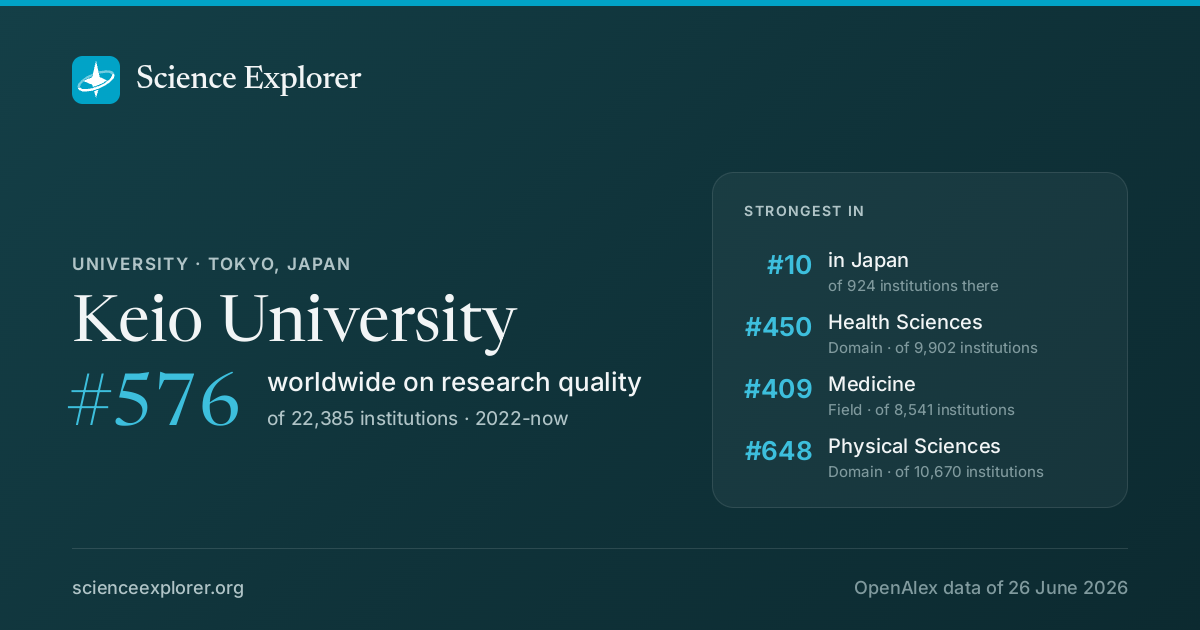
In research, Keio University stands highest in Health Sciences (#450 of 9,902 worldwide), Medicine (#409 of 8,541 worldwide) and Physical Sciences (#648 of 10,670 worldwide), 2022-now. Relative to its size it is most specialised in Human-Computer Interaction, Sensory Systems and Gastroenterology (Human-Computer Interaction is 4.6× its share of world research).
- World rank, 2022-now
- #576 of 22,385 · #573 all time
- Rank in Japan
- #10 of 924
- Research works
- 68k ▼ 11% vs 2018-21
- Citations
- 1.1M 16.2 per fractional work
- Top-10% rate
- 7.2% all institutions 10.0%
- vs its own fields
- 0.78× 1.00× is exactly expected
- Open access
- 39% world 40%
- International
- 10% world 18%
What is Keio University known for in research?
The fields where it stands highest, 2022-now, ranked among every institution above the floor in each field.
| Field | World rank | Where that sits | Top-10% rate | Works | All time |
|---|---|---|---|---|---|
| Health SciencesDomain | #450 of 9,902 | 9.5% | 2,558 | #627 | |
| MedicineField | #409 of 8,541 | 9.6% | 2,377 | #551 | |
| Physical SciencesDomain | #648 of 10,670 | 5.2% | 3,011 | #507 | |
| Life SciencesDomain | #707 of 6,403 | 6.6% | 1,111 | #691 | |
| Computer ScienceField | #599 of 4,417 | 5.5% | 756 | #762 | |
| Social SciencesDomain | #1,428 of 9,585 | 6.5% | 1,057 | #1370 | |
| EngineeringField | #922 of 5,901 | 5.0% | 1,266 | #668 | |
| SurgerySubfield | #312 of 1,532 | 9.4% | 373 | #362 | |
| Biochemistry, Genetics and Molecular BiologyField | #626 of 2,964 | 6.6% | 588 | #600 | |
| Social SciencesField | #1,507 of 5,988 | 7.6% | 375 | #1512 |
Each strip is that field's whole ranked pool, with the notch where Keio University sits in it, in the colour of the band that rank falls in. The track under the rate is the rate itself: it carries no average mark, because the average differs by field (from about 6% in Dentistry to 21% in Economics).
Which of those standings moved
The same fields on both windows: where it stood over the whole record, and where it stands in 2022-now. The distance is the story, and it is the one thing the two rank columns above cannot show.
- Health Sciences#627 #450
- Medicine#551 #409
- Physical Sciences#507 #648
- Life Sciences#691 #707
- Computer Science#762 #599
- Social Sciences#1,370 #1,428
- Engineering#668 #922
- Surgery#362 #312
- Biochemistry, Genetics and Molecular Biology#600 #626
- Social Sciences#1,512 #1,507
A dot further right is a better standing. Fields it was not ranked in over the whole record are left out.
Which fields of science does Keio University work in?
In 2022-now, 38% of research at Keio University is in Physical Sciences, 33% in Health Sciences. Its largest fields are Medicine (31%), Engineering (16%), Computer Science (10%). It does 1.4× the world's share of Health Sciences.
Each ring splits the one inside it: the four domains of science, their fields, their subfields. Size is fractional works in 2022-now. Every slice is a page; the interactive view zooms down to single topics and colours each by how much more of it this institution does than the world.
Its 4 domains and 26 fields, with their numbers
- Physical Sciences3,36238.4%
- Engineering1,38315.8%
- Computer Science8489.7%
- Physics and Astronomy2933.3%
- Materials Science2542.9%
- Environmental Science1561.8%
- Chemistry1551.8%
- Mathematics1491.7%
- Energy430.5%
- Chemical Engineering420.5%
- Earth and Planetary Sciences390.4%
- Health Sciences2,91033.2%
- Medicine2,70330.8%
- Health Professions1481.7%
- Nursing310.4%
- Dentistry230.3%
- Veterinary40.0%
- Life Sciences1,27014.5%
- Social Sciences1,22514.0%
- Social Sciences4234.8%
- Psychology2853.2%
- Economics, Econometrics and Finance1942.2%
- Business, Management and Accounting1401.6%
- Arts and Humanities1091.2%
- Decision Sciences740.8%
What does Keio University specialise in?
Where its research is concentrated relative to its size: Human-Computer Interaction takes 4.6× the share of its output that it takes of world research.
- Human-Computer InteractionSubfield · 83.3 works4.6×
- Sensory SystemsSubfield · 21.9 works3.3×
- GastroenterologySubfield · 32.1 works3.1×
- RheumatologySubfield · 113.0 works2.8×
- Cognitive NeuroscienceSubfield · 171.6 works2.7×
- Mathematical PhysicsSubfield · 37.1 works2.7×
- Hardware and ArchitectureSubfield · 24.0 works2.4×
Location quotient, a volume reading rather than an impact one. It surfaces small, lopsided specialities.
Field profile
Location quotient across every field it publishes in: outside the ring is more than an institution of this size would be expected to publish, inside it is less.
Rings at 0.5×, 1× and 2×. Widest outward: Neuroscience, 2.3×. Every wedge is a field page.
All 26 fields, with their numbers
- Neuroscience2.33×332 works
- Medicine1.60×2,704 works
- Physics and Astronomy1.50×293 works
- Pharmacology, Toxicology and Pharmaceutics1.47×46 works
- Mathematics1.45×149 works
- Biochemistry, Genetics and Molecular Biology1.43×670 works
- Chemical Engineering1.37×42 works
- Immunology and Microbiology1.32×116 works
- Computer Science1.24×848 works
- Chemistry1.13×155 works
- Psychology1.07×285 works
- Engineering1.05×1,383 works
- Economics, Econometrics and Finance1.03×194 works
- Decision Sciences0.88×74 works
- Materials Science0.83×254 works
- Nursing0.73×31 works
- Health Professions0.64×148 works
- Energy0.53×43 works
- Dentistry0.53×23 works
- Business, Management and Accounting0.50×140 works
- Arts and Humanities0.43×109 works
- Social Sciences0.38×423 works
- Veterinary0.37×4 works
- Environmental Science0.36×156 works
- Earth and Planetary Sciences0.28×39 works
- Agricultural and Biological Sciences0.26×106 works
- Neuroscience 2.3×
- Medicine 1.6×
- Physics and Astronomy 1.5×
- Pharmacology, Toxicology and Pharmaceutics 1.5×
- Mathematics 1.4×
- Biochemistry, Genetics and Molecular Biology 1.4×
- Chemical Engineering 1.4×
- Immunology and Microbiology 1.3×
- Computer Science 1.2×
- Chemistry 1.1×
- Psychology 1.1×
- Engineering 1.1×
- Economics, Econometrics and Finance 1.0×
- Decision Sciences 0.9×
- Materials Science 0.8×
- Nursing 0.7×
- Health Professions 0.6×
- Energy 0.5×
- Dentistry 0.5×
- Business, Management and Accounting 0.5×
- Arts and Humanities 0.4×
- Social Sciences 0.4×
- Veterinary 0.4×
- Environmental Science 0.4×
- Earth and Planetary Sciences 0.3×
- Agricultural and Biological Sciences 0.3×
Who are the top researchers at Keio University?
Ranked on the quality score, Hisao Asamura, Toshiro Sato and Haruhiko Siomi lead among researchers whose main affiliation is Keio University.
- 1
Hisao Asamura
 Japan · #28,521 worldwide
50k citations · 539 works
- 2
Toshiro Sato
Japan · #79,400 worldwide
45k citations · 548 works
- 3
Haruhiko Siomi
Japan · #81,009 worldwide
19k citations · 197 works
- 4
Tomoyoshi Soga
Japan · #81,618 worldwide
36k citations · 719 works
- 5
Yuki Sugiura
Japan · #86,398 worldwide
13k citations · 360 works
- 6
Yoshiaki Kubota
Japan · #94,344 worldwide
9.5k citations · 159 works
- 7
Tadaaki Hirose
Japan · #97,922 worldwide
17k citations · 75 works
- 8
Mami Matano
Japan · #98,593 worldwide
7k citations · 51 works
- 9
Akihiko Yoshimura
Japan · #103,865 worldwide
36k citations · 484 works
- 10
Koji Taniguchi
Japan · #106,891 worldwide
13k citations · 115 works
Which keywords describe research at Keio University?
By fractional works in 2022-now, weighted toward what it does more of than the world: Epidemiology, Deep Learning, Inflammation, Treatment, Chemotherapy, Endoscopic Resection, Clinical Practice Guidelines and Diagnosis.
- Metastatic Gastric Cancer
- Preoperative Chemoradiotherapy
- Virtual Environments
- Gastric Cancer
- Haptic Interfaces
- Surgery
- Endoscopic Resection
- Tumor Microenvironment
- Autoantibodies
- Virtual Reality
- Genetic Mutations
- Prognostic Factors
- Biosensors
- Clinical Practice Guidelines
- Immunotherapy
- Diagnosis
- Chemotherapy
- Neural Networks
- Machine Learning
- Deep Learning
- Epidemiology
- Inflammation
- Treatment
- Oxidative Stress
- Quality of Life
- Cancer
- Cardiovascular Disease
- Biomedical Applications
- Neurological Disorders
- Metabolic Syndrome
- Surgical Management
- Aging
- Neoadjuvant Therapy
- Survival Analysis
- Molecular Characterization
- Regenerative Medicine
- Adjuvant Therapy
- Entanglement
- Neoadjuvant Chemotherapy
- Lymph Node Dissection
Size is fractional works in 2022-now in the topics tagged with each word; colour is the word's share of this institution's work against its share of the world's. The 40 words are chosen for being large and distinctive. Each links to the topic it comes from most.
All 40 words, with their numbers
- Epidemiology464▲ 1.33×128 topics
- Deep Learning392▲ 1.30×77 topics
- Inflammation321▲ 1.72×82 topics
- Machine Learning194▼ 0.67×78 topics
- Treatment188▲ 1.76×48 topics
- Neural Networks171▲ 1.27×35 topics
- Oxidative Stress167▲ 1.16×60 topics
- Chemotherapy152▲ 2.4×25 topics
- Quality of Life148▲ 1.17×52 topics
- Diagnosis146▲ 1.79×39 topics
- Cancer146▲ 1.24×53 topics
- Immunotherapy127▲ 2.0×19 topics
- Cardiovascular Disease127▲ 1.27×38 topics
- Clinical Practice Guidelines124▲ 2.6×14 topics
- Biomedical Applications123▲ 1.19×36 topics
- Biosensors107▲ 2.5×12 topics
- Neurological Disorders105▲ 2.1×20 topics
- Prognostic Factors104▲ 2.7×14 topics
- Metabolic Syndrome102▲ 1.44×23 topics
- Genetic Mutations100▲ 2.6×23 topics
- Surgical Management94▲ 2.6×20 topics
- Virtual Reality86▲ 2.0×17 topics
- Aging84▲ 1.76×18 topics
- Autoantibodies80▲ 3.9×8 topics
- Neoadjuvant Therapy80▲ 3.8×5 topics
- Tumor Microenvironment78▲ 1.97×8 topics
- Survival Analysis76▲ 3.1×7 topics
- Endoscopic Resection76▲ 8.7×2 topics
- Molecular Characterization74▲ 4.8×6 topics
- Surgery72▲ 2.4×12 topics
- Regenerative Medicine62▲ 2.8×6 topics
- Haptic Interfaces60▲ 12×2 topics
- Adjuvant Therapy54▲ 4.9×2 topics
- Gastric Cancer52▲ 5.4×3 topics
- Entanglement52▲ 3.9×4 topics
- Virtual Environments45▲ 15×2 topics
- Neoadjuvant Chemotherapy44▲ 6.1×2 topics
- Preoperative Chemoradiotherapy43▲ 6.1×2 topics
- Lymph Node Dissection41▲ 8.1×1 topic
- Metastatic Gastric Cancer41▲ 8.1×1 topic
Which research topics does Keio University publish most on?
By volume in 2022-now: Gastric Cancer Management and Outcomes, Photonic and Optical Devices, Esophageal Cancer Research and Treatment and Tactile and Sensory Interactions.
Area is fractional works; colour is the subfield each topic belongs to.
- 1 Gastric Cancer Management and Outcomes Pulmonary and Respiratory Medicine 41 works
- 2 Photonic and Optical Devices Electrical and Electronic Engineering 38 works
- 3 Esophageal Cancer Research and Treatment Surgery 35 works
- 4 Tactile and Sensory Interactions Cognitive Neuroscience 32 works
- 5 Virtual Reality Applications and Impacts Human-Computer Interaction 30 works
- 6 Teleoperation and Haptic Systems Mechanical Engineering 28 works
- 7 Robot Manipulation and Learning Control and Systems Engineering 27 works
- 8 Quantum Computing Algorithms and Architecture Artificial Intelligence 26 works
- 9 3D Printing in Biomedical Research Biomedical Engineering 25 works
- 10 Rheumatoid Arthritis Research and Therapies Rheumatology 25 works
How open and international is its research?
Against the world's own shares: the tick on each track. Both are shares of its output, so they sit on one scale and can be read against each other as well as against the world.
World: 40% of research is openly available.
World: 18% is written across borders.
How has Keio University's research output changed?
Output in 2022-2025 was 11% lower than in 2018-2021.
The same series as a ribbon: one cell per year, darker for more. The line above answers how much; this answers when.
Its share of all research
Growing output can still be a shrinking share: all of science grows. This is Keio University as a percentage of every work published that year, 0.033% in 2024.
Fractional works of Keio University over all fractional works that year. How the balance of science has shifted.
How much of it reaches the world top 10%
Year by year, against all institutions in the same year.
Of each year's output, the share that reached the world's 10% most cited for its field and year. Peak 7.8% in 2019.
Other research institutions in Tokyo
- The University of Tokyo
- Tokyo Institute of Technology
- Waseda University
- Tokyo University of Science
- Nihon University
- Hitachi (Japan)
- NTT (Japan)
- Tokyo Medical and Dental University


Compare Keio University with
- vs
 South China Agricultural University
- vs
 Auburn University
- vs China University of Petroleum, East China
- vs
 Institut de Recherche pour le Développement
- vs
 University of the Witwatersrand
- vs Collaborative Innovation Center of Chemistry for Energy Materials
Share Keio University's ranking



Research measures only: rankings here say nothing about teaching, admissions or student experience. Comparable institutions and collaboration partners have tabs of their own, above.
Discussion
Ask a question or share a note about Keio University. Posts are plain text and can be reported.