NEC (Germany)
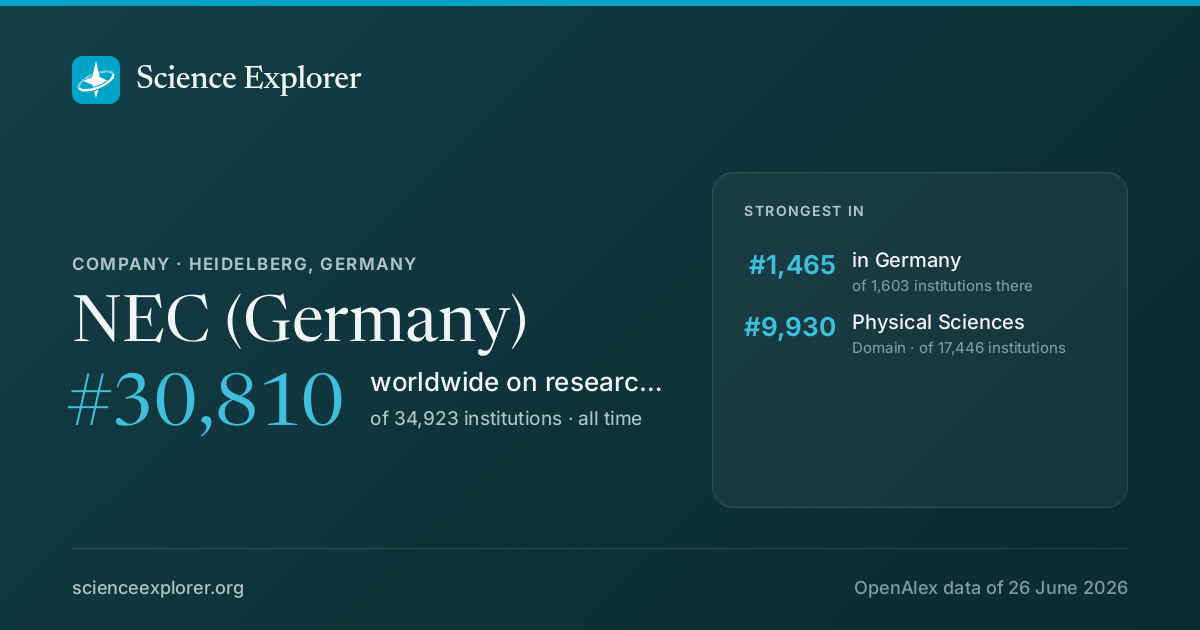
In research, NEC (Germany) stands highest in Physical Sciences (#9,930 of 17,446 worldwide), over all time.
- World rank, all time
- #30,810 of 34,923
- Rank in Germany
- #1,465 of 1,603
- Research works
- 190 ▼ 27% vs 2018-21
- Citations
- 6.7k 35.2 per fractional work
- Top-10% rate
- 17.2% all institutions 10.0%
- vs its own fields
- 0.98× 1.00× is exactly expected
- Open access
- 20% world 40%
- International
- 54% world 18%
What is NEC (Germany) known for in research?
The fields where it stands highest, over all time, ranked among every institution above the floor in each field.
| Field | World rank | Where that sits | Top-10% rate | Works |
|---|---|---|---|---|
| Physical SciencesDomain | #9,930 of 17,446 | 17.7% | 174 |
Each strip is that field's whole ranked pool, with the notch where NEC (Germany) sits in it, in the colour of the band that rank falls in. The track under the rate is the rate itself: it carries no average mark, because the average differs by field (from about 6% in Dentistry to 21% in Economics).
Which fields of science does NEC (Germany) work in?
In all years, 92% of research at NEC (Germany) is in Physical Sciences, 6% in Social Sciences. Its largest fields are Computer Science (62%), Engineering (25%), Social Sciences (3%). It does 2.2× the world's share of Physical Sciences.
Each ring splits the one inside it: the four domains of science, their fields, their subfields. Size is fractional works in all years. Every slice is a page; the interactive view zooms down to single topics and colours each by how much more of it this institution does than the world.
Its 4 domains and 20 fields, with their numbers
- Physical Sciences17491.6%
- Computer Science11761.6%
- Engineering4825.2%
- Physics and Astronomy31.3%
- Materials Science21.0%
- Earth and Planetary Sciences21.0%
- Environmental Science10.7%
- Mathematics10.4%
- Chemical Engineering00.2%
- Chemistry00.1%
- Social Sciences126.1%
- Social Sciences73.5%
- Business, Management and Accounting21.2%
- Arts and Humanities10.6%
- Decision Sciences10.6%
- Psychology00.2%
- Health Sciences21.2%
- Medicine20.9%
- Health Professions10.4%
- Life Sciences21.1%
Field profile
Location quotient across every field it publishes in: outside the ring is more than an institution of this size would be expected to publish, inside it is less.
Rings at 0.5×, 1× and 2×. Widest outward: Earth and Planetary Sciences, 5.7×. Every wedge is a field page.
All 9 fields, with their numbers
- Earth and Planetary Sciences5.66×1 works
- Computer Science3.81×2 works
- Neuroscience1.76×0 works
- Engineering1.76×2 works
- Biochemistry, Genetics and Molecular Biology1.53×1 works
- Materials Science1.31×0 works
- Immunology and Microbiology1.20×0 works
- Medicine0.93×1 works
- Physics and Astronomy0.18×0 works
Who are the top researchers at NEC (Germany)?
Ranked on the quality score, Tarik Taleb, Konstantinos Samdanis and Martin Bauer lead among researchers whose main affiliation is NEC (Germany).
- 1
Tarik Taleb
 Germany · #546,849 worldwide
1.1k citations · 30 works
- 2
Konstantinos Samdanis
Germany · #676,196 worldwide
6k citations · 107 works
- 3
Martin Bauer
Germany · #706,893 worldwide
4.1k citations · 183 works
- 4
Roberto Baldessari
Germany · #879,993 worldwide
867 citations · 29 works
- 5
João Girão
Germany · #1,754,256 worldwide
768 citations · 30 works
- 6
Martin Stiemerling
Germany · #2,220,801 worldwide
693 citations · 59 works
- 7
J. Quittek
Germany · #2,574,104 worldwide
930 citations · 54 works
- 8
Marco Liebsch
Germany · #2,774,651 worldwide
730 citations · 62 works
- 9
Marcus Brunner
Germany · #2,993,341 worldwide
713 citations · 74 works
- 10
Erich Focht
Germany · #3,018,586 worldwide
318 citations · 45 works
Which keywords describe research at NEC (Germany)?
By fractional works in all years, weighted toward what it does more of than the world: Wireless Networks, Distributed Systems, IEEE 802.11, Channel Assignment, Power Control, Resource Allocation, Deep Learning and Energy Efficiency.
- Anomaly Detection
- rate adaptation
- Resource Management
- Network Management
- MAC Protocol
- Information-Centric Networking
- Performance Analysis
- Wireless Communication
- TCP
- Software-Defined Networking
- Fault Tolerance
- Content Delivery
- Mobility Support
- Mobile Networks
- Mobile Ad Hoc Networks
- 5G Networks
- Resource Allocation
- Machine Learning
- IEEE 802.11
- Distributed Systems
- Wireless Networks
- Deep Learning
- Channel Assignment
- Power Control
- Energy Efficiency
- Routing Protocols
- Mobility Models
- Handoff Decision Algorithms
- Security
- Internet Applications
- Network Virtualization
- Congestion Control
- IoT Security
- Interference Mitigation
- Caching
- Intrusion Detection
- Mobile Agents
- Ad Hoc Networks
- Wireless Mesh Networks
- wireless LAN
Size is fractional works in all years in the topics tagged with each word; colour is the word's share of this institution's work against its share of the world's. The 40 words are chosen for being large and distinctive. Each links to the topic it comes from most.
All 40 words, with their numbers
- Wireless Networks22▲ 51×8 topics
- Distributed Systems19▲ 41×6 topics
- Deep Learning17▲ 4.3×21 topics
- IEEE 802.1117▲ 226×2 topics
- Channel Assignment14▲ 70×3 topics
- Machine Learning14▲ 3.4×20 topics
- Power Control13▲ 62×3 topics
- Resource Allocation13▲ 30×6 topics
- Energy Efficiency12▲ 8.1×10 topics
- 5G Networks12▲ 50×4 topics
- Routing Protocols12▲ 75×3 topics
- Mobile Ad Hoc Networks12▲ 91×2 topics
- Mobility Models12▲ 91×2 topics
- Mobile Networks12▲ 89×2 topics
- Handoff Decision Algorithms11▲ 364×1 topic
- Mobility Support11▲ 364×1 topic
- Security11▲ 13×12 topics
- Content Delivery10▲ 80×2 topics
- Internet Applications10▲ 93×2 topics
- Fault Tolerance9▲ 23×4 topics
- Network Virtualization8▲ 147×1 topic
- Software-Defined Networking8▲ 147×1 topic
- Congestion Control7▲ 139×1 topic
- TCP7▲ 139×1 topic
- IoT Security7▲ 22×3 topics
- Wireless Communication7▲ 27×4 topics
- Interference Mitigation7▲ 98×2 topics
- Performance Analysis7▲ 21×2 topics
- Caching6▲ 89×1 topic
- Information-Centric Networking6▲ 89×1 topic
- Intrusion Detection6▲ 35×3 topics
- MAC Protocol6▲ 83×2 topics
- Mobile Agents6▲ 117×1 topic
- Network Management6▲ 64×1 topic
- Ad Hoc Networks6▲ 88×1 topic
- Resource Management6▲ 19×2 topics
- Wireless Mesh Networks6▲ 88×1 topic
- rate adaptation6▲ 134×1 topic
- wireless LAN6▲ 134×1 topic
- Anomaly Detection6▲ 20×3 topics
Which research topics does NEC (Germany) publish most on?
By volume in 2022-now: Privacy-Preserving Technologies in Data, Protein Structure and Dynamics, Software-Defined Networks and 5G and Radiomics and Machine Learning in Medical Imaging.
Area is fractional works; colour is the subfield each topic belongs to.
- 1 Privacy-Preserving Technologies in Data Artificial Intelligence 0 works
- 2 Protein Structure and Dynamics Molecular Biology 0 works
- 3 Software-Defined Networks and 5G Computer Networks and Communications 0 works
- 4 Radiomics and Machine Learning in Medical Imaging Radiology, Nuclear Medicine and Imaging 0 works
- 5 Reservoir Engineering and Simulation Methods Ocean Engineering 0 works
- 6 Advanced Manufacturing and Logistics Optimization Industrial and Manufacturing Engineering 0 works
- 7 Artificial Intelligence in Healthcare and Education Health Informatics 0 works
- 8 Seismic Imaging and Inversion Techniques Geophysics 0 works
- 9 Geological Modeling and Analysis Geochemistry and Petrology 0 works
- 10 Machine Learning in Materials Science Materials Chemistry 0 works
How open and international is its research?
Against the world's own shares: the tick on each track. Both are shares of its output, so they sit on one scale and can be read against each other as well as against the world.
World: 40% of research is openly available.
World: 18% is written across borders.
How has NEC (Germany)'s research output changed?
Output in 2022-2025 was 27% lower than in 2018-2021.
The same series as a ribbon: one cell per year, darker for more. The line above answers how much; this answers when.
Its share of all research
Growing output can still be a shrinking share: all of science grows. This is NEC (Germany) as a percentage of every work published that year, 0.000021% in 2024.
Fractional works of NEC (Germany) over all fractional works that year. How the balance of science has shifted.
Other research institutions in Heidelberg
- Heidelberg University
- European Molecular Biology Laboratory
- Chirurgische Universitätsklinik Heidelberg
- Hautklinik Heidelberg
- Augenklinik Heidelberg
- Universitäts-HNO-Klinik Heidelberg
- Klinik und Poliklinik für Mund-, Kiefer- und Gesichtschirurgie
- National Center for Tumor Diseases

Share NEC (Germany)'s ranking
Badges for a website1Each links back here and updates with every snapshot

Research measures only: rankings here say nothing about teaching, admissions or student experience. Comparable institutions and collaboration partners have tabs of their own, above.
Discussion
Ask a question or share a note about NEC (Germany). Keep it to the research: no personal attacks, advertising or links. Any reader can report a post, which collapses it for everyone until it is opened.