Science Explorer Back to mapMap
University · Norfolk · United States

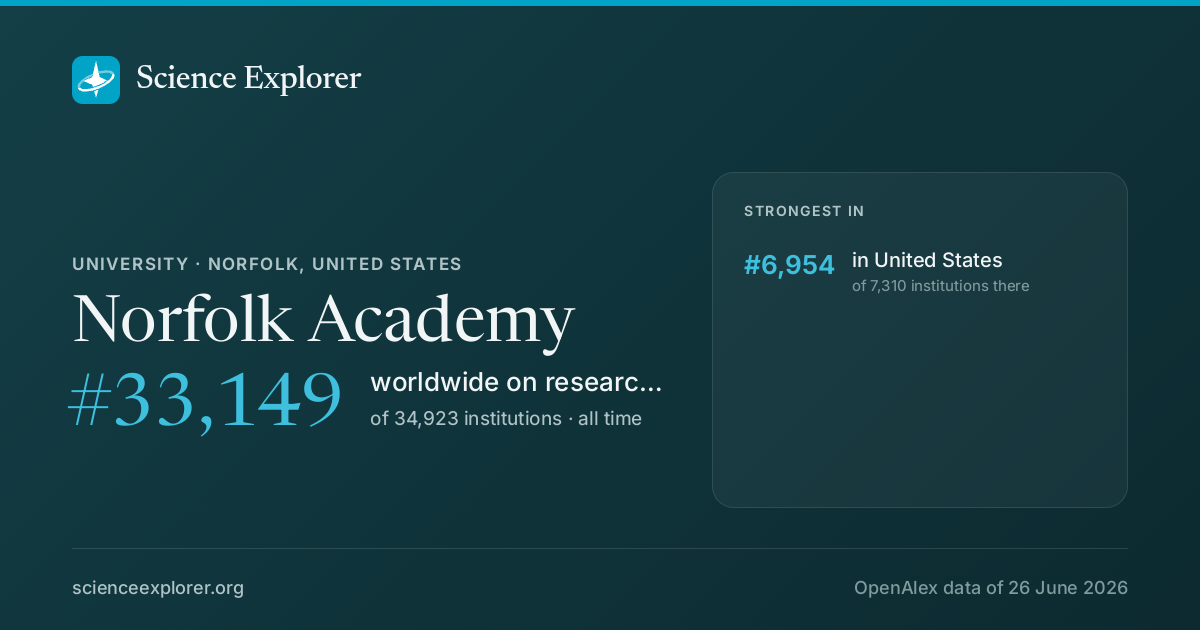
Norfolk Academy

World rank, all time
#33,149
of 34,923
Rank in United States
#6,954
of 7,310
Research works
122
▲ 37% vs 2018-21
Citations
1.3k
10.7 per fractional work
Top-10% rate
5.3%
all institutions 10.0%
vs its own fields
0.89×
1.00× is exactly expected
Open access
25%
world 40%
International
2%
world 18%

Which fields of science does Norfolk Academy work in?

In all years, 60% of research at Norfolk Academy is in Health Sciences, 23% in Social Sciences. Its largest fields are Medicine (53%), Social Sciences (11%), Arts and Humanities (8%). It does 2.4× the world's share of Health Sciences.

Health Sciences: 73 fractional works · 60.0% of its workMedicine: 64 fractional works · 52.8% of its workSurgery: 12 fractional works · 10.2% of its workPulmonary and Respiratory Medicine: 7 fractional works · 5.8% of its workPhysiology: 6 fractional works · 4.7% of its workNeurology: 3 fractional works · 2.8% of its workOncology: 2 fractional works · 1.9% of its workEpidemiology: 2 fractional works · 1.9% of its workOtorhinolaryngology: 2 fractional works · 1.8% of its workRheumatology: 2 fractional works · 1.8% of its workRadiology, Nuclear Medicine and Imaging: 2 fractional works · 1.7% of its workEmergency Medicine: 2 fractional works · 1.5% of its workPublic Health, Environmental and Occupational Health: 2 fractional works · 1.5% of its workOphthalmology: 2 fractional works · 1.5% of its workCardiology and Cardiovascular Medicine: 2 fractional works · 1.4% of its workGenetics: 2 fractional works · 1.3% of its workPathology and Forensic Medicine: 2 fractional works · 1.3% of its workReproductive Medicine: 2 fractional works · 1.3% of its workImmunology and Allergy: 1 fractional works · 1.2% of its workOrthopedics and Sports Medicine: 1 fractional works · 1.2% of its workHematology: 1 fractional works · 1.1% of its workDermatology: 1 fractional works · 1.0% of its workAnesthesiology and Pain Medicine: 1 fractional works · 0.8% of its workInfectious Diseases: 1 fractional works · 0.7% of its workObstetrics and Gynecology: 1 fractional works · 0.7% of its workRehabilitation: 1 fractional works · 0.6% of its workPsychiatry and Mental health: 1 fractional works · 0.6% of its workPediatrics, Perinatology and Child Health: 1 fractional works · 0.6% of its workEndocrinology, Diabetes and Metabolism: 0 fractional works · 0.3% of its workBiochemistry: 0 fractional works · 0.3% of its workCritical Care and Intensive Care Medicine: 0 fractional works · 0.3% of its workGastroenterology: 0 fractional works · 0.3% of its workNephrology: 0 fractional works · 0.3% of its workPharmacology: 0 fractional works · 0.3% of its workUrology: 0 fractional works · 0.3% of its workHealth Professions: 8 fractional works · 6.8% of its workGeneral Health Professions: 3 fractional works · 2.4% of its workSpeech and Hearing: 3 fractional works · 2.3% of its workOccupational Therapy: 1 fractional works · 0.8% of its workEmergency Medical Services: 1 fractional works · 0.6% of its workComplementary and Manual Therapy: 0 fractional works · 0.4% of its workPharmacy: 0 fractional works · 0.3% of its workVeterinary: 0 fractional works · 0.3% of its workSmall Animals: 0 fractional works · 0.3% of its workSocial Sciences: 28 fractional works · 23.3% of its workSocial Sciences: 13 fractional works · 11.0% of its workPolitical Science and International Relations: 4 fractional works · 2.9% of its workSociology and Political Science: 3 fractional works · 2.4% of its workLaw: 2 fractional works · 1.9% of its workAnthropology: 2 fractional works · 1.5% of its workEducation: 1 fractional works · 0.8% of its workHealth: 1 fractional works · 0.6% of its workPublic Administration: 0 fractional works · 0.4% of its workCultural Studies: 0 fractional works · 0.3% of its workSafety Research: 0 fractional works · 0.3% of its workArts and Humanities: 9 fractional works · 7.8% of its workLiterature and Literary Theory: 4 fractional works · 3.0% of its workHistory and Philosophy of Science: 2 fractional works · 1.6% of its workHistory: 2 fractional works · 1.5% of its workLanguage and Linguistics: 0 fractional works · 0.4% of its workArcheology: 0 fractional works · 0.4% of its workClassics: 0 fractional works · 0.3% of its workPhilosophy: 0 fractional works · 0.3% of its workVisual Arts and Performing Arts: 0 fractional works · 0.3% of its workBusiness, Management and Accounting: 2 fractional works · 1.8% of its workManagement of Technology and Innovation: 1 fractional works · 0.8% of its workMarketing: 1 fractional works · 0.7% of its workOrganizational Behavior and Human Resource Management: 0 fractional works · 0.3% of its workPsychology: 2 fractional works · 1.4% of its workClinical Psychology: 1 fractional works · 0.6% of its workSocial Psychology: 1 fractional works · 0.5% of its workExperimental and Cognitive Psychology: 0 fractional works · 0.3% of its workEconomics, Econometrics and Finance: 2 fractional works · 1.4% of its workFinance: 1 fractional works · 0.8% of its workEconomics and Econometrics: 1 fractional works · 0.6% of its workLife Sciences: 10 fractional works · 8.5% of its workBiochemistry, Genetics and Molecular Biology: 5 fractional works · 4.4% of its workGenetics: 4 fractional works · 2.9% of its workMolecular Biology: 1 fractional works · 0.9% of its workCell Biology: 0 fractional works · 0.3% of its workDevelopmental Biology: 0 fractional works · 0.3% of its workImmunology and Microbiology: 2 fractional works · 2.1% of its workImmunology: 1 fractional works · 1.1% of its workMicrobiology: 1 fractional works · 0.7% of its workParasitology: 0 fractional works · 0.3% of its workNeuroscience: 2 fractional works · 1.8% of its workCognitive Neuroscience: 1 fractional works · 1.0% of its workSensory Systems: 1 fractional works · 0.6% of its workCellular and Molecular Neuroscience: 0 fractional works · 0.3% of its workPharmacology, Toxicology and Pharmaceutics: 0 fractional works · 0.3% of its workPharmacology: 0 fractional works · 0.3% of its workPhysical Sciences: 10 fractional works · 8.3% of its workEngineering: 6 fractional works · 4.8% of its workMechanical Engineering: 1 fractional works · 1.1% of its workMechanics of Materials: 1 fractional works · 0.8% of its workOcean Engineering: 1 fractional works · 0.8% of its workElectrical and Electronic Engineering: 1 fractional works · 0.6% of its workBiomedical Engineering: 1 fractional works · 0.6% of its workAerospace Engineering: 0 fractional works · 0.3% of its workBuilding and Construction: 0 fractional works · 0.3% of its workControl and Systems Engineering: 0 fractional works · 0.3% of its workEnvironmental Science: 2 fractional works · 1.5% of its workManagement, Monitoring, Policy and Law: 1 fractional works · 1.1% of its workEcology: 0 fractional works · 0.3% of its workSmaller subfields together: 0 fractional works · 0.1% of its workMathematics: 1 fractional works · 0.7% of its workAlgebra and Number Theory: 0 fractional works · 0.3% of its workDiscrete Mathematics and Combinatorics: 0 fractional works · 0.3% of its workSmaller subfields together: 0 fractional works · 0.1% of its workEarth and Planetary Sciences: 1 fractional works · 0.5% of its workPaleontology: 0 fractional works · 0.3% of its workSmaller subfields together: 0 fractional works · 0.2% of its workPhysics and Astronomy: 1 fractional works · 0.5% of its workAstronomy and Astrophysics: 0 fractional works · 0.3% of its workAtomic and Molecular Physics, and Optics: 0 fractional works · 0.2% of its workChemistry: 0 fractional works · 0.2% of its workEnergy: 0 fractional works · 0.1% of its workALL ITS WORKNorfolk Academy122fractional works, all years
Life Sciences8%Physical Sciences8%Health Sciences60%Social Sciences23%

Each ring splits the one inside it: the four domains of science, their fields, their subfields. Size is fractional works in all years. Every slice is a page; the interactive view zooms down to single topics and colours each by how much more of it this institution does than the world.

Its 4 domains and 19 fields, with their numbers
    1. Medicine6452.8%
    2. Health Professions86.8%
    3. Veterinary00.3%
    1. Social Sciences1311.0%
    2. Arts and Humanities97.8%
    3. Business, Management and Accounting21.8%
    4. Psychology21.4%
    5. Economics, Econometrics and Finance21.4%
    1. Biochemistry, Genetics and Molecular Biology54.4%
    2. Immunology and Microbiology22.1%
    3. Neuroscience21.8%
    4. Pharmacology, Toxicology and Pharmaceutics00.3%
    1. Engineering64.8%
    2. Environmental Science21.5%
    3. Mathematics10.7%
    4. Earth and Planetary Sciences10.5%
    5. Physics and Astronomy10.5%
    6. Chemistry00.2%
    7. Energy00.1%
All of science, and how each field's share has moved since 1950: the Science domain explorer

Field profile

Location quotient across every field it publishes in: outside the ring is more than an institution of this size would be expected to publish, inside it is less.

Immunology and Microbiology: 1.99× its world share, 0 worksImmunology and Micro…Earth and Planetary Sciences: 1.06× its world share, 0 worksEarth and Planetary …Energy: 1.09× its world share, 0 worksEnergyEngineering: 0.33× its world share, 1 worksEngineeringEnvironmental Science: 0.60× its world share, 0 worksEnvironmental ScienceMedicine: 2.60× its world share, 8 worksMedicineArts and Humanities: 7.85× its world share, 4 worksArts and HumanitiesSocial Sciences: 1.16× its world share, 2 worksSocial Sciences1×world share
more than its size predictsabout as predictedless

Rings at 0.5×, 1× and 2×. Widest outward: Arts and Humanities, 7.8×. Every wedge is a field page.

All 8 fields, with their numbers
  1. Arts and Humanities7.85×4 works
  2. Medicine2.60×8 works
  3. Immunology and Microbiology1.99×0 works
  4. Social Sciences1.16×2 works
  5. Energy1.09×0 works
  6. Earth and Planetary Sciences1.06×0 works
  7. Environmental Science0.60×0 works
  8. Engineering0.33×1 works

Who are the top researchers at Norfolk Academy?

Ranked on the quality score, ReginaldT. Payne, HUGH H. CRAWFORD and Angela Duff Hogan lead among researchers whose main affiliation is Norfolk Academy.

  1. 1 ReginaldT. Payne United States · #2,214,066 worldwide 249 citations · 18 works
  2. 2 HUGH H. CRAWFORD United States · #2,617,284 worldwide 761 citations · 38 works
  3. 3 Angela Duff Hogan United States · #4,510,405 worldwide 420 citations · 56 works
  4. 4 Joe B. Goldberg United States · #5,289,446 worldwide 7 citations · 29 works
All ranked researchers at Norfolk Academy

What are the most cited papers from Norfolk Academy?

The most cited paper from Norfolk Academy is "Mutations of ARX are associated with striking pleiotropy and consistent genotype–phenotype correlation" (Mitsuhiro Kato et al., 2004), with 332 citations. Next come "Time-frequency analysis of the dispersion of Lamb modes" (220) and "THE GROWTH PATTERN OF THE EXTERNAL EAR" (165).

Most cited papers
#PaperReleasedCitations
1 Mutations of ARX are associated with striking pleiotropy and consistent genotype–phenotype correlation Mitsuhiro Kato et al. · Human Mutation 9 Jan 2004 332
2 Time-frequency analysis of the dispersion of Lamb modes William H. Prosser, Michael D. Seale, Barry T. Smith · The Journal of the Acoustical Society of America Open access May 1999 220
3 THE GROWTH PATTERN OF THE EXTERNAL EAR J E Adamson, CHARLES E. HORTOX, HUGH H. CRAWFORD · Plastic & Reconstructive Surgery Oct 1965 165
4 The Role of Social Support in Breastfeeding Promotion: A Literature Review Vinitha Krishna Raj, Stacey Beth Plichta · Journal of Human Lactation Mar 1998 157
5 Lamb wave assessment of fatigue and thermal damage in composites Michael D. Seale, Barry T. Smith, William H. Prosser · The Journal of the Acoustical Society of America Open access May 1998 122
All 60 most cited papers, with filters and sorting

Which keywords describe research at Norfolk Academy?

By fractional works in all years, weighted toward what it does more of than the world: Epidemiology, Quality of Life, Complications, History, Medical Education, Culture, Genetics and Diagnosis.

▲ more of its work than of the world's◆ about the world's share▼ less than the world's

Size is fractional works in all years in the topics tagged with each word; colour is the word's share of this institution's work against its share of the world's. The 40 words are chosen for being large and distinctive. Each links to the topic it comes from most.

All 40 words, with their numbers
  1. Epidemiology18▲ 3.8×39 topics
  2. Quality of Life6▲ 3.9×11 topics
  3. Treatment5▲ 3.1×7 topics
  4. History5▲ 5.0×7 topics
  5. Public Health5▲ 2.9×7 topics
  6. Diagnosis5▲ 3.8×10 topics
  7. Genetics4▲ 4.8×4 topics
  8. Complications4▲ 7.0×7 topics
  9. Culture4▲ 6.8×4 topics
  10. Medical Education4▲ 13×5 topics
  11. Identity4▲ 3.9×4 topics
  12. Gender3▲ 4.8×5 topics
  13. Management3▲ 3.5×7 topics
  14. Risk Factors3▲ 2.5×8 topics
  15. Surgical Techniques3▲ 77×2 topics
  16. Primary Care3▲ 5.7×3 topics
  17. Hearing Loss3▲ 15×4 topics
  18. Colonialism3▲ 4.4×6 topics
  19. Radiotherapy3▲ 5.8×5 topics
  20. Training3▲ 11×2 topics
  21. Asthma2▲ 16×2 topics
  22. Immunology2▲ 16×2 topics
  23. Mechanical Ventilation2▲ 14×2 topics
  24. Point-of-Care Testing2▲ 60×2 topics
  25. Blood Transfusion2▲ 33×3 topics
  26. Medical History2▲ 44×1 topic
  27. Neurosurgery2▲ 132×1 topic
  28. Social Determinants2▲ 9.1×2 topics
  29. Allergic Diseases2▲ 21×1 topic
  30. Community Health2▲ 12×1 topic
  31. Eosinophils2▲ 21×1 topic
  32. Pediatrics2▲ 38×1 topic
  33. Preanalytical Variables2▲ 106×1 topic
  34. Reference Intervals2▲ 106×1 topic
  35. Science2▲ 8.9×2 topics
  36. Airway Stenosis2▲ 24×1 topic
  37. Breast Reconstruction2▲ 25×2 topics
  38. Endoscopic Surgery2▲ 15×2 topics
  39. Tracheostomy2▲ 24×1 topic
  40. Anatomy2▲ 18×2 topics

Which research topics does Norfolk Academy publish most on?

By volume in 2022-now: History of Science and Medicine, Inhalation and Respiratory Drug Delivery, Asthma and respiratory diseases and Food Allergy and Anaphylaxis Research.

  1. 1 History of Science and Medicine History and Philosophy of Science 2 works
  2. 2 Inhalation and Respiratory Drug Delivery Pulmonary and Respiratory Medicine 2 works
  3. 3 Asthma and respiratory diseases Physiology 1 works
  4. 4 Food Allergy and Anaphylaxis Research Immunology and Allergy 1 works
  5. 5 Respiratory and Cough-Related Research Pulmonary and Respiratory Medicine 1 works
  6. 6 Australian Indigenous Culture and History Anthropology 0 works
  7. 7 History and International Relations Political Science and International Relations 0 works
  8. 8 Heart Failure Treatment and Management Cardiology and Cardiovascular Medicine 0 works
  9. 9 Maritime and Coastal Archaeology Archeology 0 works
  10. 10 Diverse Historical and Scientific Studies History and Philosophy of Science 0 works

How open and international is its research?

Against the world's own shares: the tick on each track. Both are shares of its output, so they sit on one scale and can be read against each other as well as against the world.

openly available25.3%not open74.7%

World: 40% of research is openly available.

with international co-authors1.8%domestic only98.2%

World: 18% is written across borders.

How has Norfolk Academy's research output changed?

Output in 2022-2025 was 37% higher than in 2018-2021.

still counting1990200020102020
grewheldshrank

The same series as a ribbon: one cell per year, darker for more. The line above answers how much; this answers when.

Its share of all research

Growing output can still be a shrinking share: all of science grows. This is Norfolk Academy as a percentage of every work published that year, 0.00016% in 2024.

still counting0.0010%0.0020%Norfolk Academy0.000068% in 202519801990200020102020

Fractional works of Norfolk Academy over all fractional works that year. How the balance of science has shifted.

Other research institutions in Norfolk

All research institutions in Norfolk

Share Norfolk Academy's ranking

Norfolk Academy on Science Explorer

A card with Norfolk Academy's standing and the fields it leads in, for a post or a slide. A link to this page previews as the same card.

Download the card

1200 × 630 PNG, sized for social posts, drawn from the latest snapshot.

Badges for a website1Each links back here and updates with every snapshot

Research measures only: rankings here say nothing about teaching, admissions or student experience. Comparable institutions and collaboration partners have tabs of their own, above.

Discussion

Ask a question or share a note about Norfolk Academy. Posts are plain text and can be reported.