Science Explorer Back to mapMap
Discussion
Hospital / health system · Norfolk · United States

Children's Specialty Group

World rank, all time
#31,142
of 34,923
Rank in United States
#6,576
of 7,310
Research works
183
▼ 23% vs 2018-21
Citations
2.9k
15.7 per fractional work
Top-10% rate
6.8%
all institutions 10.0%
vs its own fields
0.87×
1.00× is exactly expected
Open access
45%
world 40%
International
20%
world 18%

Which fields of science does Children's Specialty Group work in?

In 2022-now, 71% of research at Children's Specialty Group is in Health Sciences, 16% in Life Sciences. Its largest fields are Medicine (64%), Biochemistry, Genetics and Molecular Biology (9%), Health Professions (6%). It does 2.6× the world's share of Health Sciences.

Health Sciences: 30 fractional works · 71.0% of its workMedicine: 27 fractional works · 64.0% of its workSurgery: 6 fractional works · 14.0% of its workPediatrics, Perinatology and Child Health: 2 fractional works · 5.9% of its workEpidemiology: 2 fractional works · 5.0% of its workPulmonary and Respiratory Medicine: 2 fractional works · 4.3% of its workInfectious Diseases: 2 fractional works · 4.3% of its workCardiology and Cardiovascular Medicine: 1 fractional works · 2.7% of its workHematology: 1 fractional works · 2.6% of its workRheumatology: 1 fractional works · 2.5% of its workOncology: 1 fractional works · 2.2% of its workPathology and Forensic Medicine: 1 fractional works · 2.1% of its workOrthopedics and Sports Medicine: 1 fractional works · 1.9% of its workEndocrinology, Diabetes and Metabolism: 1 fractional works · 1.7% of its workGenetics: 1 fractional works · 1.6% of its workPsychiatry and Mental health: 1 fractional works · 1.6% of its workUrology: 1 fractional works · 1.6% of its workPhysiology: 1 fractional works · 1.3% of its workGeriatrics and Gerontology: 0 fractional works · 1.1% of its workPharmacology: 0 fractional works · 1.1% of its workRehabilitation: 0 fractional works · 1.0% of its workRadiology, Nuclear Medicine and Imaging: 0 fractional works · 1.0% of its workFamily Practice: 0 fractional works · 0.8% of its workCritical Care and Intensive Care Medicine: 0 fractional works · 0.8% of its workEmergency Medicine: 0 fractional works · 0.7% of its workNeurology: 0 fractional works · 0.6% of its workAnesthesiology and Pain Medicine: 0 fractional works · 0.5% of its workNephrology: 0 fractional works · 0.3% of its workObstetrics and Gynecology: 0 fractional works · 0.3% of its workPublic Health, Environmental and Occupational Health: 0 fractional works · 0.3% of its workHealth Professions: 3 fractional works · 5.9% of its workGeneral Health Professions: 2 fractional works · 3.8% of its workEmergency Medical Services: 0 fractional works · 1.1% of its workSpeech and Hearing: 0 fractional works · 0.7% of its workSmaller subfields together: 0 fractional works · 0.3% of its workNursing: 0 fractional works · 1.0% of its workNutrition and Dietetics: 0 fractional works · 1.0% of its workVeterinary: 0 fractional works · 0.1% of its workLife Sciences: 7 fractional works · 16.5% of its workBiochemistry, Genetics and Molecular Biology: 4 fractional works · 9.3% of its workMolecular Biology: 3 fractional works · 6.4% of its workGenetics: 1 fractional works · 2.0% of its workClinical Biochemistry: 0 fractional works · 0.7% of its workSmaller subfields together: 0 fractional works · 0.2% of its workImmunology and Microbiology: 2 fractional works · 4.4% of its workImmunology: 1 fractional works · 2.9% of its workMicrobiology: 0 fractional works · 1.1% of its workParasitology: 0 fractional works · 0.4% of its workNeuroscience: 1 fractional works · 2.4% of its workCognitive Neuroscience: 0 fractional works · 0.9% of its workEndocrine and Autonomic Systems: 0 fractional works · 0.8% of its workDevelopmental Neuroscience: 0 fractional works · 0.4% of its workSmaller subfields together: 0 fractional works · 0.3% of its workAgricultural and Biological Sciences: 0 fractional works · 0.3% of its workAgronomy and Crop Science: 0 fractional works · 0.3% of its workPharmacology, Toxicology and Pharmaceutics: 0 fractional works · 0.1% of its workSocial Sciences: 5 fractional works · 11.4% of its workSocial Sciences: 2 fractional works · 5.1% of its workSociology and Political Science: 1 fractional works · 3.3% of its workEducation: 1 fractional works · 1.4% of its workHealth: 0 fractional works · 0.3% of its workSmaller subfields together: 0 fractional works · 0.2% of its workPsychology: 2 fractional works · 4.9% of its workClinical Psychology: 1 fractional works · 2.8% of its workSocial Psychology: 1 fractional works · 1.4% of its workDevelopmental and Educational Psychology: 0 fractional works · 0.6% of its workSmaller subfields together: 0 fractional works · 0.2% of its workArts and Humanities: 0 fractional works · 1.0% of its workPhilosophy: 0 fractional works · 1.0% of its workDecision Sciences: 0 fractional works · 0.4% of its workPhysical Sciences: 0 fractional works · 1.2% of its workEngineering: 0 fractional works · 1.2% of its workOcean Engineering: 0 fractional works · 0.5% of its workBiomedical Engineering: 0 fractional works · 0.4% of its workMechanical Engineering: 0 fractional works · 0.3% of its workALL ITS WORKChildren'sSpecialty Group42fractional works, 2022-now
Life Sciences16%Physical Sciences1%Health Sciences71%Social Sciences11%

Each ring splits the one inside it: the four domains of science, their fields, their subfields. Size is fractional works in 2022-now. Every slice is a page; the interactive view zooms down to single topics and colours each by how much more of it this institution does than the world.

Its 4 domains and 14 fields, with their numbers
    1. Medicine2764.0%
    2. Health Professions35.9%
    3. Nursing01.0%
    4. Veterinary00.1%
    1. Biochemistry, Genetics and Molecular Biology49.3%
    2. Immunology and Microbiology24.4%
    3. Neuroscience12.4%
    4. Agricultural and Biological Sciences00.3%
    5. Pharmacology, Toxicology and Pharmaceutics00.1%
    1. Social Sciences25.1%
    2. Psychology24.9%
    3. Arts and Humanities01.0%
    4. Decision Sciences00.4%
    1. Engineering01.2%
All of science, and how each field's share has moved since 1950: the Science domain explorer

Field profile

Location quotient across every field it publishes in: outside the ring is more than an institution of this size would be expected to publish, inside it is less.

Agricultural and Biological Sciences: 0.06× its world share, 0 worksAgricultural and Bio…Biochemistry, Genetics and Molecular Biology: 1.74× its world share, 4 worksBiochemistry, Geneti…Immunology and Microbiology: 4.38× its world share, 2 worksImmunology and Micro…Neuroscience: 1.49× its world share, 1 worksNeurosciencePharmacology, Toxicology and Pharmaceutics: 0.32× its world share, 0 worksPharmacology, Toxico…Engineering: 0.08× its world share, 0 worksEngineeringHealth Professions: 2.26× its world share, 2 worksHealth ProfessionsMedicine: 3.33× its world share, 27 worksMedicineNursing: 2.00× its world share, 0 worksNursingVeterinary: 0.45× its world share, 0 worksVeterinaryArts and Humanities: 0.34× its world share, 0 worksArts and HumanitiesDecision Sciences: 0.40× its world share, 0 worksDecision SciencesPsychology: 1.62× its world share, 2 worksPsychologySocial Sciences: 0.40× its world share, 2 worksSocial Sciences1×world share
more than its size predictsabout as predictedless

Rings at 0.5×, 1× and 2×. Widest outward: Immunology and Microbiology, 4.4×. Every wedge is a field page.

All 14 fields, with their numbers
  1. Immunology and Microbiology4.38×2 works
  2. Medicine3.33×27 works
  3. Health Professions2.26×2 works
  4. Nursing2.00×0 works
  5. Biochemistry, Genetics and Molecular Biology1.74×4 works
  6. Psychology1.62×2 works
  7. Neuroscience1.49×1 works
  8. Veterinary0.45×0 works
  9. Decision Sciences0.40×0 works
  10. Social Sciences0.40×2 works
  11. Arts and Humanities0.34×0 works
  12. Pharmacology, Toxicology and Pharmaceutics0.32×0 works
  13. Engineering0.08×0 works
  14. Agricultural and Biological Sciences0.06×0 works

Who are the top researchers at Children's Specialty Group?

Ranked on the quality score, David F. Bindelglass, Nancy Naughton and Lori A. Algar lead among researchers whose main affiliation is Children's Specialty Group.

  1. 1 David F. Bindelglass United States · #2,734,265 worldwide 425 citations · 19 works
  2. 2 Nancy Naughton United States · #4,222,019 worldwide 474 citations · 28 works
  3. 3 Lori A. Algar United States · #4,913,340 worldwide 339 citations · 24 works
  4. 4 Moaied A. Hassan United States · #5,784,740 worldwide 37 citations · 28 works
All ranked researchers at Children's Specialty Group

What are the most cited papers from Children's Specialty Group?

The most cited paper from Children's Specialty Group is "Global Retinoblastoma Presentation and Analysis by National Income Level" (Global Retinoblastoma Study Group et al., 2020), with 382 citations. Next come "Graphical Depiction of Longitudinal Study Designs in Health Care Databases" (278) and "Prospective Multicenter Study of Surgical Correction of Pectus Excavatum: Design, Perioperative Complications, Pain, and Baseline Pulmonary Function Facilitated by Internet-Based Data Collection" (227).

Most cited papers
#PaperReleasedCitations
1 Global Retinoblastoma Presentation and Analysis by National Income Level Global Retinoblastoma Study Group et al. · JAMA Oncology Open access473 authors 27 Feb 2020 382
2 Graphical Depiction of Longitudinal Study Designs in Health Care Databases Sebastian Schneeweiß, Jeremy A. Rassen, Jeffrey Scott Brown et al. · Annals of Internal Medicine Open access 11 Mar 2019 278
3 Prospective Multicenter Study of Surgical Correction of Pectus Excavatum: Design, Perioperative Complications, Pain, and Baseline Pulmonary Function Facilitated by Internet-Based Data Collection Robert E. Kelly, Robert C. Shamberger, Robert B. Mellins et al. · Journal of the American College of Surgeons 22 Jun 2007 227
4 Cerebral Palsy: Introduction and Diagnosis (Part I) Martha Wilson Jones, Elaine R. Morgan, Jean E. Shelton et al. · Journal of Pediatric Health Care May 2007 204
5 Identification of a Recurrent Microdeletion at 17q23.1q23.2 Flanked by Segmental Duplications Associated with Heart Defects and Limb Abnormalities Blake C. Ballif et al. · The American Journal of Human Genetics Open access Mar 2010 170
All 60 most cited papers, with filters and sorting

Which keywords describe research at Children's Specialty Group?

By fractional works in 2022-now, weighted toward what it does more of than the world: Epidemiology, Clinical Trials, Neurodevelopmental Outcomes, Risk Factors, Genetic Variants, Inflammation, Surgical Management and Treatment.

▲ more of its work than of the world's◆ about the world's share▼ less than the world's

Size is fractional works in 2022-now in the topics tagged with each word; colour is the word's share of this institution's work against its share of the world's. The 18 words are chosen for being large and distinctive. Each links to the topic it comes from most.

All 18 words, with their numbers
  1. Epidemiology5▲ 3.2×29 topics
  2. Inflammation2▲ 2.6×17 topics
  3. Risk Factors2▲ 4.4×9 topics
  4. Clinical Trials2▲ 7.2×4 topics
  5. Neurodevelopmental Outcomes2▲ 22×5 topics
  6. Treatment2▲ 3.6×12 topics
  7. Genetic Variants2▲ 20×4 topics
  8. Surgical Management1▲ 7.7×4 topics
  9. Diabetes1▲ 5.1×4 topics
  10. Diagnosis1▲ 2.7×6 topics
  11. Preterm Infants1▲ 21×3 topics
  12. Pulmonary Hypertension1▲ 19×3 topics
  13. Angiomyxoma1▲ 154×1 topic
  14. Cholesterol-lowering1▲ 51×1 topic
  15. Prostate1▲ 154×1 topic
  16. Proteasome1▲ 69×1 topic
  17. Statins1▲ 33×1 topic
  18. Ubiquitin1▲ 69×1 topic

Which research topics does Children's Specialty Group publish most on?

By volume in 2022-now: Lipoproteins and Cardiovascular Health, Ubiquitin and proteasome pathways, Urologic and reproductive health conditions and Congenital Heart Disease Studies.

  1. 1 Lipoproteins and Cardiovascular Health Surgery 1 works
  2. 2 Ubiquitin and proteasome pathways Molecular Biology 1 works
  3. 3 Urologic and reproductive health conditions Rheumatology 1 works
  4. 4 Congenital Heart Disease Studies Epidemiology 1 works
  5. 5 Testicular diseases and treatments Surgery 1 works
  6. 6 Autoimmune and Inflammatory Disorders Research Hematology 1 works
  7. 7 Urological Disorders and Treatments Urology 1 works
  8. 8 Parvovirus B19 Infection Studies Infectious Diseases 1 works
  9. 9 Pulmonary Hypertension Research and Treatments Pulmonary and Respiratory Medicine 1 works
  10. 10 Viral-associated cancers and disorders Oncology 1 works

How open and international is its research?

Against the world's own shares: the tick on each track. Both are shares of its output, so they sit on one scale and can be read against each other as well as against the world.

openly available45.0%not open55.0%

World: 40% of research is openly available.

with international co-authors19.9%domestic only80.1%

World: 18% is written across borders.

How has Children's Specialty Group's research output changed?

Output in 2022-2025 was 23% lower than in 2018-2021.

still counting1990200020102020
grewheldshrank

The same series as a ribbon: one cell per year, darker for more. The line above answers how much; this answers when.

Its share of all research

Growing output can still be a shrinking share: all of science grows. This is Children's Specialty Group as a percentage of every work published that year, 0.00015% in 2024.

still counting0.00050%0.0010%Children's Specialty Group0.00012% in 202519801990200020102020

Fractional works of Children's Specialty Group over all fractional works that year. How the balance of science has shifted.

Other research institutions in Norfolk

All research institutions in Norfolk

Share Children's Specialty Group's ranking
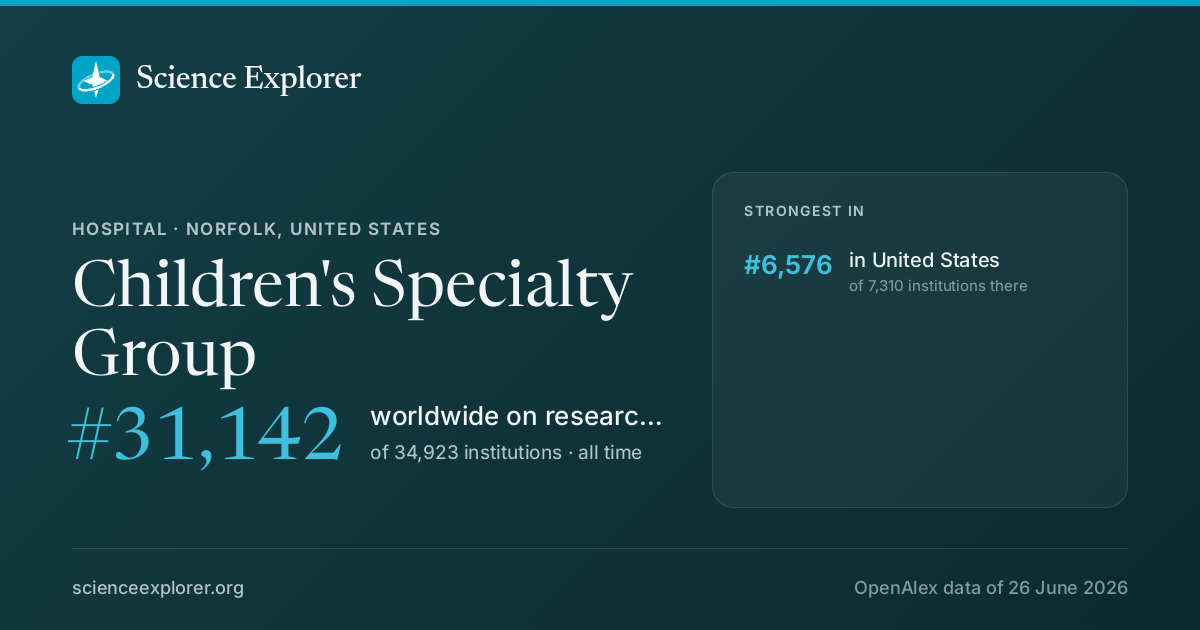
Children's Specialty Group on Science Explorer

A card with Children's Specialty Group's standing and the fields it leads in, for a post or a slide. A link to this page previews as the same card.

Download the card

1200 × 630 PNG, sized for social posts, drawn from the latest snapshot.

Badges for a website1Each links back here and updates with every snapshot

Research measures only: rankings here say nothing about teaching, admissions or student experience. Comparable institutions and collaboration partners have tabs of their own, above.

Discussion

Ask a question or share a note about Children's Specialty Group. Posts are plain text and can be reported.