Numerical Algorithms Group (United Kingdom)
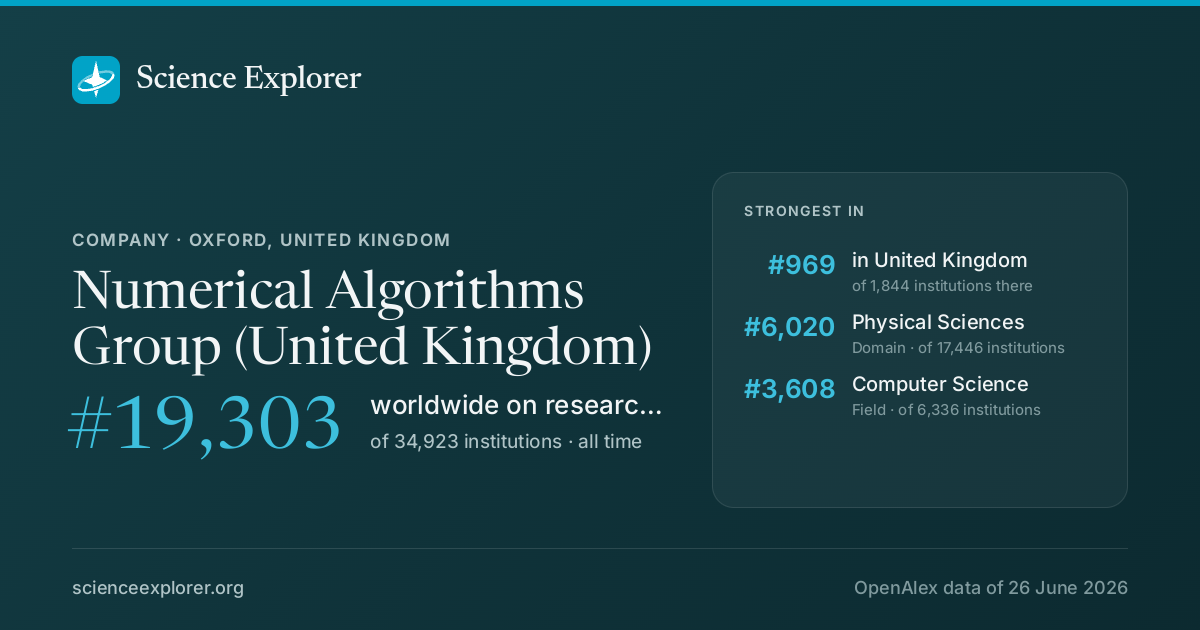
In research, Numerical Algorithms Group (United Kingdom) stands highest in Physical Sciences (#6,020 of 17,446 worldwide) and Computer Science (#3,608 of 6,336 worldwide), over all time.
- World rank, all time
- #19,303 of 34,923
- Rank in United Kingdom
- #969 of 1,844
- Research works
- 318 ▼ 58% vs 2018-21
- Citations
- 6.9k 21.8 per fractional work
- Top-10% rate
- 3.2% all institutions 10.0%
- vs its own fields
- 1.01× 1.00× is exactly expected
- Open access
- 36% world 40%
- International
- 35% world 18%
What is Numerical Algorithms Group (United Kingdom) known for in research?
The fields where it stands highest, over all time, ranked among every institution above the floor in each field.
| Field | World rank | Where that sits | Top-10% rate | Works |
|---|---|---|---|---|
| Physical SciencesDomain | #6,020 of 17,446 | 10.4% | 277 | |
| Computer ScienceField | #3,608 of 6,336 | 9.4% | 137 |
Each strip is that field's whole ranked pool, with the notch where Numerical Algorithms Group (United Kingdom) sits in it, in the colour of the band that rank falls in. The track under the rate is the rate itself: it carries no average mark, because the average differs by field (from about 6% in Dentistry to 21% in Economics).
Which fields of science does Numerical Algorithms Group (United Kingdom) work in?
In all years, 87% of research at Numerical Algorithms Group (United Kingdom) is in Physical Sciences, 8% in Social Sciences. Its largest fields are Computer Science (43%), Engineering (23%), Mathematics (11%). It does 2.1× the world's share of Physical Sciences.
Each ring splits the one inside it: the four domains of science, their fields, their subfields. Size is fractional works in all years. Every slice is a page; the interactive view zooms down to single topics and colours each by how much more of it this institution does than the world.
Its 4 domains and 21 fields, with their numbers
- Physical Sciences27787.2%
- Computer Science13743.1%
- Engineering7423.4%
- Mathematics3511.1%
- Physics and Astronomy195.8%
- Materials Science51.5%
- Earth and Planetary Sciences41.1%
- Environmental Science30.8%
- Chemistry10.3%
- Chemical Engineering00.1%
- Social Sciences268.2%
- Health Sciences92.9%
- Medicine51.5%
- Health Professions41.4%
- Dentistry00.1%
- Life Sciences51.7%
Field profile
Location quotient across every field it publishes in: outside the ring is more than an institution of this size would be expected to publish, inside it is less.
Rings at 0.5×, 1× and 2×. Widest outward: Computer Science, 4.6×. Every wedge is a field page.
All 12 fields, with their numbers
- Computer Science4.64×3 works
- Dentistry4.05×0 works
- Physics and Astronomy3.71×1 works
- Mathematics2.50×0 works
- Engineering1.58×2 works
- Decision Sciences1.35×0 works
- Earth and Planetary Sciences1.07×0 works
- Medicine0.89×2 works
- Psychology0.77×0 works
- Health Professions0.74×0 works
- Neuroscience0.48×0 works
- Biochemistry, Genetics and Molecular Biology0.35×0 works
Who are the top researchers at Numerical Algorithms Group (United Kingdom)?
Ranked on the quality score, Sven J. Hammarling, Jeremy Du Croz and Malcolm A. Sabin lead among researchers whose main affiliation is Numerical Algorithms Group (United Kingdom).
- 1
Sven J. Hammarling
 United Kingdom · #318,216 worldwide
7.1k citations · 91 works
- 2
Jeremy Du Croz
United Kingdom · #808,742 worldwide
4.5k citations · 27 works
- 3
Malcolm A. Sabin
United Kingdom · #1,445,955 worldwide
4.6k citations · 199 works
- 4
Mawussi Zounon
United Kingdom · #1,576,102 worldwide
474 citations · 39 works
- 5
Emmanuel Agullo
United Kingdom · #2,810,367 worldwide
1.8k citations · 186 works
- 6
Malcolm J. Cohen
United Kingdom · #2,851,492 worldwide
87 citations · 22 works
- 7
B. L. Shea
United Kingdom · #3,720,012 worldwide
205 citations · 15 works
- 8
George Levy
United Kingdom · #3,787,664 worldwide
234 citations · 40 works
- 9
Adrian Tate
United Kingdom · #3,818,764 worldwide
86 citations · 15 works
- 10
Stojce Nakov
United Kingdom · #4,014,336 worldwide
18 citations · 18 works
Which keywords describe research at Numerical Algorithms Group (United Kingdom)?
By fractional works in all years, weighted toward what it does more of than the world: Parallel Computing, High-Performance Computing, Iterative Methods, Matrix Computations, Numerical Linear Algebra, Fluid-Structure Interaction, Distributed Systems and GPU Computing.
- Nonlinear Programming
- Distributed Storage
- Mathematical Information Retrieval
- Simulation
- Visualization
- Convex Optimization
- Exponential Integrators
- Hamiltonian Systems
- NURBS
- Structural Analysis
- Floating-Point Arithmetic
- Discontinuous Galerkin Methods
- High-Order Schemes
- Task Scheduling
- Machine Learning
- Workflow Management
- GPU Computing
- Fluid-Structure Interaction
- Matrix Computations
- High-Performance Computing
- Parallel Computing
- Iterative Methods
- Numerical Linear Algebra
- Distributed Systems
- Performance Optimization
- Resource Management
- Grid Computing
- Adaptive Mesh Refinement
- Boundary Element Method
- Finite Element Methods
- Interval Analysis
- Finite Elements
- Differential Equations
- Numerical Integration
- Symplectic Methods
- Maxwell's Equations
- Semidefinite Programming
- Math Search
- Global Optimization
- Network Coding
Size is fractional works in all years in the topics tagged with each word; colour is the word's share of this institution's work against its share of the world's. The 40 words are chosen for being large and distinctive. Each links to the topic it comes from most.
All 40 words, with their numbers
- Parallel Computing48▲ 84×4 topics
- High-Performance Computing33▲ 70×2 topics
- Iterative Methods24▲ 122×2 topics
- Matrix Computations22▲ 153×1 topic
- Numerical Linear Algebra22▲ 153×1 topic
- Fluid-Structure Interaction20▲ 36×5 topics
- Distributed Systems18▲ 24×5 topics
- GPU Computing18▲ 80×1 topic
- Performance Optimization18▲ 56×1 topic
- Workflow Management18▲ 58×2 topics
- Resource Management16▲ 29×2 topics
- Machine Learning15▲ 2.2×26 topics
- Grid Computing15▲ 71×1 topic
- Task Scheduling15▲ 71×1 topic
- Adaptive Mesh Refinement14▲ 49×2 topics
- High-Order Schemes14▲ 49×2 topics
- Boundary Element Method14▲ 63×2 topics
- Discontinuous Galerkin Methods10▲ 92×1 topic
- Finite Element Methods10▲ 92×1 topic
- Floating-Point Arithmetic9▲ 182×1 topic
- Interval Analysis9▲ 182×1 topic
- Structural Analysis9▲ 18×2 topics
- Finite Elements9▲ 73×1 topic
- NURBS9▲ 73×1 topic
- Differential Equations8▲ 77×2 topics
- Hamiltonian Systems8▲ 59×2 topics
- Numerical Integration8▲ 62×2 topics
- Exponential Integrators8▲ 78×1 topic
- Symplectic Methods8▲ 78×1 topic
- Convex Optimization8▲ 32×5 topics
- Maxwell's Equations8▲ 42×2 topics
- Visualization8▲ 42×2 topics
- Semidefinite Programming7▲ 50×2 topics
- Simulation7▲ 6.5×5 topics
- Math Search7▲ 234×1 topic
- Mathematical Information Retrieval7▲ 234×1 topic
- Global Optimization6▲ 32×2 topics
- Distributed Storage6▲ 47×1 topic
- Network Coding6▲ 23×1 topic
- Nonlinear Programming6▲ 70×1 topic
Which research topics does Numerical Algorithms Group (United Kingdom) publish most on?
By volume in 2022-now: Distributed and Parallel Computing Systems, Hydrocarbon exploration and reservoir analysis, Fault Detection and Control Systems and Matrix Theory and Algorithms.
Area is fractional works; colour is the subfield each topic belongs to.
- 1 Distributed and Parallel Computing Systems Computer Networks and Communications 0 works
- 2 Hydrocarbon exploration and reservoir analysis Mechanics of Materials 0 works
- 3 Fault Detection and Control Systems Control and Systems Engineering 0 works
- 4 Matrix Theory and Algorithms Computational Theory and Mathematics 0 works
- 5 Parallel Computing and Optimization Techniques Hardware and Architecture 0 works
- 6 Radiomics and Machine Learning in Medical Imaging Radiology, Nuclear Medicine and Imaging 0 works
- 7 Reservoir Engineering and Simulation Methods Ocean Engineering 0 works
- 8 Radiation Therapy and Dosimetry Pulmonary and Respiratory Medicine 0 works
- 9 Dental Anxiety and Anesthesia Techniques Oral Surgery 0 works
- 10 Numerical Methods and Algorithms Computational Theory and Mathematics 0 works
How open and international is its research?
Against the world's own shares: the tick on each track. Both are shares of its output, so they sit on one scale and can be read against each other as well as against the world.
World: 40% of research is openly available.
World: 18% is written across borders.
How has Numerical Algorithms Group (United Kingdom)'s research output changed?
Output in 2022-2025 was 58% lower than in 2018-2021.
The same series as a ribbon: one cell per year, darker for more. The line above answers how much; this answers when.
Its share of all research
Growing output can still be a shrinking share: all of science grows. This is Numerical Algorithms Group (United Kingdom) as a percentage of every work published that year, 0.000021% in 2024.
Fractional works of Numerical Algorithms Group (United Kingdom) over all fractional works that year. How the balance of science has shifted.
Other research institutions in Oxford
- University of Oxford
- Science Oxford
- Oxford Brookes University
- Oxford University Hospitals NHS Trust
- Nuffield Orthopaedic Centre
- Genomics (United Kingdom)
- Oxford Archaeology
- Oxford Health NHS Foundation Trust

Share Numerical Algorithms Group (United Kingdom)'s ranking
Badges for a website1Each links back here and updates with every snapshot

Research measures only: rankings here say nothing about teaching, admissions or student experience. Comparable institutions and collaboration partners have tabs of their own, above.
Discussion
Ask a question or share a note about Numerical Algorithms Group (United Kingdom). Posts are plain text and can be reported.