Science Explorer Back to mapMap
Institution · Los Angeles · United States

Paul Hastings

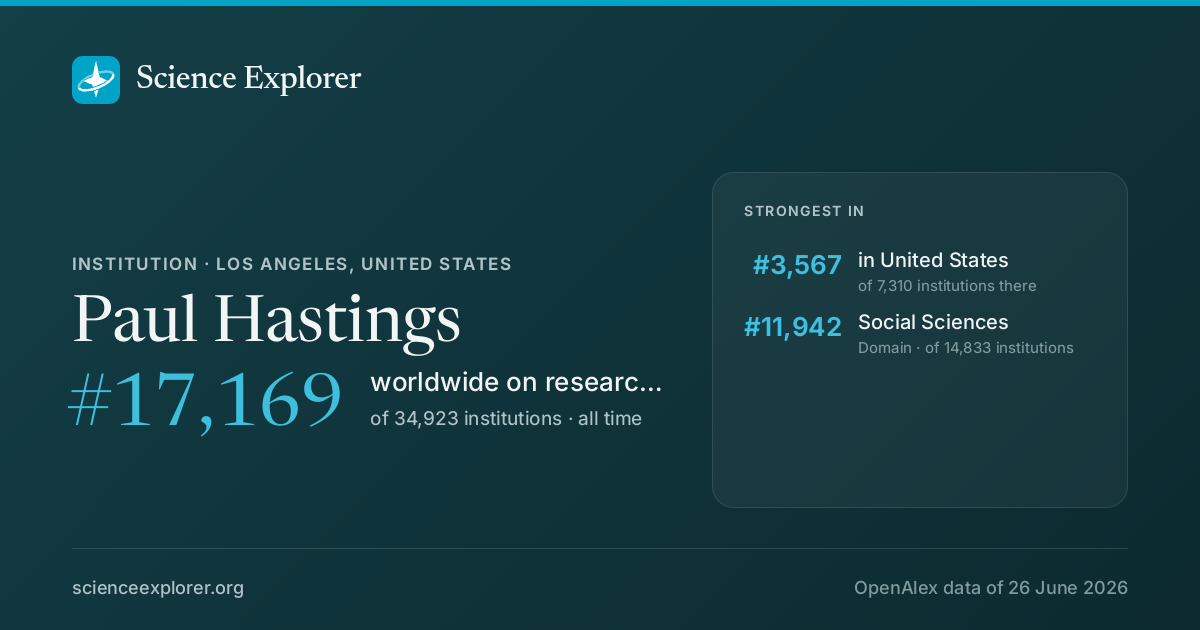
In research, Paul Hastings stands highest in Social Sciences (#11,942 of 14,833 worldwide), over all time.

World rank, all time
#17,169
of 34,923
Rank in United States
#3,567
of 7,310
Research works
357
▼ 58% vs 2018-21
Citations
6.1k
17.2 per fractional work
Top-10% rate
10.4%
all institutions 10.0%
vs its own fields
0.80×
1.00× is exactly expected
Open access
24%
world 40%
International
17%
world 18%

What is Paul Hastings known for in research?

The fields where it stands highest, over all time, ranked among every institution above the floor in each field.

FieldWorld rankWhere that sitsTop-10% rateWorks
Social SciencesDomain #11,942 of 14,833 5.4%175

Each strip is that field's whole ranked pool, with the notch where Paul Hastings sits in it, in the colour of the band that rank falls in. The track under the rate is the rate itself: it carries no average mark, because the average differs by field (from about 6% in Dentistry to 21% in Economics).

Which fields of science does Paul Hastings work in?

In 2022-now, 55% of research at Paul Hastings is in Social Sciences, 27% in Physical Sciences. Its largest fields are Social Sciences (17%), Business, Management and Accounting (15%), Medicine (12%). It does 1.8× the world's share of Social Sciences.

Social Sciences: 11 fractional works · 55.3% of its workSocial Sciences: 3 fractional works · 16.9% of its workEducation: 1 fractional works · 4.4% of its workLaw: 1 fractional works · 3.2% of its workSafety Research: 1 fractional works · 3.2% of its workPolitical Science and International Relations: 0 fractional works · 1.6% of its workSociology and Political Science: 0 fractional works · 1.6% of its workDevelopment: 0 fractional works · 1.2% of its workCultural Studies: 0 fractional works · 0.8% of its workGeography, Planning and Development: 0 fractional works · 0.8% of its workBusiness, Management and Accounting: 3 fractional works · 14.5% of its workAccounting: 1 fractional works · 6.6% of its workStrategy and Management: 1 fractional works · 4.3% of its workOrganizational Behavior and Human Resource Management: 0 fractional works · 2.4% of its workManagement Information Systems: 0 fractional works · 1.2% of its workArts and Humanities: 2 fractional works · 12.0% of its workArcheology: 1 fractional works · 6.7% of its workHistory: 1 fractional works · 3.3% of its workVisual Arts and Performing Arts: 0 fractional works · 1.2% of its workLanguage and Linguistics: 0 fractional works · 0.8% of its workPsychology: 1 fractional works · 6.3% of its workSocial Psychology: 1 fractional works · 2.8% of its workDevelopmental and Educational Psychology: 0 fractional works · 1.8% of its workClinical Psychology: 0 fractional works · 1.5% of its workApplied Psychology: 0 fractional works · 0.2% of its workDecision Sciences: 1 fractional works · 3.4% of its workManagement Science and Operations Research: 0 fractional works · 1.8% of its workStatistics, Probability and Uncertainty: 0 fractional works · 1.6% of its workEconomics, Econometrics and Finance: 0 fractional works · 2.1% of its workFinance: 0 fractional works · 1.4% of its workEconomics and Econometrics: 0 fractional works · 0.7% of its workPhysical Sciences: 6 fractional works · 27.0% of its workComputer Science: 2 fractional works · 9.6% of its workComputational Theory and Mathematics: 1 fractional works · 5.7% of its workComputer Vision and Pattern Recognition: 0 fractional works · 1.9% of its workInformation Systems: 0 fractional works · 1.2% of its workComputer Science Applications: 0 fractional works · 0.8% of its workEngineering: 1 fractional works · 4.3% of its workControl and Systems Engineering: 0 fractional works · 1.6% of its workSafety, Risk, Reliability and Quality: 0 fractional works · 1.6% of its workMechanical Engineering: 0 fractional works · 0.5% of its workMechanics of Materials: 0 fractional works · 0.5% of its workSmaller subfields together: 0 fractional works · 0.0% of its workEnvironmental Science: 1 fractional works · 3.1% of its workEnvironmental Chemistry: 0 fractional works · 0.8% of its workHealth, Toxicology and Mutagenesis: 0 fractional works · 0.8% of its workEcology: 0 fractional works · 0.6% of its workGlobal and Planetary Change: 0 fractional works · 0.3% of its workEcological Modeling: 0 fractional works · 0.3% of its workNature and Landscape Conservation: 0 fractional works · 0.3% of its workMaterials Science: 1 fractional works · 2.7% of its workMaterials Chemistry: 0 fractional works · 1.9% of its workPolymers and Plastics: 0 fractional works · 0.8% of its workChemistry: 0 fractional works · 2.4% of its workInorganic Chemistry: 0 fractional works · 1.1% of its workSpectroscopy: 0 fractional works · 0.8% of its workAnalytical Chemistry: 0 fractional works · 0.5% of its workEarth and Planetary Sciences: 0 fractional works · 2.4% of its workPaleontology: 0 fractional works · 1.9% of its workSpace and Planetary Science: 0 fractional works · 0.5% of its workMathematics: 0 fractional works · 1.6% of its workApplied Mathematics: 0 fractional works · 1.6% of its workChemical Engineering: 0 fractional works · 0.5% of its workCatalysis: 0 fractional works · 0.5% of its workPhysics and Astronomy: 0 fractional works · 0.3% of its workRadiation: 0 fractional works · 0.3% of its workHealth Sciences: 3 fractional works · 13.3% of its workMedicine: 3 fractional works · 12.3% of its workEpidemiology: 1 fractional works · 4.0% of its workSurgery: 0 fractional works · 1.6% of its workPublic Health, Environmental and Occupational Health: 0 fractional works · 1.0% of its workCardiology and Cardiovascular Medicine: 0 fractional works · 1.0% of its workHematology: 0 fractional works · 0.8% of its workNeurology: 0 fractional works · 0.8% of its workOncology: 0 fractional works · 0.6% of its workRehabilitation: 0 fractional works · 0.5% of its workPsychiatry and Mental health: 0 fractional works · 0.5% of its workPhysiology: 0 fractional works · 0.3% of its workPulmonary and Respiratory Medicine: 0 fractional works · 0.3% of its workAnesthesiology and Pain Medicine: 0 fractional works · 0.2% of its workInfectious Diseases: 0 fractional works · 0.2% of its workSmaller subfields together: 0 fractional works · 0.3% of its workHealth Professions: 0 fractional works · 1.0% of its workOccupational Therapy: 0 fractional works · 0.5% of its workEmergency Medical Services: 0 fractional works · 0.5% of its workLife Sciences: 1 fractional works · 4.4% of its workBiochemistry, Genetics and Molecular Biology: 1 fractional works · 2.5% of its workMolecular Biology: 0 fractional works · 1.6% of its workCell Biology: 0 fractional works · 0.5% of its workCancer Research: 0 fractional works · 0.3% of its workAgricultural and Biological Sciences: 0 fractional works · 1.1% of its workPlant Science: 0 fractional works · 1.1% of its workImmunology and Microbiology: 0 fractional works · 0.8% of its workMicrobiology: 0 fractional works · 0.8% of its workALL ITS WORKPaul Hastings21fractional works, 2022-now
Life Sciences4%Physical Sciences27%Health Sciences13%Social Sciences55%

Each ring splits the one inside it: the four domains of science, their fields, their subfields. Size is fractional works in 2022-now. Every slice is a page; the interactive view zooms down to single topics and colours each by how much more of it this institution does than the world.

Its 4 domains and 20 fields, with their numbers
    1. Social Sciences316.9%
    2. Business, Management and Accounting314.5%
    3. Arts and Humanities212.0%
    4. Psychology16.3%
    5. Decision Sciences13.4%
    6. Economics, Econometrics and Finance02.1%
    1. Computer Science29.6%
    2. Engineering14.3%
    3. Environmental Science13.1%
    4. Materials Science12.7%
    5. Chemistry02.4%
    6. Earth and Planetary Sciences02.4%
    7. Mathematics01.6%
    8. Chemical Engineering00.5%
    9. Physics and Astronomy00.3%
    1. Medicine312.3%
    2. Health Professions01.0%
    1. Biochemistry, Genetics and Molecular Biology12.5%
    2. Agricultural and Biological Sciences01.1%
    3. Immunology and Microbiology00.8%
All of science, and how each field's share has moved since 1950: the Science domain explorer

Field profile

Location quotient across every field it publishes in: outside the ring is more than an institution of this size would be expected to publish, inside it is less.

Agricultural and Biological Sciences: 0.23× its world share, 0 worksAgricultural and Bio…Biochemistry, Genetics and Molecular Biology: 0.47× its world share, 0 worksBiochemistry, Geneti…Immunology and Microbiology: 0.80× its world share, 0 worksImmunology and Micro…Chemical Engineering: 1.54× its world share, 0 worksChemical EngineeringChemistry: 1.54× its world share, 0 worksChemistryComputer Science: 1.23× its world share, 2 worksComputer ScienceEarth and Planetary Sciences: 1.55× its world share, 0 worksEarth and Planetary …Engineering: 0.29× its world share, 1 worksEngineeringEnvironmental Science: 0.62× its world share, 1 worksEnvironmental ScienceMaterials Science: 0.77× its world share, 1 worksMaterials ScienceMathematics: 1.37× its world share, 0 worksMathematicsPhysics and Astronomy: 0.15× its world share, 0 worksPhysics and AstronomyHealth Professions: 0.38× its world share, 0 worksHealth ProfessionsMedicine: 0.64× its world share, 2 worksMedicineArts and Humanities: 4.16× its world share, 2 worksArts and HumanitiesBusiness, Management and Accounting: 4.52× its world share, 3 worksBusiness, Management…Decision Sciences: 3.58× its world share, 1 worksDecision SciencesEconomics, Econometrics and Finance: 1.00× its world share, 0 worksEconomics, Econometr…Psychology: 2.06× its world share, 1 worksPsychologySocial Sciences: 1.34× its world share, 4 worksSocial Sciences1×world share
more than its size predictsabout as predictedless

Rings at 0.5×, 1× and 2×. Widest outward: Business, Management and Accounting, 4.5×. Every wedge is a field page.

All 20 fields, with their numbers
  1. Business, Management and Accounting4.52×3 works
  2. Arts and Humanities4.16×2 works
  3. Decision Sciences3.58×1 works
  4. Psychology2.06×1 works
  5. Earth and Planetary Sciences1.55×0 works
  6. Chemical Engineering1.54×0 works
  7. Chemistry1.54×0 works
  8. Mathematics1.37×0 works
  9. Social Sciences1.34×4 works
  10. Computer Science1.23×2 works
  11. Economics, Econometrics and Finance1.00×0 works
  12. Immunology and Microbiology0.80×0 works
  13. Materials Science0.77×1 works
  14. Medicine0.64×2 works
  15. Environmental Science0.62×1 works
  16. Biochemistry, Genetics and Molecular Biology0.47×0 works
  17. Health Professions0.38×0 works
  18. Engineering0.29×1 works
  19. Agricultural and Biological Sciences0.23×0 works
  20. Physics and Astronomy0.15×0 works

Who are the top researchers at Paul Hastings?

Ranked on the quality score, Paul Gipe, Barbara A. Brown and Herman W. Liebert lead among researchers whose main affiliation is Paul Hastings.

  1. 1 Paul Gipe United States · #2,117,356 worldwide 966 citations · 54 works
  2. 2 Barbara A. Brown United States · #2,908,597 worldwide 221 citations · 16 works
  3. 3 Herman W. Liebert United States · #3,610,721 worldwide 3 citations · 21 works
  4. 4 C. A. Zoldi United States · #3,630,587 worldwide 43 citations · 17 works
  5. 5 Behnam Dayanim United States · #4,410,642 worldwide 24 citations · 16 works
  6. 6 Pierre Kirch United States · #5,123,461 worldwide 4 citations · 29 works
  7. 7 Michael Cohen United States · #5,715,643 worldwide 985 citations · 114 works
All ranked researchers at Paul Hastings

What are the most cited papers from Paul Hastings?

The most cited paper from Paul Hastings is "What is Meant by Calling Emotions Basic" (Paul Ekman, Daniel T. Cordaro, 2011), with 1,355 citations. Next come "Cross-cultural recognition of basic emotions through nonverbal emotional vocalizations" (808) and "COMPARISON OF ANTERIOR AND POSTERIOR ILIAC CREST BONE GRAFTS IN TERMS OF HARVEST-SITE MORBIDITY AND FUNCTIONAL OUTCOMES" (671).

Most cited papers
#PaperReleasedCitations
1 What is Meant by Calling Emotions Basic Paul Ekman, Daniel T. Cordaro · Emotion Review 20 Sep 2011 1,355
2 Cross-cultural recognition of basic emotions through nonverbal emotional vocalizations Disa Anna Sauter, Frank Eisner, Paul Ekman et al. · Proceedings of the National Academy of Sciences Open access 25 Jan 2010 808
3 COMPARISON OF ANTERIOR AND POSTERIOR ILIAC CREST BONE GRAFTS IN TERMS OF HARVEST-SITE MORBIDITY AND FUNCTIONAL OUTCOMES Elke R. Ahlmann, Michael J. Patzakis, Nikolaos T. Roidis et al. · Journal of Bone and Joint Surgery May 2002 671
4 No Safe Haven: A Study of Violence Exposure in an Urban Community Mary Schwab‐Stone, Tim S. Ayers, Wesley J. Kasprow et al. · Journal of the American Academy of Child & Adolescent Psychiatry Oct 1995 555
5 Meta-Analysis of Genome-Wide Association Studies in >80 000 Subjects Identifies Multiple Loci for C-Reactive Protein Levels Abbas Dehghan et al. · Circulation ReviewOpen access114 authors 8 Feb 2011 525
All 60 most cited papers, with filters and sorting

Which research topics does Paul Hastings publish most on?

By volume in 2022-now: Maritime and Coastal Archaeology, Numerical Methods and Algorithms, Historical and Archaeological Studies and European and International Contract Law.

  1. 1 Maritime and Coastal Archaeology Archeology 1 works
  2. 2 Numerical Methods and Algorithms Computational Theory and Mathematics 1 works
  3. 3 Historical and Archaeological Studies History 0 works
  4. 4 European and International Contract Law Law 0 works
  5. 5 Corporate Social Responsibility Reporting Strategy and Management 0 works
  6. 6 Law, logistics, and international trade Accounting 0 works
  7. 7 Management and Organizational Studies Organizational Behavior and Human Resource Management 0 works
  8. 8 Machine Learning in Materials Science Materials Chemistry 0 works
  9. 9 Archaeology and ancient environmental studies Paleontology 0 works
  10. 10 Image Processing and 3D Reconstruction Computer Vision and Pattern Recognition 0 works

How open and international is its research?

Against the world's own shares: the tick on each track. Both are shares of its output, so they sit on one scale and can be read against each other as well as against the world.

openly available24.1%not open75.9%

World: 40% of research is openly available.

with international co-authors16.8%domestic only83.2%

World: 18% is written across borders.

How has Paul Hastings's research output changed?

Output in 2022-2025 was 58% lower than in 2018-2021.

still counting1990200020102020
grewheldshrank

The same series as a ribbon: one cell per year, darker for more. The line above answers how much; this answers when.

Its share of all research

Growing output can still be a shrinking share: all of science grows. This is Paul Hastings as a percentage of every work published that year, 0.000059% in 2024.

still counting0.00050%0.0010%0.0015%Paul Hastings0.000049% in 202519801990200020102020

Fractional works of Paul Hastings over all fractional works that year. How the balance of science has shifted.

Other research institutions in Los Angeles

All research institutions in Los Angeles

Share Paul Hastings's ranking

Paul Hastings on Science Explorer

A card with Paul Hastings's standing and the fields it leads in, for a post or a slide. A link to this page previews as the same card.

Download the card

1200 × 630 PNG, sized for social posts, drawn from the latest snapshot.

Badges for a website1Each links back here and updates with every snapshot

Research measures only: rankings here say nothing about teaching, admissions or student experience. Comparable institutions and collaboration partners have tabs of their own, above.

Discussion

Ask a question or share a note about Paul Hastings. Posts are plain text and can be reported.