Science Explorer Back to mapMap
Discussion
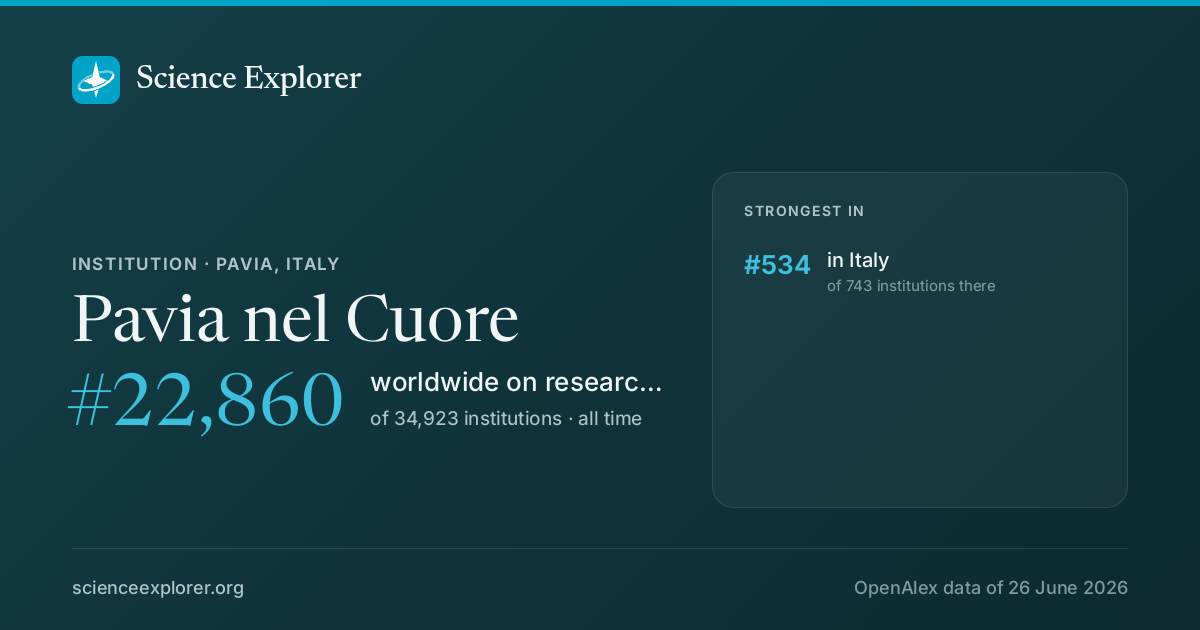
Institution · Pavia · Italy

Pavia nel Cuore

World rank, all time
#22,860
of 34,923
Rank in Italy
#534
of 743
Research works
218
▼ 52% vs 2018-21
Citations
3.4k
15.8 per fractional work
Top-10% rate
15.6%
all institutions 10.0%
vs its own fields
0.91×
1.00× is exactly expected
Open access
34%
world 40%
International
16%
world 18%

Which fields of science does Pavia nel Cuore work in?

In 2022-now, 35% of research at Pavia nel Cuore is in Social Sciences, 29% in Health Sciences. Its largest fields are Medicine (27%), Arts and Humanities (15%), Social Sciences (12%). It does 1.3× the world's share of Social Sciences.

Social Sciences: 7 fractional works · 34.8% of its workArts and Humanities: 3 fractional works · 14.6% of its workArcheology: 1 fractional works · 3.3% of its workLanguage and Linguistics: 1 fractional works · 3.3% of its workPhilosophy: 1 fractional works · 3.3% of its workHistory: 0 fractional works · 1.6% of its workLiterature and Literary Theory: 0 fractional works · 1.6% of its workReligious studies: 0 fractional works · 1.6% of its workSocial Sciences: 3 fractional works · 12.3% of its workLaw: 1 fractional works · 4.9% of its workAnthropology: 0 fractional works · 1.6% of its workPolitical Science and International Relations: 0 fractional works · 1.6% of its workSociology and Political Science: 0 fractional works · 1.1% of its workEducation: 0 fractional works · 0.9% of its workDemography: 0 fractional works · 0.8% of its workUrban Studies: 0 fractional works · 0.8% of its workGender Studies: 0 fractional works · 0.5% of its workPsychology: 1 fractional works · 6.4% of its workClinical Psychology: 1 fractional works · 3.2% of its workExperimental and Cognitive Psychology: 0 fractional works · 1.6% of its workSocial Psychology: 0 fractional works · 0.9% of its workDevelopmental and Educational Psychology: 0 fractional works · 0.7% of its workBusiness, Management and Accounting: 0 fractional works · 0.8% of its workAccounting: 0 fractional works · 0.8% of its workEconomics, Econometrics and Finance: 0 fractional works · 0.8% of its workEconomics and Econometrics: 0 fractional works · 0.8% of its workHealth Sciences: 6 fractional works · 29.3% of its workMedicine: 6 fractional works · 27.1% of its workPulmonary and Respiratory Medicine: 1 fractional works · 5.8% of its workCardiology and Cardiovascular Medicine: 1 fractional works · 3.3% of its workPublic Health, Environmental and Occupational Health: 1 fractional works · 2.8% of its workSurgery: 1 fractional works · 2.7% of its workEpidemiology: 1 fractional works · 2.5% of its workPhysiology: 0 fractional works · 1.9% of its workHepatology: 0 fractional works · 1.1% of its workOncology: 0 fractional works · 1.1% of its workOrthopedics and Sports Medicine: 0 fractional works · 0.8% of its workAnatomy: 0 fractional works · 0.5% of its workEmergency Medicine: 0 fractional works · 0.5% of its workPathology and Forensic Medicine: 0 fractional works · 0.5% of its workPediatrics, Perinatology and Child Health: 0 fractional works · 0.5% of its workReproductive Medicine: 0 fractional works · 0.4% of its workOphthalmology: 0 fractional works · 0.4% of its workAnesthesiology and Pain Medicine: 0 fractional works · 0.3% of its workNephrology: 0 fractional works · 0.3% of its workEndocrinology, Diabetes and Metabolism: 0 fractional works · 0.3% of its workGeriatrics and Gerontology: 0 fractional works · 0.3% of its workPharmacology: 0 fractional works · 0.3% of its workInfectious Diseases: 0 fractional works · 0.2% of its workNeurology: 0 fractional works · 0.2% of its workHealth Professions: 0 fractional works · 1.9% of its workPhysical Therapy, Sports Therapy and Rehabilitation: 0 fractional works · 1.1% of its workGeneral Health Professions: 0 fractional works · 0.5% of its workOccupational Therapy: 0 fractional works · 0.3% of its workNursing: 0 fractional works · 0.3% of its workNutrition and Dietetics: 0 fractional works · 0.3% of its workPhysical Sciences: 4 fractional works · 20.5% of its workEngineering: 1 fractional works · 4.9% of its workElectrical and Electronic Engineering: 0 fractional works · 2.1% of its workBiomedical Engineering: 0 fractional works · 1.5% of its workBuilding and Construction: 0 fractional works · 0.8% of its workMechanical Engineering: 0 fractional works · 0.5% of its workPhysics and Astronomy: 1 fractional works · 4.9% of its workAtomic and Molecular Physics, and Optics: 1 fractional works · 4.9% of its workEarth and Planetary Sciences: 1 fractional works · 2.5% of its workPaleontology: 0 fractional works · 0.9% of its workSpace and Planetary Science: 0 fractional works · 0.8% of its workAtmospheric Science: 0 fractional works · 0.4% of its workEarth-Surface Processes: 0 fractional works · 0.4% of its workEnvironmental Science: 0 fractional works · 2.4% of its workManagement, Monitoring, Policy and Law: 0 fractional works · 0.9% of its workEnvironmental Engineering: 0 fractional works · 0.5% of its workGlobal and Planetary Change: 0 fractional works · 0.5% of its workEcology: 0 fractional works · 0.4% of its workSmaller subfields together: 0 fractional works · 0.0% of its workEnergy: 0 fractional works · 2.1% of its workRenewable Energy, Sustainability and the Environment: 0 fractional works · 1.6% of its workEnergy Engineering and Power Technology: 0 fractional works · 0.5% of its workChemistry: 0 fractional works · 1.3% of its workPhysical and Theoretical Chemistry: 0 fractional works · 0.8% of its workInorganic Chemistry: 0 fractional works · 0.5% of its workComputer Science: 0 fractional works · 1.1% of its workArtificial Intelligence: 0 fractional works · 1.1% of its workMaterials Science: 0 fractional works · 1.0% of its workMaterials Chemistry: 0 fractional works · 1.0% of its workChemical Engineering: 0 fractional works · 0.2% of its workCatalysis: 0 fractional works · 0.2% of its workLife Sciences: 3 fractional works · 15.4% of its workBiochemistry, Genetics and Molecular Biology: 2 fractional works · 8.3% of its workMolecular Biology: 1 fractional works · 4.4% of its workGenetics: 0 fractional works · 1.7% of its workBiophysics: 0 fractional works · 1.2% of its workEndocrinology: 0 fractional works · 0.5% of its workBiochemistry: 0 fractional works · 0.3% of its workSmaller subfields together: 0 fractional works · 0.1% of its workNeuroscience: 1 fractional works · 3.2% of its workCellular and Molecular Neuroscience: 0 fractional works · 1.2% of its workNeurology: 0 fractional works · 0.9% of its workBehavioral Neuroscience: 0 fractional works · 0.8% of its workSmaller subfields together: 0 fractional works · 0.2% of its workAgricultural and Biological Sciences: 0 fractional works · 2.4% of its workPlant Science: 0 fractional works · 1.5% of its workFood Science: 0 fractional works · 0.8% of its workSmaller subfields together: 0 fractional works · 0.1% of its workImmunology and Microbiology: 0 fractional works · 1.2% of its workImmunology: 0 fractional works · 1.2% of its workPharmacology, Toxicology and Pharmaceutics: 0 fractional works · 0.3% of its workPharmacology: 0 fractional works · 0.3% of its workALL ITS WORKPavia nel Cuore21fractional works, 2022-now
Life Sciences15%Physical Sciences20%Health Sciences29%Social Sciences35%

Each ring splits the one inside it: the four domains of science, their fields, their subfields. Size is fractional works in 2022-now. Every slice is a page; the interactive view zooms down to single topics and colours each by how much more of it this institution does than the world.

Its 4 domains and 22 fields, with their numbers
    1. Arts and Humanities314.6%
    2. Social Sciences312.3%
    3. Psychology16.4%
    4. Business, Management and Accounting00.8%
    5. Economics, Econometrics and Finance00.8%
    1. Medicine627.1%
    2. Health Professions01.9%
    3. Nursing00.3%
    1. Engineering14.9%
    2. Physics and Astronomy14.9%
    3. Earth and Planetary Sciences12.5%
    4. Environmental Science02.4%
    5. Energy02.1%
    6. Chemistry01.3%
    7. Computer Science01.1%
    8. Materials Science01.0%
    9. Chemical Engineering00.2%
    1. Biochemistry, Genetics and Molecular Biology28.3%
    2. Neuroscience13.2%
    3. Agricultural and Biological Sciences02.4%
    4. Immunology and Microbiology01.2%
    5. Pharmacology, Toxicology and Pharmaceutics00.3%
All of science, and how each field's share has moved since 1950: the Science domain explorer

Field profile

Location quotient across every field it publishes in: outside the ring is more than an institution of this size would be expected to publish, inside it is less.

Agricultural and Biological Sciences: 0.51× its world share, 0 worksAgricultural and Bio…Biochemistry, Genetics and Molecular Biology: 1.56× its world share, 2 worksBiochemistry, Geneti…Immunology and Microbiology: 1.19× its world share, 0 worksImmunology and Micro…Neuroscience: 1.95× its world share, 1 worksNeurosciencePharmacology, Toxicology and Pharmaceutics: 0.76× its world share, 0 worksPharmacology, Toxico…Chemical Engineering: 0.66× its world share, 0 worksChemical EngineeringChemistry: 0.81× its world share, 0 worksChemistryComputer Science: 0.15× its world share, 0 worksComputer ScienceEarth and Planetary Sciences: 1.61× its world share, 0 worksEarth and Planetary …Energy: 2.35× its world share, 0 worksEnergyEngineering: 0.33× its world share, 1 worksEngineeringEnvironmental Science: 0.49× its world share, 0 worksEnvironmental ScienceMaterials Science: 0.30× its world share, 0 worksMaterials SciencePhysics and Astronomy: 2.18× its world share, 1 worksPhysics and AstronomyHealth Professions: 0.72× its world share, 0 worksHealth ProfessionsMedicine: 1.41× its world share, 6 worksMedicineNursing: 0.66× its world share, 0 worksNursingArts and Humanities: 5.04× its world share, 3 worksArts and HumanitiesBusiness, Management and Accounting: 0.25× its world share, 0 worksBusiness, Management…Economics, Econometrics and Finance: 0.38× its world share, 0 worksEconomics, Econometr…Psychology: 2.09× its world share, 1 worksPsychologySocial Sciences: 0.97× its world share, 2 worksSocial Sciences1×world share
more than its size predictsabout as predictedless

Rings at 0.5×, 1× and 2×. Widest outward: Arts and Humanities, 5.0×. Every wedge is a field page.

All 22 fields, with their numbers
  1. Arts and Humanities5.04×3 works
  2. Energy2.35×0 works
  3. Physics and Astronomy2.18×1 works
  4. Psychology2.09×1 works
  5. Neuroscience1.95×1 works
  6. Earth and Planetary Sciences1.61×0 works
  7. Biochemistry, Genetics and Molecular Biology1.56×2 works
  8. Medicine1.41×6 works
  9. Immunology and Microbiology1.19×0 works
  10. Social Sciences0.97×2 works
  11. Chemistry0.81×0 works
  12. Pharmacology, Toxicology and Pharmaceutics0.76×0 works
  13. Health Professions0.72×0 works
  14. Chemical Engineering0.66×0 works
  15. Nursing0.66×0 works
  16. Agricultural and Biological Sciences0.51×0 works
  17. Environmental Science0.49×0 works
  18. Economics, Econometrics and Finance0.38×0 works
  19. Engineering0.33×1 works
  20. Materials Science0.30×0 works
  21. Business, Management and Accounting0.25×0 works
  22. Computer Science0.15×0 works

Who are the top researchers at Pavia nel Cuore?

Ranked on the quality score, Antonella Lanati lead among researchers whose main affiliation is Pavia nel Cuore.

  1. 1 Antonella Lanati Italy · #2,211,020 worldwide 276 citations · 31 works
All ranked researchers at Pavia nel Cuore

What are the most cited papers from Pavia nel Cuore?

The most cited paper from Pavia nel Cuore is "European guidelines on cardiovascular disease prevention in clinical practice: executive summary" (Ian Graham et al., 2007), with 3,759 citations. Next come "Myalgic encephalomyelitis: International Consensus Criteria" (1,300) and "Exercise benefits on Alzheimer’s disease: State-of-the-science" (354).

Most cited papers
#PaperReleasedCitations
1 European guidelines on cardiovascular disease prevention in clinical practice: executive summary Ian Graham et al. · European Heart Journal Open access 28 Aug 2007 3,759
2 Myalgic encephalomyelitis: International Consensus Criteria Bruce M. Carruthers et al. · Journal of Internal Medicine Open access 20 Jul 2011 1,300
3 Exercise benefits on Alzheimer’s disease: State-of-the-science Pedro L. Valenzuela, Adrián Castillo‐García, Javier Salvador Morales et al. · Ageing Research Reviews Review 16 Jun 2020 354
4 An approach to the dynamics of clay firing Maria Pia Riccardi · Applied Clay Science Oct 1999 304
5 Anion‐Induced Urea Deprotonation Massimo Boiocchi, Laura Del Boca, David Esteban‐Gómez et al. · Chemistry - A European Journal Open access 2005 257
All 60 most cited papers, with filters and sorting

Which research topics does Pavia nel Cuore publish most on?

By volume in 2022-now: Linguistic Education and Pedagogy, Magnetic properties of thin films, Psychotherapy Techniques and Applications and Quantum and electron transport phenomena.

  1. 1 Linguistic Education and Pedagogy Language and Linguistics 0 works
  2. 2 Magnetic properties of thin films Atomic and Molecular Physics, and Optics 0 works
  3. 3 Psychotherapy Techniques and Applications Clinical Psychology 0 works
  4. 4 Quantum and electron transport phenomena Atomic and Molecular Physics, and Optics 0 works
  5. 5 Early Modern Women Writers Religious studies 0 works
  6. 6 Phenomenology and Existential Philosophy Experimental and Cognitive Psychology 0 works
  7. 7 Prostate Cancer Treatment and Research Pulmonary and Respiratory Medicine 0 works
  8. 8 Prostate Cancer Diagnosis and Treatment Pulmonary and Respiratory Medicine 0 works
  9. 9 Second Language Learning and Teaching Literature and Literary Theory 0 works
  10. 10 Medieval and Early Modern Justice Political Science and International Relations 0 works

How open and international is its research?

Against the world's own shares: the tick on each track. Both are shares of its output, so they sit on one scale and can be read against each other as well as against the world.

openly available33.6%not open66.4%

World: 40% of research is openly available.

with international co-authors16.4%domestic only83.6%

World: 18% is written across borders.

How has Pavia nel Cuore's research output changed?

Output in 2022-2025 was 52% lower than in 2018-2021.

still counting1990200020102020
grewheldshrank

The same series as a ribbon: one cell per year, darker for more. The line above answers how much; this answers when.

Its share of all research

Growing output can still be a shrinking share: all of science grows. This is Pavia nel Cuore as a percentage of every work published that year, 0.000039% in 2024.

still counting0.00025%0.00050%0.00075%Pavia nel Cuore0.000080% in 202519801990200020102020

Fractional works of Pavia nel Cuore over all fractional works that year. How the balance of science has shifted.

Other research institutions in Pavia

All research institutions in Pavia

Share Pavia nel Cuore's ranking

Pavia nel Cuore on Science Explorer

A card with Pavia nel Cuore's standing and the fields it leads in, for a post or a slide. A link to this page previews as the same card.

Download the card

1200 × 630 PNG, sized for social posts, drawn from the latest snapshot.

Badges for a website1Each links back here and updates with every snapshot

Research measures only: rankings here say nothing about teaching, admissions or student experience. Comparable institutions and collaboration partners have tabs of their own, above.

Discussion

Ask a question or share a note about Pavia nel Cuore. Keep it to the research: no personal attacks, advertising or links. Any reader can report a post, which collapses it for everyone until it is opened.