Science Explorer Back to mapMap
Discussion
Nonprofit · Manhattan · United States

Regional Plan Association

World rank, all time
#25,465
of 34,923
Rank in United States
#5,324
of 7,310
Research works
201
▲ 74% vs 2018-21
Citations
1.2k
5.8 per fractional work
Top-10% rate
7.1%
all institutions 10.0%
vs its own fields
0.92×
1.00× is exactly expected
Open access
33%
world 40%
International
18%
world 18%

Which fields of science does Regional Plan Association work in?

In 2022-now, 44% of research at Regional Plan Association is in Social Sciences, 31% in Physical Sciences. Its largest fields are Social Sciences (26%), Environmental Science (15%), Medicine (10%). It does 1.6× the world's share of Social Sciences.

Social Sciences: 14 fractional works · 44.4% of its workSocial Sciences: 8 fractional works · 26.1% of its workSociology and Political Science: 2 fractional works · 7.3% of its workLaw: 1 fractional works · 3.5% of its workUrban Studies: 1 fractional works · 2.7% of its workEducation: 1 fractional works · 2.6% of its workTransportation: 1 fractional works · 2.0% of its workPolitical Science and International Relations: 1 fractional works · 1.8% of its workGeography, Planning and Development: 0 fractional works · 1.4% of its workGender Studies: 0 fractional works · 1.2% of its workAnthropology: 0 fractional works · 1.0% of its workSafety Research: 0 fractional works · 1.0% of its workDemography: 0 fractional works · 0.9% of its workPublic Administration: 0 fractional works · 0.3% of its workHealth: 0 fractional works · 0.2% of its workSmaller subfields together: 0 fractional works · 0.2% of its workEconomics, Econometrics and Finance: 2 fractional works · 5.8% of its workEconomics and Econometrics: 2 fractional works · 5.3% of its workFinance: 0 fractional works · 0.5% of its workArts and Humanities: 2 fractional works · 5.0% of its workArcheology: 1 fractional works · 2.1% of its workHistory: 0 fractional works · 1.4% of its workHistory and Philosophy of Science: 0 fractional works · 1.0% of its workConservation: 0 fractional works · 0.5% of its workSmaller subfields together: 0 fractional works · 0.0% of its workBusiness, Management and Accounting: 1 fractional works · 3.5% of its workStrategy and Management: 1 fractional works · 1.7% of its workManagement Information Systems: 0 fractional works · 1.0% of its workMarketing: 0 fractional works · 0.5% of its workAccounting: 0 fractional works · 0.2% of its workPsychology: 1 fractional works · 2.7% of its workSocial Psychology: 1 fractional works · 1.7% of its workClinical Psychology: 0 fractional works · 1.1% of its workDecision Sciences: 0 fractional works · 1.2% of its workInformation Systems and Management: 0 fractional works · 1.0% of its workManagement Science and Operations Research: 0 fractional works · 0.2% of its workPhysical Sciences: 10 fractional works · 30.9% of its workEnvironmental Science: 5 fractional works · 15.0% of its workGlobal and Planetary Change: 1 fractional works · 4.6% of its workNature and Landscape Conservation: 1 fractional works · 2.5% of its workEcology: 1 fractional works · 2.4% of its workManagement, Monitoring, Policy and Law: 1 fractional works · 2.3% of its workHealth, Toxicology and Mutagenesis: 1 fractional works · 1.6% of its workPollution: 0 fractional works · 1.5% of its workEngineering: 3 fractional works · 9.3% of its workOcean Engineering: 1 fractional works · 4.1% of its workCivil and Structural Engineering: 0 fractional works · 1.1% of its workControl and Systems Engineering: 0 fractional works · 1.0% of its workIndustrial and Manufacturing Engineering: 0 fractional works · 1.0% of its workSafety, Risk, Reliability and Quality: 0 fractional works · 1.0% of its workBuilding and Construction: 0 fractional works · 0.6% of its workBiomedical Engineering: 0 fractional works · 0.3% of its workSmaller subfields together: 0 fractional works · 0.1% of its workEnergy: 1 fractional works · 3.6% of its workRenewable Energy, Sustainability and the Environment: 1 fractional works · 3.6% of its workComputer Science: 1 fractional works · 2.5% of its workInformation Systems: 1 fractional works · 2.3% of its workSmaller subfields together: 0 fractional works · 0.2% of its workMathematics: 0 fractional works · 0.3% of its workMathematical Physics: 0 fractional works · 0.3% of its workEarth and Planetary Sciences: 0 fractional works · 0.2% of its workHealth Sciences: 6 fractional works · 19.3% of its workMedicine: 3 fractional works · 10.4% of its workSurgery: 1 fractional works · 1.9% of its workGenetics: 0 fractional works · 1.5% of its workReproductive Medicine: 0 fractional works · 1.5% of its workPharmacology: 0 fractional works · 1.0% of its workPublic Health, Environmental and Occupational Health: 0 fractional works · 1.0% of its workPhysiology: 0 fractional works · 0.9% of its workPediatrics, Perinatology and Child Health: 0 fractional works · 0.8% of its workRadiology, Nuclear Medicine and Imaging: 0 fractional works · 0.7% of its workOrthopedics and Sports Medicine: 0 fractional works · 0.6% of its workEpidemiology: 0 fractional works · 0.5% of its workHealth Professions: 3 fractional works · 8.7% of its workGeneral Health Professions: 2 fractional works · 6.9% of its workOccupational Therapy: 0 fractional works · 1.2% of its workRadiological and Ultrasound Technology: 0 fractional works · 0.6% of its workNursing: 0 fractional works · 0.1% of its workLife Sciences: 2 fractional works · 5.4% of its workAgricultural and Biological Sciences: 2 fractional works · 4.9% of its workGeneral Agricultural and Biological Sciences: 1 fractional works · 3.9% of its workSoil Science: 0 fractional works · 0.3% of its workFood Science: 0 fractional works · 0.2% of its workPlant Science: 0 fractional works · 0.2% of its workSmaller subfields together: 0 fractional works · 0.2% of its workBiochemistry, Genetics and Molecular Biology: 0 fractional works · 0.6% of its workMolecular Biology: 0 fractional works · 0.3% of its workGenetics: 0 fractional works · 0.2% of its workALL ITS WORKRegional PlanAssociation32fractional works, 2022-now
Life Sciences5%Physical Sciences31%Health Sciences19%Social Sciences44%

Each ring splits the one inside it: the four domains of science, their fields, their subfields. Size is fractional works in 2022-now. Every slice is a page; the interactive view zooms down to single topics and colours each by how much more of it this institution does than the world.

Its 4 domains and 17 fields, with their numbers
    1. Social Sciences826.1%
    2. Economics, Econometrics and Finance25.8%
    3. Arts and Humanities25.0%
    4. Business, Management and Accounting13.5%
    5. Psychology12.7%
    6. Decision Sciences01.2%
    1. Environmental Science515.0%
    2. Engineering39.3%
    3. Energy13.6%
    4. Computer Science12.5%
    5. Mathematics00.3%
    6. Earth and Planetary Sciences00.2%
    1. Medicine310.4%
    2. Health Professions38.7%
    3. Nursing00.1%
    1. Agricultural and Biological Sciences24.9%
    2. Biochemistry, Genetics and Molecular Biology00.6%
All of science, and how each field's share has moved since 1950: the Science domain explorer

Field profile

Location quotient across every field it publishes in: outside the ring is more than an institution of this size would be expected to publish, inside it is less.

Agricultural and Biological Sciences: 1.02× its world share, 2 worksAgricultural and Bio…Biochemistry, Genetics and Molecular Biology: 0.10× its world share, 0 worksBiochemistry, Geneti…Computer Science: 0.32× its world share, 1 worksComputer ScienceEarth and Planetary Sciences: 0.10× its world share, 0 worksEarth and Planetary …Energy: 3.90× its world share, 1 worksEnergyEngineering: 0.62× its world share, 3 worksEngineeringEnvironmental Science: 3.02× its world share, 5 worksEnvironmental ScienceMathematics: 0.29× its world share, 0 worksMathematicsHealth Professions: 3.31× its world share, 3 worksHealth ProfessionsMedicine: 0.54× its world share, 3 worksMedicineNursing: 0.19× its world share, 0 worksNursingArts and Humanities: 1.74× its world share, 2 worksArts and HumanitiesBusiness, Management and Accounting: 1.08× its world share, 1 worksBusiness, Management…Decision Sciences: 1.28× its world share, 0 worksDecision SciencesEconomics, Econometrics and Finance: 2.71× its world share, 2 worksEconomics, Econometr…Psychology: 0.89× its world share, 1 worksPsychologySocial Sciences: 2.06× its world share, 8 worksSocial Sciences1×world share
more than its size predictsabout as predictedless

Rings at 0.5×, 1× and 2×. Widest outward: Energy, 3.9×. Every wedge is a field page.

All 17 fields, with their numbers
  1. Energy3.90×1 works
  2. Health Professions3.31×3 works
  3. Environmental Science3.02×5 works
  4. Economics, Econometrics and Finance2.71×2 works
  5. Social Sciences2.06×8 works
  6. Arts and Humanities1.74×2 works
  7. Decision Sciences1.28×0 works
  8. Business, Management and Accounting1.08×1 works
  9. Agricultural and Biological Sciences1.02×2 works
  10. Psychology0.89×1 works
  11. Engineering0.62×3 works
  12. Medicine0.54×3 works
  13. Computer Science0.32×1 works
  14. Mathematics0.29×0 works
  15. Nursing0.19×0 works
  16. Biochemistry, Genetics and Molecular Biology0.10×0 works
  17. Earth and Planetary Sciences0.10×0 works

Who are the top researchers at Regional Plan Association?

Ranked on the quality score, Harland Bartholomew, Benton MacKaye and Alfred Bettman lead among researchers whose main affiliation is Regional Plan Association.

  1. 1 Harland Bartholomew United States · #2,181,314 worldwide 115 citations · 62 works
  2. 2 Benton MacKaye United States · #2,401,847 worldwide 232 citations · 16 works
  3. 3 Alfred Bettman United States · #2,459,396 worldwide 52 citations · 34 works
  4. 4 Henry Fagin United States · #2,698,776 worldwide 77 citations · 18 works
  5. 5 Wilbur J. Watson United States · #2,699,118 worldwide 2 citations · 21 works
  6. 6 Russell Van Nest Black United States · #2,841,853 worldwide 18 citations · 24 works
  7. 7 Bion J. Arnold United States · #2,995,252 worldwide 6 citations · 26 works
  8. 8 Harold M. Lewis United States · #3,063,000 worldwide 24 citations · 66 works
  9. 9 Jeffrey M Zupan United States · #3,063,338 worldwide 804 citations · 34 works
  10. 10 Robert D. Yaro United States · #3,078,402 worldwide 312 citations · 25 works
All ranked researchers at Regional Plan Association

What are the most cited papers from Regional Plan Association?

The most cited paper from Regional Plan Association is "Sustained Reduction of Microbial Burden on Common Hospital Surfaces through Introduction of Copper" (Michael G. Schmidt, Hubert H. Attaway, Peter A. Sharpe et al., 2012), with 211 citations. Next come "When City and Country Collide: Managing Growth at the Metropolitan Fringe" (164) and "Adopting a modern ecological view of the metropolitan landscape: the case of a greenspace system for the New York City region" (143).

Most cited papers
#PaperReleasedCitations
1 Sustained Reduction of Microbial Burden on Common Hospital Surfaces through Introduction of Copper Michael G. Schmidt, Hubert H. Attaway, Peter A. Sharpe et al. · Journal of Clinical Microbiology Open access 3 May 2012 211
2 When City and Country Collide: Managing Growth at the Metropolitan Fringe Robert D. Yaro · Journal of Planning Education and Research Dec 1999 164
3 Adopting a modern ecological view of the metropolitan landscape: the case of a greenspace system for the New York City region Alejandro Flores, Steward T. A. Pickett, Wayne C. Zipperer et al. · Landscape and Urban Planning Open access 1998 143
4 Diagnosis and Management of Partial Thickness Rotator Cuff Tears: A Comprehensive Review Kevin D. Plancher, Jaya Shanmugam, Karen Kay Briggs et al. · Journal of the American Academy of Orthopaedic Surgeons 13 Sep 2021 83
5 Climate Change Perceptions of NY State Farmers: The Role of Risk Perceptions and Adaptive Capacity Bruno Takahashi, Morey Burnham, Carol Terracina-Hartman et al. · Environmental Management 22 Sep 2016 78
All 60 most cited papers, with filters and sorting

Which keywords describe research at Regional Plan Association?

By fractional works in 2022-now, weighted toward what it does more of than the world: Sustainability, Climate Change, Economic Growth, Urbanization, Spatial Planning, Sustainable Development, Renewable Energy and Public Economics.

▲ more of its work than of the world's◆ about the world's share▼ less than the world's

Size is fractional works in 2022-now in the topics tagged with each word; colour is the word's share of this institution's work against its share of the world's. The 23 words are chosen for being large and distinctive. Each links to the topic it comes from most.

All 23 words, with their numbers
  1. Sustainability4▲ 5.0×15 topics
  2. Climate Change3▲ 3.8×16 topics
  3. Economic Growth2▲ 8.0×2 topics
  4. Sustainable Development2▲ 3.7×7 topics
  5. Urbanization2▲ 15×4 topics
  6. Renewable Energy2▲ 3.7×5 topics
  7. Globalization1▲ 2.1×5 topics
  8. Public Health1▲ 3.1×6 topics
  9. Remote Sensing1▲ 3.6×4 topics
  10. Spatial Planning1▲ 27×2 topics
  11. Supply Chain Management1▲ 4.6×4 topics
  12. Community Empowerment1▲ 5.3×4 topics
  13. Economic Development1▲ 4.5×5 topics
  14. Public Economics1▲ 41×1 topic
  15. Regional Development1▲ 10×1 topic
  16. Water Resources1▲ 14×2 topics
  17. Decision Making1▲ 11×1 topic
  18. Jury1▲ 801×1 topic
  19. Light Pollution1▲ 105×1 topic
  20. Nighttime Light Data1▲ 105×1 topic
  21. Reservoir Operation1▲ 96×1 topic
  22. Satellite Imagery1▲ 24×2 topics
  23. Water Demand1▲ 96×1 topic

Which research topics does Regional Plan Association publish most on?

By volume in 2022-now: Economic Growth and Fiscal Policies, Water resources management and optimization, Jury Decision Making Processes and Impact of Light on Environment and Health.

  1. 1 Economic Growth and Fiscal Policies Economics and Econometrics 1 works
  2. 2 Water resources management and optimization Ocean Engineering 1 works
  3. 3 Jury Decision Making Processes Law 1 works
  4. 4 Impact of Light on Environment and Health Global and Planetary Change 1 works
  5. 5 Ecology, Conservation, and Geographical Studies Nature and Landscape Conservation 1 works
  6. 6 Health and Medical Studies General Health Professions 1 works
  7. 7 Social Policies and Healthcare Reform General Health Professions 1 works
  8. 8 Energy and Environment Impacts Pollution 0 works
  9. 9 Environmental and Ecological Studies Renewable Energy, Sustainability and the Environment 0 works
  10. 10 Endometriosis Research and Treatment Reproductive Medicine 0 works

How open and international is its research?

Against the world's own shares: the tick on each track. Both are shares of its output, so they sit on one scale and can be read against each other as well as against the world.

openly available33.2%not open66.8%

World: 40% of research is openly available.

with international co-authors18.3%domestic only81.7%

World: 18% is written across borders.

How has Regional Plan Association's research output changed?

Output in 2022-2025 was 74% higher than in 2018-2021.

still counting1990200020102020
grewheldshrank

The same series as a ribbon: one cell per year, darker for more. The line above answers how much; this answers when.

Its share of all research

Growing output can still be a shrinking share: all of science grows. This is Regional Plan Association as a percentage of every work published that year, 0.00015% in 2024.

still counting0.0010%0.0020%Regional Plan Association0.00015% in 202519801990200020102020

Fractional works of Regional Plan Association over all fractional works that year. How the balance of science has shifted.

Other research institutions in Manhattan

All research institutions in Manhattan

Share Regional Plan Association's ranking
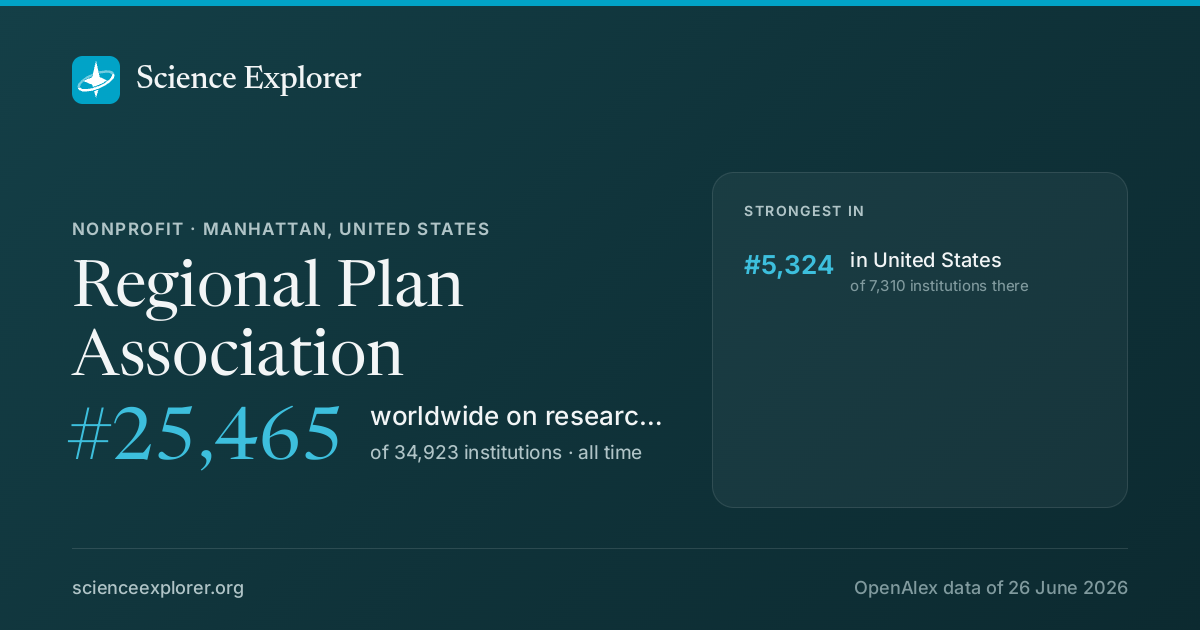
Regional Plan Association on Science Explorer

A card with Regional Plan Association's standing and the fields it leads in, for a post or a slide. A link to this page previews as the same card.

Download the card

1200 × 630 PNG, sized for social posts, drawn from the latest snapshot.

Badges for a website1Each links back here and updates with every snapshot

Research measures only: rankings here say nothing about teaching, admissions or student experience. Comparable institutions and collaboration partners have tabs of their own, above.

Discussion

Ask a question or share a note about Regional Plan Association. Keep it to the research: no personal attacks, advertising or links. Any reader can report a post, which collapses it for everyone until it is opened.
