Science Explorer Back to mapMap
Discussion
University · Manhattan · United States

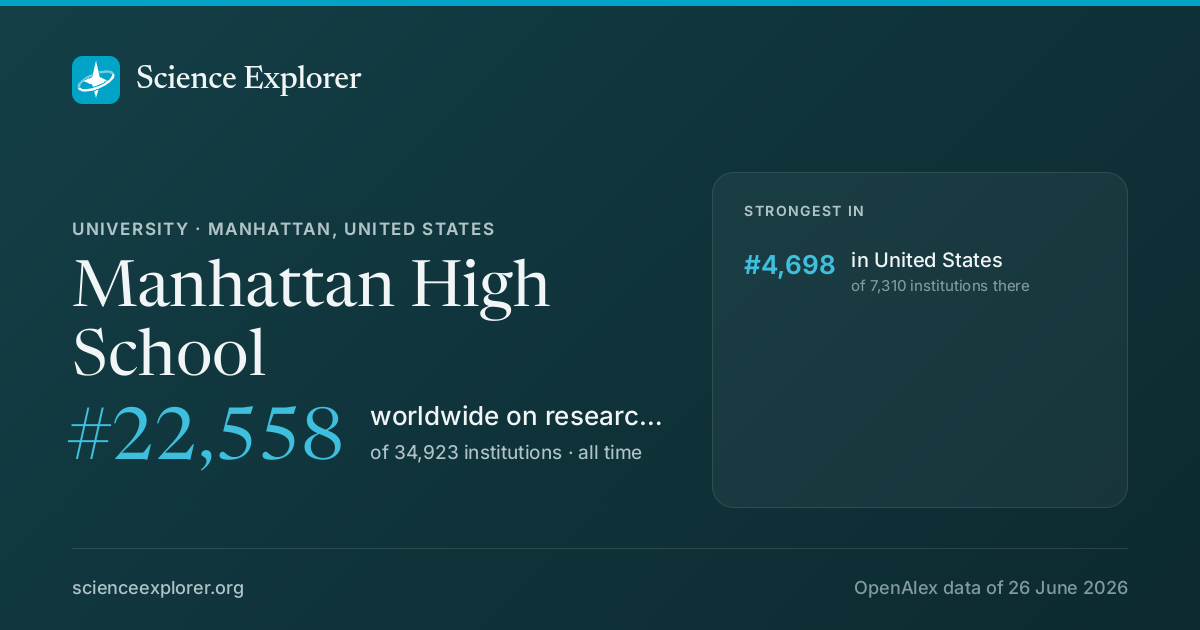
Manhattan High School

World rank, all time
#22,558
of 34,923
Rank in United States
#4,698
of 7,310
Research works
195
▲ 99% vs 2018-21
Citations
2.9k
14.9 per fractional work
Top-10% rate
9.6%
all institutions 10.0%
vs its own fields
0.98×
1.00× is exactly expected
Open access
22%
world 40%
International
8%
world 18%

Which fields of science does Manhattan High School work in?

In 2022-now, 43% of research at Manhattan High School is in Physical Sciences, 41% in Social Sciences. Its largest fields are Social Sciences (25%), Engineering (12%), Materials Science (10%). It does 1.5× the world's share of Social Sciences.

Physical Sciences: 12 fractional works · 42.6% of its workEngineering: 3 fractional works · 11.9% of its workElectrical and Electronic Engineering: 1 fractional works · 4.2% of its workControl and Systems Engineering: 1 fractional works · 2.7% of its workBiomedical Engineering: 1 fractional works · 2.0% of its workAerospace Engineering: 0 fractional works · 1.2% of its workSafety, Risk, Reliability and Quality: 0 fractional works · 0.6% of its workMechanical Engineering: 0 fractional works · 0.5% of its workCivil and Structural Engineering: 0 fractional works · 0.4% of its workAutomotive Engineering: 0 fractional works · 0.2% of its workMaterials Science: 3 fractional works · 10.5% of its workBiomaterials: 1 fractional works · 3.5% of its workMaterials Chemistry: 1 fractional works · 3.4% of its workCeramics and Composites: 1 fractional works · 2.4% of its workPolymers and Plastics: 0 fractional works · 0.5% of its workGeneral Materials Science: 0 fractional works · 0.4% of its workElectronic, Optical and Magnetic Materials: 0 fractional works · 0.2% of its workEnvironmental Science: 2 fractional works · 5.9% of its workEcological Modeling: 1 fractional works · 3.8% of its workGlobal and Planetary Change: 0 fractional works · 1.2% of its workEnvironmental Engineering: 0 fractional works · 0.6% of its workEcology: 0 fractional works · 0.3% of its workSmaller subfields together: 0 fractional works · 0.0% of its workMathematics: 1 fractional works · 4.7% of its workMathematical Physics: 0 fractional works · 1.8% of its workTheoretical Computer Science: 0 fractional works · 1.8% of its workModeling and Simulation: 0 fractional works · 1.2% of its workPhysics and Astronomy: 1 fractional works · 3.4% of its workRadiation: 0 fractional works · 1.8% of its workStatistical and Nonlinear Physics: 0 fractional works · 1.2% of its workAtomic and Molecular Physics, and Optics: 0 fractional works · 0.4% of its workSmaller subfields together: 0 fractional works · 0.0% of its workComputer Science: 1 fractional works · 2.9% of its workArtificial Intelligence: 0 fractional works · 1.1% of its workInformation Systems: 0 fractional works · 1.1% of its workComputer Science Applications: 0 fractional works · 0.5% of its workComputer Vision and Pattern Recognition: 0 fractional works · 0.3% of its workSmaller subfields together: 0 fractional works · 0.0% of its workEnergy: 0 fractional works · 1.3% of its workRenewable Energy, Sustainability and the Environment: 0 fractional works · 1.0% of its workEnergy Engineering and Power Technology: 0 fractional works · 0.3% of its workEarth and Planetary Sciences: 0 fractional works · 1.2% of its workAtmospheric Science: 0 fractional works · 1.2% of its workChemistry: 0 fractional works · 0.6% of its workOrganic Chemistry: 0 fractional works · 0.6% of its workChemical Engineering: 0 fractional works · 0.2% of its workFluid Flow and Transfer Processes: 0 fractional works · 0.2% of its workSocial Sciences: 12 fractional works · 40.9% of its workSocial Sciences: 7 fractional works · 25.2% of its workEducation: 5 fractional works · 16.0% of its workSociology and Political Science: 1 fractional works · 3.6% of its workSafety Research: 1 fractional works · 2.7% of its workHealth: 0 fractional works · 1.8% of its workDemography: 0 fractional works · 0.6% of its workPolitical Science and International Relations: 0 fractional works · 0.6% of its workEconomics, Econometrics and Finance: 2 fractional works · 5.8% of its workEconomics and Econometrics: 1 fractional works · 5.2% of its workFinance: 0 fractional works · 0.6% of its workBusiness, Management and Accounting: 2 fractional works · 5.4% of its workAccounting: 1 fractional works · 3.9% of its workOrganizational Behavior and Human Resource Management: 0 fractional works · 1.2% of its workMarketing: 0 fractional works · 0.3% of its workSmaller subfields together: 0 fractional works · 0.0% of its workPsychology: 1 fractional works · 4.4% of its workExperimental and Cognitive Psychology: 1 fractional works · 2.5% of its workClinical Psychology: 0 fractional works · 1.0% of its workSocial Psychology: 0 fractional works · 0.9% of its workLife Sciences: 3 fractional works · 10.6% of its workBiochemistry, Genetics and Molecular Biology: 2 fractional works · 5.4% of its workMolecular Biology: 1 fractional works · 2.7% of its workBiophysics: 0 fractional works · 1.8% of its workGenetics: 0 fractional works · 0.5% of its workEndocrinology: 0 fractional works · 0.3% of its workSmaller subfields together: 0 fractional works · 0.2% of its workAgricultural and Biological Sciences: 1 fractional works · 4.1% of its workAgronomy and Crop Science: 0 fractional works · 1.2% of its workInsect Science: 0 fractional works · 0.9% of its workEcology, Evolution, Behavior and Systematics: 0 fractional works · 0.9% of its workGeneral Agricultural and Biological Sciences: 0 fractional works · 0.6% of its workSoil Science: 0 fractional works · 0.6% of its workImmunology and Microbiology: 0 fractional works · 0.7% of its workImmunology: 0 fractional works · 0.6% of its workSmaller subfields together: 0 fractional works · 0.1% of its workNeuroscience: 0 fractional works · 0.4% of its workCognitive Neuroscience: 0 fractional works · 0.4% of its workHealth Sciences: 2 fractional works · 5.9% of its workMedicine: 2 fractional works · 5.9% of its workPulmonary and Respiratory Medicine: 0 fractional works · 1.6% of its workCardiology and Cardiovascular Medicine: 0 fractional works · 1.2% of its workEpidemiology: 0 fractional works · 0.6% of its workOncology: 0 fractional works · 0.6% of its workPathology and Forensic Medicine: 0 fractional works · 0.6% of its workOphthalmology: 0 fractional works · 0.4% of its workRadiology, Nuclear Medicine and Imaging: 0 fractional works · 0.4% of its workPublic Health, Environmental and Occupational Health: 0 fractional works · 0.3% of its workSmaller subfields together: 0 fractional works · 0.2% of its workALL ITS WORKManhattan HighSchool28fractional works, 2022-now
Life Sciences11%Physical Sciences43%Health Sciences6%Social Sciences41%

Each ring splits the one inside it: the four domains of science, their fields, their subfields. Size is fractional works in 2022-now. Every slice is a page; the interactive view zooms down to single topics and colours each by how much more of it this institution does than the world.

Its 4 domains and 19 fields, with their numbers
    1. Engineering311.9%
    2. Materials Science310.5%
    3. Environmental Science25.9%
    4. Mathematics14.7%
    5. Physics and Astronomy13.4%
    6. Computer Science12.9%
    7. Energy01.3%
    8. Earth and Planetary Sciences01.2%
    9. Chemistry00.6%
    10. Chemical Engineering00.2%
    1. Social Sciences725.2%
    2. Economics, Econometrics and Finance25.8%
    3. Business, Management and Accounting25.4%
    4. Psychology14.4%
    1. Biochemistry, Genetics and Molecular Biology25.4%
    2. Agricultural and Biological Sciences14.1%
    3. Immunology and Microbiology00.7%
    4. Neuroscience00.4%
    1. Medicine25.9%
All of science, and how each field's share has moved since 1950: the Science domain explorer

Field profile

Location quotient across every field it publishes in: outside the ring is more than an institution of this size would be expected to publish, inside it is less.

Agricultural and Biological Sciences: 0.87× its world share, 1 worksAgricultural and Bio…Biochemistry, Genetics and Molecular Biology: 1.01× its world share, 2 worksBiochemistry, Geneti…Immunology and Microbiology: 0.70× its world share, 0 worksImmunology and Micro…Neuroscience: 0.22× its world share, 0 worksNeuroscienceChemical Engineering: 0.68× its world share, 0 worksChemical EngineeringChemistry: 0.38× its world share, 0 worksChemistryComputer Science: 0.37× its world share, 1 worksComputer ScienceEarth and Planetary Sciences: 0.75× its world share, 0 worksEarth and Planetary …Energy: 1.39× its world share, 0 worksEnergyEngineering: 0.79× its world share, 3 worksEngineeringEnvironmental Science: 1.19× its world share, 2 worksEnvironmental ScienceMaterials Science: 3.00× its world share, 3 worksMaterials ScienceMathematics: 4.02× its world share, 1 worksMathematicsPhysics and Astronomy: 1.52× its world share, 1 worksPhysics and AstronomyMedicine: 0.31× its world share, 2 worksMedicineBusiness, Management and Accounting: 1.68× its world share, 2 worksBusiness, Management…Economics, Econometrics and Finance: 2.73× its world share, 2 worksEconomics, Econometr…Psychology: 1.45× its world share, 1 worksPsychologySocial Sciences: 2.00× its world share, 7 worksSocial Sciences1×world share
more than its size predictsabout as predictedless

Rings at 0.5×, 1× and 2×. Widest outward: Mathematics, 4.0×. Every wedge is a field page.

All 19 fields, with their numbers
  1. Mathematics4.02×1 works
  2. Materials Science3.00×3 works
  3. Economics, Econometrics and Finance2.73×2 works
  4. Social Sciences2.00×7 works
  5. Business, Management and Accounting1.68×2 works
  6. Physics and Astronomy1.52×1 works
  7. Psychology1.45×1 works
  8. Energy1.39×0 works
  9. Environmental Science1.19×2 works
  10. Biochemistry, Genetics and Molecular Biology1.01×2 works
  11. Agricultural and Biological Sciences0.87×1 works
  12. Engineering0.79×3 works
  13. Earth and Planetary Sciences0.75×0 works
  14. Immunology and Microbiology0.70×0 works
  15. Chemical Engineering0.68×0 works
  16. Chemistry0.38×0 works
  17. Computer Science0.37×1 works
  18. Medicine0.31×2 works
  19. Neuroscience0.22×0 works

Who are the top researchers at Manhattan High School?

Ranked on the quality score, Theo. H. Scheffer, Max Berger and Ingrid Seitz lead among researchers whose main affiliation is Manhattan High School.

  1. 1 Theo. H. Scheffer United States · #2,768,643 worldwide 256 citations · 52 works
  2. 2 Max Berger United States · #3,453,116 worldwide 47 citations · 23 works
  3. 3 Ingrid Seitz United States · #4,983,106 worldwide 8 citations · 18 works
  4. 4 Louis J. Miller United States · #5,956,636 worldwide 16 citations · 44 works
All ranked researchers at Manhattan High School

What are the most cited papers from Manhattan High School?

The most cited paper from Manhattan High School is "Journal of Molecular Structure" (Christer B. Aakeröy, 1997), with 1,149 citations. Next come "Optimization Techniques for System Reliability with RedundancyߞA Review" (243) and "Recent trends in analytical applications of organically modified silicate materials" (184).

Most cited papers
#PaperReleasedCitations
1 Journal of Molecular Structure Christer B. Aakeröy · Journal of Chemical Crystallography Open access 1997 1,149
2 Optimization Techniques for System Reliability with RedundancyߞA Review Frank A. Tillman, Ching-Lai Hwang, Way Kuo · IEEE Transactions on Reliability Aug 1977 243
3 Recent trends in analytical applications of organically modified silicate materials Maryanne M. Collinson · TrAC Trends in Analytical Chemistry 2002 184
4 Massively parallel 454‐sequencing of fungal communities in Quercus spp. ectomycorrhizas indicates seasonal dynamics in urban and rural sites Ari Jumpponen, Kenneth L. Jones, J. David Mattox et al. · Molecular Ecology Open access 10 Feb 2010 169
5 Considerations for using bacteriophages for plant disease control Jeffrey B. Jones, Gary Edward Vallad, Fanny B. Iriarte et al. · Bacteriophage Open access Oct 2012 165
All 59 most cited papers, with filters and sorting

Which keywords describe research at Manhattan High School?

By fractional works in 2022-now, weighted toward what it does more of than the world: Teacher Professional Development, Technology Integration, Biomedical Applications, Student Motivation, Analytic Hierarchy Process, Biodegradable Polymers, Educational Leadership and Fuzzy Modeling.

▲ more of its work than of the world's◆ about the world's share▼ less than the world's

Size is fractional works in 2022-now in the topics tagged with each word; colour is the word's share of this institution's work against its share of the world's. The 12 words are chosen for being large and distinctive. Each links to the topic it comes from most.

All 12 words, with their numbers
  1. Biomedical Applications2▲ 4.5×2 topics
  2. Teacher Professional Development1▲ 29×2 topics
  3. Technology Integration1▲ 15×2 topics
  4. Analytic Hierarchy Process1▲ 64×1 topic
  5. Biodegradable Polymers1▲ 20×1 topic
  6. Educational Leadership1▲ 28×2 topics
  7. Educational Technology1▲ 3.0×4 topics
  8. Fuzzy Modeling1▲ 475×1 topic
  9. Nanocomposites1▲ 4.7×2 topics
  10. Polylactic Acid1▲ 47×1 topic
  11. School Improvement1▲ 42×2 topics
  12. Student Motivation1▲ 18×3 topics

Which research topics does Manhattan High School publish most on?

By volume in 2022-now: Evaluation Methods in Various Fields, biodegradable polymer synthesis and properties, Teacher Education and Leadership Studies and Glass properties and applications.

  1. 1 Evaluation Methods in Various Fields Ecological Modeling 1 works
  2. 2 biodegradable polymer synthesis and properties Biomaterials 1 works
  3. 3 Teacher Education and Leadership Studies Education 1 works
  4. 4 Glass properties and applications Ceramics and Composites 1 works
  5. 5 Education and Communication Studies Education 1 works
  6. 6 School Choice and Performance Education 1 works
  7. 7 Innovative Microfluidic and Catalytic Techniques Innovation Biomedical Engineering 0 works
  8. 8 Teacher Professional Development and Motivation Education 0 works
  9. 9 History and Theory of Mathematics Theoretical Computer Science 0 works
  10. 10 Advanced Radiotherapy Techniques Radiation 0 works

How open and international is its research?

Against the world's own shares: the tick on each track. Both are shares of its output, so they sit on one scale and can be read against each other as well as against the world.

openly available21.9%not open78.1%

World: 40% of research is openly available.

with international co-authors8.4%domestic only91.6%

World: 18% is written across borders.

How has Manhattan High School's research output changed?

Output in 2022-2025 was 99% higher than in 2018-2021.

still counting1990200020102020
grewheldshrank

The same series as a ribbon: one cell per year, darker for more. The line above answers how much; this answers when.

Its share of all research

Growing output can still be a shrinking share: all of science grows. This is Manhattan High School as a percentage of every work published that year, 0.00010% in 2024.

still counting0.0010%0.0020%0.0030%Manhattan High School0.00013% in 202519801990200020102020

Fractional works of Manhattan High School over all fractional works that year. How the balance of science has shifted.

Other research institutions in Manhattan

All research institutions in Manhattan

Share Manhattan High School's ranking

Manhattan High School on Science Explorer

A card with Manhattan High School's standing and the fields it leads in, for a post or a slide. A link to this page previews as the same card.

Download the card

1200 × 630 PNG, sized for social posts, drawn from the latest snapshot.

Badges for a website1Each links back here and updates with every snapshot

Research measures only: rankings here say nothing about teaching, admissions or student experience. Comparable institutions and collaboration partners have tabs of their own, above.

Discussion

Ask a question or share a note about Manhattan High School. Keep it to the research: no personal attacks, advertising or links. Any reader can report a post, which collapses it for everyone until it is opened.