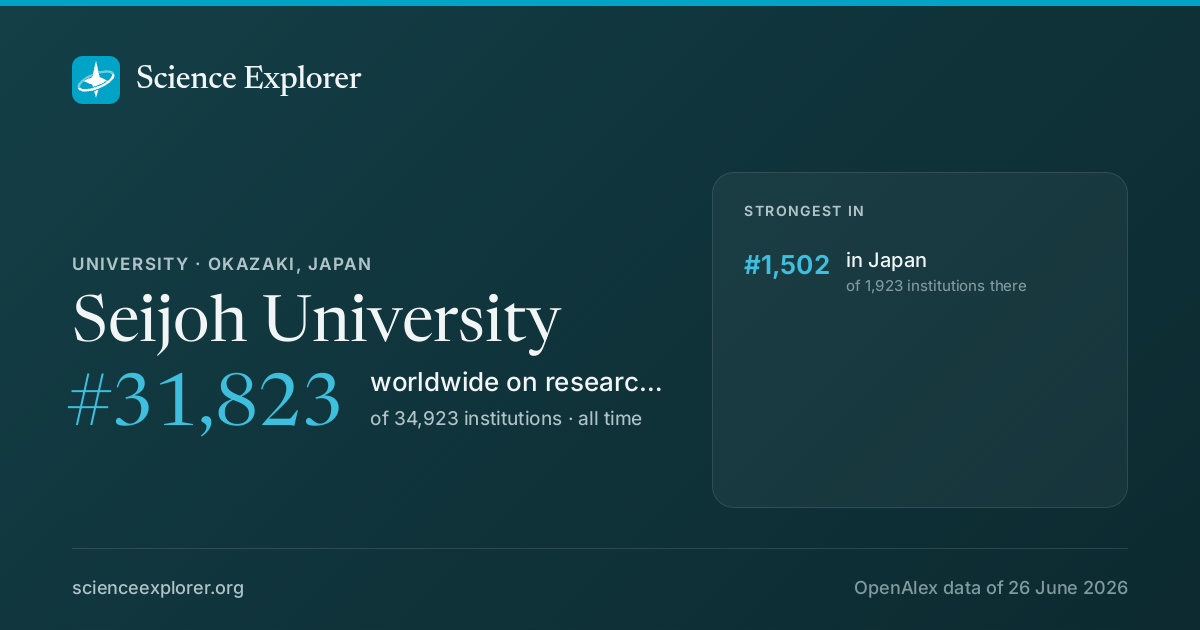
- World rank, all time
- #31,823 of 34,923
- Rank in Japan
- #1,502 of 1,923
- Research works
- 177 ▼ 27% vs 2018-21
- Citations
- 1.9k 10.8 per fractional work
- Top-10% rate
- 3.1% all institutions 10.0%
- vs its own fields
- 0.82× 1.00× is exactly expected
- Open access
- 60% world 40%
- International
- 8% world 18%
Which fields of science does Seijoh University work in?
In 2022-now, 69% of research at Seijoh University is in Health Sciences, 19% in Social Sciences. Its largest fields are Medicine (59%), Health Professions (11%), Psychology (9%). It does 2.5× the world's share of Health Sciences.
Each ring splits the one inside it: the four domains of science, their fields, their subfields. Size is fractional works in 2022-now. Every slice is a page; the interactive view zooms down to single topics and colours each by how much more of it this institution does than the world.
Its 4 domains and 12 fields, with their numbers
- Health Sciences2869.5%
- Medicine2358.9%
- Health Professions410.6%
- Social Sciences718.7%
- Physical Sciences26.2%
- Engineering24.3%
- Environmental Science11.7%
- Earth and Planetary Sciences00.2%
- Life Sciences25.6%
Field profile
Location quotient across every field it publishes in: outside the ring is more than an institution of this size would be expected to publish, inside it is less.
Rings at 0.5×, 1× and 2×. Widest outward: Health Professions, 4.0×. Every wedge is a field page.
All 12 fields, with their numbers
- Health Professions4.01×4 works
- Medicine3.07×24 works
- Psychology2.87×4 works
- Neuroscience1.70×1 works
- Social Sciences0.62×3 works
- Economics, Econometrics and Finance0.60×0 works
- Biochemistry, Genetics and Molecular Biology0.53×1 works
- Environmental Science0.34×1 works
- Engineering0.29×2 works
- Business, Management and Accounting0.26×0 works
- Earth and Planetary Sciences0.09×0 works
- Immunology and Microbiology0.05×0 works
- Health Professions 4.0×
- Medicine 3.1×
- Psychology 2.9×
- Neuroscience 1.7×
- Social Sciences 0.6×
- Economics, Econometrics and Finance 0.6×
- Biochemistry, Genetics and Molecular Biology 0.5×
- Environmental Science 0.3×
- Engineering 0.3×
- Business, Management and Accounting 0.3×
- Earth and Planetary Sciences 0.1×
- Immunology and Microbiology 0.1×
Who are the top researchers at Seijoh University?
Ranked on the quality score, Tokunori Takeda, Naoki Tomiyama and Motoyuki Abe lead among researchers whose main affiliation is Seijoh University.
- 1
Tokunori Takeda
 Japan · #1,646,276 worldwide
825 citations · 16 works
- 2
Naoki Tomiyama
Japan · #2,691,735 worldwide
915 citations · 78 works
- 3
Motoyuki Abe
Japan · #2,942,777 worldwide
503 citations · 19 works
- 4
Yuta Kubo
Japan · #3,416,091 worldwide
373 citations · 46 works
- 5
Akira Ochi
Japan · #3,626,285 worldwide
528 citations · 70 works
- 6
Kyosuke Yorozuya
Japan · #4,448,279 worldwide
121 citations · 32 works
- 7
Tomokazu Abe
Japan · #4,546,820 worldwide
58 citations · 17 works
- 8
Remi Fujita
Japan · #4,742,850 worldwide
144 citations · 28 works
- 9
Takehito Nishida
Japan · #4,787,653 worldwide
19 citations · 25 works
- 10
Daisuke Mori
Japan · #4,908,541 worldwide
216 citations · 18 works
Which keywords describe research at Seijoh University?
By fractional works in 2022-now, weighted toward what it does more of than the world: Aging, Inflammation, Muscle Mass, Cancer Cachexia, Sarcopenia, Rehabilitation, Quality of Life and Physical Performance.
- Resistance Training
- Biomechanics
- Obesity
- Interventions
- Constraint-Induced Therapy
- Mortality
- Fall Risk
- Social Relationships
- Public Health
- Health-related Quality of Life
- Cardiovascular Disease
- Anxiety
- Depression
- Mortality Risk
- Elderly Patients
- Sarcopenia
- Cancer Cachexia
- Epidemiology
- Inflammation
- Aging
- Muscle Mass
- Quality of Life
- Rehabilitation
- Physical Performance
- Functional Recovery
- Elderly
- Social Support
- Clinical Practice Guidelines
- Complications
- High-Intensity Interval Training
- Risk Factors
- Diabetes
- Gait Speed
- Neural Plasticity
- Gait Analysis
- Motor Recovery
- Treatment
- Cognitive Decline
- Running Injuries
Size is fractional works in 2022-now in the topics tagged with each word; colour is the word's share of this institution's work against its share of the world's. The 39 words are chosen for being large and distinctive. Each links to the topic it comes from most.
All 39 words, with their numbers
- Aging5▲ 25×5 topics
- Inflammation5▲ 6.3×8 topics
- Muscle Mass4▲ 83×2 topics
- Epidemiology4▲ 2.2×10 topics
- Quality of Life3▲ 5.3×15 topics
- Cancer Cachexia3▲ 78×1 topic
- Rehabilitation3▲ 17×7 topics
- Sarcopenia3▲ 78×1 topic
- Physical Performance2▲ 55×2 topics
- Elderly Patients2▲ 29×3 topics
- Functional Recovery2▲ 32×3 topics
- Mortality Risk2▲ 19×2 topics
- Elderly2▲ 17×3 topics
- Depression2▲ 4.3×6 topics
- Social Support2▲ 7.2×4 topics
- Anxiety1▲ 7.2×5 topics
- Clinical Practice Guidelines1▲ 6.4×5 topics
- Cardiovascular Disease1▲ 2.8×6 topics
- Complications1▲ 6.4×2 topics
- Health-related Quality of Life1▲ 14×3 topics
- High-Intensity Interval Training1▲ 30×2 topics
- Public Health1▲ 2.2×6 topics
- Risk Factors1▲ 3.1×6 topics
- Social Relationships1▲ 35×2 topics
- Diabetes1▲ 6.0×3 topics
- Fall Risk1▲ 64×1 topic
- Gait Speed1▲ 64×1 topic
- Mortality1▲ 5.2×4 topics
- Neural Plasticity1▲ 16×2 topics
- Constraint-Induced Therapy1▲ 36×1 topic
- Gait Analysis1▲ 30×2 topics
- Interventions1▲ 22×3 topics
- Motor Recovery1▲ 36×1 topic
- Obesity1▲ 3.7×2 topics
- Treatment1▲ 2.3×7 topics
- Biomechanics1▲ 8.4×1 topic
- Cognitive Decline1▲ 21×2 topics
- Resistance Training1▲ 29×2 topics
- Running Injuries1▲ 70×1 topic
Which research topics does Seijoh University publish most on?
By volume in 2022-now: Nutrition and Health in Aging, Balance, Gait, and Falls Prevention, Stroke Rehabilitation and Recovery and Body Composition Measurement Techniques.
Area is fractional works; colour is the subfield each topic belongs to.
- 1 Nutrition and Health in Aging Physiology 3 works
- 2 Balance, Gait, and Falls Prevention Physical Therapy, Sports Therapy and Rehabilitation 1 works
- 3 Stroke Rehabilitation and Recovery Rehabilitation 1 works
- 4 Body Composition Measurement Techniques Physiology 1 works
- 5 Lower Extremity Biomechanics and Pathologies Biomedical Engineering 1 works
- 6 Health disparities and outcomes Health 1 works
- 7 Dementia and Cognitive Impairment Research Psychiatry and Mental health 1 works
- 8 Frailty in Older Adults Geriatrics and Gerontology 1 works
- 9 Total Knee Arthroplasty Outcomes Surgery 1 works
- 10 Cerebral Palsy and Movement Disorders Psychiatry and Mental health 1 works
How open and international is its research?
Against the world's own shares: the tick on each track. Both are shares of its output, so they sit on one scale and can be read against each other as well as against the world.
World: 40% of research is openly available.
World: 18% is written across borders.
How has Seijoh University's research output changed?
Output in 2022-2025 was 27% lower than in 2018-2021.
The same series as a ribbon: one cell per year, darker for more. The line above answers how much; this answers when.
Its share of all research
Growing output can still be a shrinking share: all of science grows. This is Seijoh University as a percentage of every work published that year, 0.00011% in 2024.
Fractional works of Seijoh University over all fractional works that year. How the balance of science has shifted.
Other research institutions in Okazaki
- Anjo Kosei Hospital
- Okazaki Institute for Integrative Bioscience
- Okazaki National Research Institutes
- Okazaki City Hospital
- Hokuto Hospital
- University of Human Environments
- Toyota Physical and Chemical Research Institute
- Inuyama Chuo Hospital
Share Seijoh University's ranking
Badges for a website1Each links back here and updates with every snapshot

Research measures only: rankings here say nothing about teaching, admissions or student experience. Comparable institutions and collaboration partners have tabs of their own, above.
Discussion
Ask a question or share a note about Seijoh University. Keep it to the research: no personal attacks, advertising or links. Any reader can report a post, which collapses it for everyone until it is opened.