Sinopec (China)
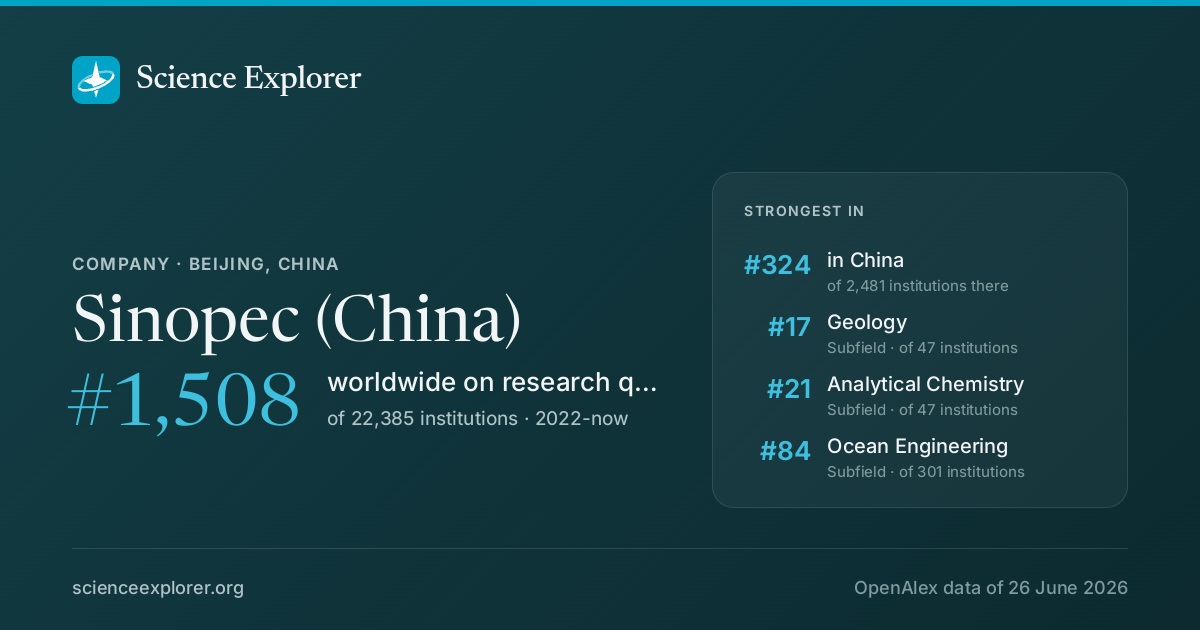
In research, Sinopec (China) stands highest in Physical Sciences (#676 of 10,670 worldwide), Engineering (#633 of 5,901 worldwide) and Environmental Science (#568 of 3,334 worldwide), 2022-now. Relative to its size it is most specialised in Ocean Engineering, Geology and Geophysics (Ocean Engineering is 25.0× its share of world research).
- World rank, 2022-now
- #1,508 of 22,385 · #2,011 all time
- Rank in China
- #324 of 2,481
- Research works
- 19k ▲ 85% vs 2018-21
- Citations
- 132k 7.0 per fractional work
- Top-10% rate
- 10.4% all institutions 10.0%
- vs its own fields
- 1.00× 1.00× is exactly expected
- Open access
- 18% world 40%
- International
- 6% world 18%
What is Sinopec (China) known for in research?
The fields where it stands highest, 2022-now, ranked among every institution above the floor in each field.
| Field | World rank | Where that sits | Top-10% rate | Works | All time |
|---|---|---|---|---|---|
| Physical SciencesDomain | #676 of 10,670 | 10.5% | 4,113 | #1071 | |
| EngineeringField | #633 of 5,901 | 9.5% | 2,194 | #1226 | |
| Environmental ScienceField | #568 of 3,334 | 11.4% | 317 | #1385 | |
| Earth and Planetary SciencesField | #212 of 1,088 | 13.6% | 462 | #465 | |
| Mechanical EngineeringSubfield | #289 of 1,319 | 9.1% | 545 | #641 | |
| Mechanics of MaterialsSubfield | #117 of 482 | 11.4% | 459 | #403 | |
| Materials ScienceField | #600 of 2,276 | 11.0% | 407 | #983 | |
| Ocean EngineeringSubfield | #84 of 301 | 9.6% | 567 | #236 | |
| Materials ChemistrySubfield | #493 of 1,473 | 12.0% | 263 | #926 | |
| GeologySubfield | #17 of 47 | 27.2% | 107 | #83 |
Each strip is that field's whole ranked pool, with the notch where Sinopec (China) sits in it, in the colour of the band that rank falls in. The track under the rate is the rate itself: it carries no average mark, because the average differs by field (from about 6% in Dentistry to 21% in Economics).
Which of those standings moved
The same fields on both windows: where it stood over the whole record, and where it stands in 2022-now. The distance is the story, and it is the one thing the two rank columns above cannot show.
- Physical Sciences#1,071 #676
- Engineering#1,226 #633
- Environmental Science#1,385 #568
- Earth and Planetary Sciences#465 #212
- Mechanical Engineering#641 #289
- Mechanics of Materials#403 #117
- Materials Science#983 #600
- Ocean Engineering#236 #84
- Materials Chemistry#926 #493
- Geology#83 #17
A dot further right is a better standing. Fields it was not ranked in over the whole record are left out.
Which fields of science does Sinopec (China) work in?
In 2022-now, 96% of research at Sinopec (China) is in Physical Sciences, 2% in Social Sciences. Its largest fields are Engineering (51%), Earth and Planetary Sciences (11%), Materials Science (10%). It does 2.5× the world's share of Physical Sciences.
Each ring splits the one inside it: the four domains of science, their fields, their subfields. Size is fractional works in 2022-now. Every slice is a page; the interactive view zooms down to single topics and colours each by how much more of it this institution does than the world.
Its 4 domains and 26 fields, with their numbers
- Physical Sciences4,75296.1%
- Engineering2,51650.9%
- Earth and Planetary Sciences55411.2%
- Materials Science4729.6%
- Environmental Science3737.6%
- Chemistry3426.9%
- Chemical Engineering1543.1%
- Energy1432.9%
- Computer Science1392.8%
- Physics and Astronomy541.1%
- Mathematics50.1%
- Social Sciences771.6%
- Social Sciences250.5%
- Decision Sciences210.4%
- Business, Management and Accounting120.2%
- Arts and Humanities80.2%
- Economics, Econometrics and Finance80.2%
- Psychology30.1%
- Life Sciences711.4%
- Health Sciences430.9%
- Medicine340.7%
- Health Professions70.2%
- Dentistry10.0%
- Veterinary00.0%
- Nursing00.0%
What does Sinopec (China) specialise in?
Where its research is concentrated relative to its size: Ocean Engineering takes 25.0× the share of its output that it takes of world research.
- Ocean EngineeringSubfield · 642.9 works25×
- GeologySubfield · 122.5 works18×
- GeophysicsSubfield · 266.6 works15×
- CatalysisSubfield · 110.6 works15×
- Mechanics of MaterialsSubfield · 522.3 works15×
- Process Chemistry and TechnologySubfield · 24.3 works12×
- Analytical ChemistrySubfield · 110.9 works12×
Location quotient, a volume reading rather than an impact one. It surfaces small, lopsided specialities.
Field profile
Location quotient across every field it publishes in: outside the ring is more than an institution of this size would be expected to publish, inside it is less.
Rings at 0.5×, 1× and 2×. Widest outward: Chemical Engineering, 8.9×. Every wedge is a field page.
All 26 fields, with their numbers
- Chemical Engineering8.93×154 works
- Earth and Planetary Sciences7.14×554 works
- Chemistry4.41×342 works
- Engineering3.39×2,516 works
- Energy3.14×143 works
- Materials Science2.74×472 works
- Environmental Science1.52×373 works
- Physics and Astronomy0.49×54 works
- Decision Sciences0.45×22 works
- Computer Science0.36×139 works
- Pharmacology, Toxicology and Pharmaceutics0.21×4 works
- Biochemistry, Genetics and Molecular Biology0.19×49 works
- Mathematics0.09×5 works
- Business, Management and Accounting0.08×12 works
- Economics, Econometrics and Finance0.08×8 works
- Agricultural and Biological Sciences0.06×14 works
- Health Professions0.06×7 works
- Arts and Humanities0.06×8 works
- Dentistry0.04×1 works
- Medicine0.04×34 works
- Veterinary0.04×0 works
- Social Sciences0.04×25 works
- Immunology and Microbiology0.03×2 works
- Neuroscience0.03×3 works
- Psychology0.02×3 works
- Nursing0.01×0 works
- Chemical Engineering 8.9×
- Earth and Planetary Sciences 7.1×
- Chemistry 4.4×
- Engineering 3.4×
- Energy 3.1×
- Materials Science 2.7×
- Environmental Science 1.5×
- Physics and Astronomy 0.5×
- Decision Sciences 0.5×
- Computer Science 0.4×
- Pharmacology, Toxicology and Pharmaceutics 0.2×
- Biochemistry, Genetics and Molecular Biology 0.2×
- Mathematics 0.1×
- Business, Management and Accounting 0.1×
- Economics, Econometrics and Finance 0.1×
- Agricultural and Biological Sciences 0.1×
- Health Professions 0.1×
- Arts and Humanities 0.1×
- Dentistry 0.0×
- Medicine 0.0×
- Veterinary 0.0×
- Social Sciences 0.0×
- Immunology and Microbiology 0.0×
- Neuroscience 0.0×
- Psychology 0.0×
- Nursing 0.0×
Who are the top researchers at Sinopec (China)?
Ranked on the quality score, Zhijun Jin, Quanyou Liu and Ruyue Wang lead among researchers whose main affiliation is Sinopec (China).
- 1
Zhijun Jin
 China · #62,356 worldwide
11k citations · 419 works
- 2
Quanyou Liu
China · #172,239 worldwide
5.8k citations · 250 works
- 3
Ruyue Wang
China · #186,672 worldwide
4k citations · 184 works
- 4
Maowen Li
China · #232,997 worldwide
6.7k citations · 205 works
- 5
Tonglou Guo
China · #293,978 worldwide
4k citations · 95 works
- 6
Yingcheng Li
China · #323,840 worldwide
2.7k citations · 162 works
- 7
Xusheng Guo
China · #363,319 worldwide
2.6k citations · 50 works
- 8
Haikuan Nie
China · #366,253 worldwide
2.6k citations · 77 works
- 9
Zhiguo Shu
China · #371,291 worldwide
1.7k citations · 51 works
- 10
Chuanming Wang
China · #385,060 worldwide
4.7k citations · 124 works
Which keywords describe research at Sinopec (China)?
By fractional works in 2022-now, weighted toward what it does more of than the world: Pore Structure, Shale Gas, Gas Permeability, Nanopores, Mudstones, Thermal Maturity, Nanoparticles and Hydraulic Fracturing.
- Biodegradation
- Heterogeneous Catalysts
- Closed-Loop Control
- Uncertainty Quantification
- Crustal Structure
- Tectonics
- Full-Waveform Tomography
- Elastic Properties
- Inverse Problems
- Geophysical Imaging
- Pore-scale Modeling
- Well Integrity
- Surfactants
- Porous Media
- CO2 Sequestration
- Fracture Propagation
- Hydraulic Fracturing
- Mudstones
- Nanoparticles
- Shale Gas
- Pore Structure
- Gas Permeability
- Nanopores
- Thermal Maturity
- Catalysis
- Shale Gas Reservoirs
- Vibration Analysis
- Rheological Properties
- Drilling Fluids
- Nanofluids
- X-ray Computed Tomography
- Ionic Liquids
- Optimization
- Petroleum
- Seismic Waveform Inversion
- Continental Margin
- Data Assimilation
- Ensemble Kalman Filter
- Well Placement
- Catalytic
Size is fractional works in 2022-now in the topics tagged with each word; colour is the word's share of this institution's work against its share of the world's. The 40 words are chosen for being large and distinctive. Each links to the topic it comes from most.
All 40 words, with their numbers
- Pore Structure438▲ 72×3 topics
- Shale Gas436▲ 74×2 topics
- Gas Permeability410▲ 86×2 topics
- Nanoparticles408▲ 6.5×40 topics
- Nanopores399▲ 86×2 topics
- Mudstones398▲ 111×1 topic
- Thermal Maturity398▲ 111×1 topic
- Hydraulic Fracturing375▲ 71×2 topics
- Catalysis357▲ 11×26 topics
- Fracture Propagation336▲ 114×1 topic
- Shale Gas Reservoirs336▲ 114×1 topic
- CO2 Sequestration322▲ 33×4 topics
- Vibration Analysis230▲ 17×7 topics
- Porous Media229▲ 35×6 topics
- Rheological Properties220▲ 25×6 topics
- Surfactants218▲ 45×5 topics
- Drilling Fluids212▲ 81×1 topic
- Well Integrity212▲ 81×1 topic
- Nanofluids185▲ 45×2 topics
- Pore-scale Modeling184▲ 99×1 topic
- X-ray Computed Tomography184▲ 99×1 topic
- Geophysical Imaging176▲ 67×2 topics
- Ionic Liquids162▲ 12×10 topics
- Inverse Problems148▲ 27×3 topics
- Optimization147▲ 6.6×18 topics
- Elastic Properties146▲ 38×3 topics
- Petroleum146▲ 64×2 topics
- Full-Waveform Tomography144▲ 70×1 topic
- Seismic Waveform Inversion144▲ 70×1 topic
- Tectonics122▲ 21×3 topics
- Continental Margin122▲ 42×2 topics
- Crustal Structure122▲ 42×2 topics
- Data Assimilation119▲ 15×4 topics
- Uncertainty Quantification118▲ 30×2 topics
- Ensemble Kalman Filter117▲ 23×2 topics
- Closed-Loop Control117▲ 53×1 topic
- Well Placement117▲ 53×1 topic
- Heterogeneous Catalysts115▲ 25×3 topics
- Catalytic113▲ 19×6 topics
- Biodegradation111▲ 22×6 topics
Which research topics does Sinopec (China) publish most on?
By volume in 2022-now: Hydrocarbon exploration and reservoir analysis, Hydraulic Fracturing and Reservoir Analysis, Drilling and Well Engineering and Enhanced Oil Recovery Techniques.
Area is fractional works; colour is the subfield each topic belongs to.
- 1 Hydrocarbon exploration and reservoir analysis Mechanics of Materials 398 works
- 2 Hydraulic Fracturing and Reservoir Analysis Mechanical Engineering 336 works
- 3 Drilling and Well Engineering Ocean Engineering 212 works
- 4 Enhanced Oil Recovery Techniques Ocean Engineering 184 works
- 5 Seismic Imaging and Inversion Techniques Geophysics 144 works
- 6 Reservoir Engineering and Simulation Methods Ocean Engineering 117 works
- 7 Catalytic Processes in Materials Science Materials Chemistry 99 works
- 8 Petroleum Processing and Analysis Analytical Chemistry 92 works
- 9 Catalysis and Hydrodesulfurization Studies Mechanical Engineering 72 works
- 10 Geological and Geophysical Studies Geology 68 works
How open and international is its research?
Against the world's own shares: the tick on each track. Both are shares of its output, so they sit on one scale and can be read against each other as well as against the world.
World: 40% of research is openly available.
World: 18% is written across borders.
How has Sinopec (China)'s research output changed?
Output in 2022-2025 was 85% higher than in 2018-2021.
The same series as a ribbon: one cell per year, darker for more. The line above answers how much; this answers when.
Its share of all research
Growing output can still be a shrinking share: all of science grows. This is Sinopec (China) as a percentage of every work published that year, 0.021% in 2024.
Fractional works of Sinopec (China) over all fractional works that year. How the balance of science has shifted.
How much of it reaches the world top 10%
Year by year, against all institutions in the same year.
Of each year's output, the share that reached the world's 10% most cited for its field and year. Peak 11.8% in 2023.
Other research institutions in Beijing
- Chinese Academy of Sciences
- Tsinghua University
- Peking University
- Chinese Academy of Agricultural Sciences
- University of Chinese Academy of Sciences
- Beihang University
- Beijing Institute of Technology
- Capital Medical University

Share Sinopec (China)'s ranking



Research measures only: rankings here say nothing about teaching, admissions or student experience. Comparable institutions and collaboration partners have tabs of their own, above.
Discussion
Ask a question or share a note about Sinopec (China). Posts are plain text and can be reported.