Structural Integrity Associates (United States)
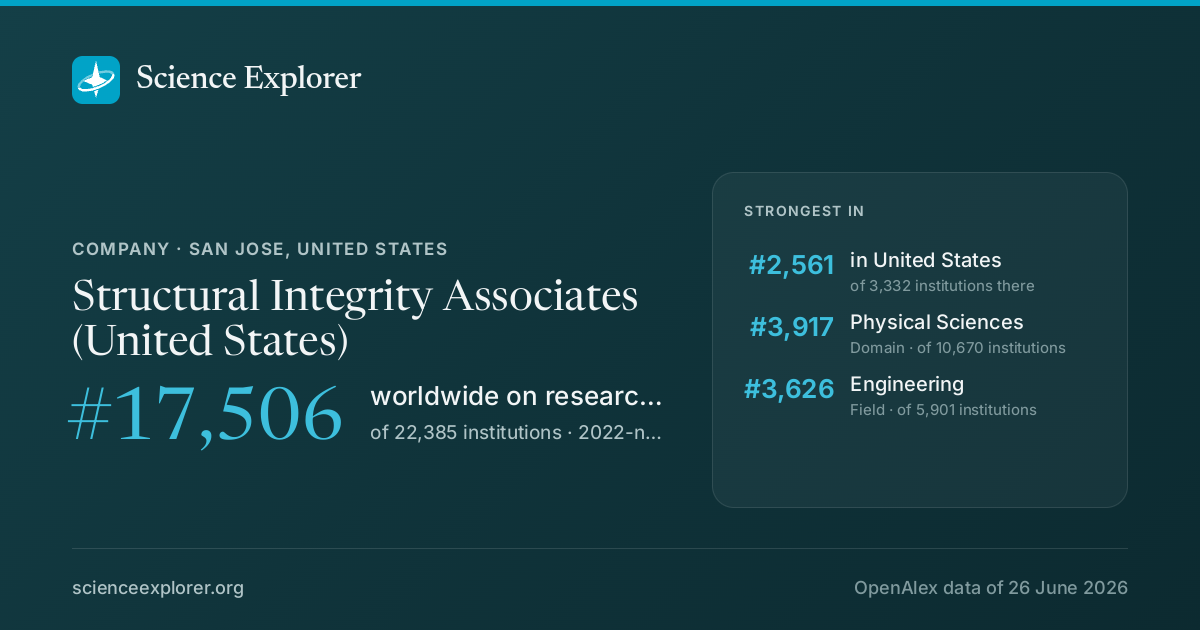
In research, Structural Integrity Associates (United States) stands highest in Physical Sciences (#3,917 of 10,670 worldwide) and Engineering (#3,626 of 5,901 worldwide), 2022-now. Relative to its size it is most specialised in Mechanical Engineering (Mechanical Engineering is 9.7× its share of world research).
- World rank, 2022-now
- #17,506 of 22,385 · #14,562 all time
- Rank in United States
- #2,561 of 3,332
- Research works
- 628 ▲ 35% vs 2018-21
- Citations
- 4.2k 6.6 per fractional work
- Top-10% rate
- 9.6% all institutions 10.0%
- vs its own fields
- 1.10× 1.00× is exactly expected
- Open access
- 15% world 40%
- International
- 21% world 18%
What is Structural Integrity Associates (United States) known for in research?
The fields where it stands highest, 2022-now, ranked among every institution above the floor in each field.
| Field | World rank | Where that sits | Top-10% rate | Works | All time |
|---|---|---|---|---|---|
| Physical SciencesDomain | #3,917 of 10,670 | 9.0% | 84 | #5212 | |
| EngineeringField | #3,626 of 5,901 | 8.7% | 71 | #4422 |
Each strip is that field's whole ranked pool, with the notch where Structural Integrity Associates (United States) sits in it, in the colour of the band that rank falls in. The track under the rate is the rate itself: it carries no average mark, because the average differs by field (from about 6% in Dentistry to 21% in Economics).
Which fields of science does Structural Integrity Associates (United States) work in?
In 2022-now, 88% of research at Structural Integrity Associates (United States) is in Physical Sciences, 5% in Social Sciences. Its largest fields are Engineering (73%), Materials Science (9%), Biochemistry, Genetics and Molecular Biology (3%). It does 2.2× the world's share of Physical Sciences.
Each ring splits the one inside it: the four domains of science, their fields, their subfields. Size is fractional works in 2022-now. Every slice is a page; the interactive view zooms down to single topics and colours each by how much more of it this institution does than the world.
Its 4 domains and 21 fields, with their numbers
- Physical Sciences10588.3%
- Engineering8672.8%
- Materials Science108.7%
- Computer Science21.6%
- Physics and Astronomy21.5%
- Environmental Science21.4%
- Earth and Planetary Sciences10.8%
- Energy00.4%
- Mathematics00.4%
- Chemistry00.4%
- Chemical Engineering00.3%
- Social Sciences65.1%
- Life Sciences54.2%
- Health Sciences32.4%
- Medicine21.9%
- Health Professions10.5%
What does Structural Integrity Associates (United States) specialise in?
Where its research is concentrated relative to its size: Mechanical Engineering takes 9.7× the share of its output that it takes of world research.
- Mechanical EngineeringSubfield · 21.0 works9.7×
Location quotient, a volume reading rather than an impact one. It surfaces small, lopsided specialities.
Field profile
Location quotient across every field it publishes in: outside the ring is more than an institution of this size would be expected to publish, inside it is less.
Rings at 0.5×, 1× and 2×. Widest outward: Engineering, 4.9×. Every wedge is a field page.
All 21 fields, with their numbers
- Engineering4.86×86 works
- Materials Science2.49×10 works
- Decision Sciences1.75×2 works
- Chemical Engineering0.89×0 works
- Physics and Astronomy0.69×2 works
- Biochemistry, Genetics and Molecular Biology0.55×4 works
- Earth and Planetary Sciences0.52×1 works
- Energy0.41×0 works
- Pharmacology, Toxicology and Pharmaceutics0.40×0 works
- Mathematics0.32×0 works
- Neuroscience0.31×1 works
- Environmental Science0.28×2 works
- Business, Management and Accounting0.23×1 works
- Chemistry0.22×0 works
- Computer Science0.20×2 works
- Health Professions0.19×1 works
- Social Sciences0.17×2 works
- Agricultural and Biological Sciences0.14×1 works
- Psychology0.14×0 works
- Medicine0.10×2 works
- Economics, Econometrics and Finance0.07×0 works
- Engineering 4.9×
- Materials Science 2.5×
- Decision Sciences 1.8×
- Chemical Engineering 0.9×
- Physics and Astronomy 0.7×
- Biochemistry, Genetics and Molecular Biology 0.6×
- Earth and Planetary Sciences 0.5×
- Energy 0.4×
- Pharmacology, Toxicology and Pharmaceutics 0.4×
- Mathematics 0.3×
- Neuroscience 0.3×
- Environmental Science 0.3×
- Business, Management and Accounting 0.2×
- Chemistry 0.2×
- Computer Science 0.2×
- Health Professions 0.2×
- Social Sciences 0.2×
- Agricultural and Biological Sciences 0.1×
- Psychology 0.1×
- Medicine 0.1×
- Economics, Econometrics and Finance 0.1×
Who are the top researchers at Structural Integrity Associates (United States)?
Ranked on the quality score, Scott Riccardella, Daniel T. Peters and Christopher S. Lohse lead among researchers whose main affiliation is Structural Integrity Associates (United States).
- 1
Scott Riccardella
 United States · #3,535,379 worldwide
1 citations · 19 works
- 2
Daniel T. Peters
United States · #3,594,647 worldwide
2.1k citations · 59 works
- 3
Christopher S. Lohse
United States · #3,671,442 worldwide
69 citations · 18 works
- 4
JA Poulis
United States · #3,820,410 worldwide
48 citations · 19 works
- 5
Nathaniel G. Cofie
United States · #4,011,177 worldwide
129 citations · 30 works
- 6
P.A. Hooijmeijer
United States · #4,214,429 worldwide
0 citations · 19 works
- 7
Esa Leskelä
United States · #4,328,904 worldwide
25 citations · 16 works
- 8
An-Yu Kuo
United States · #4,477,752 worldwide
329 citations · 39 works
- 9
Francis H. Ku
United States · #4,504,311 worldwide
25 citations · 17 works
- 9
Pekka Nurkkala
United States · #4,504,311 worldwide
20 citations · 17 works
Which keywords describe research at Structural Integrity Associates (United States)?
By fractional works in 2022-now, weighted toward what it does more of than the world: Mechanical Properties, Finite Element Analysis, Wave Propagation, Vibration Control, Ballistic Impact, Fatigue Crack Closure, Fracture Toughness Testing and Microstructure.
- Nonlinear Dynamics
- Jet Noise
- Microstructural Evolution
- Guided Lamb Waves
- Damage Detection
- Non-Destructive Testing
- Non-Destructive Evaluation
- Eddy Current Testing
- Turbulent Flow
- Delamination
- Additive Manufacturing
- Composite Materials
- Phononic Crystals
- Acoustic Metamaterials
- Elastic Waves
- Mechanical Behavior
- Microstructure
- Fatigue Crack Closure
- Vibration Control
- Finite Element Analysis
- Mechanical Properties
- Wave Propagation
- Ballistic Impact
- Fracture Toughness Testing
- Fracture Mechanics
- Defect Detection
- Subwavelength Imaging
- Material Characterization
- Adhesive Joints
- Numerical Simulation
- Cohesive Zone Models
- Large-Eddy Simulation
- Vibration Analysis
- Flow Control
- Failure Analysis
- Finite Element Method
- Piezoelectric Sensors
- Piezoelectric Impedance-Based Health Monitoring
- Acoustic Sources
- Material Properties
Size is fractional works in 2022-now in the topics tagged with each word; colour is the word's share of this institution's work against its share of the world's. The 40 words are chosen for being large and distinctive. Each links to the topic it comes from most.
All 40 words, with their numbers
- Mechanical Properties15▲ 13×26 topics
- Finite Element Analysis8▲ 30×8 topics
- Wave Propagation8▲ 59×3 topics
- Vibration Control6▲ 80×3 topics
- Ballistic Impact6▲ 79×2 topics
- Fatigue Crack Closure6▲ 174×1 topic
- Fracture Toughness Testing6▲ 174×1 topic
- Microstructure5▲ 8.7×10 topics
- Fracture Mechanics5▲ 68×3 topics
- Mechanical Behavior5▲ 34×2 topics
- Defect Detection5▲ 31×3 topics
- Elastic Waves4▲ 83×2 topics
- Subwavelength Imaging4▲ 83×2 topics
- Acoustic Metamaterials4▲ 101×1 topic
- Material Characterization4▲ 31×2 topics
- Phononic Crystals4▲ 101×1 topic
- Adhesive Joints4▲ 52×2 topics
- Composite Materials4▲ 17×8 topics
- Numerical Simulation4▲ 12×6 topics
- Additive Manufacturing4▲ 11×5 topics
- Cohesive Zone Models4▲ 95×1 topic
- Delamination4▲ 65×1 topic
- Large-Eddy Simulation4▲ 18×5 topics
- Turbulent Flow4▲ 29×3 topics
- Vibration Analysis4▲ 12×5 topics
- Eddy Current Testing4▲ 76×1 topic
- Flow Control4▲ 55×2 topics
- Non-Destructive Evaluation4▲ 76×1 topic
- Failure Analysis4▲ 32×5 topics
- Non-Destructive Testing4▲ 31×2 topics
- Finite Element Method3▲ 30×4 topics
- Damage Detection3▲ 44×2 topics
- Piezoelectric Sensors3▲ 68×2 topics
- Guided Lamb Waves3▲ 70×1 topic
- Piezoelectric Impedance-Based Health Monitoring3▲ 70×1 topic
- Microstructural Evolution3▲ 17×3 topics
- Acoustic Sources3▲ 113×1 topic
- Jet Noise3▲ 113×1 topic
- Material Properties3▲ 23×2 topics
- Nonlinear Dynamics3▲ 10×3 topics
Which research topics does Structural Integrity Associates (United States) publish most on?
By volume in 2022-now: Fatigue and fracture mechanics, Acoustic Wave Phenomena Research, Mechanical Behavior of Composites and Non-Destructive Testing Techniques.
Area is fractional works; colour is the subfield each topic belongs to.
- 1 Fatigue and fracture mechanics Mechanics of Materials 6 works
- 2 Acoustic Wave Phenomena Research Biomedical Engineering 4 works
- 3 Mechanical Behavior of Composites Mechanics of Materials 4 works
- 4 Non-Destructive Testing Techniques Mechanical Engineering 4 works
- 5 Ultrasonics and Acoustic Wave Propagation Mechanics of Materials 3 works
- 6 Aerodynamics and Acoustics in Jet Flows Aerospace Engineering 3 works
- 7 Composite Structure Analysis and Optimization Mechanics of Materials 2 works
- 8 Cellular and Composite Structures Mechanical Engineering 2 works
- 9 High-Velocity Impact and Material Behavior Materials Chemistry 2 works
- 10 Advanced ceramic materials synthesis Ceramics and Composites 2 works
How open and international is its research?
Against the world's own shares: the tick on each track. Both are shares of its output, so they sit on one scale and can be read against each other as well as against the world.
World: 40% of research is openly available.
World: 18% is written across borders.
How has Structural Integrity Associates (United States)'s research output changed?
Output in 2022-2025 was 35% higher than in 2018-2021.
The same series as a ribbon: one cell per year, darker for more. The line above answers how much; this answers when.
Its share of all research
Growing output can still be a shrinking share: all of science grows. This is Structural Integrity Associates (United States) as a percentage of every work published that year, 0.00052% in 2024.
Fractional works of Structural Integrity Associates (United States) over all fractional works that year. How the balance of science has shifted.
How much of it reaches the world top 10%
Year by year, against all institutions in the same year.
Of each year's output, the share that reached the world's 10% most cited for its field and year. Peak 13.2% in 2025.
Other research institutions in San Jose
- San Jose State University
- ITRI International
- Altera (United States)
- Adobe Systems (United States)
- Cadence Design Systems (United States)
- Western Digital (United States)
- Xilinx (United States)
- Hitachi Global Storage Technologies (United States)



Share Structural Integrity Associates (United States)'s ranking
Badges for a website1Each links back here and updates with every snapshot

Research measures only: rankings here say nothing about teaching, admissions or student experience. Comparable institutions and collaboration partners have tabs of their own, above.
Discussion
Ask a question or share a note about Structural Integrity Associates (United States). Keep it to the research: no personal attacks, advertising or links. Any reader can report a post, which collapses it for everyone until it is opened.