SunEdison (Italy)
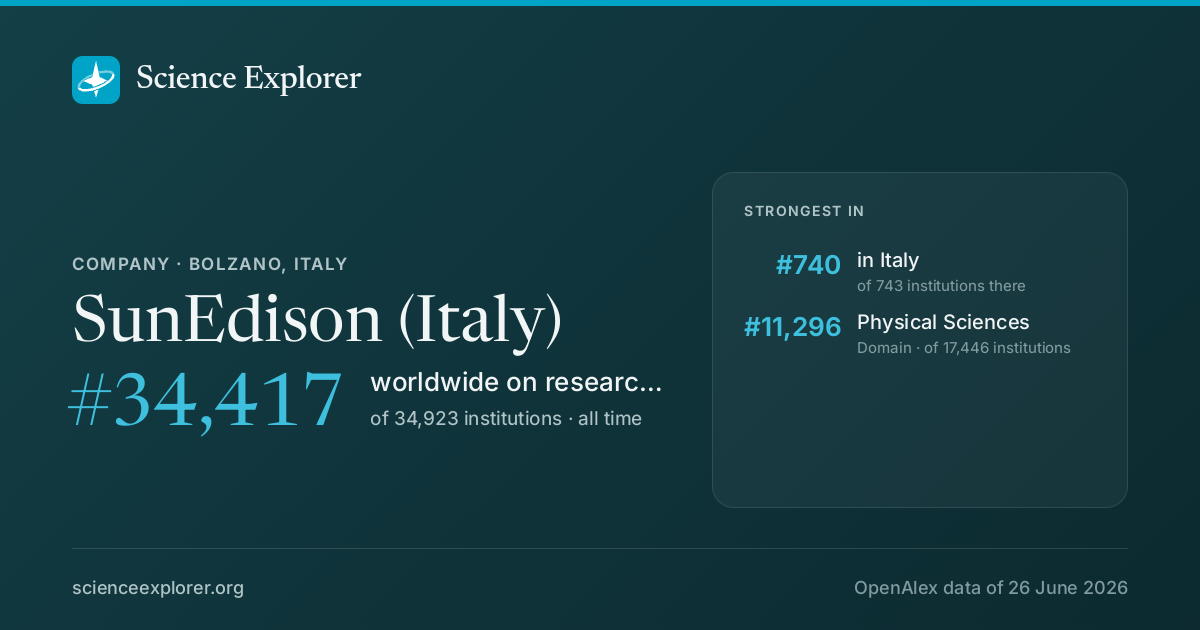
In research, SunEdison (Italy) stands highest in Physical Sciences (#11,296 of 17,446 worldwide), over all time.
- World rank, all time
- #34,417 of 34,923
- Rank in Italy
- #740 of 743
- Research works
- 133 ▼ 53% vs 2018-21
- Citations
- 2.4k 18.4 per fractional work
- Top-10% rate
- 10.6% all institutions 10.0%
- vs its own fields
- 1.05× 1.00× is exactly expected
- Open access
- 13% world 40%
- International
- 36% world 18%
What is SunEdison (Italy) known for in research?
The fields where it stands highest, over all time, ranked among every institution above the floor in each field.
| Field | World rank | Where that sits | Top-10% rate | Works |
|---|---|---|---|---|
| Physical SciencesDomain | #11,296 of 17,446 | 13.0% | 130 |
Each strip is that field's whole ranked pool, with the notch where SunEdison (Italy) sits in it, in the colour of the band that rank falls in. The track under the rate is the rate itself: it carries no average mark, because the average differs by field (from about 6% in Dentistry to 21% in Economics).
Which fields of science does SunEdison (Italy) work in?
In all years, 98% of research at SunEdison (Italy) is in Physical Sciences, 1% in Social Sciences. Its largest fields are Engineering (66%), Materials Science (17%), Physics and Astronomy (13%). It does 2.3× the world's share of Physical Sciences.
Each ring splits the one inside it: the four domains of science, their fields, their subfields. Size is fractional works in all years. Every slice is a page; the interactive view zooms down to single topics and colours each by how much more of it this institution does than the world.
Its 4 domains and 16 fields, with their numbers
- Physical Sciences13098.1%
- Engineering8765.8%
- Materials Science2216.6%
- Physics and Astronomy1712.6%
- Chemistry21.8%
- Energy10.7%
- Computer Science00.2%
- Environmental Science00.1%
- Chemical Engineering00.1%
- Earth and Planetary Sciences00.1%
- Mathematics00.1%
- Social Sciences10.9%
- Life Sciences10.7%
- Health Sciences00.2%
- Medicine00.2%
Field profile
Location quotient across every field it publishes in: outside the ring is more than an institution of this size would be expected to publish, inside it is less.
Rings at 0.5×, 1× and 2×. Widest outward: Physics and Astronomy, 4.2×. Every wedge is a field page.
All 9 fields, with their numbers
- Physics and Astronomy4.18×0 works
- Engineering3.41×2 works
- Earth and Planetary Sciences2.97×0 works
- Arts and Humanities1.61×0 works
- Biochemistry, Genetics and Molecular Biology1.38×0 works
- Materials Science1.33×0 works
- Environmental Science1.09×0 works
- Computer Science0.60×0 works
- Medicine0.42×0 works
Who are the top researchers at SunEdison (Italy)?
Ranked on the quality score, Roberto Scala, M. Olmo and Vladimir V. Voronkov lead among researchers whose main affiliation is SunEdison (Italy).
- 1
Roberto Scala
 Italy · #1,894,917 worldwide
414 citations · 16 works
- 2
M. Olmo
Italy · #2,303,241 worldwide
524 citations · 16 works
- 3
Vladimir V. Voronkov
Italy · #2,534,454 worldwide
3.7k citations · 193 works
- 4
Robert J. Falster
Italy · #3,203,487 worldwide
4.6k citations · 242 works
- 5
D. Gambaro
Italy · #4,115,405 worldwide
391 citations · 17 works
- 6
Anna V. Batunina
Italy · #4,759,273 worldwide
144 citations · 21 works
- 7
Maria Porrini
Italy · #5,729,642 worldwide
254 citations · 35 works
- 8
Gabriella Borionetti
Italy · #5,916,451 worldwide
323 citations · 52 works
Which keywords describe research at SunEdison (Italy)?
By fractional works in all years, weighted toward what it does more of than the world: Solar Cells, Photovoltaics, Efficiency, Passivation, Silicon, Plasmonics, Thin-Film Transistors and Electrical Properties.
- Fiber Reinforced Concrete
- Battery Materials
- Polyhedral Oligomeric Silsesquioxanes
- Hybrid Materials
- Rechargeable Batteries
- Energy Storage
- Lithium-ion Batteries
- Nanowire Transistors
- Material Removal Mechanism
- Solidification
- Photon Emission Microscopy
- Integrated Circuits
- High-k Dielectrics
- Porous Silicon
- Drug Delivery
- Schottky Barrier
- Electrical Properties
- Plasmonics
- Passivation
- Photovoltaics
- Solar Cells
- Efficiency
- Silicon
- Thin-Film Transistors
- Metal-Semiconductor Contacts
- Nanoparticles
- Luminescent
- Atomic Layer Deposition
- Crystal Growth
- Failure Analysis
- Phase-Field Models
- Chemical Mechanical Planarization
- Catalysis
- Tunnel Field-Effect Transistors
- Cathode Materials
- Battery Technology
- Surface Engineering
- Ion Beam
- Surface Analysis
- Nanostructured Anodes
Size is fractional works in all years in the topics tagged with each word; colour is the word's share of this institution's work against its share of the world's. The 40 words are chosen for being large and distinctive. Each links to the topic it comes from most.
All 40 words, with their numbers
- Solar Cells71▲ 172×5 topics
- Photovoltaics36▲ 111×3 topics
- Efficiency36▲ 104×3 topics
- Passivation36▲ 676×1 topic
- Silicon36▲ 366×1 topic
- Plasmonics20▲ 195×1 topic
- Thin-Film Transistors20▲ 343×1 topic
- Electrical Properties14▲ 67×2 topics
- Metal-Semiconductor Contacts14▲ 205×1 topic
- Schottky Barrier14▲ 205×1 topic
- Nanoparticles13▲ 7.4×6 topics
- Drug Delivery11▲ 17×2 topics
- Luminescent10▲ 241×1 topic
- Porous Silicon10▲ 241×1 topic
- Atomic Layer Deposition10▲ 56×1 topic
- High-k Dielectrics10▲ 56×1 topic
- Crystal Growth5▲ 12×2 topics
- Integrated Circuits5▲ 17×2 topics
- Failure Analysis5▲ 29×1 topic
- Photon Emission Microscopy5▲ 78×1 topic
- Phase-Field Models5▲ 185×1 topic
- Solidification5▲ 185×1 topic
- Chemical Mechanical Planarization2▲ 32×1 topic
- Material Removal Mechanism2▲ 32×1 topic
- Catalysis2▲ 1.97×4 topics
- Nanowire Transistors2▲ 25×1 topic
- Tunnel Field-Effect Transistors2▲ 25×1 topic
- Lithium-ion Batteries2▲ 5.9×3 topics
- Cathode Materials2▲ 6.5×3 topics
- Energy Storage2▲ 3.5×3 topics
- Battery Technology2▲ 6.8×2 topics
- Rechargeable Batteries2▲ 7.8×2 topics
- Surface Engineering2▲ 10×2 topics
- Hybrid Materials1▲ 9.8×1 topic
- Ion Beam1▲ 21×1 topic
- Polyhedral Oligomeric Silsesquioxanes1▲ 39×1 topic
- Surface Analysis1▲ 21×1 topic
- Battery Materials1▲ 9.2×1 topic
- Nanostructured Anodes1▲ 9.2×1 topic
- Fiber Reinforced Concrete1▲ 17×1 topic
Which research topics does SunEdison (Italy) publish most on?
By volume in 2022-now: Semiconductor materials and interfaces, Integrated Circuits and Semiconductor Failure Analysis, Silicon and Solar Cell Technologies and Advanced Surface Polishing Techniques.
Area is fractional works; colour is the subfield each topic belongs to.
- 1 Semiconductor materials and interfaces Atomic and Molecular Physics, and Optics 0 works
- 2 Integrated Circuits and Semiconductor Failure Analysis Electrical and Electronic Engineering 0 works
- 3 Silicon and Solar Cell Technologies Electrical and Electronic Engineering 0 works
- 4 Advanced Surface Polishing Techniques Biomedical Engineering 0 works
- 5 Industrial Vision Systems and Defect Detection Industrial and Manufacturing Engineering 0 works
- 6 Sustainable Building Design and Assessment Building and Construction 0 works
- 7 VLSI and Analog Circuit Testing Hardware and Architecture 0 works
- 8 Conservation Techniques and Studies Conservation 0 works
- 9 Advanced Chemical Sensor Technologies Biomedical Engineering 0 works
- 10 Smart Cities and Technologies Media Technology 0 works
How open and international is its research?
Against the world's own shares: the tick on each track. Both are shares of its output, so they sit on one scale and can be read against each other as well as against the world.
World: 40% of research is openly available.
World: 18% is written across borders.
How has SunEdison (Italy)'s research output changed?
Output in 2022-2025 was 53% lower than in 2018-2021.
The same series as a ribbon: one cell per year, darker for more. The line above answers how much; this answers when.
Its share of all research
Growing output can still be a shrinking share: all of science grows. This is SunEdison (Italy) as a percentage of every work published that year, 0.000024% in 2024.
Fractional works of SunEdison (Italy) over all fractional works that year. How the balance of science has shifted.
Other research institutions in Bolzano
- Free University of Bozen-Bolzano
- Eurac Research
- Ospedale di Bolzano
- Villa Melitta
- Micro Photon Devices
- Landesfachhochschule für Gesundheitsberufe Claudiana
- Techno Innovation South Tyrol (Italy)
- Istituto di Alta Formazione Musicale Conservatorio "Claudio Monteverdi"

Share SunEdison (Italy)'s ranking
Badges for a website1Each links back here and updates with every snapshot

Research measures only: rankings here say nothing about teaching, admissions or student experience. Comparable institutions and collaboration partners have tabs of their own, above.
Discussion
Ask a question or share a note about SunEdison (Italy). Posts are plain text and can be reported.