
Science Explorer Back to mapMap
Discussion
Company · Amsterdam · Netherlands

TomTom (Netherlands)

World rank, all time
#21,907
of 34,923
Rank in Netherlands
#272
of 407
Research works
154
▼ 16% vs 2018-21
Citations
2k
12.8 per fractional work
Top-10% rate
10.6%
all institutions 10.0%
vs its own fields
1.03×
1.00× is exactly expected
Open access
52%
world 40%
International
42%
world 18%

Which fields of science does TomTom (Netherlands) work in?

In 2022-now, 48% of research at TomTom (Netherlands) is in Physical Sciences, 32% in Social Sciences. Its largest fields are Engineering (19%), Computer Science (16%), Social Sciences (16%).

Physical Sciences: 15 fractional works · 47.8% of its workEngineering: 6 fractional works · 19.5% of its workBuilding and Construction: 1 fractional works · 4.0% of its workAutomotive Engineering: 1 fractional works · 3.9% of its workAerospace Engineering: 1 fractional works · 3.2% of its workOcean Engineering: 1 fractional works · 2.9% of its workElectrical and Electronic Engineering: 1 fractional works · 1.9% of its workControl and Systems Engineering: 0 fractional works · 0.9% of its workArchitecture: 0 fractional works · 0.6% of its workCivil and Structural Engineering: 0 fractional works · 0.6% of its workIndustrial and Manufacturing Engineering: 0 fractional works · 0.6% of its workBiomedical Engineering: 0 fractional works · 0.4% of its workMedia Technology: 0 fractional works · 0.4% of its workSafety, Risk, Reliability and Quality: 0 fractional works · 0.3% of its workComputer Science: 5 fractional works · 16.4% of its workComputer Vision and Pattern Recognition: 2 fractional works · 5.4% of its workArtificial Intelligence: 1 fractional works · 4.1% of its workInformation Systems: 1 fractional works · 3.6% of its workHuman-Computer Interaction: 0 fractional works · 1.1% of its workSignal Processing: 0 fractional works · 1.0% of its workSoftware: 0 fractional works · 1.0% of its workComputational Theory and Mathematics: 0 fractional works · 0.3% of its workEnvironmental Science: 3 fractional works · 9.9% of its workGlobal and Planetary Change: 2 fractional works · 4.9% of its workEcology: 1 fractional works · 2.4% of its workEnvironmental Engineering: 0 fractional works · 1.4% of its workNature and Landscape Conservation: 0 fractional works · 0.6% of its workHealth, Toxicology and Mutagenesis: 0 fractional works · 0.3% of its workManagement, Monitoring, Policy and Law: 0 fractional works · 0.3% of its workEnergy: 0 fractional works · 1.1% of its workRenewable Energy, Sustainability and the Environment: 0 fractional works · 1.1% of its workEarth and Planetary Sciences: 0 fractional works · 0.4% of its workOceanography: 0 fractional works · 0.4% of its workPhysics and Astronomy: 0 fractional works · 0.4% of its workAstronomy and Astrophysics: 0 fractional works · 0.2% of its workSmaller subfields together: 0 fractional works · 0.1% of its workMaterials Science: 0 fractional works · 0.1% of its workChemistry: 0 fractional works · 0.1% of its workSocial Sciences: 10 fractional works · 32.2% of its workSocial Sciences: 5 fractional works · 16.0% of its workEducation: 2 fractional works · 5.1% of its workPolitical Science and International Relations: 1 fractional works · 2.0% of its workSafety Research: 1 fractional works · 1.9% of its workLaw: 0 fractional works · 1.6% of its workSociology and Political Science: 0 fractional works · 1.4% of its workGeography, Planning and Development: 0 fractional works · 1.1% of its workTransportation: 0 fractional works · 0.9% of its workDemography: 0 fractional works · 0.6% of its workCultural Studies: 0 fractional works · 0.4% of its workGender Studies: 0 fractional works · 0.4% of its workHealth: 0 fractional works · 0.4% of its workArcheology: 0 fractional works · 0.3% of its workEconomics, Econometrics and Finance: 2 fractional works · 6.8% of its workEconomics and Econometrics: 2 fractional works · 5.8% of its workFinance: 0 fractional works · 0.8% of its workGeneral Economics, Econometrics and Finance: 0 fractional works · 0.2% of its workArts and Humanities: 2 fractional works · 6.3% of its workArcheology: 1 fractional works · 2.2% of its workLiterature and Literary Theory: 1 fractional works · 1.7% of its workReligious studies: 0 fractional works · 1.1% of its workHistory: 0 fractional works · 0.8% of its workPhilosophy: 0 fractional works · 0.4% of its workHistory and Philosophy of Science: 0 fractional works · 0.2% of its workPsychology: 1 fractional works · 2.5% of its workClinical Psychology: 1 fractional works · 2.5% of its workDecision Sciences: 0 fractional works · 0.5% of its workInformation Systems and Management: 0 fractional works · 0.3% of its workSmaller subfields together: 0 fractional works · 0.2% of its workHealth Sciences: 4 fractional works · 14.2% of its workMedicine: 3 fractional works · 11.4% of its workPhysiology: 1 fractional works · 2.6% of its workSurgery: 1 fractional works · 2.3% of its workInfectious Diseases: 0 fractional works · 1.6% of its workPublic Health, Environmental and Occupational Health: 0 fractional works · 0.9% of its workHematology: 0 fractional works · 0.9% of its workComplementary and alternative medicine: 0 fractional works · 0.8% of its workGenetics: 0 fractional works · 0.6% of its workPediatrics, Perinatology and Child Health: 0 fractional works · 0.6% of its workRadiology, Nuclear Medicine and Imaging: 0 fractional works · 0.4% of its workSmaller subfields together: 0 fractional works · 0.7% of its workHealth Professions: 1 fractional works · 2.6% of its workGeneral Health Professions: 1 fractional works · 2.5% of its workSmaller subfields together: 0 fractional works · 0.1% of its workNursing: 0 fractional works · 0.3% of its workNutrition and Dietetics: 0 fractional works · 0.3% of its workLife Sciences: 2 fractional works · 5.7% of its workAgricultural and Biological Sciences: 2 fractional works · 5.2% of its workEcology, Evolution, Behavior and Systematics: 1 fractional works · 3.3% of its workForestry: 0 fractional works · 1.6% of its workGeneral Agricultural and Biological Sciences: 0 fractional works · 0.3% of its workBiochemistry, Genetics and Molecular Biology: 0 fractional works · 0.6% of its workMolecular Biology: 0 fractional works · 0.3% of its workSmaller subfields together: 0 fractional works · 0.3% of its workALL ITS WORKTomTom(Netherlands)31fractional works, 2022-now
Life Sciences6%Physical Sciences48%Health Sciences14%Social Sciences32%

Each ring splits the one inside it: the four domains of science, their fields, their subfields. Size is fractional works in 2022-now. Every slice is a page; the interactive view zooms down to single topics and colours each by how much more of it this institution does than the world.

Its 4 domains and 18 fields, with their numbers
    1. Engineering619.5%
    2. Computer Science516.4%
    3. Environmental Science39.9%
    4. Energy01.1%
    5. Earth and Planetary Sciences00.4%
    6. Physics and Astronomy00.4%
    7. Materials Science00.1%
    8. Chemistry00.1%
    1. Social Sciences516.0%
    2. Economics, Econometrics and Finance26.8%
    3. Arts and Humanities26.3%
    4. Psychology12.5%
    5. Decision Sciences00.5%
    1. Medicine311.4%
    2. Health Professions12.6%
    3. Nursing00.3%
    1. Agricultural and Biological Sciences25.2%
    2. Biochemistry, Genetics and Molecular Biology00.6%
All of science, and how each field's share has moved since 1950: the Science domain explorer

Field profile

Location quotient across every field it publishes in: outside the ring is more than an institution of this size would be expected to publish, inside it is less.

Agricultural and Biological Sciences: 1.09× its world share, 2 worksAgricultural and Bio…Biochemistry, Genetics and Molecular Biology: 0.11× its world share, 0 worksBiochemistry, Geneti…Chemistry: 0.07× its world share, 0 worksChemistryComputer Science: 2.11× its world share, 5 worksComputer ScienceEarth and Planetary Sciences: 0.23× its world share, 0 worksEarth and Planetary …Energy: 1.18× its world share, 0 worksEnergyEngineering: 1.30× its world share, 6 worksEngineeringEnvironmental Science: 1.99× its world share, 3 worksEnvironmental ScienceMaterials Science: 0.04× its world share, 0 worksMaterials SciencePhysics and Astronomy: 0.17× its world share, 0 worksPhysics and AstronomyHealth Professions: 0.98× its world share, 1 worksHealth ProfessionsMedicine: 0.59× its world share, 4 worksMedicineNursing: 0.56× its world share, 0 worksNursingArts and Humanities: 2.19× its world share, 2 worksArts and HumanitiesDecision Sciences: 0.54× its world share, 0 worksDecision SciencesEconomics, Econometrics and Finance: 3.18× its world share, 2 worksEconomics, Econometr…Psychology: 0.83× its world share, 1 worksPsychologySocial Sciences: 1.26× its world share, 5 worksSocial Sciences1×world share
more than its size predictsabout as predictedless

Rings at 0.5×, 1× and 2×. Widest outward: Economics, Econometrics and Finance, 3.2×. Every wedge is a field page.

All 18 fields, with their numbers
  1. Economics, Econometrics and Finance3.18×2 works
  2. Arts and Humanities2.19×2 works
  3. Computer Science2.11×5 works
  4. Environmental Science1.99×3 works
  5. Engineering1.30×6 works
  6. Social Sciences1.26×5 works
  7. Energy1.18×0 works
  8. Agricultural and Biological Sciences1.09×2 works
  9. Health Professions0.98×1 works
  10. Psychology0.83×1 works
  11. Medicine0.59×4 works
  12. Nursing0.56×0 works
  13. Decision Sciences0.54×0 works
  14. Earth and Planetary Sciences0.23×0 works
  15. Physics and Astronomy0.17×0 works
  16. Biochemistry, Genetics and Molecular Biology0.11×0 works
  17. Chemistry0.07×0 works
  18. Materials Science0.04×0 works

Who are the top researchers at TomTom (Netherlands)?

Ranked on the quality score, Jürgen Haffer and Tom Parfitt lead among researchers whose main affiliation is TomTom (Netherlands).

  1. 1 Jürgen Haffer Netherlands · #2,533,988 worldwide 3.9k citations · 67 works
  2. 2 Tom Parfitt Netherlands · #5,351,551 worldwide 333 citations · 43 works
All ranked researchers at TomTom (Netherlands)

What are the most cited papers from TomTom (Netherlands)?

The most cited paper from TomTom (Netherlands) is "The management of respiratory motion in radiation oncology report of AAPM Task Group 76a)" (Paul Keall, G. S. Mageras, James M. Balter et al., 2006), with 2,297 citations. Next come "Standardized Assessment of Automatic Segmentation of White Matter Hyperintensities and Results of the WMH Segmentation Challenge" (311) and "MSG-GAN: Multi-Scale Gradients for Generative Adversarial Networks" (246).

Most cited papers
#PaperReleasedCitations
1 The management of respiratory motion in radiation oncology report of AAPM Task Group 76a) Paul Keall, G. S. Mageras, James M. Balter et al. · Medical Physics Open access 26 Sep 2006 2,297
2 Standardized Assessment of Automatic Segmentation of White Matter Hyperintensities and Results of the WMH Segmentation Challenge Hugo J. Kuijf et al. · IEEE Transactions on Medical Imaging Open access 19 Mar 2019 311
3 MSG-GAN: Multi-Scale Gradients for Generative Adversarial Networks Animesh Karnewar, Oliver Wang Conference paper Jun 2020 246
4 Particle Filters: A Hands-On Tutorial Jos Elfring, Elena Torta, René van de Molengraft · Sensors Open access 9 Jan 2021 205
5 Collateral Clock Is More Important Than Time Clock for Tissue Fate Achala S. Vagal, Richard Ivan Aviv, Heidi Sucharew et al. · Stroke Open access Sep 2018 163
All 62 most cited papers, with filters and sorting

Which keywords describe research at TomTom (Netherlands)?

By fractional works in 2022-now, weighted toward what it does more of than the world: Deep Learning, Remote Sensing, Climate Change, Intelligent Transportation Systems, Ecosystem Resilience, Forest Fires, Wildfire Activity and Machine Learning.

▲ more of its work than of the world's◆ about the world's share▼ less than the world's

Size is fractional works in 2022-now in the topics tagged with each word; colour is the word's share of this institution's work against its share of the world's. The 9 words are chosen for being large and distinctive. Each links to the topic it comes from most.

All 9 words, with their numbers
  1. Deep Learning4▲ 3.6×13 topics
  2. Climate Change2▲ 2.9×6 topics
  3. Machine Learning2▲ 1.94×9 topics
  4. Remote Sensing2▲ 5.0×3 topics
  5. Intelligent Transportation Systems2▲ 33×3 topics
  6. Ecosystem Resilience1▲ 22×2 topics
  7. Biodiversity1▲ 4.3×2 topics
  8. Forest Fires1▲ 74×1 topic
  9. Wildfire Activity1▲ 74×1 topic

Which research topics does TomTom (Netherlands) publish most on?

By volume in 2022-now: Fire effects on ecosystems, Autonomous Vehicle Technology and Safety, Research studies in Vietnam and Traffic Prediction and Management Techniques.

  1. 1 Fire effects on ecosystems Global and Planetary Change 1 works
  2. 2 Autonomous Vehicle Technology and Safety Automotive Engineering 1 works
  3. 3 Research studies in Vietnam Ecology 1 works
  4. 4 Traffic Prediction and Management Techniques Building and Construction 1 works
  5. 5 Biomedical Ethics and Regulation Physiology 1 works
  6. 6 Vehicular Ad Hoc Networks (VANETs) Electrical and Electronic Engineering 1 works
  7. 7 Pharmaceutical Economics and Policy Economics and Econometrics 1 works
  8. 8 Robotics and Sensor-Based Localization Aerospace Engineering 0 works
  9. 9 Advanced Neural Network Applications Computer Vision and Pattern Recognition 0 works
  10. 10 Botany and Geology in Latin America and Caribbean Ecology, Evolution, Behavior and Systematics 0 works

How open and international is its research?

Against the world's own shares: the tick on each track. Both are shares of its output, so they sit on one scale and can be read against each other as well as against the world.

openly available51.9%not open48.1%

World: 40% of research is openly available.

with international co-authors42.5%domestic only57.5%

World: 18% is written across borders.

How has TomTom (Netherlands)'s research output changed?

Output in 2022-2025 was 16% lower than in 2018-2021.

still counting1990200020102020
grewheldshrank

The same series as a ribbon: one cell per year, darker for more. The line above answers how much; this answers when.

Its share of all research

Growing output can still be a shrinking share: all of science grows. This is TomTom (Netherlands) as a percentage of every work published that year, 0.000099% in 2024.

still counting0.00020%0.00040%TomTom (Netherlands)0.00010% in 202519801990200020102020

Fractional works of TomTom (Netherlands) over all fractional works that year. How the balance of science has shifted.

Other research institutions in Amsterdam

All research institutions in Amsterdam

Share TomTom (Netherlands)'s ranking
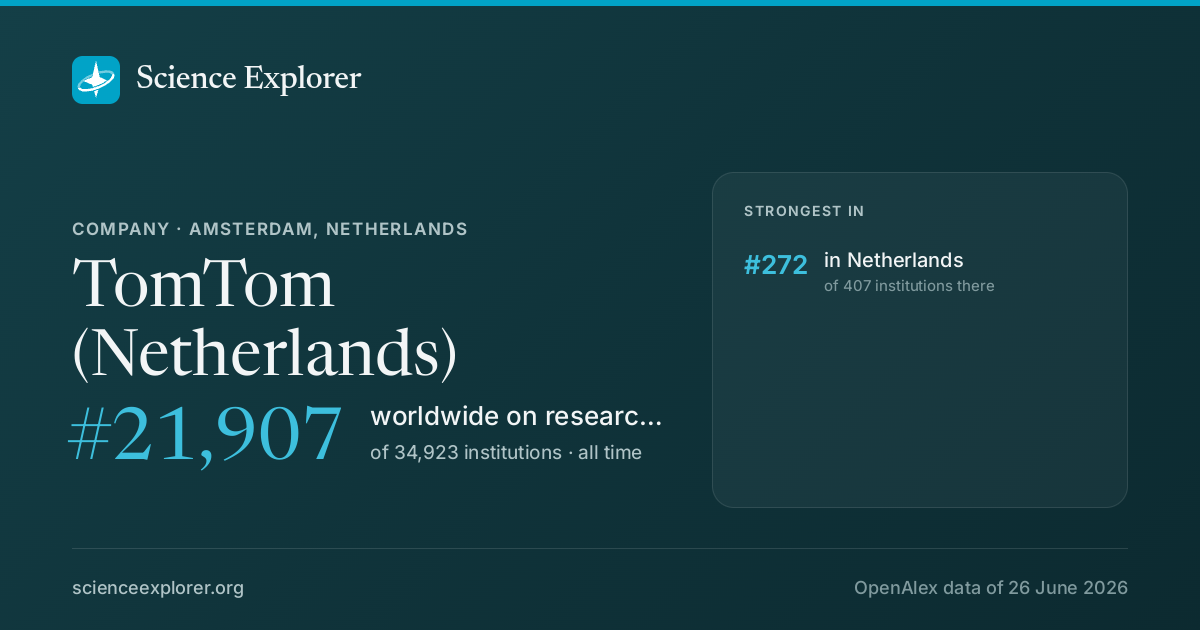
TomTom (Netherlands) on Science Explorer

A card with TomTom (Netherlands)'s standing and the fields it leads in, for a post or a slide. A link to this page previews as the same card.

Download the card

1200 × 630 PNG, sized for social posts, drawn from the latest snapshot.

Badges for a website1Each links back here and updates with every snapshot

Research measures only: rankings here say nothing about teaching, admissions or student experience. Comparable institutions and collaboration partners have tabs of their own, above.

Discussion

Ask a question or share a note about TomTom (Netherlands). Keep it to the research: no personal attacks, advertising or links. Any reader can report a post, which collapses it for everyone until it is opened.