United States Census Bureau

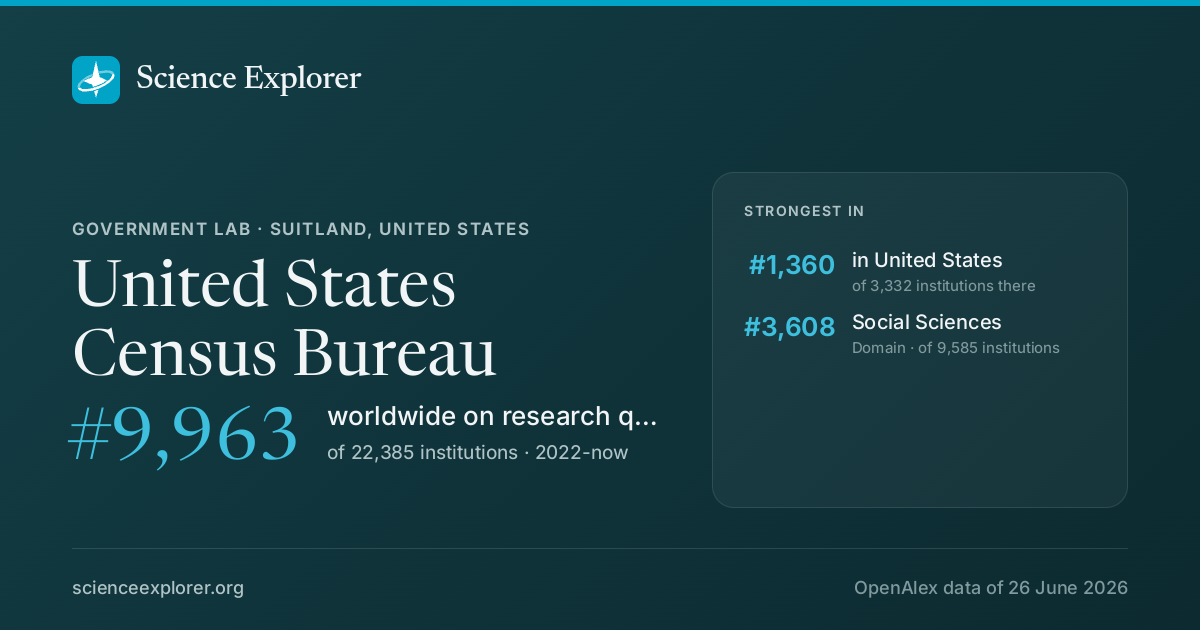
In research, United States Census Bureau stands highest in Social Sciences (#3,608 of 9,585 worldwide) and Social Sciences (#3,577 of 5,988 worldwide), 2022-now. Relative to its size it is most specialised in Economics and Econometrics, Economics, Econometrics and Finance and Mathematics (Economics and Econometrics is 10.0× its share of world research).
- World rank, 2022-now
- #9,963 of 22,385 · #3,949 all time
- Rank in United States
- #1,360 of 3,332
- Research works
- 1.8k ▼ 13% vs 2018-21
- Citations
- 49k 27.5 per fractional work
- Top-10% rate
- 12.1% all institutions 10.0%
- vs its own fields
- 0.94× 1.00× is exactly expected
- Open access
- 36% world 40%
- International
- 9% world 18%
What is United States Census Bureau known for in research?
The fields where it stands highest, 2022-now, ranked among every institution above the floor in each field.
| Field | World rank | Where that sits | Top-10% rate | Works | All time |
|---|---|---|---|---|---|
| Social SciencesDomain | #3,608 of 9,585 | 13.3% | 133 | #1528 | |
| Social SciencesField | #3,577 of 5,988 | 10.0% | 67 | #1654 |
Each strip is that field's whole ranked pool, with the notch where United States Census Bureau sits in it, in the colour of the band that rank falls in. The track under the rate is the rate itself: it carries no average mark, because the average differs by field (from about 6% in Dentistry to 21% in Economics).
Which fields of science does United States Census Bureau work in?
In 2022-now, 64% of research at United States Census Bureau is in Social Sciences, 24% in Physical Sciences. Its largest fields are Social Sciences (32%), Economics, Econometrics and Finance (19%), Mathematics (10%). It does 2.5× the world's share of Social Sciences.
Each ring splits the one inside it: the four domains of science, their fields, their subfields. Size is fractional works in 2022-now. Every slice is a page; the interactive view zooms down to single topics and colours each by how much more of it this institution does than the world.
Its 4 domains and 24 fields, with their numbers
- Social Sciences14163.7%
- Social Sciences7132.1%
- Economics, Econometrics and Finance4319.4%
- Decision Sciences135.7%
- Business, Management and Accounting104.7%
- Psychology31.5%
- Arts and Humanities00.1%
- Physical Sciences5424.3%
- Mathematics229.8%
- Computer Science198.7%
- Environmental Science62.7%
- Engineering31.5%
- Earth and Planetary Sciences10.4%
- Physics and Astronomy10.4%
- Chemistry10.3%
- Energy10.3%
- Chemical Engineering00.1%
- Materials Science00.0%
- Health Sciences2310.4%
- Health Professions135.8%
- Medicine104.5%
- Nursing00.0%
- Dentistry00.0%
- Life Sciences41.6%
What does United States Census Bureau specialise in?
Where its research is concentrated relative to its size: Economics and Econometrics takes 10.0× the share of its output that it takes of world research.
- Economics and EconometricsSubfield · 35.2 works10×
- Economics, Econometrics and FinanceField · 43.1 works9.1×
- MathematicsField · 21.8 works8.4×
Location quotient, a volume reading rather than an impact one. It surfaces small, lopsided specialities.
Field profile
Location quotient across every field it publishes in: outside the ring is more than an institution of this size would be expected to publish, inside it is less.
Rings at 0.5×, 1× and 2×. Widest outward: Economics, Econometrics and Finance, 9.1×. Every wedge is a field page.
All 24 fields, with their numbers
- Economics, Econometrics and Finance9.09×43 works
- Mathematics8.36×22 works
- Decision Sciences5.94×13 works
- Social Sciences2.54×71 works
- Health Professions2.20×13 works
- Business, Management and Accounting1.45×10 works
- Computer Science1.12×19 works
- Environmental Science0.54×6 works
- Psychology0.51×3 works
- Energy0.33×1 works
- Chemical Engineering0.29×0 works
- Earth and Planetary Sciences0.28×1 works
- Agricultural and Biological Sciences0.24×2 works
- Medicine0.23×10 works
- Chemistry0.21×1 works
- Physics and Astronomy0.16×1 works
- Neuroscience0.11×0 works
- Engineering0.10×3 works
- Nursing0.09×0 works
- Biochemistry, Genetics and Molecular Biology0.05×1 works
- Immunology and Microbiology0.05×0 works
- Arts and Humanities0.05×0 works
- Dentistry0.03×0 works
- Materials Science0.01×0 works
- Economics, Econometrics and Finance 9.1×
- Mathematics 8.4×
- Decision Sciences 5.9×
- Social Sciences 2.5×
- Health Professions 2.2×
- Business, Management and Accounting 1.4×
- Computer Science 1.1×
- Environmental Science 0.5×
- Psychology 0.5×
- Energy 0.3×
- Chemical Engineering 0.3×
- Earth and Planetary Sciences 0.3×
- Agricultural and Biological Sciences 0.2×
- Medicine 0.2×
- Chemistry 0.2×
- Physics and Astronomy 0.2×
- Neuroscience 0.1×
- Engineering 0.1×
- Nursing 0.1×
- Biochemistry, Genetics and Molecular Biology 0.1×
- Immunology and Microbiology 0.1×
- Arts and Humanities 0.1×
- Dentistry 0.0×
- Materials Science 0.0×
Who are the top researchers at United States Census Bureau?
Ranked on the quality score, Ron S. Jarmin, Norman J. Johnson and Paul C. Glick lead among researchers whose main affiliation is United States Census Bureau.
- 1
Ron S. Jarmin
 United States · #151,567 worldwide
10k citations · 157 works
- 2
Norman J. Johnson
United States · #156,760 worldwide
6k citations · 63 works
- 3
Paul C. Glick
United States · #168,080 worldwide
3.4k citations · 98 works
- 4
Larry H. Long
United States · #212,109 worldwide
2.1k citations · 64 works
- 5
Eric Backlund
United States · #228,487 worldwide
3.9k citations · 22 works
- 6
Lucia Foster
United States · #250,093 worldwide
7k citations · 120 works
- 7
Javier Miranda
United States · #251,579 worldwide
9.5k citations · 162 works
- 8
David Johnson
United States · #267,911 worldwide
18k citations · 150 works
- 9
Sonya R. Porter
United States · #299,802 worldwide
2.9k citations · 40 works
- 10
James R. Spletzer
United States · #335,846 worldwide
3.1k citations · 96 works
Which keywords describe research at United States Census Bureau?
By fractional works in 2022-now, weighted toward what it does more of than the world: Labor Market, Technological Change, Economic Development, Unemployment, Neighborhood Effects, Data Quality, Gender Inequality and Economic Growth.
- Welfare Reform
- Household Decision Making
- Geographic Information Systems
- Residential Segregation
- Human Capital
- Record Linkage
- Income Inequality
- Health Outcomes
- Data Integration
- R&D
- Income Tax
- Mixture Models
- Survey Methodology
- Wage Inequality
- Big Data
- Data Quality
- Neighborhood Effects
- Unemployment
- Economic Growth
- Technological Change
- Labor Market
- Economic Development
- Globalization
- Mental Health
- Education
- Gender Inequality
- Skill-Biased
- Response Rates
- Innovation
- Social Support
- Labor Force Participation
- Capture-Recapture
- Population Size Estimation
- Community Development
- Data Cleaning
- Social Mobility
- Racial Segregation
- Social Policy
- Health Care Utilization
- Social Media Analysis
Size is fractional works in 2022-now in the topics tagged with each word; colour is the word's share of this institution's work against its share of the world's. The 40 words are chosen for being large and distinctive. Each links to the topic it comes from most.
All 40 words, with their numbers
- Labor Market15▲ 23×9 topics
- Technological Change12▲ 142×2 topics
- Economic Development11▲ 6.2×8 topics
- Economic Growth10▲ 5.5×12 topics
- Globalization10▲ 2.2×14 topics
- Unemployment10▲ 54×2 topics
- Mental Health10▲ 3.0×15 topics
- Neighborhood Effects10▲ 40×3 topics
- Education9▲ 2.5×4 topics
- Data Quality9▲ 93×3 topics
- Gender Inequality9▲ 28×4 topics
- Big Data8▲ 4.0×7 topics
- Skill-Biased8▲ 211×1 topic
- Wage Inequality8▲ 211×1 topic
- Response Rates8▲ 682×1 topic
- Survey Methodology8▲ 682×1 topic
- Innovation8▲ 3.4×7 topics
- Mixture Models8▲ 179×2 topics
- Social Support8▲ 6.3×7 topics
- Income Tax7▲ 43×2 topics
- Labor Force Participation7▲ 73×2 topics
- R&D7▲ 41×2 topics
- Capture-Recapture6▲ 921×1 topic
- Data Integration6▲ 17×3 topics
- Population Size Estimation6▲ 921×1 topic
- Health Outcomes6▲ 10×4 topics
- Community Development6▲ 15×3 topics
- Income Inequality6▲ 19×6 topics
- Data Cleaning6▲ 91×1 topic
- Record Linkage6▲ 91×1 topic
- Social Mobility6▲ 94×2 topics
- Human Capital6▲ 17×3 topics
- Racial Segregation6▲ 163×1 topic
- Residential Segregation6▲ 163×1 topic
- Social Policy5▲ 26×2 topics
- Geographic Information Systems5▲ 22×2 topics
- Health Care Utilization5▲ 21×2 topics
- Household Decision Making5▲ 105×1 topic
- Social Media Analysis5▲ 70×2 topics
- Welfare Reform5▲ 105×1 topic
Which research topics does United States Census Bureau publish most on?
By volume in 2022-now: Labor market dynamics and wage inequality, Survey Methodology and Nonresponse, Census and Population Estimation and Data Quality and Management.
Area is fractional works; colour is the subfield each topic belongs to.
- 1 Labor market dynamics and wage inequality Economics and Econometrics 8 works
- 2 Survey Methodology and Nonresponse Sociology and Political Science 8 works
- 3 Census and Population Estimation Statistics and Probability 6 works
- 4 Data Quality and Management Management Science and Operations Research 6 works
- 5 Urban, Neighborhood, and Segregation Studies Sociology and Political Science 6 works
- 6 Gender, Labor, and Family Dynamics Gender Studies 5 works
- 7 Statistical Methods and Bayesian Inference Statistics and Probability 5 works
- 8 Data-Driven Disease Surveillance Epidemiology 5 works
- 9 Firm Innovation and Growth Economics and Econometrics 4 works
- 10 demographic modeling and climate adaptation Management Science and Operations Research 3 works
How open and international is its research?
Against the world's own shares: the tick on each track. Both are shares of its output, so they sit on one scale and can be read against each other as well as against the world.
World: 40% of research is openly available.
World: 18% is written across borders.
How has United States Census Bureau's research output changed?
Output in 2022-2025 was 13% lower than in 2018-2021.
The same series as a ribbon: one cell per year, darker for more. The line above answers how much; this answers when.
Its share of all research
Growing output can still be a shrinking share: all of science grows. This is United States Census Bureau as a percentage of every work published that year, 0.0011% in 2024.
Fractional works of United States Census Bureau over all fractional works that year. How the balance of science has shifted.
How much of it reaches the world top 10%
Year by year, against all institutions in the same year.
Of each year's output, the share that reached the world's 10% most cited for its field and year. Peak 19.4% in 2013.
Share United States Census Bureau's ranking
Badges for a website1Each links back here and updates with every snapshot

Research measures only: rankings here say nothing about teaching, admissions or student experience. Comparable institutions and collaboration partners have tabs of their own, above.
Discussion
Ask a question or share a note about United States Census Bureau. Posts are plain text and can be reported.