Science Explorer Back to mapMap
Discussion
University · Mogi das Cruzes · Brazil

Universidade Braz Cubas

World rank, all time
#21,315
of 34,923
Rank in Brazil
#661
of 834
Research works
237
▼ 21% vs 2018-21
Citations
1.6k
6.6 per fractional work
Top-10% rate
5.7%
all institutions 10.0%
vs its own fields
0.93×
1.00× is exactly expected
Open access
72%
world 40%
International
14%
world 18%

Which fields of science does Universidade Braz Cubas work in?

In 2022-now, 41% of research at Universidade Braz Cubas is in Health Sciences, 29% in Social Sciences. Its largest fields are Social Sciences (20%), Medicine (16%), Dentistry (13%). It does 1.6× the world's share of Health Sciences.

Health Sciences: 17 fractional works · 41.0% of its workMedicine: 6 fractional works · 15.8% of its workPublic Health, Environmental and Occupational Health: 2 fractional works · 4.1% of its workUrology: 1 fractional works · 1.9% of its workSurgery: 1 fractional works · 1.3% of its workRheumatology: 0 fractional works · 1.2% of its workPhysiology: 0 fractional works · 1.0% of its workEpidemiology: 0 fractional works · 1.0% of its workNeurology: 0 fractional works · 0.9% of its workRadiology, Nuclear Medicine and Imaging: 0 fractional works · 0.9% of its workOncology: 0 fractional works · 0.8% of its workDermatology: 0 fractional works · 0.7% of its workPulmonary and Respiratory Medicine: 0 fractional works · 0.6% of its workGenetics: 0 fractional works · 0.5% of its workInfectious Diseases: 0 fractional works · 0.2% of its workPathology and Forensic Medicine: 0 fractional works · 0.2% of its workSmaller subfields together: 0 fractional works · 0.5% of its workDentistry: 5 fractional works · 12.7% of its workOrthodontics: 2 fractional works · 5.6% of its workOral Surgery: 1 fractional works · 3.5% of its workPeriodontics: 1 fractional works · 2.4% of its workGeneral Dentistry: 0 fractional works · 1.2% of its workHealth Professions: 5 fractional works · 12.2% of its workGeneral Health Professions: 3 fractional works · 6.8% of its workHealth Information Management: 1 fractional works · 1.9% of its workComplementary and Manual Therapy: 0 fractional works · 1.1% of its workPharmacy: 0 fractional works · 1.0% of its workEmergency Medical Services: 0 fractional works · 0.8% of its workSpeech and Hearing: 0 fractional works · 0.4% of its workSmaller subfields together: 0 fractional works · 0.2% of its workNursing: 0 fractional works · 0.3% of its workNutrition and Dietetics: 0 fractional works · 0.3% of its workSocial Sciences: 12 fractional works · 29.0% of its workSocial Sciences: 8 fractional works · 20.1% of its workEducation: 3 fractional works · 7.8% of its workSociology and Political Science: 2 fractional works · 3.9% of its workLaw: 1 fractional works · 2.5% of its workDemography: 1 fractional works · 2.5% of its workGender Studies: 1 fractional works · 2.1% of its workHealth: 0 fractional works · 1.0% of its workGeography, Planning and Development: 0 fractional works · 0.4% of its workBusiness, Management and Accounting: 2 fractional works · 5.8% of its workAccounting: 1 fractional works · 2.1% of its workStrategy and Management: 1 fractional works · 1.5% of its workMarketing: 0 fractional works · 0.8% of its workManagement of Technology and Innovation: 0 fractional works · 0.6% of its workOrganizational Behavior and Human Resource Management: 0 fractional works · 0.5% of its workTourism, Leisure and Hospitality Management: 0 fractional works · 0.3% of its workPsychology: 1 fractional works · 2.8% of its workClinical Psychology: 0 fractional works · 1.2% of its workDevelopmental and Educational Psychology: 0 fractional works · 1.1% of its workExperimental and Cognitive Psychology: 0 fractional works · 0.3% of its workSmaller subfields together: 0 fractional works · 0.1% of its workDecision Sciences: 0 fractional works · 0.3% of its workInformation Systems and Management: 0 fractional works · 0.3% of its workLife Sciences: 7 fractional works · 16.9% of its workAgricultural and Biological Sciences: 4 fractional works · 10.6% of its workForestry: 2 fractional works · 6.2% of its workFood Science: 1 fractional works · 3.0% of its workInsect Science: 0 fractional works · 0.8% of its workPlant Science: 0 fractional works · 0.5% of its workBiochemistry, Genetics and Molecular Biology: 1 fractional works · 3.3% of its workBiophysics: 1 fractional works · 1.8% of its workMolecular Biology: 1 fractional works · 1.4% of its workSmaller subfields together: 0 fractional works · 0.1% of its workImmunology and Microbiology: 1 fractional works · 2.7% of its workVirology: 0 fractional works · 1.1% of its workParasitology: 0 fractional works · 0.8% of its workImmunology: 0 fractional works · 0.4% of its workMicrobiology: 0 fractional works · 0.2% of its workSmaller subfields together: 0 fractional works · 0.1% of its workNeuroscience: 0 fractional works · 0.3% of its workCognitive Neuroscience: 0 fractional works · 0.2% of its workSmaller subfields together: 0 fractional works · 0.0% of its workPhysical Sciences: 5 fractional works · 13.1% of its workComputer Science: 2 fractional works · 4.9% of its workInformation Systems: 2 fractional works · 4.9% of its workEnvironmental Science: 1 fractional works · 3.7% of its workEcology: 1 fractional works · 2.1% of its workManagement, Monitoring, Policy and Law: 0 fractional works · 1.2% of its workSmaller subfields together: 0 fractional works · 0.3% of its workEngineering: 1 fractional works · 2.4% of its workBiomedical Engineering: 1 fractional works · 1.4% of its workMechanical Engineering: 0 fractional works · 0.5% of its workAutomotive Engineering: 0 fractional works · 0.3% of its workBuilding and Construction: 0 fractional works · 0.2% of its workSmaller subfields together: 0 fractional works · 0.0% of its workChemistry: 0 fractional works · 1.0% of its workAnalytical Chemistry: 0 fractional works · 1.0% of its workMathematics: 0 fractional works · 0.9% of its workApplied Mathematics: 0 fractional works · 0.4% of its workGeometry and Topology: 0 fractional works · 0.4% of its workMaterials Science: 0 fractional works · 0.3% of its workMaterials Chemistry: 0 fractional works · 0.3% of its workPhysics and Astronomy: 0 fractional works · 0.0% of its workALL ITS WORKUniversidade BrazCubas40fractional works, 2022-now
Life Sciences17%Physical Sciences13%Health Sciences41%Social Sciences29%

Each ring splits the one inside it: the four domains of science, their fields, their subfields. Size is fractional works in 2022-now. Every slice is a page; the interactive view zooms down to single topics and colours each by how much more of it this institution does than the world.

Its 4 domains and 19 fields, with their numbers
    1. Medicine615.8%
    2. Dentistry512.7%
    3. Health Professions512.2%
    4. Nursing00.3%
    1. Social Sciences820.1%
    2. Business, Management and Accounting25.8%
    3. Psychology12.8%
    4. Decision Sciences00.3%
    1. Agricultural and Biological Sciences410.6%
    2. Biochemistry, Genetics and Molecular Biology13.3%
    3. Immunology and Microbiology12.7%
    4. Neuroscience00.3%
    1. Computer Science24.9%
    2. Environmental Science13.7%
    3. Engineering12.4%
    4. Chemistry01.0%
    5. Mathematics00.9%
    6. Materials Science00.3%
    7. Physics and Astronomy00.0%
All of science, and how each field's share has moved since 1950: the Science domain explorer

Field profile

Location quotient across every field it publishes in: outside the ring is more than an institution of this size would be expected to publish, inside it is less.

Agricultural and Biological Sciences: 2.23× its world share, 4 worksAgricultural and Bio…Biochemistry, Genetics and Molecular Biology: 0.62× its world share, 1 worksBiochemistry, Geneti…Immunology and Microbiology: 2.71× its world share, 1 worksImmunology and Micro…Neuroscience: 0.17× its world share, 0 worksNeuroscienceChemistry: 0.62× its world share, 0 worksChemistryComputer Science: 0.63× its world share, 2 worksComputer ScienceEngineering: 0.16× its world share, 1 worksEngineeringEnvironmental Science: 0.74× its world share, 2 worksEnvironmental ScienceMaterials Science: 0.08× its world share, 0 worksMaterials ScienceMathematics: 0.75× its world share, 0 worksMathematicsPhysics and Astronomy: 0.01× its world share, 0 worksPhysics and AstronomyDentistry: 26.16× its world share, 5 worksDentistryHealth Professions: 4.63× its world share, 5 worksHealth ProfessionsMedicine: 0.82× its world share, 6 worksMedicineNursing: 0.56× its world share, 0 worksNursingBusiness, Management and Accounting: 1.82× its world share, 2 worksBusiness, Management…Decision Sciences: 0.32× its world share, 0 worksDecision SciencesPsychology: 0.91× its world share, 1 worksPsychologySocial Sciences: 1.59× its world share, 8 worksSocial Sciences1×world share
more than its size predictsabout as predictedless

Rings at 0.5×, 1× and 2×. Widest outward: Dentistry, 26.2×. Every wedge is a field page.

All 19 fields, with their numbers
  1. Dentistry26.16×5 works
  2. Health Professions4.63×5 works
  3. Immunology and Microbiology2.71×1 works
  4. Agricultural and Biological Sciences2.23×4 works
  5. Business, Management and Accounting1.82×2 works
  6. Social Sciences1.59×8 works
  7. Psychology0.91×1 works
  8. Medicine0.82×6 works
  9. Mathematics0.75×0 works
  10. Environmental Science0.74×2 works
  11. Computer Science0.63×2 works
  12. Biochemistry, Genetics and Molecular Biology0.62×1 works
  13. Chemistry0.62×0 works
  14. Nursing0.56×0 works
  15. Decision Sciences0.32×0 works
  16. Neuroscience0.17×0 works
  17. Engineering0.16×1 works
  18. Materials Science0.08×0 works
  19. Physics and Astronomy0.01×0 works

Who are the top researchers at Universidade Braz Cubas?

Ranked on the quality score, Jorge L. S. Lino, Luís Sérgio Sardinha and Dárcio Kitakawa lead among researchers whose main affiliation is Universidade Braz Cubas.

  1. 1 Jorge L. S. Lino Brazil · #4,642,056 worldwide 92 citations · 16 works
  2. 2 Luís Sérgio Sardinha Brazil · #4,718,433 worldwide 43 citations · 31 works
  3. 3 Dárcio Kitakawa Brazil · #6,099,343 worldwide 204 citations · 39 works
All ranked researchers at Universidade Braz Cubas

What are the most cited papers from Universidade Braz Cubas?

The most cited paper from Universidade Braz Cubas is "Evaluation of Mineral Trioxide Aggregate and Calcium Hydroxide Cement as Pulp-capping Agents in Human Teeth" (Maria de Lourdes Rodrigues Accorinte, R Holland, Alessandra Reis et al., 2008), with 239 citations. Next come "Maternal high-fat feeding through pregnancy and lactation predisposes mouse offspring to molecular insulin resistance and fatty liver" (184) and "Vibration spectroscopy and body biofluids: Literature review for clinical applications" (116).

Most cited papers
#PaperReleasedCitations
1 Evaluation of Mineral Trioxide Aggregate and Calcium Hydroxide Cement as Pulp-capping Agents in Human Teeth Maria de Lourdes Rodrigues Accorinte, R Holland, Alessandra Reis et al. · Journal of Endodontics 2008 239
2 Maternal high-fat feeding through pregnancy and lactation predisposes mouse offspring to molecular insulin resistance and fatty liver Nicole G. Ashino, Karen N. Saito, Flavia D. Souza et al. · The Journal of Nutritional Biochemistry 3 May 2011 184
3 Vibration spectroscopy and body biofluids: Literature review for clinical applications Leonardo Barbosa Leal, Marcelo Saito Nogueira, Renata de Azevedo Canevari et al. · Photodiagnosis and Photodynamic Therapy 30 Sep 2018 116
4 Association between halitosis and mouth breathing in children Lara Jansiski Motta, Joanna Carolina Bachiega, Carolina Cardoso Guedes et al. · Clinics Open access Jun 2011 110
5 Response of Human Dental Pulp Capped with MTA and Calcium Hydroxide Powder M. L. R. Accorinte, Alessandro Dourado Loguércio, Alessandra Reis et al. · Operative Dentistry 2008 109
All 61 most cited papers, with filters and sorting

Which keywords describe research at Universidade Braz Cubas?

By fractional works in 2022-now, weighted toward what it does more of than the world: Healthcare, Educational Technology, Public Health, Quality of Life, Forest Biomass, Wood Residues, Health Policy and Epidemiology.

▲ more of its work than of the world's◆ about the world's share▼ less than the world's

Size is fractional works in 2022-now in the topics tagged with each word; colour is the word's share of this institution's work against its share of the world's. The 39 words are chosen for being large and distinctive. Each links to the topic it comes from most.

All 39 words, with their numbers
  1. Epidemiology4▲ 2.5×14 topics
  2. Healthcare4▲ 7.8×3 topics
  3. Public Health3▲ 5.8×5 topics
  4. Quality of Life3▲ 5.8×9 topics
  5. Educational Technology3▲ 6.8×4 topics
  6. Environmental Impact3▲ 3.8×2 topics
  7. Forest Biomass2▲ 191×1 topic
  8. Wood Residues2▲ 191×1 topic
  9. Health Policy2▲ 39×2 topics
  10. Online Learning2▲ 7.2×3 topics
  11. Chronic Diseases2▲ 19×2 topics
  12. Information Technology2▲ 10×1 topic
  13. Primary Care2▲ 13×2 topics
  14. Smart Library2▲ 123×1 topic
  15. Health2▲ 12×3 topics
  16. Healthcare Access2▲ 16×2 topics
  17. Nutrition2▲ 9.7×3 topics
  18. Sustainability2▲ 1.76×4 topics
  19. Brazilian Health System2▲ 98×1 topic
  20. Community-Based Care2▲ 98×1 topic
  21. Research2▲ 31×2 topics
  22. Distance Education2▲ 19×1 topic
  23. Training2▲ 17×1 topic
  24. Public Policy1▲ 7.3×2 topics
  25. Risk Factors1▲ 3.2×5 topics
  26. Brazil1▲ 36×2 topics
  27. Infection Control1▲ 38×3 topics
  28. Teacher Training1▲ 5.4×4 topics
  29. Clinical Trials1▲ 4.5×2 topics
  30. Education1▲ 1.67×5 topics
  31. Dental Materials1▲ 51×1 topic
  32. Restorative Dentistry1▲ 51×1 topic
  33. Social Determinants1▲ 14×4 topics
  34. Alimentation1▲ 288×1 topic
  35. Constitutional Law1▲ 19×1 topic
  36. Food Program1▲ 288×1 topic
  37. Human Rights1▲ 2.4×1 topic
  38. Political Economy1▲ 9.7×1 topic
  39. Social Welfare1▲ 26×1 topic

Which research topics does Universidade Braz Cubas publish most on?

By volume in 2022-now: Agricultural and Food Sciences, Healthcare during COVID-19 Pandemic, Health, Nursing, Elderly Care and Academic Research in Diverse Fields.

  1. 1 Agricultural and Food Sciences Forestry 2 works
  2. 2 Healthcare during COVID-19 Pandemic Information Systems 2 works
  3. 3 Health, Nursing, Elderly Care General Health Professions 2 works
  4. 4 Academic Research in Diverse Fields Education 2 works
  5. 5 Dental materials and restorations Orthodontics 1 works
  6. 6 Food, Nutrition, and Cultural Practices Food Science 1 works
  7. 7 Brazilian Legal Issues Law 1 works
  8. 8 Social and Political Issues Sociology and Political Science 1 works
  9. 9 Healthcare Regulation Health Information Management 1 works
  10. 10 Orthodontics and Dentofacial Orthopedics Orthodontics 1 works

How open and international is its research?

Against the world's own shares: the tick on each track. Both are shares of its output, so they sit on one scale and can be read against each other as well as against the world.

openly available72.2%not open27.8%

World: 40% of research is openly available.

with international co-authors14.0%domestic only86.0%

World: 18% is written across borders.

How has Universidade Braz Cubas's research output changed?

Output in 2022-2025 was 21% lower than in 2018-2021.

still counting1990200020102020
grewheldshrank

The same series as a ribbon: one cell per year, darker for more. The line above answers how much; this answers when.

Its share of all research

Growing output can still be a shrinking share: all of science grows. This is Universidade Braz Cubas as a percentage of every work published that year, 0.000066% in 2024.

still counting0.00025%0.00050%0.00075%Universidade Braz Cubas0.00010% in 20251990200020102020

Fractional works of Universidade Braz Cubas over all fractional works that year. How the balance of science has shifted.

Other research institutions in Mogi das Cruzes

All research institutions in Mogi das Cruzes

Share Universidade Braz Cubas's ranking
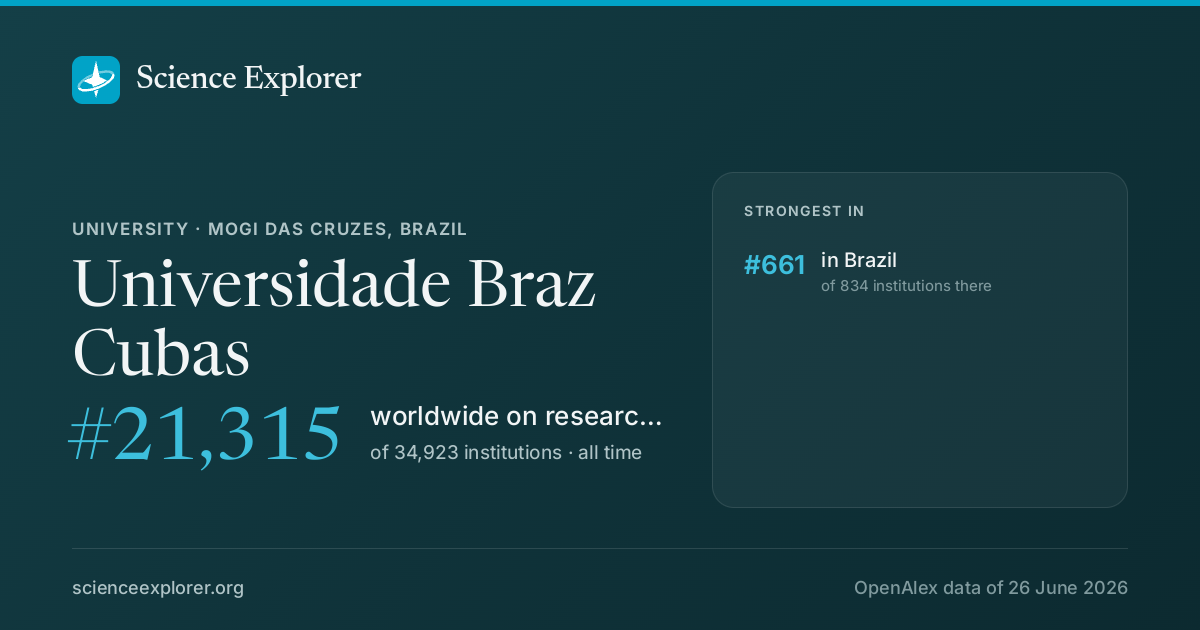
Universidade Braz Cubas on Science Explorer

A card with Universidade Braz Cubas's standing and the fields it leads in, for a post or a slide. A link to this page previews as the same card.

Download the card

1200 × 630 PNG, sized for social posts, drawn from the latest snapshot.

Badges for a website1Each links back here and updates with every snapshot

Research measures only: rankings here say nothing about teaching, admissions or student experience. Comparable institutions and collaboration partners have tabs of their own, above.

Discussion

Ask a question or share a note about Universidade Braz Cubas. Keep it to the research: no personal attacks, advertising or links. Any reader can report a post, which collapses it for everyone until it is opened.