Universidade do Estado do Pará

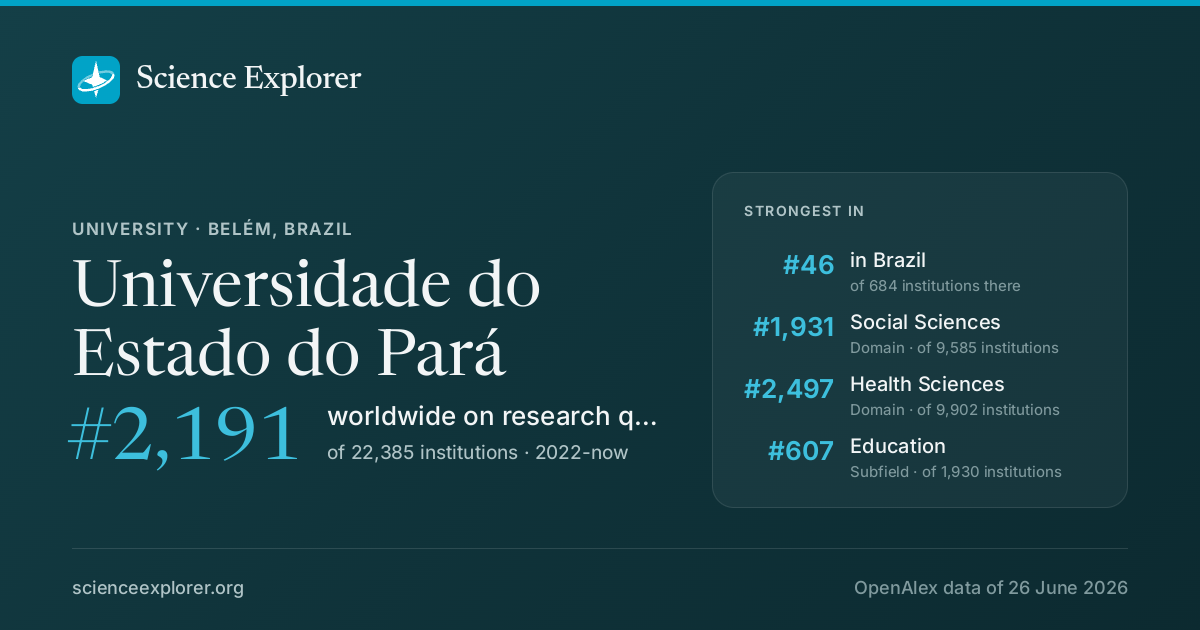
In research, Universidade do Estado do Pará stands highest in Social Sciences (#1,931 of 9,585 worldwide), Social Sciences (#1,503 of 5,988 worldwide) and Health Sciences (#2,497 of 9,902 worldwide), 2022-now. Relative to its size it is most specialised in Forestry, Management, Monitoring, Policy and Law and Occupational Therapy (Forestry is 17.5× its share of world research).
- World rank, 2022-now
- #2,191 of 22,385 · #2,696 all time
- Rank in Brazil
- #46 of 684
- Research works
- 7.2k ▲ 14% vs 2018-21
- Citations
- 27k 3.7 per fractional work
- Top-10% rate
- 5.9% all institutions 10.0%
- vs its own fields
- 0.76× 1.00× is exactly expected
- Open access
- 85% world 40%
- International
- 15% world 18%
What is Universidade do Estado do Pará known for in research?
The fields where it stands highest, 2022-now, ranked among every institution above the floor in each field.
| Field | World rank | Where that sits | Top-10% rate | Works | All time |
|---|---|---|---|---|---|
| Social SciencesDomain | #1,931 of 9,585 | 7.5% | 1,062 | #2219 | |
| Social SciencesField | #1,503 of 5,988 | 8.2% | 776 | #2138 | |
| Health SciencesDomain | #2,497 of 9,902 | 3.9% | 928 | #2598 | |
| EducationSubfield | #607 of 1,930 | 9.2% | 399 | #755 | |
| MedicineField | #2,751 of 8,541 | 3.1% | 575 | #2778 | |
| Management, Monitoring, Policy and LawSubfield | #146 of 341 | 10.7% | 125 | #329 | |
| Life SciencesDomain | #3,018 of 6,403 | 4.1% | 239 | #4084 | |
| Agricultural and Biological SciencesField | #1,644 of 3,157 | 4.9% | 144 | #2688 | |
| Physical SciencesDomain | #5,716 of 10,670 | 6.8% | 411 | #7121 | |
| Health ProfessionsField | #1,063 of 1,895 | 5.3% | 321 | #1284 |
Each strip is that field's whole ranked pool, with the notch where Universidade do Estado do Pará sits in it, in the colour of the band that rank falls in. The track under the rate is the rate itself: it carries no average mark, because the average differs by field (from about 6% in Dentistry to 21% in Economics).
Which of those standings moved
The same fields on both windows: where it stood over the whole record, and where it stands in 2022-now. The distance is the story, and it is the one thing the two rank columns above cannot show.
- Social Sciences#2,219 #1,931
- Social Sciences#2,138 #1,503
- Health Sciences#2,598 #2,497
- Education#755 #607
- Medicine#2,778 #2,751
- Management, Monitoring, Policy and Law#329 #146
- Life Sciences#4,084 #3,018
- Agricultural and Biological Sciences#2,688 #1,644
- Physical Sciences#7,121 #5,716
- Health Professions#1,284 #1,063
A dot further right is a better standing. Fields it was not ranked in over the whole record are left out.
Which fields of science does Universidade do Estado do Pará work in?
In 2022-now, 40% of research at Universidade do Estado do Pará is in Social Sciences, 35% in Health Sciences. Its largest fields are Social Sciences (29%), Medicine (21%), Health Professions (12%). It does 1.6× the world's share of Social Sciences.
Each ring splits the one inside it: the four domains of science, their fields, their subfields. Size is fractional works in 2022-now. Every slice is a page; the interactive view zooms down to single topics and colours each by how much more of it this institution does than the world.
Its 4 domains and 26 fields, with their numbers
- Social Sciences1,19939.7%
- Social Sciences87529.0%
- Arts and Humanities943.1%
- Psychology933.1%
- Decision Sciences772.5%
- Business, Management and Accounting501.6%
- Economics, Econometrics and Finance110.4%
- Health Sciences1,04834.7%
- Medicine64721.4%
- Health Professions36412.1%
- Dentistry180.6%
- Nursing170.6%
- Veterinary30.1%
- Physical Sciences48916.2%
- Environmental Science2739.1%
- Computer Science1214.0%
- Engineering602.0%
- Materials Science90.3%
- Physics and Astronomy70.2%
- Mathematics60.2%
- Chemistry50.2%
- Earth and Planetary Sciences50.2%
- Energy20.1%
- Chemical Engineering00.0%
- Life Sciences2819.3%
What does Universidade do Estado do Pará specialise in?
Where its research is concentrated relative to its size: Forestry takes 17.5× the share of its output that it takes of world research.
- ForestrySubfield · 54.9 works17×
- Management, Monitoring, Policy and LawSubfield · 141.2 works8.0×
- Occupational TherapySubfield · 38.3 works7.6×
- Health Information ManagementSubfield · 50.2 works6.5×
- Information Systems and ManagementSubfield · 53.9 works6.3×
- Urban StudiesSubfield · 51.2 works6.1×
Location quotient, a volume reading rather than an impact one. It surfaces small, lopsided specialities.
Field profile
Location quotient across every field it publishes in: outside the ring is more than an institution of this size would be expected to publish, inside it is less.
Rings at 0.5×, 1× and 2×. Widest outward: Health Professions, 4.6×. Every wedge is a field page.
All 26 fields, with their numbers
- Health Professions4.57×364 works
- Decision Sciences2.64×77 works
- Social Sciences2.29×875 works
- Environmental Science1.82×273 works
- Agricultural and Biological Sciences1.20×172 works
- Dentistry1.20×18 works
- Nursing1.15×17 works
- Medicine1.12×647 works
- Arts and Humanities1.07×94 works
- Immunology and Microbiology1.01×31 works
- Psychology1.01×93 works
- Veterinary0.78×3 works
- Computer Science0.51×121 works
- Business, Management and Accounting0.51×50 works
- Neuroscience0.49×24 works
- Pharmacology, Toxicology and Pharmaceutics0.32×3 works
- Biochemistry, Genetics and Molecular Biology0.31×50 works
- Mathematics0.17×6 works
- Economics, Econometrics and Finance0.17×11 works
- Engineering0.13×60 works
- Chemistry0.11×5 works
- Physics and Astronomy0.11×8 works
- Earth and Planetary Sciences0.10×5 works
- Materials Science0.09×9 works
- Energy0.08×2 works
- Chemical Engineering0.04×0 works
- Health Professions 4.6×
- Decision Sciences 2.6×
- Social Sciences 2.3×
- Environmental Science 1.8×
- Agricultural and Biological Sciences 1.2×
- Dentistry 1.2×
- Nursing 1.1×
- Medicine 1.1×
- Arts and Humanities 1.1×
- Immunology and Microbiology 1.0×
- Psychology 1.0×
- Veterinary 0.8×
- Computer Science 0.5×
- Business, Management and Accounting 0.5×
- Neuroscience 0.5×
- Pharmacology, Toxicology and Pharmaceutics 0.3×
- Biochemistry, Genetics and Molecular Biology 0.3×
- Mathematics 0.2×
- Economics, Econometrics and Finance 0.2×
- Engineering 0.1×
- Chemistry 0.1×
- Physics and Astronomy 0.1×
- Earth and Planetary Sciences 0.1×
- Materials Science 0.1×
- Energy 0.1×
- Chemical Engineering 0.0×
Who are the top researchers at Universidade do Estado do Pará?
Ranked on the quality score, Vitor William Batista Martins, Terezinha Sirley Ribeiro Sousa and Camilla Costa Silva lead among researchers whose main affiliation is Universidade do Estado do Pará.
- 1
Vitor William Batista Martins
 Brazil · #1,407,818 worldwide
1.1k citations · 148 works
- 2
Terezinha Sirley Ribeiro Sousa
Brazil · #1,922,492 worldwide
76 citations · 58 works
- 3
Camilla Costa Silva
Brazil · #2,125,523 worldwide
253 citations · 16 works
- 4
Renata Melo e Silva de Oliveira
Brazil · #2,182,398 worldwide
350 citations · 55 works
- 5
Darly Rodrigues Pompeu
Brazil · #2,499,658 worldwide
879 citations · 20 works
- 6
Leanna Silva Aquino
Brazil · #2,515,899 worldwide
12 citations · 22 works
- 7
Erik Artur Cortinhas‐Alves
Brazil · #2,777,807 worldwide
324 citations · 17 works
- 8
Léony Luís Lopes Negrão
Brazil · #2,815,967 worldwide
347 citations · 36 works
- 9
Yzaura Lohanny Lima da Silva
Brazil · #2,942,019 worldwide
187 citations · 25 works
- 10
João Colares da Mota Neto
Brazil · #3,105,823 worldwide
135 citations · 39 works
Which keywords describe research at Universidade do Estado do Pará?
By fractional works in 2022-now, weighted toward what it does more of than the world: Public Health, Teacher Training, Public Policy, Educational Technology, Quality of Life, Curriculum Development, Healthcare Access and Qualitative Research.
- Educational Reform
- Inclusion
- Smart Library
- Educational Policies
- Chronic Diseases
- Teaching Methodologies
- Social Participation
- Active Learning
- Water Resources
- Health
- Primary Care
- Biodiversity
- Science Education
- Health Policy
- Sustainable Development
- Qualitative Research
- Healthcare
- Educational Technology
- Sustainability
- Epidemiology
- Public Health
- Teacher Training
- Quality of Life
- Public Policy
- Curriculum Development
- Healthcare Access
- Online Learning
- Social Inequality
- Waste Management
- Environmental Education
- Social Determinants
- Health Education
- Educational Games
- Eco-friendly Practices
- Didactic Models
- Social Determinants of Health
- Inclusive Education
- Digital Innovation
- Aging Population
- Pedagogical Practices
Size is fractional works in 2022-now in the topics tagged with each word; colour is the word's share of this institution's work against its share of the world's. The 40 words are chosen for being large and distinctive. Each links to the topic it comes from most.
All 40 words, with their numbers
- Public Health312▲ 7.1×50 topics
- Epidemiology278▲ 2.3×120 topics
- Teacher Training251▲ 14×14 topics
- Sustainability222▲ 3.0×57 topics
- Quality of Life220▲ 5.0×55 topics
- Educational Technology216▲ 6.0×21 topics
- Public Policy193▲ 13×16 topics
- Healthcare173▲ 5.0×15 topics
- Curriculum Development171▲ 8.3×8 topics
- Qualitative Research166▲ 6.5×19 topics
- Healthcare Access153▲ 19×8 topics
- Sustainable Development136▲ 2.9×36 topics
- Online Learning133▲ 5.3×9 topics
- Health Policy131▲ 28×6 topics
- Social Inequality124▲ 15×8 topics
- Science Education115▲ 62×2 topics
- Waste Management113▲ 9.4×9 topics
- Biodiversity112▲ 4.9×20 topics
- Environmental Education108▲ 23×7 topics
- Primary Care106▲ 9.5×7 topics
- Social Determinants106▲ 17×8 topics
- Health98▲ 8.1×13 topics
- Health Education96▲ 7.3×8 topics
- Water Resources94▲ 13×4 topics
- Educational Games94▲ 32×2 topics
- Active Learning93▲ 17×5 topics
- Eco-friendly Practices92▲ 53×2 topics
- Social Participation92▲ 51×1 topic
- Didactic Models91▲ 77×1 topic
- Teaching Methodologies91▲ 23×1 topic
- Social Determinants of Health87▲ 13×4 topics
- Chronic Diseases86▲ 11×8 topics
- Inclusive Education86▲ 7.9×13 topics
- Educational Policies84▲ 26×3 topics
- Digital Innovation82▲ 48×1 topic
- Smart Library82▲ 68×1 topic
- Aging Population81▲ 31×4 topics
- Inclusion81▲ 18×6 topics
- Pedagogical Practices80▲ 30×2 topics
- Educational Reform80▲ 22×4 topics
Which research topics does Universidade do Estado do Pará publish most on?
By volume in 2022-now: Environmental Sustainability and Education, Science and Education Research, Healthcare during COVID-19 Pandemic and Health, Nursing, Elderly Care.
Area is fractional works; colour is the subfield each topic belongs to.
- 1 Environmental Sustainability and Education Management, Monitoring, Policy and Law 92 works
- 2 Science and Education Research Education 91 works
- 3 Healthcare during COVID-19 Pandemic Information Systems 82 works
- 4 Health, Nursing, Elderly Care General Health Professions 78 works
- 5 Education Pedagogy and Practices Education 77 works
- 6 Academic Research in Diverse Fields Education 72 works
- 7 Maternal and Neonatal Healthcare General Health Professions 62 works
- 8 Health Education and Validation Education 55 works
- 9 Business and Management Studies Information Systems and Management 52 works
- 10 Healthcare Regulation Health Information Management 48 works
How open and international is its research?
Against the world's own shares: the tick on each track. Both are shares of its output, so they sit on one scale and can be read against each other as well as against the world.
World: 40% of research is openly available.
World: 18% is written across borders.
How has Universidade do Estado do Pará's research output changed?
Output in 2022-2025 was 14% higher than in 2018-2021.
The same series as a ribbon: one cell per year, darker for more. The line above answers how much; this answers when.
Its share of all research
Growing output can still be a shrinking share: all of science grows. This is Universidade do Estado do Pará as a percentage of every work published that year, 0.014% in 2024.
Fractional works of Universidade do Estado do Pará over all fractional works that year. How the balance of science has shifted.
How much of it reaches the world top 10%
Year by year, against all institutions in the same year.
Of each year's output, the share that reached the world's 10% most cited for its field and year. Peak 8.6% in 2018.
Other research institutions in Belém
- Universidade Federal do Pará
- Universidade Federal Rural da Amazônia
- Instituto Federal de Educação, Ciência e Tecnologia do Pará
- Universidade da Amazônia
- Museu Paraense Emílio Goeldi
- Centro Universitário do Pará
- Amazon Research Foundation
- Vale Technological Institute

Share Universidade do Estado do Pará's ranking
Badges for a website1Each links back here and updates with every snapshot

Research measures only: rankings here say nothing about teaching, admissions or student experience. Comparable institutions and collaboration partners have tabs of their own, above.
Discussion
Ask a question or share a note about Universidade do Estado do Pará. Posts are plain text and can be reported.