Science Explorer Back to mapMap
Discussion
Institution · San Francisco · United States

A.P. Giannini Foundation

World rank, all time
#14,350
of 34,923
Rank in United States
#2,963
of 7,310
Research works
281
▲ 117% vs 2018-21
Citations
10k
37.3 per fractional work
Top-10% rate
11.2%
all institutions 10.0%
vs its own fields
1.18×
1.00× is exactly expected
Open access
31%
world 40%
International
19%
world 18%

Which fields of science does A.P. Giannini Foundation work in?

In 2022-now, 52% of research at A.P. Giannini Foundation is in Physical Sciences, 19% in Health Sciences. Its largest fields are Engineering (32%), Medicine (18%), Environmental Science (7%). It does 1.3× the world's share of Physical Sciences.

Physical Sciences: 22 fractional works · 51.5% of its workEngineering: 14 fractional works · 31.6% of its workComputational Mechanics: 4 fractional works · 8.5% of its workMechanical Engineering: 4 fractional works · 8.5% of its workControl and Systems Engineering: 2 fractional works · 3.9% of its workCivil and Structural Engineering: 1 fractional works · 3.3% of its workBiomedical Engineering: 1 fractional works · 3.1% of its workAerospace Engineering: 1 fractional works · 2.3% of its workMechanics of Materials: 0 fractional works · 0.8% of its workSafety, Risk, Reliability and Quality: 0 fractional works · 0.8% of its workElectrical and Electronic Engineering: 0 fractional works · 0.4% of its workOcean Engineering: 0 fractional works · 0.3% of its workEnvironmental Science: 3 fractional works · 6.9% of its workNature and Landscape Conservation: 1 fractional works · 2.3% of its workGlobal and Planetary Change: 1 fractional works · 1.3% of its workEcology: 0 fractional works · 0.9% of its workEnvironmental Engineering: 0 fractional works · 0.8% of its workPollution: 0 fractional works · 0.6% of its workEcological Modeling: 0 fractional works · 0.3% of its workEnvironmental Chemistry: 0 fractional works · 0.3% of its workIndustrial and Manufacturing Engineering: 0 fractional works · 0.3% of its workWater Science and Technology: 0 fractional works · 0.3% of its workPhysics and Astronomy: 2 fractional works · 5.4% of its workStatistical and Nonlinear Physics: 2 fractional works · 4.2% of its workAstronomy and Astrophysics: 0 fractional works · 1.2% of its workComputer Science: 2 fractional works · 4.0% of its workComputer Networks and Communications: 1 fractional works · 2.5% of its workComputational Theory and Mathematics: 0 fractional works · 0.8% of its workHardware and Architecture: 0 fractional works · 0.8% of its workSmaller subfields together: 0 fractional works · 0.0% of its workEnergy: 1 fractional works · 2.4% of its workRenewable Energy, Sustainability and the Environment: 1 fractional works · 2.4% of its workMathematics: 0 fractional works · 1.0% of its workNumerical Analysis: 0 fractional works · 0.8% of its workModeling and Simulation: 0 fractional works · 0.3% of its workEarth and Planetary Sciences: 0 fractional works · 0.2% of its workHealth Sciences: 8 fractional works · 18.7% of its workMedicine: 8 fractional works · 17.7% of its workSurgery: 2 fractional works · 4.6% of its workOncology: 1 fractional works · 3.4% of its workPulmonary and Respiratory Medicine: 1 fractional works · 2.7% of its workPediatrics, Perinatology and Child Health: 1 fractional works · 1.8% of its workReproductive Medicine: 1 fractional works · 1.5% of its workPublic Health, Environmental and Occupational Health: 1 fractional works · 1.4% of its workCardiology and Cardiovascular Medicine: 0 fractional works · 0.8% of its workObstetrics and Gynecology: 0 fractional works · 0.8% of its workPathology and Forensic Medicine: 0 fractional works · 0.5% of its workNeurology: 0 fractional works · 0.3% of its workHealth Professions: 0 fractional works · 0.8% of its workSpeech and Hearing: 0 fractional works · 0.4% of its workSmaller subfields together: 0 fractional works · 0.4% of its workNursing: 0 fractional works · 0.3% of its workNutrition and Dietetics: 0 fractional works · 0.3% of its workSocial Sciences: 8 fractional works · 17.8% of its workEconomics, Econometrics and Finance: 3 fractional works · 6.0% of its workEconomics and Econometrics: 2 fractional works · 4.8% of its workGeneral Economics, Econometrics and Finance: 0 fractional works · 1.0% of its workFinance: 0 fractional works · 0.3% of its workArts and Humanities: 2 fractional works · 5.0% of its workHistory and Philosophy of Science: 1 fractional works · 2.3% of its workVisual Arts and Performing Arts: 0 fractional works · 1.2% of its workHistory: 0 fractional works · 0.8% of its workMusic: 0 fractional works · 0.8% of its workSocial Sciences: 2 fractional works · 4.7% of its workSociology and Political Science: 1 fractional works · 1.8% of its workPolitical Science and International Relations: 0 fractional works · 0.8% of its workAnthropology: 0 fractional works · 0.8% of its workGender Studies: 0 fractional works · 0.6% of its workUrban Studies: 0 fractional works · 0.4% of its workSafety Research: 0 fractional works · 0.3% of its workPsychology: 1 fractional works · 1.5% of its workExperimental and Cognitive Psychology: 0 fractional works · 0.8% of its workSocial Psychology: 0 fractional works · 0.8% of its workSmaller subfields together: 0 fractional works · 0.0% of its workBusiness, Management and Accounting: 0 fractional works · 0.6% of its workTourism, Leisure and Hospitality Management: 0 fractional works · 0.3% of its workSmaller subfields together: 0 fractional works · 0.3% of its workLife Sciences: 5 fractional works · 11.9% of its workBiochemistry, Genetics and Molecular Biology: 2 fractional works · 4.7% of its workGenetics: 1 fractional works · 1.2% of its workBiochemistry: 0 fractional works · 1.2% of its workMolecular Biology: 0 fractional works · 1.1% of its workCancer Research: 0 fractional works · 0.8% of its workBiotechnology: 0 fractional works · 0.4% of its workNeuroscience: 2 fractional works · 3.9% of its workCognitive Neuroscience: 2 fractional works · 3.9% of its workAgricultural and Biological Sciences: 1 fractional works · 3.4% of its workPlant Science: 0 fractional works · 1.0% of its workGeneral Agricultural and Biological Sciences: 0 fractional works · 0.8% of its workFood Science: 0 fractional works · 0.5% of its workSoil Science: 0 fractional works · 0.5% of its workEcology, Evolution, Behavior and Systematics: 0 fractional works · 0.3% of its workInsect Science: 0 fractional works · 0.3% of its workSmaller subfields together: 0 fractional works · 0.0% of its workALL ITS WORKA.P. GianniniFoundation43fractional works, 2022-now
Life Sciences12%Physical Sciences52%Health Sciences19%Social Sciences18%

Each ring splits the one inside it: the four domains of science, their fields, their subfields. Size is fractional works in 2022-now. Every slice is a page; the interactive view zooms down to single topics and colours each by how much more of it this institution does than the world.

Its 4 domains and 18 fields, with their numbers
    1. Engineering1431.6%
    2. Environmental Science36.9%
    3. Physics and Astronomy25.4%
    4. Computer Science24.0%
    5. Energy12.4%
    6. Mathematics01.0%
    7. Earth and Planetary Sciences00.2%
    1. Medicine817.7%
    2. Health Professions00.8%
    3. Nursing00.3%
    1. Economics, Econometrics and Finance36.0%
    2. Arts and Humanities25.0%
    3. Social Sciences24.7%
    4. Psychology11.5%
    5. Business, Management and Accounting00.6%
    1. Biochemistry, Genetics and Molecular Biology24.7%
    2. Neuroscience23.9%
    3. Agricultural and Biological Sciences13.4%
All of science, and how each field's share has moved since 1950: the Science domain explorer

Field profile

Location quotient across every field it publishes in: outside the ring is more than an institution of this size would be expected to publish, inside it is less.

Agricultural and Biological Sciences: 0.71× its world share, 2 worksAgricultural and Bio…Biochemistry, Genetics and Molecular Biology: 0.87× its world share, 2 worksBiochemistry, Geneti…Neuroscience: 2.37× its world share, 2 worksNeuroscienceComputer Science: 0.52× its world share, 2 worksComputer ScienceEarth and Planetary Sciences: 0.10× its world share, 0 worksEarth and Planetary …Energy: 2.65× its world share, 1 worksEnergyEngineering: 2.11× its world share, 14 worksEngineeringEnvironmental Science: 1.39× its world share, 3 worksEnvironmental ScienceMathematics: 0.87× its world share, 0 worksMathematicsPhysics and Astronomy: 2.43× its world share, 2 worksPhysics and AstronomyHealth Professions: 0.29× its world share, 0 worksHealth ProfessionsMedicine: 0.92× its world share, 8 worksMedicineNursing: 0.52× its world share, 0 worksNursingArts and Humanities: 1.73× its world share, 2 worksArts and HumanitiesBusiness, Management and Accounting: 0.18× its world share, 0 worksBusiness, Management…Economics, Econometrics and Finance: 2.82× its world share, 3 worksEconomics, Econometr…Psychology: 0.50× its world share, 1 worksPsychologySocial Sciences: 0.37× its world share, 2 worksSocial Sciences1×world share
more than its size predictsabout as predictedless

Rings at 0.5×, 1× and 2×. Widest outward: Economics, Econometrics and Finance, 2.8×. Every wedge is a field page.

All 18 fields, with their numbers
  1. Economics, Econometrics and Finance2.82×3 works
  2. Energy2.65×1 works
  3. Physics and Astronomy2.43×2 works
  4. Neuroscience2.37×2 works
  5. Engineering2.11×14 works
  6. Arts and Humanities1.73×2 works
  7. Environmental Science1.39×3 works
  8. Medicine0.92×8 works
  9. Biochemistry, Genetics and Molecular Biology0.87×2 works
  10. Mathematics0.87×0 works
  11. Agricultural and Biological Sciences0.71×2 works
  12. Computer Science0.52×2 works
  13. Nursing0.52×0 works
  14. Psychology0.50×1 works
  15. Social Sciences0.37×2 works
  16. Health Professions0.29×0 works
  17. Business, Management and Accounting0.18×0 works
  18. Earth and Planetary Sciences0.10×0 works

Who are the top researchers at A.P. Giannini Foundation?

Ranked on the quality score, Lawrence Shepard, Sylvia Lane and Edwin C. Voorhies lead among researchers whose main affiliation is A.P. Giannini Foundation.

  1. 1 Lawrence Shepard United States · #2,733,005 worldwide 357 citations · 21 works
  2. 2 Sylvia Lane United States · #3,303,856 worldwide 535 citations · 70 works
  3. 3 Edwin C. Voorhies United States · #3,359,380 worldwide 12 citations · 17 works
  4. 4 Adriano C. Ducati United States · #3,633,351 worldwide 228 citations · 23 works
All ranked researchers at A.P. Giannini Foundation

What are the most cited papers from A.P. Giannini Foundation?

The most cited paper from A.P. Giannini Foundation is "Sacituzumab Govitecan in Metastatic Triple-Negative Breast Cancer" (Aditya Bardia et al., 2021), with 1,671 citations. Next come "Treatment landscape of triple-negative breast cancer — expanded options, evolving needs" (1,433) and "The Economic Impacts of Climate Change: Evidence from Agricultural Output and Random Fluctuations in Weather: Comment" (1,079).

Most cited papers
#PaperReleasedCitations
1 Sacituzumab Govitecan in Metastatic Triple-Negative Breast Cancer Aditya Bardia et al. · New England Journal of Medicine Open access 21 Apr 2021 1,671
2 Treatment landscape of triple-negative breast cancer — expanded options, evolving needs Giampaolo Bianchini, Carmine De Angelis, Luca Licata et al. · Nature Reviews Clinical Oncology Review 9 Nov 2021 1,433
3 The Economic Impacts of Climate Change: Evidence from Agricultural Output and Random Fluctuations in Weather: Comment Anthony C. Fisher, W. Michael Hanemann, Michael J. Roberts et al. · American Economic Review Open access Dec 2012 1,079
4 Informal Insurance Arrangements with Limited Commitment: Theory and Evidence from Village Economies Ethan A. Ligon, Jonathan P. Thomas, Tim S. Worrall · The Review of Economic Studies 2002 635
5 Structural gravity and fixed effects Thibault Fally · Journal of International Economics 4 Jun 2015 535
All 59 most cited papers, with filters and sorting

Which keywords describe research at A.P. Giannini Foundation?

By fractional works in 2022-now, weighted toward what it does more of than the world: Renewable Energy, Sustainability, Renewable Resources, Automotive Engineering, Engineering, Fluid Dynamics, Lightweight Materials and Anaesthesia.

▲ more of its work than of the world's◆ about the world's share▼ less than the world's

Size is fractional works in 2022-now in the topics tagged with each word; colour is the word's share of this institution's work against its share of the world's. The 26 words are chosen for being large and distinctive. Each links to the topic it comes from most.

All 26 words, with their numbers
  1. Sustainability5▲ 5.0×10 topics
  2. Renewable Energy5▲ 7.6×7 topics
  3. Renewable Resources4▲ 54×2 topics
  4. Automotive Engineering4▲ 1011×1 topic
  5. Engineering4▲ 185×1 topic
  6. Fluid Dynamics4▲ 60×1 topic
  7. Lightweight Materials4▲ 1011×1 topic
  8. Sustainable Development2▲ 3.3×5 topics
  9. Anaesthesia2▲ 542×1 topic
  10. Medical Gases2▲ 542×1 topic
  11. Climate Change2▲ 1.65×13 topics
  12. Experimental Tools2▲ 324×1 topic
  13. Smartphones2▲ 131×1 topic
  14. Adaptive Control2▲ 29×2 topics
  15. Education1▲ 1.79×3 topics
  16. Flexible Manipulators1▲ 174×1 topic
  17. Multibody Dynamics1▲ 174×1 topic
  18. Globalization1▲ 1.37×6 topics
  19. Environmental Impact1▲ 1.46×5 topics
  20. Cancer Therapy1▲ 4.1×4 topics
  21. Civil Engineering1▲ 45×1 topic
  22. Construction1▲ 17×1 topic
  23. Healthcare1▲ 2.0×1 topic
  24. Inertial Navigation Systems1▲ 89×1 topic
  25. Research1▲ 19×1 topic
  26. Sensor Fusion1▲ 22×1 topic

Which research topics does A.P. Giannini Foundation publish most on?

By volume in 2022-now: Engineering and Materials Science Studies, Physics and Engineering Research Articles, Biomedical and Chemical Research and Experimental and Theoretical Physics Studies.

  1. 1 Engineering and Materials Science Studies Mechanical Engineering 4 works
  2. 2 Physics and Engineering Research Articles Computational Mechanics 4 works
  3. 3 Biomedical and Chemical Research Surgery 2 works
  4. 4 Experimental and Theoretical Physics Studies Statistical and Nonlinear Physics 2 works
  5. 5 Dynamics and Control of Mechanical Systems Control and Systems Engineering 1 works
  6. 6 Inertial Sensor and Navigation Aerospace Engineering 1 works
  7. 7 Civil and Structural Engineering Research Civil and Structural Engineering 1 works
  8. 8 Sports Science and Education History and Philosophy of Science 1 works
  9. 9 Elasticity and Material Modeling Biomedical Engineering 1 works
  10. 10 Sarcoma Diagnosis and Treatment Pulmonary and Respiratory Medicine 1 works

How open and international is its research?

Against the world's own shares: the tick on each track. Both are shares of its output, so they sit on one scale and can be read against each other as well as against the world.

openly available30.7%not open69.3%

World: 40% of research is openly available.

with international co-authors19.3%domestic only80.7%

World: 18% is written across borders.

How has A.P. Giannini Foundation's research output changed?

Output in 2022-2025 was 117% higher than in 2018-2021.

still counting1990200020102020
grewheldshrank

The same series as a ribbon: one cell per year, darker for more. The line above answers how much; this answers when.

Its share of all research

Growing output can still be a shrinking share: all of science grows. This is A.P. Giannini Foundation as a percentage of every work published that year, 0.00044% in 2024.

still counting0.00050%0.0010%0.0015%A.P. Giannini Foundation0.00012% in 202519801990200020102020

Fractional works of A.P. Giannini Foundation over all fractional works that year. How the balance of science has shifted.

Other research institutions in San Francisco

All research institutions in San Francisco

Share A.P. Giannini Foundation's ranking
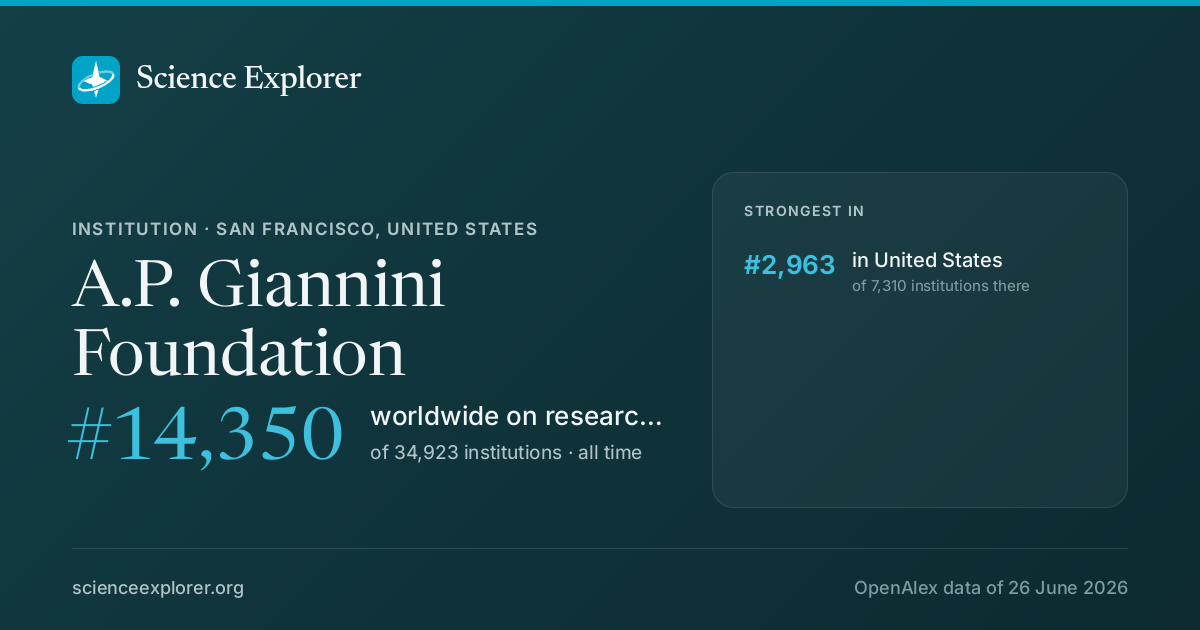
A.P. Giannini Foundation on Science Explorer

A card with A.P. Giannini Foundation's standing and the fields it leads in, for a post or a slide. A link to this page previews as the same card.

Download the card

1200 × 630 PNG, sized for social posts, drawn from the latest snapshot.

Badges for a website1Each links back here and updates with every snapshot

Research measures only: rankings here say nothing about teaching, admissions or student experience. Comparable institutions and collaboration partners have tabs of their own, above.

Discussion

Ask a question or share a note about A.P. Giannini Foundation. Posts are plain text and can be reported.