Bechtel (United States)

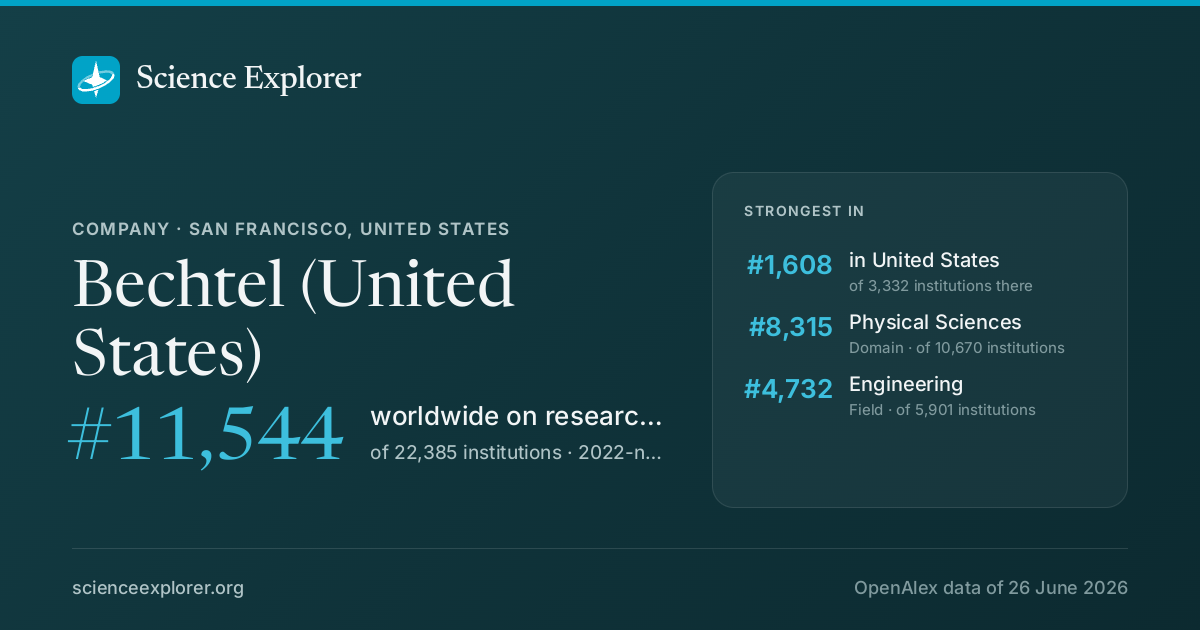
In research, Bechtel (United States) stands highest in Physical Sciences (#8,315 of 10,670 worldwide) and Engineering (#4,732 of 5,901 worldwide), 2022-now.
- World rank, 2022-now
- #11,544 of 22,385 · #5,606 all time
- Rank in United States
- #1,608 of 3,332
- Research works
- 2.6k ◆ 1% vs 2018-21
- Citations
- 27k 10.3 per fractional work
- Top-10% rate
- 4.8% all institutions 10.0%
- vs its own fields
- 0.88× 1.00× is exactly expected
- Open access
- 18% world 40%
- International
- 13% world 18%
What is Bechtel (United States) known for in research?
The fields where it stands highest, 2022-now, ranked among every institution above the floor in each field.
| Field | World rank | Where that sits | Top-10% rate | Works | All time |
|---|---|---|---|---|---|
| Physical SciencesDomain | #8,315 of 10,670 | 1.4% | 96 | #3918 | |
| EngineeringField | #4,732 of 5,901 | 1.2% | 70 | #3892 |
Each strip is that field's whole ranked pool, with the notch where Bechtel (United States) sits in it, in the colour of the band that rank falls in. The track under the rate is the rate itself: it carries no average mark, because the average differs by field (from about 6% in Dentistry to 21% in Economics).
Which fields of science does Bechtel (United States) work in?
In 2022-now, 57% of research at Bechtel (United States) is in Physical Sciences, 28% in Social Sciences. Its largest fields are Engineering (41%), Social Sciences (11%), Arts and Humanities (10%). It does 1.4× the world's share of Physical Sciences.
Each ring splits the one inside it: the four domains of science, their fields, their subfields. Size is fractional works in 2022-now. Every slice is a page; the interactive view zooms down to single topics and colours each by how much more of it this institution does than the world.
Its 4 domains and 26 fields, with their numbers
- Physical Sciences10456.8%
- Engineering7540.8%
- Materials Science74.0%
- Energy63.3%
- Environmental Science52.9%
- Computer Science52.7%
- Chemical Engineering20.9%
- Earth and Planetary Sciences10.7%
- Chemistry10.6%
- Physics and Astronomy10.6%
- Mathematics10.4%
- Social Sciences5228.3%
- Social Sciences2111.3%
- Arts and Humanities189.6%
- Psychology52.8%
- Business, Management and Accounting42.0%
- Economics, Econometrics and Finance31.6%
- Decision Sciences20.9%
- Health Sciences1910.5%
- Medicine158.2%
- Health Professions41.9%
- Nursing00.2%
- Dentistry00.0%
- Veterinary00.0%
- Life Sciences84.4%
Field profile
Location quotient across every field it publishes in: outside the ring is more than an institution of this size would be expected to publish, inside it is less.
Rings at 0.5×, 1× and 2×. Widest outward: Energy, 3.6×. Every wedge is a field page.
All 26 fields, with their numbers
- Energy3.56×6 works
- Arts and Humanities3.34×18 works
- Engineering2.72×75 works
- Chemical Engineering2.60×2 works
- Materials Science1.15×7 works
- Decision Sciences0.95×2 works
- Psychology0.92×5 works
- Social Sciences0.89×21 works
- Economics, Econometrics and Finance0.76×3 works
- Health Professions0.73×4 works
- Business, Management and Accounting0.62×4 works
- Neuroscience0.60×2 works
- Environmental Science0.59×5 works
- Pharmacology, Toxicology and Pharmaceutics0.51×0 works
- Nursing0.49×0 works
- Medicine0.43×15 works
- Earth and Planetary Sciences0.42×1 works
- Chemistry0.40×1 works
- Computer Science0.34×5 works
- Agricultural and Biological Sciences0.32×3 works
- Mathematics0.31×1 works
- Immunology and Microbiology0.30×1 works
- Biochemistry, Genetics and Molecular Biology0.27×3 works
- Veterinary0.27×0 works
- Physics and Astronomy0.25×1 works
- Dentistry0.09×0 works
- Energy 3.6×
- Arts and Humanities 3.3×
- Engineering 2.7×
- Chemical Engineering 2.6×
- Materials Science 1.1×
- Decision Sciences 0.9×
- Psychology 0.9×
- Social Sciences 0.9×
- Economics, Econometrics and Finance 0.8×
- Health Professions 0.7×
- Business, Management and Accounting 0.6×
- Neuroscience 0.6×
- Environmental Science 0.6×
- Pharmacology, Toxicology and Pharmaceutics 0.5×
- Nursing 0.5×
- Medicine 0.4×
- Earth and Planetary Sciences 0.4×
- Chemistry 0.4×
- Computer Science 0.3×
- Agricultural and Biological Sciences 0.3×
- Mathematics 0.3×
- Immunology and Microbiology 0.3×
- Biochemistry, Genetics and Molecular Biology 0.3×
- Veterinary 0.3×
- Physics and Astronomy 0.2×
- Dentistry 0.1×
Who are the top researchers at Bechtel (United States)?
Ranked on the quality score, Yifan Zheng, Luis M. Moreschi and Stewart W. Taylor lead among researchers whose main affiliation is Bechtel (United States).
- 1
Yifan Zheng
 United States · #333,707 worldwide
5k citations · 111 works
- 2
Luis M. Moreschi
United States · #1,612,066 worldwide
1.1k citations · 19 works
- 3
Stewart W. Taylor
United States · #1,659,103 worldwide
1.1k citations · 33 works
- 4
Caspar W. Weinberger
United States · #2,309,141 worldwide
461 citations · 46 works
- 5
Yozo Mikata
United States · #2,596,157 worldwide
1.1k citations · 114 works
- 6
Sungjin Bae
United States · #2,911,788 worldwide
667 citations · 25 works
- 7
Roger D. Flanagan
United States · #2,977,487 worldwide
532 citations · 24 works
- 8
B.V. Cockeram
United States · #3,155,819 worldwide
2k citations · 74 works
- 9
C. Thomas Conroy
United States · #3,222,941 worldwide
413 citations · 15 works
- 10
Peter Q. Leung
United States · #3,229,053 worldwide
404 citations · 67 works
Which keywords describe research at Bechtel (United States)?
By fractional works in 2022-now, weighted toward what it does more of than the world: Renewable Energy, Finite Element Analysis, Heat Transfer, Sustainability, Environmental Impact, Identity, Energy Storage and Numerical Simulation.
- Control Strategies
- Waste Heat Recovery
- Fracture Mechanisms
- Bildung
- Religious Practices
- Loosening Mechanism
- Medieval Architecture
- Cultural History
- Humanities
- Greenhouse Gas Emissions
- Adsorbent Materials
- Renewable Resources
- Failure Analysis
- Thermodynamic Analysis
- Gender
- Mechanical Properties
- Energy Efficiency
- Identity
- Heat Transfer
- Sustainability
- Renewable Energy
- Environmental Impact
- Finite Element Analysis
- Energy Storage
- Sustainable Development
- Numerical Simulation
- Energy Transition
- Cultural Identity
- Large-Eddy Simulation
- Carbon Dioxide Capture
- CO2 Capture Technology
- Hydrogen
- Intellectual History
- Electrolysis
- Power-to-Gas
- Medieval Literature
- Threaded Fasteners
- Fatigue Fracture
- Organic Rankine Cycle
- Autorschaft
Size is fractional works in 2022-now in the topics tagged with each word; colour is the word's share of this institution's work against its share of the world's. The 40 words are chosen for being large and distinctive. Each links to the topic it comes from most.
All 40 words, with their numbers
- Renewable Energy13▲ 4.9×18 topics
- Sustainability10▲ 2.3×19 topics
- Environmental Impact9▲ 2.8×17 topics
- Heat Transfer6▲ 7.2×12 topics
- Finite Element Analysis6▲ 15×8 topics
- Identity6▲ 4.8×15 topics
- Energy Storage6▲ 5.0×4 topics
- Energy Efficiency5▲ 2.9×12 topics
- Sustainable Development5▲ 1.72×11 topics
- Mechanical Properties4▲ 2.4×14 topics
- Numerical Simulation4▲ 8.3×9 topics
- Gender4▲ 4.4×9 topics
- Energy Transition4▲ 15×3 topics
- Thermodynamic Analysis4▲ 33×2 topics
- Cultural Identity3▲ 3.6×8 topics
- Failure Analysis3▲ 19×4 topics
- Large-Eddy Simulation3▲ 9.4×4 topics
- Renewable Resources3▲ 9.2×3 topics
- Carbon Dioxide Capture3▲ 18×2 topics
- Adsorbent Materials3▲ 41×1 topic
- CO2 Capture Technology3▲ 41×1 topic
- Greenhouse Gas Emissions3▲ 5.6×4 topics
- Hydrogen3▲ 18×2 topics
- Humanities3▲ 55×2 topics
- Intellectual History3▲ 52×2 topics
- Cultural History2▲ 11×2 topics
- Electrolysis2▲ 21×1 topic
- Medieval Architecture2▲ 70×2 topics
- Power-to-Gas2▲ 21×1 topic
- Loosening Mechanism2▲ 143×1 topic
- Medieval Literature2▲ 70×1 topic
- Religious Practices2▲ 31×1 topic
- Threaded Fasteners2▲ 143×1 topic
- Bildung2▲ 39×2 topics
- Fatigue Fracture2▲ 105×1 topic
- Fracture Mechanisms2▲ 105×1 topic
- Organic Rankine Cycle2▲ 54×1 topic
- Waste Heat Recovery2▲ 22×1 topic
- Autorschaft2▲ 60×1 topic
- Control Strategies2▲ 8.6×4 topics
Which research topics does Bechtel (United States) publish most on?
By volume in 2022-now: Carbon Dioxide Capture Technologies, Hybrid Renewable Energy Systems, Historical, Literary, and Cultural Studies and Engineering Structural Analysis Methods.
Area is fractional works; colour is the subfield each topic belongs to.
- 1 Carbon Dioxide Capture Technologies Mechanical Engineering 3 works
- 2 Hybrid Renewable Energy Systems Energy Engineering and Power Technology 2 works
- 3 Historical, Literary, and Cultural Studies Classics 2 works
- 4 Engineering Structural Analysis Methods Mechanical Engineering 2 works
- 5 Thermodynamic and Exergetic Analyses of Power and Cooling Systems Mechanical Engineering 2 works
- 6 Mechanical Failure Analysis and Simulation Mechanical Engineering 2 works
- 7 German Literature and Culture Studies Literature and Literary Theory 2 works
- 8 Medieval European History and Architecture Archeology 2 works
- 9 Spacecraft and Cryogenic Technologies Aerospace Engineering 2 works
- 10 Fatigue and fracture mechanics Mechanics of Materials 2 works
How open and international is its research?
Against the world's own shares: the tick on each track. Both are shares of its output, so they sit on one scale and can be read against each other as well as against the world.
World: 40% of research is openly available.
World: 18% is written across borders.
How has Bechtel (United States)'s research output changed?
Output in 2022-2025 was 1% lower than in 2018-2021.
The same series as a ribbon: one cell per year, darker for more. The line above answers how much; this answers when.
Its share of all research
Growing output can still be a shrinking share: all of science grows. This is Bechtel (United States) as a percentage of every work published that year, 0.00076% in 2024.
Fractional works of Bechtel (United States) over all fractional works that year. How the balance of science has shifted.
How much of it reaches the world top 10%
Year by year, against all institutions in the same year.
Of each year's output, the share that reached the world's 10% most cited for its field and year. Peak 10.9% in 2000.
Other research institutions in San Francisco
- University of California, San Francisco
- San Francisco State University
- University of San Francisco
- Institute on Aging
- Golden Gate University
- University of California Hastings College of the Law
- Cal Humanities
- Gladstone Institutes

Share Bechtel (United States)'s ranking
Badges for a website1Each links back here and updates with every snapshot

Research measures only: rankings here say nothing about teaching, admissions or student experience. Comparable institutions and collaboration partners have tabs of their own, above.
Discussion
Ask a question or share a note about Bechtel (United States). Posts are plain text and can be reported.