- World rank, all time
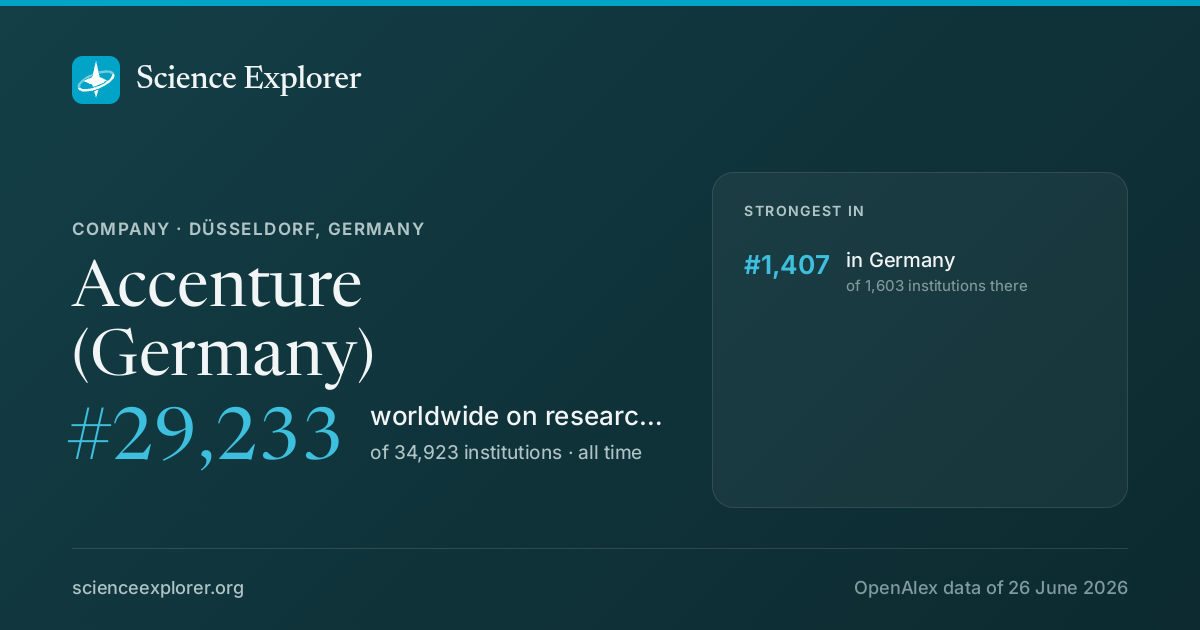
- #29,233 of 34,923
- Rank in Germany
- #1,407 of 1,603
- Research works
- 146 ▲ 38% vs 2018-21
- Citations
- 1.1k 7.7 per fractional work
- Top-10% rate
- 8.2% all institutions 10.0%
- vs its own fields
- 1.00× 1.00× is exactly expected
- Open access
- 13% world 40%
- International
- 25% world 18%
Which fields of science does Accenture (Germany) work in?
In 2022-now, 52% of research at Accenture (Germany) is in Social Sciences, 41% in Physical Sciences. Its largest fields are Business, Management and Accounting (36%), Engineering (26%), Social Sciences (11%). It does 1.8× the world's share of Social Sciences.
Each ring splits the one inside it: the four domains of science, their fields, their subfields. Size is fractional works in 2022-now. Every slice is a page; the interactive view zooms down to single topics and colours each by how much more of it this institution does than the world.
Its 4 domains and 20 fields, with their numbers
- Social Sciences1751.6%
- Business, Management and Accounting1235.9%
- Social Sciences410.6%
- Arts and Humanities12.6%
- Decision Sciences01.1%
- Psychology00.8%
- Economics, Econometrics and Finance00.6%
- Physical Sciences1440.6%
- Engineering925.6%
- Computer Science25.3%
- Environmental Science13.6%
- Mathematics13.0%
- Chemistry01.0%
- Materials Science00.6%
- Chemical Engineering00.5%
- Energy00.5%
- Earth and Planetary Sciences00.3%
- Physics and Astronomy00.2%
- Health Sciences24.5%
- Medicine14.4%
- Health Professions00.1%
- Life Sciences13.2%
Field profile
Location quotient across every field it publishes in: outside the ring is more than an institution of this size would be expected to publish, inside it is less.
Rings at 0.5×, 1× and 2×. Widest outward: Business, Management and Accounting, 11.2×. Every wedge is a field page.
All 20 fields, with their numbers
- Business, Management and Accounting11.15×12 works
- Mathematics2.56×1 works
- Engineering1.71×8 works
- Chemical Engineering1.44×0 works
- Decision Sciences1.08×0 works
- Arts and Humanities0.90×1 works
- Social Sciences0.84×4 works
- Environmental Science0.73×1 works
- Computer Science0.68×2 works
- Chemistry0.64×0 works
- Biochemistry, Genetics and Molecular Biology0.58×1 works
- Energy0.49×0 works
- Psychology0.28×0 works
- Economics, Econometrics and Finance0.27×0 works
- Medicine0.23×2 works
- Earth and Planetary Sciences0.21×0 works
- Materials Science0.18×0 works
- Immunology and Microbiology0.12×0 works
- Physics and Astronomy0.06×0 works
- Health Professions0.05×0 works
- Business, Management and Accounting 11.2×
- Mathematics 2.6×
- Engineering 1.7×
- Chemical Engineering 1.4×
- Decision Sciences 1.1×
- Arts and Humanities 0.9×
- Social Sciences 0.8×
- Environmental Science 0.7×
- Computer Science 0.7×
- Chemistry 0.6×
- Biochemistry, Genetics and Molecular Biology 0.6×
- Energy 0.5×
- Psychology 0.3×
- Economics, Econometrics and Finance 0.3×
- Medicine 0.2×
- Earth and Planetary Sciences 0.2×
- Materials Science 0.2×
- Immunology and Microbiology 0.1×
- Physics and Astronomy 0.1×
- Health Professions 0.1×
Who are the top researchers at Accenture (Germany)?
Ranked on the quality score, Andreas Pfeifer, Andreas Schüler and Svenja Falk lead among researchers whose main affiliation is Accenture (Germany).
- 1
Andreas Pfeifer
 Germany · #2,623,517 worldwide
1k citations · 157 works
- 2
Andreas Schüler
Germany · #3,982,248 worldwide
94 citations · 61 works
- 3
Svenja Falk
Germany · #4,195,200 worldwide
374 citations · 52 works
Which keywords describe research at Accenture (Germany)?
By fractional works in 2022-now, weighted toward what it does more of than the world: Big Data, Digital Transformation, Sustainable Development, E-commerce, Customer Experience, Business Models, Artificial Intelligence and Mobile Health.
- Kinetic Theory
- Cryptogenic Stroke
- Innovation
- Organizational Performance
- Value Chains
- Leadership
- Reconfigurable Manufacturing Systems
- Flexible Automation
- Teacher Education
- Qualitative Inhaltsanalyse
- Supply Chain Management
- Mobile Health
- Artificial Intelligence
- Customer Experience
- Digital Transformation
- Big Data
- Sustainable Development
- E-commerce
- Business Models
- Technology Innovation
- Sustainability
- Education
- Competence
- Learning
- Electric Vehicles
- Information Technology
- Internet of Things
- Employee Engagement
- Boltzmann Equation
- Environmental Management
- Patent Foramen Ovale
Size is fractional works in 2022-now in the topics tagged with each word; colour is the word's share of this institution's work against its share of the world's. The 31 words are chosen for being large and distinctive. Each links to the topic it comes from most.
All 31 words, with their numbers
- Big Data5▲ 16×5 topics
- Digital Transformation4▲ 24×2 topics
- Sustainable Development4▲ 7.5×5 topics
- Customer Experience4▲ 70×2 topics
- E-commerce4▲ 20×4 topics
- Artificial Intelligence4▲ 7.6×2 topics
- Business Models4▲ 147×2 topics
- Mobile Health4▲ 72×1 topic
- Technology Innovation4▲ 309×1 topic
- Supply Chain Management3▲ 8.6×7 topics
- Sustainability3▲ 3.2×9 topics
- Qualitative Inhaltsanalyse2▲ 171×2 topics
- Education2▲ 3.7×3 topics
- Teacher Education2▲ 49×2 topics
- Competence2▲ 522×1 topic
- Flexible Automation2▲ 235×1 topic
- Learning2▲ 20×1 topic
- Reconfigurable Manufacturing Systems2▲ 235×1 topic
- Electric Vehicles2▲ 19×3 topics
- Leadership2▲ 9.6×5 topics
- Information Technology1▲ 8.8×1 topic
- Value Chains1▲ 239×1 topic
- Internet of Things1▲ 4.1×4 topics
- Organizational Performance1▲ 14×4 topics
- Employee Engagement1▲ 18×2 topics
- Innovation1▲ 3.2×3 topics
- Boltzmann Equation1▲ 143×1 topic
- Cryptogenic Stroke1▲ 171×1 topic
- Environmental Management1▲ 7.4×2 topics
- Kinetic Theory1▲ 67×1 topic
- Patent Foramen Ovale1▲ 171×1 topic
Which research topics does Accenture (Germany) publish most on?
By volume in 2022-now: Digital Innovation in Industries, Flexible and Reconfigurable Manufacturing Systems, Education Methods and Technologies and Corporate Governance and Management.
Area is fractional works; colour is the subfield each topic belongs to.
- 1 Digital Innovation in Industries Management of Technology and Innovation 4 works
- 2 Flexible and Reconfigurable Manufacturing Systems Industrial and Manufacturing Engineering 2 works
- 3 Education Methods and Technologies Education 2 works
- 4 Corporate Governance and Management Strategy and Management 1 works
- 5 Gas Dynamics and Kinetic Theory Applied Mathematics 1 works
- 6 Cardiovascular and Diving-Related Complications Pulmonary and Respiratory Medicine 1 works
- 7 Big Data and Business Intelligence Management Information Systems 1 works
- 8 Corporate Management and Leadership Organizational Behavior and Human Resource Management 1 works
- 9 Libraries and Information Services Museology 1 works
- 10 Information Technology Governance and Strategy Management Information Systems 1 works
How open and international is its research?
Against the world's own shares: the tick on each track. Both are shares of its output, so they sit on one scale and can be read against each other as well as against the world.
World: 40% of research is openly available.
World: 18% is written across borders.
How has Accenture (Germany)'s research output changed?
Output in 2022-2025 was 38% higher than in 2018-2021.
The same series as a ribbon: one cell per year, darker for more. The line above answers how much; this answers when.
Its share of all research
Growing output can still be a shrinking share: all of science grows. This is Accenture (Germany) as a percentage of every work published that year, 0.00012% in 2024.
Fractional works of Accenture (Germany) over all fractional works that year. How the balance of science has shifted.
Other research institutions in Düsseldorf
- Heinrich Heine University Düsseldorf
- Hochschule Düsseldorf University of Applied Sciences
- Henkel (Germany)
- Nippon Steel (Germany)
- Mitsui Chemicals (Germany)
- Huawei Technologies (Germany)
- Asahi Kasei (Germany)
- Vodafone (Germany)
Share Accenture (Germany)'s ranking
Badges for a website1Each links back here and updates with every snapshot

Research measures only: rankings here say nothing about teaching, admissions or student experience. Comparable institutions and collaboration partners have tabs of their own, above.
Discussion
Ask a question or share a note about Accenture (Germany). Posts are plain text and can be reported.