Science Explorer Back to mapMap
Discussion

AZ Technology (United States)

World rank, all time
#24,618
of 34,923
Rank in United States
#5,124
of 7,310
Research works
140
▲ 64% vs 2018-21
Citations
2.9k
20.6 per fractional work
Top-10% rate
28.2%
all institutions 10.0%
vs its own fields
1.07×
1.00× is exactly expected
Open access
32%
world 40%
International
18%
world 18%

Which fields of science does AZ Technology (United States) work in?

In 2022-now, 48% of research at AZ Technology (United States) is in Physical Sciences, 24% in Life Sciences. Its largest fields are Engineering (26%), Social Sciences (20%), Biochemistry, Genetics and Molecular Biology (15%). It does 1.4× the world's share of Life Sciences.

Physical Sciences: 11 fractional works · 48.2% of its workEngineering: 6 fractional works · 25.7% of its workBiomedical Engineering: 2 fractional works · 7.7% of its workAerospace Engineering: 1 fractional works · 6.5% of its workBuilding and Construction: 1 fractional works · 3.5% of its workElectrical and Electronic Engineering: 1 fractional works · 2.7% of its workIndustrial and Manufacturing Engineering: 0 fractional works · 2.2% of its workMechanics of Materials: 0 fractional works · 0.8% of its workOcean Engineering: 0 fractional works · 0.8% of its workSafety, Risk, Reliability and Quality: 0 fractional works · 0.5% of its workComputational Mechanics: 0 fractional works · 0.3% of its workControl and Systems Engineering: 0 fractional works · 0.3% of its workMechanical Engineering: 0 fractional works · 0.3% of its workMedia Technology: 0 fractional works · 0.3% of its workEnergy: 2 fractional works · 6.9% of its workRenewable Energy, Sustainability and the Environment: 2 fractional works · 6.9% of its workEnvironmental Science: 1 fractional works · 6.1% of its workEnvironmental Engineering: 1 fractional works · 2.5% of its workEcology: 0 fractional works · 1.2% of its workWater Science and Technology: 0 fractional works · 1.0% of its workEnvironmental Chemistry: 0 fractional works · 0.8% of its workManagement, Monitoring, Policy and Law: 0 fractional works · 0.8% of its workComputer Science: 1 fractional works · 4.4% of its workArtificial Intelligence: 0 fractional works · 2.2% of its workComputer Networks and Communications: 0 fractional works · 2.2% of its workMaterials Science: 0 fractional works · 2.0% of its workSurfaces, Coatings and Films: 0 fractional works · 0.9% of its workBiomaterials: 0 fractional works · 0.6% of its workElectronic, Optical and Magnetic Materials: 0 fractional works · 0.5% of its workPhysics and Astronomy: 0 fractional works · 2.0% of its workAstronomy and Astrophysics: 0 fractional works · 1.5% of its workAtomic and Molecular Physics, and Optics: 0 fractional works · 0.5% of its workMathematics: 0 fractional works · 0.8% of its workModeling and Simulation: 0 fractional works · 0.8% of its workChemical Engineering: 0 fractional works · 0.3% of its workFluid Flow and Transfer Processes: 0 fractional works · 0.3% of its workLife Sciences: 5 fractional works · 24.1% of its workBiochemistry, Genetics and Molecular Biology: 3 fractional works · 15.1% of its workMolecular Biology: 3 fractional works · 12.6% of its workGenetics: 0 fractional works · 1.8% of its workBiotechnology: 0 fractional works · 0.8% of its workAgricultural and Biological Sciences: 2 fractional works · 9.0% of its workPlant Science: 1 fractional works · 3.1% of its workAgronomy and Crop Science: 0 fractional works · 2.2% of its workEcology, Evolution, Behavior and Systematics: 0 fractional works · 2.2% of its workGeneral Agricultural and Biological Sciences: 0 fractional works · 1.5% of its workSocial Sciences: 5 fractional works · 23.0% of its workSocial Sciences: 4 fractional works · 19.5% of its workEducation: 1 fractional works · 5.9% of its workPolitical Science and International Relations: 1 fractional works · 5.9% of its workCultural Studies: 1 fractional works · 5.2% of its workSociology and Political Science: 0 fractional works · 1.5% of its workTransportation: 0 fractional works · 0.8% of its workCommunication: 0 fractional works · 0.3% of its workEconomics, Econometrics and Finance: 0 fractional works · 2.2% of its workEconomics and Econometrics: 0 fractional works · 2.2% of its workPsychology: 0 fractional works · 1.0% of its workSocial Psychology: 0 fractional works · 1.0% of its workArts and Humanities: 0 fractional works · 0.3% of its workLiterature and Literary Theory: 0 fractional works · 0.3% of its workHealth Sciences: 1 fractional works · 4.7% of its workMedicine: 1 fractional works · 3.9% of its workEpidemiology: 0 fractional works · 0.8% of its workRehabilitation: 0 fractional works · 0.8% of its workGenetics: 0 fractional works · 0.5% of its workRadiology, Nuclear Medicine and Imaging: 0 fractional works · 0.5% of its workPhysiology: 0 fractional works · 0.4% of its workCardiology and Cardiovascular Medicine: 0 fractional works · 0.3% of its workPsychiatry and Mental health: 0 fractional works · 0.3% of its workInfectious Diseases: 0 fractional works · 0.2% of its workSurgery: 0 fractional works · 0.2% of its workSmaller subfields together: 0 fractional works · 0.1% of its workHealth Professions: 0 fractional works · 0.8% of its workEmergency Medical Services: 0 fractional works · 0.8% of its workALL ITS WORKAZ Technology(United States)23fractional works, 2022-now
Life Sciences24%Physical Sciences48%Health Sciences5%Social Sciences23%

Each ring splits the one inside it: the four domains of science, their fields, their subfields. Size is fractional works in 2022-now. Every slice is a page; the interactive view zooms down to single topics and colours each by how much more of it this institution does than the world.

Its 4 domains and 16 fields, with their numbers
    1. Engineering625.7%
    2. Energy26.9%
    3. Environmental Science16.1%
    4. Computer Science14.4%
    5. Materials Science02.0%
    6. Physics and Astronomy02.0%
    7. Mathematics00.8%
    8. Chemical Engineering00.3%
    1. Biochemistry, Genetics and Molecular Biology315.1%
    2. Agricultural and Biological Sciences29.0%
    1. Social Sciences419.5%
    2. Economics, Econometrics and Finance02.2%
    3. Psychology01.0%
    4. Arts and Humanities00.3%
    1. Medicine13.9%
    2. Health Professions00.8%
All of science, and how each field's share has moved since 1950: the Science domain explorer

Field profile

Location quotient across every field it publishes in: outside the ring is more than an institution of this size would be expected to publish, inside it is less.

Agricultural and Biological Sciences: 1.90× its world share, 2 worksAgricultural and Bio…Biochemistry, Genetics and Molecular Biology: 2.84× its world share, 3 worksBiochemistry, Geneti…Chemical Engineering: 0.85× its world share, 0 worksChemical EngineeringComputer Science: 0.57× its world share, 1 worksComputer ScienceEnergy: 7.51× its world share, 2 worksEnergyEngineering: 1.71× its world share, 6 worksEngineeringEnvironmental Science: 1.22× its world share, 1 worksEnvironmental ScienceMaterials Science: 0.59× its world share, 0 worksMaterials ScienceMathematics: 0.63× its world share, 0 worksMathematicsPhysics and Astronomy: 0.89× its world share, 0 worksPhysics and AstronomyHealth Professions: 0.28× its world share, 0 worksHealth ProfessionsMedicine: 0.20× its world share, 1 worksMedicineArts and Humanities: 0.10× its world share, 0 worksArts and HumanitiesEconomics, Econometrics and Finance: 1.04× its world share, 0 worksEconomics, Econometr…Psychology: 0.32× its world share, 0 worksPsychologySocial Sciences: 1.54× its world share, 4 worksSocial Sciences1×world share
more than its size predictsabout as predictedless

Rings at 0.5×, 1× and 2×. Widest outward: Energy, 7.5×. Every wedge is a field page.

All 16 fields, with their numbers
  1. Energy7.51×2 works
  2. Biochemistry, Genetics and Molecular Biology2.84×3 works
  3. Agricultural and Biological Sciences1.90×2 works
  4. Engineering1.71×6 works
  5. Social Sciences1.54×4 works
  6. Environmental Science1.22×1 works
  7. Economics, Econometrics and Finance1.04×0 works
  8. Physics and Astronomy0.89×0 works
  9. Chemical Engineering0.85×0 works
  10. Mathematics0.63×0 works
  11. Materials Science0.59×0 works
  12. Computer Science0.57×1 works
  13. Psychology0.32×0 works
  14. Health Professions0.28×0 works
  15. Medicine0.20×1 works
  16. Arts and Humanities0.10×0 works

Who are the top researchers at AZ Technology (United States)?

Ranked on the quality score, Séan Dennis Simpson, Michael Köpke and Alexander P. Mueller lead among researchers whose main affiliation is AZ Technology (United States).

  1. 1 Séan Dennis Simpson United States · #72,486 worldwide 6.8k citations · 69 works
  2. 2 Michael Köpke United States · #78,207 worldwide 6.7k citations · 91 works
  3. 3 Alexander P. Mueller United States · #1,045,450 worldwide 1.3k citations · 19 works
  4. 4 James Daniell United States · #1,270,551 worldwide 1.4k citations · 22 works
  5. 5 Hood Chatham United States · #1,373,416 worldwide 1.2k citations · 72 works
  6. 6 David G. Crandall United States · #3,778,510 worldwide 121 citations · 15 works
  7. 7 Richard J. Mell United States · #4,373,875 worldwide 18 citations · 15 works
  8. 8 Donald R. Wilkes United States · #5,524,100 worldwide 57 citations · 36 works
All ranked researchers at AZ Technology (United States)

What are the most cited papers from AZ Technology (United States)?

The most cited paper from AZ Technology (United States) is "A genomic catalog of Earth’s microbiomes" (Stephen Nayfach et al., 2020), with 1,007 citations. Next come "Carbon-negative production of acetone and isopropanol by gas fermentation at industrial pilot scale" (501) and "Gas Fermentation—A Flexible Platform for Commercial Scale Production of Low-Carbon-Fuels and Chemicals from Waste and Renewable Feedstocks" (497).

Most cited papers
#PaperReleasedCitations
1 A genomic catalog of Earth’s microbiomes Stephen Nayfach et al. · Nature Biotechnology Open access267 authors 9 Nov 2020 1,007
2 Carbon-negative production of acetone and isopropanol by gas fermentation at industrial pilot scale Fungmin Eric Liew et al. · Nature Biotechnology Open access 21 Feb 2022 501
3 Gas Fermentation—A Flexible Platform for Commercial Scale Production of Low-Carbon-Fuels and Chemicals from Waste and Renewable Feedstocks Fungmin Eric Liew, Michael E. Martin, Ryan C. Tappel et al. · Frontiers in Microbiology Open access 10 May 2016 497
4 Energy Efficient Medium Access Protocol for Wireless Medical Body Area Sensor Networks O. Omeni, Alan Chi Wai Wong, Alison J. Burdett et al. · IEEE Transactions on Biomedical Circuits and Systems 25 Nov 2008 327
5 In vitro prototyping and rapid optimization of biosynthetic enzymes for cell design Ashty S. Karim, Quentin M. Dudley, Alex Juminaga et al. · Nature Chemical Biology Open access 15 Jun 2020 262
All 60 most cited papers, with filters and sorting

Which keywords describe research at AZ Technology (United States)?

By fractional works in 2022-now, weighted toward what it does more of than the world: Curriculum Development, Hydrogen Production, Microbial Community, Bioenergy, Biodiesel, Data Integration, Semantic Web and Renewable Energy.

▲ more of its work than of the world's◆ about the world's share▼ less than the world's

Size is fractional works in 2022-now in the topics tagged with each word; colour is the word's share of this institution's work against its share of the world's. The 8 words are chosen for being large and distinctive. Each links to the topic it comes from most.

All 8 words, with their numbers
  1. Curriculum Development1▲ 9.2×5 topics
  2. Hydrogen Production1▲ 22×2 topics
  3. Microbial Community1▲ 67×2 topics
  4. Renewable Energy1▲ 3.8×3 topics
  5. Bioenergy1▲ 89×2 topics
  6. Biodiesel1▲ 52×2 topics
  7. Data Integration1▲ 26×2 topics
  8. Semantic Web1▲ 46×2 topics

Which research topics does AZ Technology (United States) publish most on?

By volume in 2022-now: Biofuel production and bioconversion, Microbial Metabolic Engineering and Bioproduction, Algal biology and biofuel production and Anaerobic Digestion and Biogas Production.

  1. 1 Biofuel production and bioconversion Biomedical Engineering 1 works
  2. 2 Microbial Metabolic Engineering and Bioproduction Molecular Biology 1 works
  3. 3 Algal biology and biofuel production Renewable Energy, Sustainability and the Environment 1 works
  4. 4 Anaerobic Digestion and Biogas Production Building and Construction 1 works
  5. 5 Microbial Fuel Cells and Bioremediation Environmental Engineering 1 works
  6. 6 Balkan and Eastern European Studies Economics and Econometrics 0 works
  7. 7 Ruminant Nutrition and Digestive Physiology Agronomy and Crop Science 0 works
  8. 8 Biomedical Text Mining and Ontologies Molecular Biology 0 works
  9. 9 Genetically Modified Organisms Research Plant Science 0 works
  10. 10 Semantic Web and Ontologies Artificial Intelligence 0 works

How open and international is its research?

Against the world's own shares: the tick on each track. Both are shares of its output, so they sit on one scale and can be read against each other as well as against the world.

openly available32.4%not open67.6%

World: 40% of research is openly available.

with international co-authors17.8%domestic only82.2%

World: 18% is written across borders.

How has AZ Technology (United States)'s research output changed?

Output in 2022-2025 was 64% higher than in 2018-2021.

still counting1990200020102020
grewheldshrank

The same series as a ribbon: one cell per year, darker for more. The line above answers how much; this answers when.

Its share of all research

Growing output can still be a shrinking share: all of science grows. This is AZ Technology (United States) as a percentage of every work published that year, 0.00017% in 2024.

still counting0.00050%0.0010%AZ Technology (United States)0.00010% in 202519801990200020102020

Fractional works of AZ Technology (United States) over all fractional works that year. How the balance of science has shifted.

Other research institutions in Huntsville

All research institutions in Huntsville

Share AZ Technology (United States)'s ranking
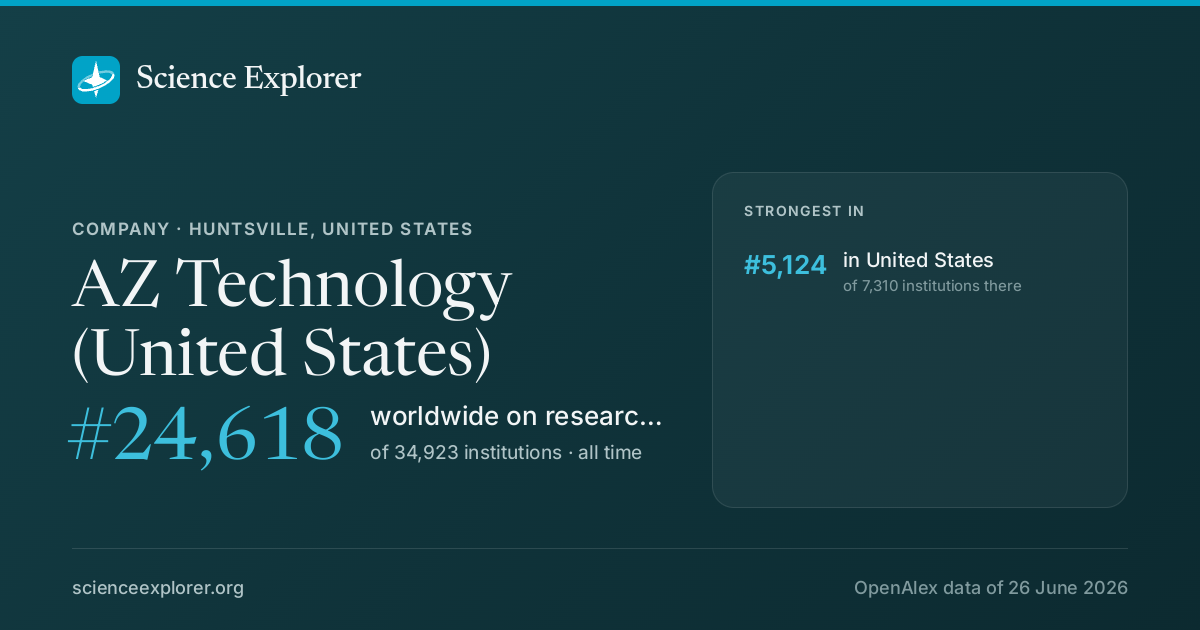
AZ Technology (United States) on Science Explorer

A card with AZ Technology (United States)'s standing and the fields it leads in, for a post or a slide. A link to this page previews as the same card.

Download the card

1200 × 630 PNG, sized for social posts, drawn from the latest snapshot.

Badges for a website1Each links back here and updates with every snapshot

Research measures only: rankings here say nothing about teaching, admissions or student experience. Comparable institutions and collaboration partners have tabs of their own, above.

Discussion

Ask a question or share a note about AZ Technology (United States). Keep it to the research: no personal attacks, advertising or links. Any reader can report a post, which collapses it for everyone until it is opened.