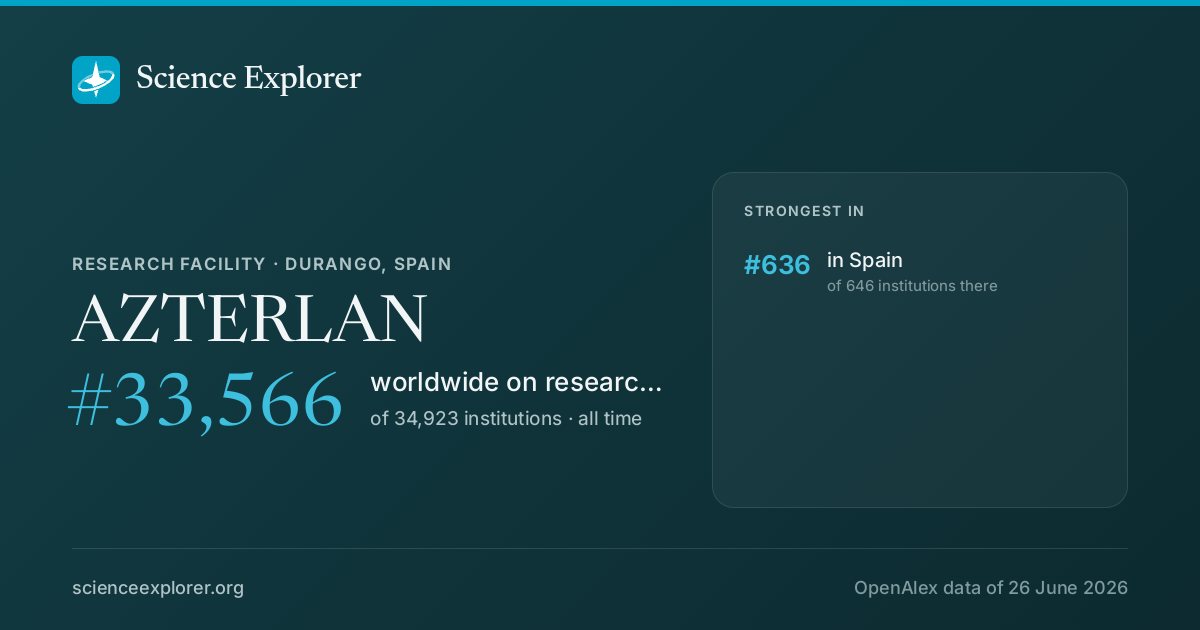
- World rank, all time
- #33,566 of 34,923
- Rank in Spain
- #636 of 646
- Research works
- 122 ▲ 3% vs 2018-21
- Citations
- 1k 8.5 per fractional work
- Top-10% rate
- 5.3% all institutions 10.0%
- vs its own fields
- 0.93× 1.00× is exactly expected
- Open access
- 64% world 40%
- International
- 38% world 18%
Which fields of science does AZTERLAN work in?
In 2022-now, 90% of research at AZTERLAN is in Physical Sciences, 5% in Social Sciences. Its largest fields are Engineering (68%), Materials Science (15%), Computer Science (4%). It does 2.1× the world's share of Physical Sciences.
Each ring splits the one inside it: the four domains of science, their fields, their subfields. Size is fractional works in 2022-now. Every slice is a page; the interactive view zooms down to single topics and colours each by how much more of it this institution does than the world.
Its 4 domains and 14 fields, with their numbers
- Physical Sciences3290.3%
- Engineering2468.1%
- Materials Science515.0%
- Computer Science24.5%
- Environmental Science11.5%
- Physics and Astronomy00.9%
- Earth and Planetary Sciences00.2%
- Social Sciences25.5%
- Psychology13.1%
- Social Sciences11.9%
- Arts and Humanities00.5%
- Health Sciences12.3%
- Health Professions11.5%
- Medicine00.7%
- Life Sciences12.0%
Field profile
Location quotient across every field it publishes in: outside the ring is more than an institution of this size would be expected to publish, inside it is less.
Rings at 0.5×, 1× and 2×. Widest outward: Engineering, 4.5×. Every wedge is a field page.
All 14 fields, with their numbers
- Engineering4.54×24 works
- Materials Science4.30×5 works
- Psychology1.02×1 works
- Computer Science0.57×2 works
- Health Professions0.57×0 works
- Physics and Astronomy0.43×0 works
- Agricultural and Biological Sciences0.30×0 works
- Environmental Science0.30×0 works
- Neuroscience0.26×0 works
- Arts and Humanities0.16×0 works
- Earth and Planetary Sciences0.15×0 works
- Social Sciences0.15×1 works
- Medicine0.04×0 works
- Biochemistry, Genetics and Molecular Biology0.02×0 works
- Engineering 4.5×
- Materials Science 4.3×
- Psychology 1.0×
- Computer Science 0.6×
- Health Professions 0.6×
- Physics and Astronomy 0.4×
- Agricultural and Biological Sciences 0.3×
- Environmental Science 0.3×
- Neuroscience 0.3×
- Arts and Humanities 0.2×
- Earth and Planetary Sciences 0.1×
- Social Sciences 0.1×
- Medicine 0.0×
- Biochemistry, Genetics and Molecular Biology 0.0×
Who are the top researchers at AZTERLAN?
Ranked on the quality score, Rodolfo González-Martínez, Pello Larrañaga and Gorka Alonso lead among researchers whose main affiliation is AZTERLAN.
- 1
Rodolfo González-Martínez
 Spain · #2,387,801 worldwide
1.3k citations · 25 works
- 2
Pello Larrañaga
Spain · #2,956,089 worldwide
532 citations · 24 works
- 3
Gorka Alonso
Spain · #3,471,667 worldwide
562 citations · 34 works
- 4
Ramón Suárez
Spain · #3,760,195 worldwide
438 citations · 40 works
- 5
R. Suárez
Spain · #4,083,304 worldwide
458 citations · 31 works
- 6
Antonio Sánchez-Ruiz
Spain · #4,537,109 worldwide
62 citations · 17 works
- 7
Fernando Santos
Spain · #4,603,742 worldwide
116 citations · 17 works
- 8
Urko de la Torre
Spain · #4,701,929 worldwide
268 citations · 20 works
- 9
Alberto del Saz Fucho
Spain · #4,702,889 worldwide
17 citations · 20 works
- 10
Andrea Niklas
Spain · #4,853,534 worldwide
450 citations · 39 works
Which keywords describe research at AZTERLAN?
By fractional works in 2022-now, weighted toward what it does more of than the world: Mechanical Properties, Microstructure, Grain Refinement, Microstructural Evolution, Corrosion Behavior, Additive Manufacturing, High-Strength Steels and Martensite Transformation.
- Superalloys
- 3D Printing
- Carbon Nanotubes
- Stainless Steels
- Recycling
- Language Acquisition
- Hot Deformation
- Welding
- Hydrogen Embrittlement
- Residual Stress
- Selective Laser Melting
- Heat Transfer
- Tool Steels
- Automotive Industry
- Material Characterization
- Wear Resistance
- Martensite Transformation
- Additive Manufacturing
- Microstructural Evolution
- Microstructure
- Mechanical Properties
- Grain Refinement
- Corrosion Behavior
- High-Strength Steels
- Process Parameters
- Aerospace Applications
- Aluminium Alloys
- Cryogenic Treatment
- Sustainability
- Metallic Components
- Phase Stability
- High Temperature
- Laser Welding
- Dynamic Recrystallization
- Polymer Composites
- Passive Films
- Second Language Learning
- Applications
- Processing Techniques
- High-Temperature Alloys
Size is fractional works in 2022-now in the topics tagged with each word; colour is the word's share of this institution's work against its share of the world's. The 40 words are chosen for being large and distinctive. Each links to the topic it comes from most.
All 40 words, with their numbers
- Mechanical Properties11▲ 33×13 topics
- Microstructure11▲ 58×9 topics
- Grain Refinement5▲ 135×3 topics
- Microstructural Evolution4▲ 82×3 topics
- Corrosion Behavior4▲ 124×3 topics
- Additive Manufacturing3▲ 27×2 topics
- High-Strength Steels3▲ 253×1 topic
- Martensite Transformation3▲ 253×1 topic
- Process Parameters2▲ 68×2 topics
- Wear Resistance2▲ 185×2 topics
- Aerospace Applications2▲ 70×3 topics
- Material Characterization2▲ 60×2 topics
- Aluminium Alloys2▲ 160×1 topic
- Automotive Industry2▲ 160×1 topic
- Cryogenic Treatment2▲ 224×1 topic
- Tool Steels2▲ 224×1 topic
- Sustainability2▲ 2.4×4 topics
- Heat Transfer2▲ 12×3 topics
- Metallic Components2▲ 82×1 topic
- Selective Laser Melting2▲ 82×1 topic
- Phase Stability2▲ 72×2 topics
- Residual Stress2▲ 93×2 topics
- High Temperature2▲ 71×2 topics
- Hydrogen Embrittlement2▲ 53×2 topics
- Laser Welding2▲ 92×1 topic
- Welding2▲ 68×1 topic
- Dynamic Recrystallization1▲ 102×1 topic
- Hot Deformation1▲ 102×1 topic
- Polymer Composites1▲ 16×3 topics
- Language Acquisition1▲ 29×2 topics
- Passive Films1▲ 101×1 topic
- Recycling1▲ 8.7×4 topics
- Second Language Learning1▲ 36×2 topics
- Stainless Steels1▲ 101×1 topic
- Applications1▲ 11×2 topics
- Carbon Nanotubes1▲ 9.5×2 topics
- Processing Techniques1▲ 34×2 topics
- 3D Printing1▲ 13×1 topic
- High-Temperature Alloys1▲ 146×1 topic
- Superalloys1▲ 146×1 topic
Which research topics does AZTERLAN publish most on?
By volume in 2022-now: Microstructure and Mechanical Properties of Steels, Metal Alloys Wear and Properties, Aluminum Alloy Microstructure Properties and Additive Manufacturing Materials and Processes.
Area is fractional works; colour is the subfield each topic belongs to.
- 1 Microstructure and Mechanical Properties of Steels Mechanical Engineering 3 works
- 2 Metal Alloys Wear and Properties Materials Chemistry 2 works
- 3 Aluminum Alloy Microstructure Properties Aerospace Engineering 2 works
- 4 Additive Manufacturing Materials and Processes Mechanical Engineering 2 works
- 5 Welding Techniques and Residual Stresses Mechanical Engineering 2 works
- 6 Metallurgy and Material Forming Mechanics of Materials 1 works
- 7 Hydrogen embrittlement and corrosion behaviors in metals Metals and Alloys 1 works
- 8 Phonetics and Phonology Research Experimental and Cognitive Psychology 1 works
- 9 Aluminum Alloys Composites Properties Mechanical Engineering 1 works
- 10 High Temperature Alloys and Creep Mechanical Engineering 1 works
How open and international is its research?
Against the world's own shares: the tick on each track. Both are shares of its output, so they sit on one scale and can be read against each other as well as against the world.
World: 40% of research is openly available.
World: 18% is written across borders.
How has AZTERLAN's research output changed?
Output in 2022-2025 was 3% higher than in 2018-2021.
The same series as a ribbon: one cell per year, darker for more. The line above answers how much; this answers when.
Its share of all research
Growing output can still be a shrinking share: all of science grows. This is AZTERLAN as a percentage of every work published that year, 0.00016% in 2024.
Fractional works of AZTERLAN over all fractional works that year. How the balance of science has shifted.
Other research institutions in Durango
Share AZTERLAN's ranking
Badges for a website1Each links back here and updates with every snapshot

Research measures only: rankings here say nothing about teaching, admissions or student experience. Comparable institutions and collaboration partners have tabs of their own, above.
Discussion
Ask a question or share a note about AZTERLAN. Keep it to the research: no personal attacks, advertising or links. Any reader can report a post, which collapses it for everyone until it is opened.