Belfast City Council
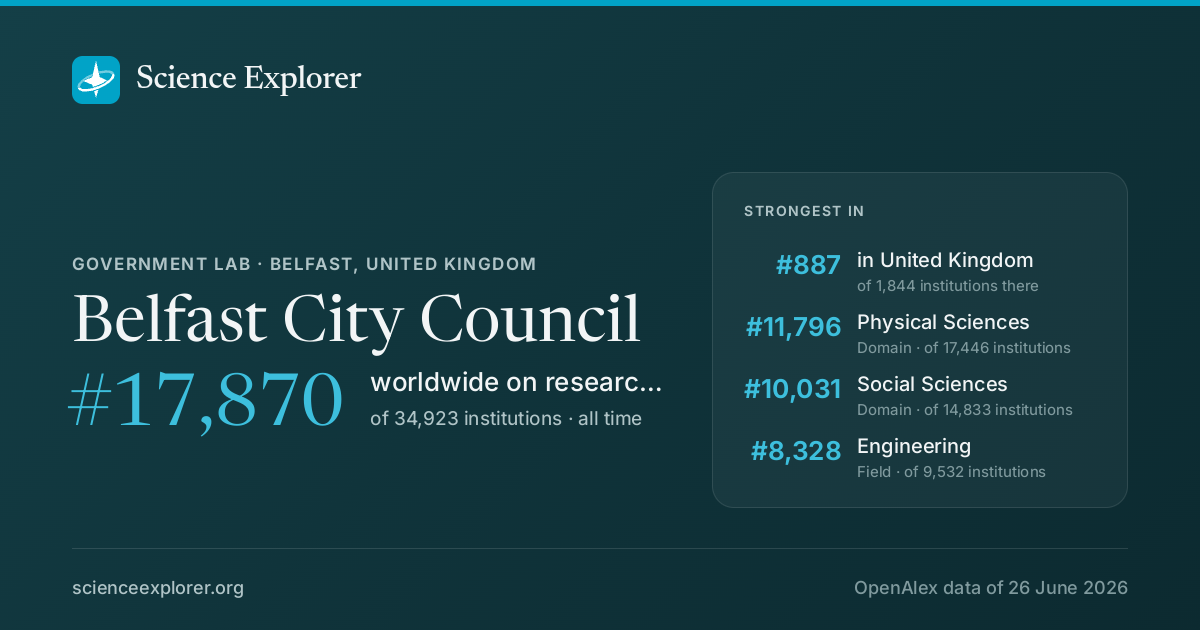
In research, Belfast City Council stands highest in Physical Sciences (#11,796 of 17,446 worldwide), Social Sciences (#10,031 of 14,833 worldwide) and Engineering (#8,328 of 9,532 worldwide), over all time.
- World rank, all time
- #17,870 of 34,923
- Rank in United Kingdom
- #887 of 1,844
- Research works
- 822 ▼ 96% vs 2018-21
- Citations
- 6.2k 7.5 per fractional work
- Top-10% rate
- 6.2% all institutions 10.0%
- vs its own fields
- 0.59× 1.00× is exactly expected
- Open access
- 36% world 40%
- International
- 9% world 18%
What is Belfast City Council known for in research?
The fields where it stands highest, over all time, ranked among every institution above the floor in each field.
| Field | World rank | Where that sits | Top-10% rate | Works |
|---|---|---|---|---|
| Physical SciencesDomain | #11,796 of 17,446 | 7.2% | 461 | |
| Social SciencesDomain | #10,031 of 14,833 | 8.0% | 326 | |
| EngineeringField | #8,328 of 9,532 | 6.7% | 355 |
Each strip is that field's whole ranked pool, with the notch where Belfast City Council sits in it, in the colour of the band that rank falls in. The track under the rate is the rate itself: it carries no average mark, because the average differs by field (from about 6% in Dentistry to 21% in Economics).
Which fields of science does Belfast City Council work in?
In all years, 56% of research at Belfast City Council is in Physical Sciences, 40% in Social Sciences. Its largest fields are Engineering (43%), Social Sciences (14%), Economics, Econometrics and Finance (9%). It does 1.9× the world's share of Social Sciences.
Each ring splits the one inside it: the four domains of science, their fields, their subfields. Size is fractional works in all years. Every slice is a page; the interactive view zooms down to single topics and colours each by how much more of it this institution does than the world.
Its 4 domains and 24 fields, with their numbers
- Physical Sciences46156.1%
- Engineering35543.1%
- Energy354.2%
- Environmental Science313.8%
- Materials Science161.9%
- Computer Science91.1%
- Earth and Planetary Sciences80.9%
- Physics and Astronomy30.4%
- Chemical Engineering20.2%
- Mathematics20.2%
- Chemistry10.2%
- Social Sciences32639.6%
- Social Sciences11914.5%
- Economics, Econometrics and Finance749.0%
- Arts and Humanities465.6%
- Decision Sciences404.9%
- Business, Management and Accounting334.0%
- Psychology131.6%
- Health Sciences222.7%
- Health Professions121.4%
- Medicine101.2%
- Nursing00.0%
- Veterinary00.0%
- Life Sciences131.6%
Field profile
Location quotient across every field it publishes in: outside the ring is more than an institution of this size would be expected to publish, inside it is less.
Rings at 0.5×, 1× and 2×. Widest outward: Veterinary, 4.2×. Every wedge is a field page.
All 15 fields, with their numbers
- Veterinary4.25×0 works
- Environmental Science2.44×1 works
- Arts and Humanities2.33×1 works
- Business, Management and Accounting1.67×0 works
- Social Sciences1.38×1 works
- Engineering1.36×2 works
- Medicine1.36×2 works
- Earth and Planetary Sciences1.29×0 works
- Economics, Econometrics and Finance1.26×0 works
- Decision Sciences1.04×0 works
- Neuroscience1.00×0 works
- Biochemistry, Genetics and Molecular Biology0.38×0 works
- Agricultural and Biological Sciences0.24×0 works
- Psychology0.19×0 works
- Immunology and Microbiology0.14×0 works
- Veterinary 4.2×
- Environmental Science 2.4×
- Arts and Humanities 2.3×
- Business, Management and Accounting 1.7×
- Social Sciences 1.4×
- Engineering 1.4×
- Medicine 1.4×
- Earth and Planetary Sciences 1.3×
- Economics, Econometrics and Finance 1.3×
- Decision Sciences 1.0×
- Neuroscience 1.0×
- Biochemistry, Genetics and Molecular Biology 0.4×
- Agricultural and Biological Sciences 0.2×
- Psychology 0.2×
- Immunology and Microbiology 0.1×
Who are the top researchers at Belfast City Council?
Ranked on the quality score, Sean MacIntyre, Martin Haran and Michael McCord lead among researchers whose main affiliation is Belfast City Council.
- 1
Sean MacIntyre
 United Kingdom · #1,735,007 worldwide
129 citations · 42 works
- 2
Martin Haran
United Kingdom · #2,841,040 worldwide
0 citations · 20 works
- 3
Michael McCord
United Kingdom · #2,845,214 worldwide
0 citations · 35 works
- 4
Martin Hinch
United Kingdom · #2,987,602 worldwide
11 citations · 23 works
- 5
John McCord
United Kingdom · #3,076,890 worldwide
0 citations · 16 works
- 6
David Coyles
United Kingdom · #3,264,521 worldwide
66 citations · 16 works
- 7
Olawumi Fadeyi
United Kingdom · #3,375,161 worldwide
18 citations · 22 works
- 8
Saul Golden
United Kingdom · #3,419,811 worldwide
18 citations · 30 works
- 9
Paul Clarke
United Kingdom · #3,856,322 worldwide
100 citations · 54 works
- 10
Sharon McClements
United Kingdom · #4,017,247 worldwide
18 citations · 18 works
Which keywords describe research at Belfast City Council?
By fractional works in all years, weighted toward what it does more of than the world: Sustainability, Risk Management, Urban Development, Energy Efficiency, Construction, Facilities Management, Renewable Energy and Neoliberalism.
- Life Cycle Assessment
- Project Success
- Construction Projects
- Sustainable Buildings
- Climate Change Impact
- Energy Simulation
- Cultural Heritage
- Housing
- Tunnel Fires
- Ventilation Systems
- Detonation Propulsion
- Mortgage Credit Expansion
- Income Inequality
- Corporate Governance
- Prefabrication
- Supply Chain Management
- Sustainable Development
- Construction
- Energy Efficiency
- Risk Management
- Sustainability
- Urban Development
- Renewable Energy
- Facilities Management
- Neoliberalism
- BIM
- Real Estate Market
- Artificial Neural Networks
- Housing Supply
- Shareholder Value
- Pulse Detonation Engines
- Smoke Control
- Financialization
- Model Predictive Control
- Heat Transfer
- Thermal Comfort
- Building Energy Consumption
- Blast Loading
- Leadership Style
- Stakeholder Analysis
Size is fractional works in all years in the topics tagged with each word; colour is the word's share of this institution's work against its share of the world's. The 40 words are chosen for being large and distinctive. Each links to the topic it comes from most.
All 40 words, with their numbers
- Sustainability92▲ 6.3×43 topics
- Risk Management52▲ 18×7 topics
- Urban Development48▲ 18×7 topics
- Energy Efficiency45▲ 6.9×16 topics
- Renewable Energy41▲ 5.0×28 topics
- Construction36▲ 42×3 topics
- Facilities Management35▲ 83×2 topics
- Sustainable Development31▲ 3.2×20 topics
- Neoliberalism30▲ 10×5 topics
- Supply Chain Management30▲ 7.0×8 topics
- BIM29▲ 87×1 topic
- Prefabrication29▲ 87×1 topic
- Real Estate Market29▲ 69×2 topics
- Corporate Governance28▲ 6.3×8 topics
- Artificial Neural Networks28▲ 8.2×3 topics
- Income Inequality28▲ 24×5 topics
- Housing Supply26▲ 75×1 topic
- Mortgage Credit Expansion26▲ 75×1 topic
- Shareholder Value26▲ 34×3 topics
- Detonation Propulsion26▲ 106×1 topic
- Pulse Detonation Engines26▲ 106×1 topic
- Ventilation Systems25▲ 111×2 topics
- Smoke Control24▲ 131×1 topic
- Tunnel Fires24▲ 131×1 topic
- Financialization24▲ 32×1 topic
- Housing24▲ 59×1 topic
- Model Predictive Control24▲ 13×3 topics
- Cultural Heritage23▲ 6.5×11 topics
- Heat Transfer23▲ 5.5×7 topics
- Energy Simulation23▲ 40×2 topics
- Thermal Comfort23▲ 32×2 topics
- Climate Change Impact22▲ 14×2 topics
- Building Energy Consumption22▲ 48×1 topic
- Sustainable Buildings22▲ 48×1 topic
- Blast Loading21▲ 57×2 topics
- Construction Projects20▲ 67×2 topics
- Leadership Style20▲ 36×2 topics
- Project Success19▲ 74×1 topic
- Stakeholder Analysis19▲ 56×1 topic
- Life Cycle Assessment19▲ 13×6 topics
Which research topics does Belfast City Council publish most on?
By volume in 2022-now: Diverticular Disease and Complications, Tourism, Volunteerism, and Development, Consumer Behavior in Brand Consumption and Identification and Intellectual Property Law.
Area is fractional works; colour is the subfield each topic belongs to.
- 1 Diverticular Disease and Complications Surgery 0 works
- 2 Tourism, Volunteerism, and Development Demography 0 works
- 3 Consumer Behavior in Brand Consumption and Identification Marketing 0 works
- 4 Intellectual Property Law Law 0 works
- 5 Nonprofit Sector and Volunteering Sociology and Political Science 0 works
- 6 Colorectal Cancer Screening and Detection Oncology 0 works
- 7 Fashion and Cultural Textiles Museology 0 works
- 8 Gastric Cancer Management and Outcomes Pulmonary and Respiratory Medicine 0 works
- 9 Irish and British Studies Sociology and Political Science 0 works
- 10 Vehicle Noise and Vibration Control Automotive Engineering 0 works
How open and international is its research?
Against the world's own shares: the tick on each track. Both are shares of its output, so they sit on one scale and can be read against each other as well as against the world.
World: 40% of research is openly available.
World: 18% is written across borders.
How has Belfast City Council's research output changed?
Output in 2022-2025 was 96% lower than in 2018-2021.
The same series as a ribbon: one cell per year, darker for more. The line above answers how much; this answers when.
Its share of all research
Growing output can still be a shrinking share: all of science grows. This is Belfast City Council as a percentage of every work published that year, 0.000015% in 2024.
Fractional works of Belfast City Council over all fractional works that year. How the balance of science has shifted.
How much of it reaches the world top 10%
Year by year, against all institutions in the same year.
Of each year's output, the share that reached the world's 10% most cited for its field and year. Peak 16.5% in 2009.
Other research institutions in Belfast
- Queen's University Belfast
- Belfast Health and Social Care Trust
- Institute for Conflict Research
- Agri Food and Biosciences Institute
- Education Authority
- Government of Northern Ireland
- Public Health Agency
- Department of Agriculture and Rural Development
Share Belfast City Council's ranking
Badges for a website1Each links back here and updates with every snapshot

Research measures only: rankings here say nothing about teaching, admissions or student experience. Comparable institutions and collaboration partners have tabs of their own, above.
Discussion
Ask a question or share a note about Belfast City Council. Posts are plain text and can be reported.