Science Explorer Back to mapMap
Nonprofit · Topeka · United States

Brewster Place

World rank, all time
#21,051
of 34,923
Rank in United States
#4,368
of 7,310
Research works
201
▲ 5% vs 2018-21
Citations
2k
10.1 per fractional work
Top-10% rate
4.6%
all institutions 10.0%
vs its own fields
0.89×
1.00× is exactly expected
Open access
42%
world 40%
International
14%
world 18%

Which fields of science does Brewster Place work in?

In 2022-now, 42% of research at Brewster Place is in Physical Sciences, 33% in Social Sciences. Its largest fields are Engineering (22%), Medicine (18%), Social Sciences (17%).

Physical Sciences: 11 fractional works · 42.5% of its workEngineering: 6 fractional works · 21.6% of its workElectrical and Electronic Engineering: 2 fractional works · 6.2% of its workControl and Systems Engineering: 1 fractional works · 3.9% of its workMechanical Engineering: 1 fractional works · 3.7% of its workOcean Engineering: 1 fractional works · 2.7% of its workSafety, Risk, Reliability and Quality: 1 fractional works · 2.6% of its workBiomedical Engineering: 0 fractional works · 1.4% of its workMechanics of Materials: 0 fractional works · 0.7% of its workCivil and Structural Engineering: 0 fractional works · 0.4% of its workComputer Science: 2 fractional works · 6.4% of its workInformation Systems: 1 fractional works · 3.9% of its workArtificial Intelligence: 0 fractional works · 1.4% of its workComputer Science Applications: 0 fractional works · 0.7% of its workHuman-Computer Interaction: 0 fractional works · 0.4% of its workEnvironmental Science: 2 fractional works · 6.0% of its workGlobal and Planetary Change: 0 fractional works · 1.6% of its workEnvironmental Engineering: 0 fractional works · 1.3% of its workEnvironmental Chemistry: 0 fractional works · 1.0% of its workHealth, Toxicology and Mutagenesis: 0 fractional works · 0.7% of its workIndustrial and Manufacturing Engineering: 0 fractional works · 0.7% of its workWater Science and Technology: 0 fractional works · 0.4% of its workEcology: 0 fractional works · 0.3% of its workSmaller subfields together: 0 fractional works · 0.0% of its workChemistry: 1 fractional works · 2.6% of its workOrganic Chemistry: 1 fractional works · 2.6% of its workPhysics and Astronomy: 1 fractional works · 2.6% of its workAtomic and Molecular Physics, and Optics: 0 fractional works · 2.0% of its workCondensed Matter Physics: 0 fractional works · 0.7% of its workMaterials Science: 0 fractional works · 1.7% of its workMaterials Chemistry: 0 fractional works · 1.1% of its workElectronic, Optical and Magnetic Materials: 0 fractional works · 0.7% of its workMathematics: 0 fractional works · 1.1% of its workApplied Mathematics: 0 fractional works · 1.0% of its workSmaller subfields together: 0 fractional works · 0.2% of its workEarth and Planetary Sciences: 0 fractional works · 0.5% of its workOceanography: 0 fractional works · 0.5% of its workSocial Sciences: 8 fractional works · 32.8% of its workSocial Sciences: 4 fractional works · 17.2% of its workSociology and Political Science: 1 fractional works · 4.3% of its workEducation: 1 fractional works · 4.2% of its workLaw: 1 fractional works · 2.9% of its workCommunication: 0 fractional works · 1.3% of its workCultural Studies: 0 fractional works · 1.3% of its workDemography: 0 fractional works · 1.3% of its workPolitical Science and International Relations: 0 fractional works · 1.0% of its workSafety Research: 0 fractional works · 0.9% of its workPsychology: 1 fractional works · 5.1% of its workClinical Psychology: 1 fractional works · 3.0% of its workSocial Psychology: 0 fractional works · 2.0% of its workSmaller subfields together: 0 fractional works · 0.2% of its workBusiness, Management and Accounting: 1 fractional works · 3.4% of its workMarketing: 0 fractional works · 1.8% of its workManagement of Technology and Innovation: 0 fractional works · 1.0% of its workManagement Information Systems: 0 fractional works · 0.4% of its workSmaller subfields together: 0 fractional works · 0.2% of its workArts and Humanities: 1 fractional works · 2.6% of its workPhilosophy: 0 fractional works · 1.3% of its workVisual Arts and Performing Arts: 0 fractional works · 1.3% of its workSmaller subfields together: 0 fractional works · 0.0% of its workDecision Sciences: 1 fractional works · 2.4% of its workInformation Systems and Management: 0 fractional works · 1.3% of its workStatistics, Probability and Uncertainty: 0 fractional works · 0.7% of its workManagement Science and Operations Research: 0 fractional works · 0.4% of its workEconomics, Econometrics and Finance: 1 fractional works · 2.1% of its workGeneral Economics, Econometrics and Finance: 0 fractional works · 2.0% of its workSmaller subfields together: 0 fractional works · 0.2% of its workHealth Sciences: 6 fractional works · 21.9% of its workMedicine: 5 fractional works · 18.0% of its workSurgery: 1 fractional works · 5.1% of its workCardiology and Cardiovascular Medicine: 1 fractional works · 3.2% of its workPsychiatry and Mental health: 1 fractional works · 2.0% of its workPublic Health, Environmental and Occupational Health: 0 fractional works · 1.3% of its workComplementary and alternative medicine: 0 fractional works · 1.3% of its workAnesthesiology and Pain Medicine: 0 fractional works · 1.0% of its workPulmonary and Respiratory Medicine: 0 fractional works · 0.9% of its workOncology: 0 fractional works · 0.7% of its workPediatrics, Perinatology and Child Health: 0 fractional works · 0.6% of its workDermatology: 0 fractional works · 0.5% of its workInfectious Diseases: 0 fractional works · 0.3% of its workRheumatology: 0 fractional works · 0.3% of its workEpidemiology: 0 fractional works · 0.2% of its workOrthopedics and Sports Medicine: 0 fractional works · 0.2% of its workSmaller subfields together: 0 fractional works · 0.2% of its workVeterinary: 1 fractional works · 2.5% of its workSmall Animals: 1 fractional works · 2.5% of its workHealth Professions: 0 fractional works · 0.8% of its workRadiological and Ultrasound Technology: 0 fractional works · 0.7% of its workSmaller subfields together: 0 fractional works · 0.2% of its workNursing: 0 fractional works · 0.6% of its workNutrition and Dietetics: 0 fractional works · 0.6% of its workLife Sciences: 1 fractional works · 2.8% of its workBiochemistry, Genetics and Molecular Biology: 0 fractional works · 1.4% of its workMolecular Biology: 0 fractional works · 0.9% of its workGenetics: 0 fractional works · 0.4% of its workNeuroscience: 0 fractional works · 0.9% of its workCognitive Neuroscience: 0 fractional works · 0.9% of its workAgricultural and Biological Sciences: 0 fractional works · 0.2% of its workEcology, Evolution, Behavior and Systematics: 0 fractional works · 0.2% of its workImmunology and Microbiology: 0 fractional works · 0.2% of its workParasitology: 0 fractional works · 0.2% of its workALL ITS WORKBrewster Place26fractional works, 2022-now
Life Sciences3%Physical Sciences42%Health Sciences22%Social Sciences33%

Each ring splits the one inside it: the four domains of science, their fields, their subfields. Size is fractional works in 2022-now. Every slice is a page; the interactive view zooms down to single topics and colours each by how much more of it this institution does than the world.

Its 4 domains and 22 fields, with their numbers
    1. Engineering621.6%
    2. Computer Science26.4%
    3. Environmental Science26.0%
    4. Chemistry12.6%
    5. Physics and Astronomy12.6%
    6. Materials Science01.7%
    7. Mathematics01.1%
    8. Earth and Planetary Sciences00.5%
    1. Social Sciences417.2%
    2. Psychology15.1%
    3. Business, Management and Accounting13.4%
    4. Arts and Humanities12.6%
    5. Decision Sciences12.4%
    6. Economics, Econometrics and Finance12.1%
    1. Medicine518.0%
    2. Veterinary12.5%
    3. Health Professions00.8%
    4. Nursing00.6%
    1. Biochemistry, Genetics and Molecular Biology01.4%
    2. Neuroscience00.9%
    3. Agricultural and Biological Sciences00.2%
    4. Immunology and Microbiology00.2%
All of science, and how each field's share has moved since 1950: the Science domain explorer

Field profile

Location quotient across every field it publishes in: outside the ring is more than an institution of this size would be expected to publish, inside it is less.

Agricultural and Biological Sciences: 0.05× its world share, 0 worksAgricultural and Bio…Biochemistry, Genetics and Molecular Biology: 0.26× its world share, 0 worksBiochemistry, Geneti…Immunology and Microbiology: 0.22× its world share, 0 worksImmunology and Micro…Neuroscience: 0.58× its world share, 0 worksNeuroscienceChemistry: 1.66× its world share, 1 worksChemistryComputer Science: 0.82× its world share, 2 worksComputer ScienceEarth and Planetary Sciences: 0.33× its world share, 0 worksEarth and Planetary …Engineering: 1.44× its world share, 6 worksEngineeringEnvironmental Science: 1.20× its world share, 2 worksEnvironmental ScienceMaterials Science: 0.50× its world share, 0 worksMaterials ScienceMathematics: 0.97× its world share, 0 worksMathematicsPhysics and Astronomy: 1.17× its world share, 1 worksPhysics and AstronomyHealth Professions: 0.31× its world share, 0 worksHealth ProfessionsMedicine: 0.94× its world share, 5 worksMedicineNursing: 1.26× its world share, 0 worksNursingVeterinary: 18.35× its world share, 1 worksVeterinaryArts and Humanities: 0.90× its world share, 1 worksArts and HumanitiesBusiness, Management and Accounting: 1.06× its world share, 1 worksBusiness, Management…Decision Sciences: 2.47× its world share, 1 worksDecision SciencesEconomics, Econometrics and Finance: 0.99× its world share, 0 worksEconomics, Econometr…Psychology: 1.69× its world share, 1 worksPsychologySocial Sciences: 1.36× its world share, 4 worksSocial Sciences1×world share
more than its size predictsabout as predictedless

Rings at 0.5×, 1× and 2×. Widest outward: Veterinary, 18.4×. Every wedge is a field page.

All 22 fields, with their numbers
  1. Veterinary18.35×1 works
  2. Decision Sciences2.47×1 works
  3. Psychology1.69×1 works
  4. Chemistry1.66×1 works
  5. Engineering1.44×6 works
  6. Social Sciences1.36×4 works
  7. Nursing1.26×0 works
  8. Environmental Science1.20×2 works
  9. Physics and Astronomy1.17×1 works
  10. Business, Management and Accounting1.06×1 works
  11. Economics, Econometrics and Finance0.99×0 works
  12. Mathematics0.97×0 works
  13. Medicine0.94×5 works
  14. Arts and Humanities0.90×1 works
  15. Computer Science0.82×2 works
  16. Neuroscience0.58×0 works
  17. Materials Science0.50×0 works
  18. Earth and Planetary Sciences0.33×0 works
  19. Health Professions0.31×0 works
  20. Biochemistry, Genetics and Molecular Biology0.26×0 works
  21. Immunology and Microbiology0.22×0 works
  22. Agricultural and Biological Sciences0.05×0 works

Who are the top researchers at Brewster Place?

Ranked on the quality score, Edward Gordon Duff, Samuel B. Ross and Arthur J. Freedman lead among researchers whose main affiliation is Brewster Place.

  1. 1 Edward Gordon Duff United States · #1,657,788 worldwide 212 citations · 55 works
  2. 2 Samuel B. Ross United States · #4,277,815 worldwide 78 citations · 25 works
  3. 3 Arthur J. Freedman United States · #4,666,210 worldwide 154 citations · 34 works
All ranked researchers at Brewster Place

What are the most cited papers from Brewster Place?

The most cited paper from Brewster Place is "2024 ACC/AHA/AACVPR/APMA/ABC/SCAI/SVM/SVN/SVS/SIR/VESS Guideline for the Management of Lower Extremity Peripheral Artery Disease: A Report of the American College of Cardiology/American Heart Association Joint Committee on Clinical Practice Guidelines" (Heather L. Gornik et al., 2024), with 696 citations. Next come "Acupuncture for peripheral joint osteoarthritis" (308) and "Association of Statin Dose With Amputation and Survival in Patients With Peripheral Artery Disease" (258).

Most cited papers
#PaperReleasedCitations
1 2024 ACC/AHA/AACVPR/APMA/ABC/SCAI/SVM/SVN/SVS/SIR/VESS Guideline for the Management of Lower Extremity Peripheral Artery Disease: A Report of the American College of Cardiology/American Heart Association Joint Committee on Clinical Practice Guidelines Heather L. Gornik et al. · Circulation Open access 14 May 2024 696
2 Acupuncture for peripheral joint osteoarthritis Eric W. Manheimer, Ke Cheng, Klaus Linde et al. · Cochrane Database of Systematic Reviews Open access 18 Jan 2010 308
3 Association of Statin Dose With Amputation and Survival in Patients With Peripheral Artery Disease Shipra Arya, Anjali Khakharia, Zachary O. Binney et al. · Circulation Open access 12 Jan 2018 258
4 Assessment of Binding Affinity via Alchemical Free-Energy Calculations Maximilian Kühn, Stuart Firth‐Clark, Paolo Tosco et al. · Journal of Chemical Information and Modeling Open access 21 May 2020 239
5 A Prospective Study of Dorsal Root Ganglion Stimulation for the Relief of Chronic Pain Timothy Ray Deer, Eric J. Grigsby, Richard L. Weiner et al. · Neuromodulation Technology at the Neural Interface 14 Dec 2012 217
All 59 most cited papers, with filters and sorting

Which keywords describe research at Brewster Place?

By fractional works in 2022-now, weighted toward what it does more of than the world: Artificial Intelligence, Blockchain Technology, Handoff Decision Algorithms, Mobility Support, Smart Contracts, Sustainability, Energy Efficiency and Internet of Things.

▲ more of its work than of the world's◆ about the world's share▼ less than the world's

Size is fractional works in 2022-now in the topics tagged with each word; colour is the word's share of this institution's work against its share of the world's. The 11 words are chosen for being large and distinctive. Each links to the topic it comes from most.

All 11 words, with their numbers
  1. Artificial Intelligence2▲ 4.6×4 topics
  2. Sustainability2▲ 2.5×8 topics
  3. Blockchain Technology1▲ 87×2 topics
  4. Epidemiology1▲ 1.19×13 topics
  5. Globalization1▲ 2.5×4 topics
  6. Energy Efficiency1▲ 4.7×3 topics
  7. Machine Learning1▲ 1.32×6 topics
  8. Handoff Decision Algorithms1▲ 619×1 topic
  9. Internet of Things1▲ 4.6×2 topics
  10. Mobility Support1▲ 619×1 topic
  11. Smart Contracts1▲ 25×2 topics

Which research topics does Brewster Place publish most on?

By volume in 2022-now: IPv6, Mobility, Handover, Networks, Security, Legal and Policy Issues, Technology Assessment and Management and Blockchain Technology Applications and Security.

  1. 1 IPv6, Mobility, Handover, Networks, Security Electrical and Electronic Engineering 1 works
  2. 2 Legal and Policy Issues Law 1 works
  3. 3 Technology Assessment and Management Safety, Risk, Reliability and Quality 1 works
  4. 4 Blockchain Technology Applications and Security Information Systems 0 works
  5. 5 Digital Transformation in Law General Economics, Econometrics and Finance 0 works
  6. 6 Fault Detection and Control Systems Control and Systems Engineering 0 works
  7. 7 Advanced Data Processing Techniques Control and Systems Engineering 0 works
  8. 8 Cardiovascular Health and Risk Factors Cardiology and Cardiovascular Medicine 0 works
  9. 9 Digital and Cyber Forensics Information Systems 0 works
  10. 10 Veterinary Orthopedics and Neurology Small Animals 0 works

How open and international is its research?

Against the world's own shares: the tick on each track. Both are shares of its output, so they sit on one scale and can be read against each other as well as against the world.

openly available41.8%not open58.2%

World: 40% of research is openly available.

with international co-authors13.7%domestic only86.3%

World: 18% is written across borders.

How has Brewster Place's research output changed?

Output in 2022-2025 was 5% higher than in 2018-2021.

still counting1990200020102020
grewheldshrank

The same series as a ribbon: one cell per year, darker for more. The line above answers how much; this answers when.

Its share of all research

Growing output can still be a shrinking share: all of science grows. This is Brewster Place as a percentage of every work published that year, 0.000062% in 2024.

still counting0.00050%0.0010%Brewster Place0.00013% in 202519801990200020102020

Fractional works of Brewster Place over all fractional works that year. How the balance of science has shifted.

Other research institutions in Topeka

All research institutions in Topeka

Share Brewster Place's ranking

Brewster Place on Science Explorer

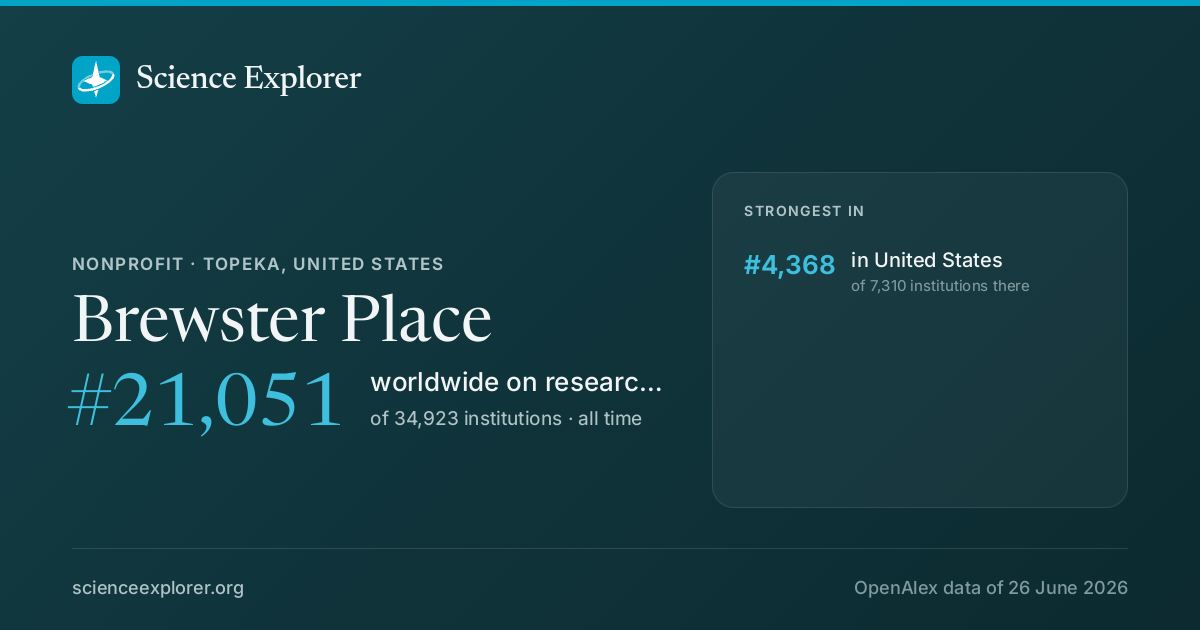
A card with Brewster Place's standing and the fields it leads in, for a post or a slide. A link to this page previews as the same card.

Download the card

1200 × 630 PNG, sized for social posts, drawn from the latest snapshot.

Badges for a website1Each links back here and updates with every snapshot

Research measures only: rankings here say nothing about teaching, admissions or student experience. Comparable institutions and collaboration partners have tabs of their own, above.

Discussion

Ask a question or share a note about Brewster Place. Keep it to the research: no personal attacks, advertising or links. Any reader can report a post, which collapses it for everyone until it is opened.

