Cascades Volcano Observatory
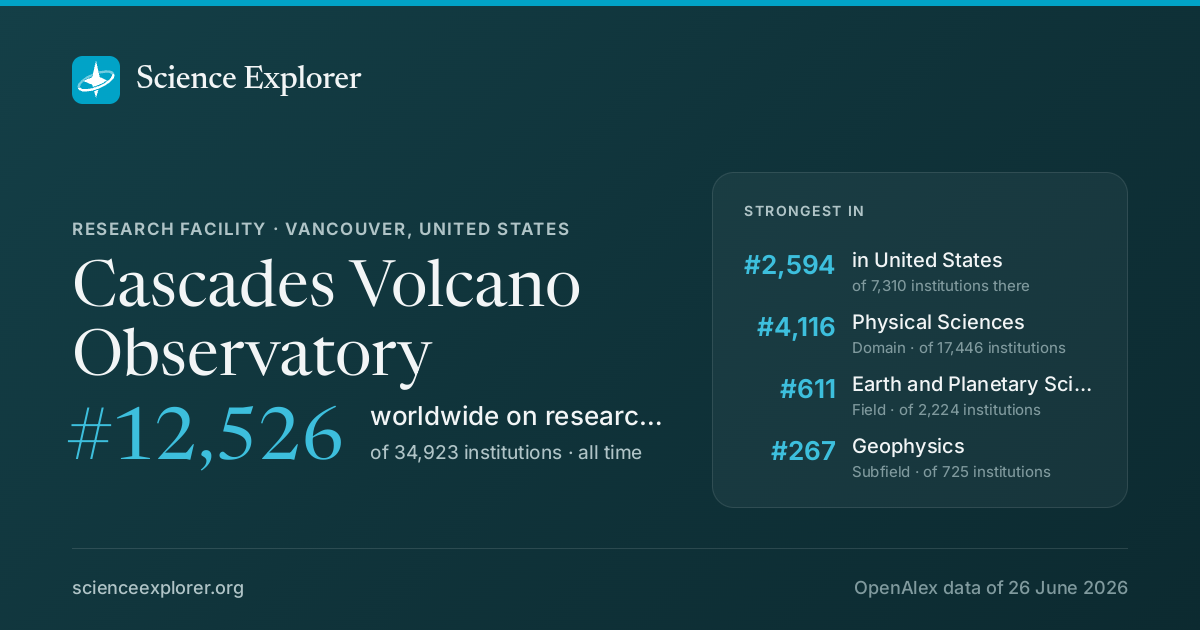
In research, Cascades Volcano Observatory stands highest in Physical Sciences (#4,116 of 17,446 worldwide), Earth and Planetary Sciences (#611 of 2,224 worldwide) and Geophysics (#267 of 725 worldwide), over all time. Relative to its size it is most specialised in Geophysics and Earth and Planetary Sciences (Geophysics is 134.6× its share of world research).
- World rank, all time
- #12,526 of 34,923
- Rank in United States
- #2,594 of 7,310
- Research works
- 361 ▼ 14% vs 2018-21
- Citations
- 16k 45.6 per fractional work
- Top-10% rate
- 13.7% all institutions 10.0%
- vs its own fields
- 1.25× 1.00× is exactly expected
- Open access
- 37% world 40%
- International
- 22% world 18%
What is Cascades Volcano Observatory known for in research?
The fields where it stands highest, over all time, ranked among every institution above the floor in each field.
| Field | World rank | Where that sits | Top-10% rate | Works |
|---|---|---|---|---|
| Physical SciencesDomain | #4,116 of 17,446 | 21.0% | 329 | |
| Earth and Planetary SciencesField | #611 of 2,224 | 18.5% | 196 | |
| GeophysicsSubfield | #267 of 725 | 17.6% | 121 |
Each strip is that field's whole ranked pool, with the notch where Cascades Volcano Observatory sits in it, in the colour of the band that rank falls in. The track under the rate is the rate itself: it carries no average mark, because the average differs by field (from about 6% in Dentistry to 21% in Economics).
Which fields of science does Cascades Volcano Observatory work in?
In 2022-now, 93% of research at Cascades Volcano Observatory is in Physical Sciences, 4% in Social Sciences. Its largest fields are Earth and Planetary Sciences (61%), Environmental Science (12%), Computer Science (11%). It does 2.2× the world's share of Physical Sciences.
Each ring splits the one inside it: the four domains of science, their fields, their subfields. Size is fractional works in 2022-now. Every slice is a page; the interactive view zooms down to single topics and colours each by how much more of it this institution does than the world.
Its 4 domains and 14 fields, with their numbers
- Physical Sciences5293.3%
- Earth and Planetary Sciences3461.2%
- Environmental Science712.0%
- Computer Science611.0%
- Engineering46.9%
- Physics and Astronomy11.7%
- Materials Science00.4%
- Mathematics00.1%
- Social Sciences23.9%
- Social Sciences23.5%
- Arts and Humanities00.4%
- Decision Sciences00.1%
- Life Sciences12.3%
- Health Sciences00.5%
- Medicine00.3%
- Health Professions00.1%
What does Cascades Volcano Observatory specialise in?
Where its research is concentrated relative to its size: Geophysics takes 134.6× the share of its output that it takes of world research.
- GeophysicsSubfield · 26.3 works135×
- Earth and Planetary SciencesField · 34.3 works39×
Location quotient, a volume reading rather than an impact one. It surfaces small, lopsided specialities.
Field profile
Location quotient across every field it publishes in: outside the ring is more than an institution of this size would be expected to publish, inside it is less.
Rings at 0.5×, 1× and 2×. Widest outward: Earth and Planetary Sciences, 39.0×. Every wedge is a field page.
All 14 fields, with their numbers
- Earth and Planetary Sciences39.05×34 works
- Environmental Science2.42×7 works
- Computer Science1.42×6 works
- Physics and Astronomy0.76×1 works
- Engineering0.46×4 works
- Agricultural and Biological Sciences0.38×1 works
- Social Sciences0.27×2 works
- Arts and Humanities0.13×0 works
- Materials Science0.11×0 works
- Biochemistry, Genetics and Molecular Biology0.09×0 works
- Decision Sciences0.08×0 works
- Health Professions0.06×0 works
- Mathematics0.05×0 works
- Medicine0.02×0 works
- Earth and Planetary Sciences 39.0×
- Environmental Science 2.4×
- Computer Science 1.4×
- Physics and Astronomy 0.8×
- Engineering 0.5×
- Agricultural and Biological Sciences 0.4×
- Social Sciences 0.3×
- Arts and Humanities 0.1×
- Materials Science 0.1×
- Biochemistry, Genetics and Molecular Biology 0.1×
- Decision Sciences 0.1×
- Health Professions 0.1×
- Mathematics 0.1×
- Medicine 0.0×
Who are the top researchers at Cascades Volcano Observatory?
Ranked on the quality score, Joseph S. Walder, Alexa R. Van Eaton and Christoph Kern lead among researchers whose main affiliation is Cascades Volcano Observatory.
- 1
Joseph S. Walder
 United States · #341,763 worldwide
5.8k citations · 92 works
- 2
Alexa R. Van Eaton
United States · #450,092 worldwide
2.2k citations · 135 works
- 3
Christoph Kern
United States · #464,997 worldwide
4.8k citations · 147 works
- 4
Angela K. Diefenbach
United States · #530,964 worldwide
1.6k citations · 52 works
- 5
Allan H. Lerner
United States · #694,956 worldwide
1.2k citations · 57 works
- 6
P. J. Kelly
United States · #800,125 worldwide
2.3k citations · 84 works
- 7
John W. Ewert
United States · #805,454 worldwide
2.4k citations · 71 works
- 8
T. M. Gerlach
United States · #1,137,141 worldwide
2.6k citations · 63 works
- 9
Weston A. Thelen
United States · #1,189,693 worldwide
2.2k citations · 138 works
- 10
Steven R. Brantley
United States · #2,749,776 worldwide
737 citations · 33 works
Which keywords describe research at Cascades Volcano Observatory?
By fractional works in 2022-now, weighted toward what it does more of than the world: Plate Tectonics, Tectonics, Subduction, Geochronology, Zircon, Geodetic Measurements, Earthquakes and Plate Boundaries.
- Satellite Imagery
- Water Quality
- Shale Gas
- Sea Level Rise
- Hazard
- GIS-based Modeling
- Mineral Prospectivity
- Compositional Data Analysis
- Monsoon Dynamics
- Sea Level
- Holocene
- Seismic Noise
- Crystal Structure Prediction
- Earthquake Detection
- Machine Learning
- Tomography
- Plate Boundaries
- Earthquakes
- Geochronology
- Tectonics
- Plate Tectonics
- Subduction
- Zircon
- Geodetic Measurements
- Climate Change
- Remote Sensing
- Citizen Science
- Seismic Signals
- Mantle Dynamics
- Surface Wave
- Paleoclimatology
- Glacial Cycles
- Geological Mapping
- Ionospheric Anomalies
- Seismic Electromagnetics
- Global Warming
- Landslide
- SAR Interferometry
- Surface Deformation Monitoring
- Satellite Observations
Size is fractional works in 2022-now in the topics tagged with each word; colour is the word's share of this institution's work against its share of the world's. The 40 words are chosen for being large and distinctive. Each links to the topic it comes from most.
All 40 words, with their numbers
- Plate Tectonics12▲ 141×3 topics
- Tectonics9▲ 137×3 topics
- Subduction8▲ 200×3 topics
- Geochronology8▲ 210×1 topic
- Zircon8▲ 210×1 topic
- Earthquakes8▲ 246×1 topic
- Geodetic Measurements8▲ 135×2 topics
- Plate Boundaries8▲ 246×1 topic
- Climate Change7▲ 4.7×21 topics
- Tomography7▲ 67×3 topics
- Remote Sensing6▲ 9.5×10 topics
- Machine Learning6▲ 3.1×6 topics
- Citizen Science4▲ 69×3 topics
- Earthquake Detection4▲ 302×1 topic
- Seismic Signals4▲ 302×1 topic
- Crystal Structure Prediction3▲ 125×1 topic
- Mantle Dynamics3▲ 125×1 topic
- Seismic Noise3▲ 121×1 topic
- Surface Wave3▲ 121×1 topic
- Holocene3▲ 43×3 topics
- Paleoclimatology3▲ 55×2 topics
- Sea Level3▲ 50×2 topics
- Glacial Cycles2▲ 65×1 topic
- Monsoon Dynamics2▲ 65×1 topic
- Geological Mapping2▲ 51×2 topics
- Compositional Data Analysis2▲ 59×1 topic
- Ionospheric Anomalies2▲ 101×1 topic
- Mineral Prospectivity2▲ 59×1 topic
- Seismic Electromagnetics2▲ 101×1 topic
- GIS-based Modeling2▲ 40×2 topics
- Global Warming2▲ 7.0×6 topics
- Hazard2▲ 44×1 topic
- Landslide2▲ 44×1 topic
- Sea Level Rise1▲ 20×3 topics
- SAR Interferometry1▲ 97×1 topic
- Shale Gas1▲ 19×2 topics
- Surface Deformation Monitoring1▲ 97×1 topic
- Water Quality1▲ 5.4×2 topics
- Satellite Observations1▲ 20×2 topics
- Satellite Imagery1▲ 14×2 topics
Which research topics does Cascades Volcano Observatory publish most on?
By volume in 2022-now: Geological and Geochemical Analysis, earthquake and tectonic studies, Seismology and Earthquake Studies and High-pressure geophysics and materials.
Area is fractional works; colour is the subfield each topic belongs to.
- 1 Geological and Geochemical Analysis Geophysics 8 works
- 2 earthquake and tectonic studies Geophysics 8 works
- 3 Seismology and Earthquake Studies Artificial Intelligence 4 works
- 4 High-pressure geophysics and materials Geophysics 3 works
- 5 Seismic Waves and Analysis Geophysics 3 works
- 6 Geology and Paleoclimatology Research Atmospheric Science 2 works
- 7 Earthquake Detection and Analysis Geophysics 2 works
- 8 Geochemistry and Geologic Mapping Artificial Intelligence 2 works
- 9 Landslides and related hazards Management, Monitoring, Policy and Law 2 works
- 10 Synthetic Aperture Radar (SAR) Applications and Techniques Aerospace Engineering 1 works
How open and international is its research?
Against the world's own shares: the tick on each track. Both are shares of its output, so they sit on one scale and can be read against each other as well as against the world.
World: 40% of research is openly available.
World: 18% is written across borders.
How has Cascades Volcano Observatory's research output changed?
Output in 2022-2025 was 14% lower than in 2018-2021.
The same series as a ribbon: one cell per year, darker for more. The line above answers how much; this answers when.
Its share of all research
Growing output can still be a shrinking share: all of science grows. This is Cascades Volcano Observatory as a percentage of every work published that year, 0.00031% in 2024.
Fractional works of Cascades Volcano Observatory over all fractional works that year. How the balance of science has shifted.
Other research institutions in Vancouver
- Children's Center
- nLIGHT (United States)
- Wisdom Health (United States)
- Clark College
- Vancouver Clinic
- Southwest Washington Medical Center
- Nautilus (United States)
- Washington School for the Deaf
Share Cascades Volcano Observatory's ranking
Badges for a website1Each links back here and updates with every snapshot

Research measures only: rankings here say nothing about teaching, admissions or student experience. Comparable institutions and collaboration partners have tabs of their own, above.
Discussion
Ask a question or share a note about Cascades Volcano Observatory. Keep it to the research: no personal attacks, advertising or links. Any reader can report a post, which collapses it for everyone until it is opened.