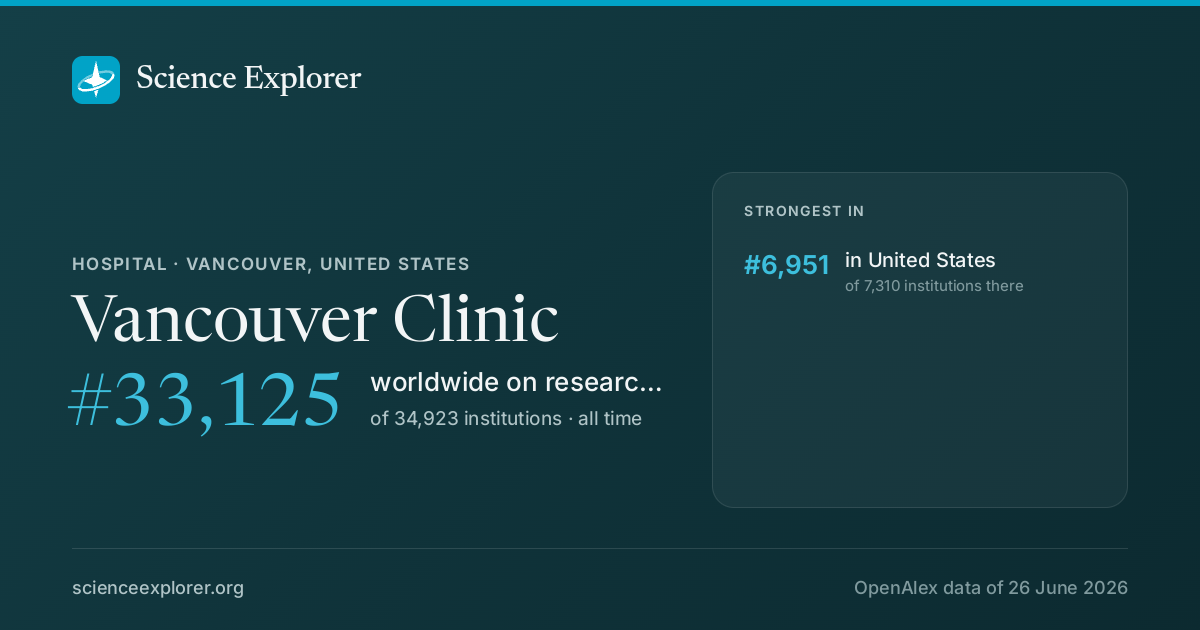
- World rank, all time
- #33,125 of 34,923
- Rank in United States
- #6,951 of 7,310
- Research works
- 143 ▼ 23% vs 2018-21
- Citations
- 2k 13.8 per fractional work
- Top-10% rate
- 6.2% all institutions 10.0%
- vs its own fields
- 0.88× 1.00× is exactly expected
- Open access
- 32% world 40%
- International
- 27% world 18%
Which fields of science does Vancouver Clinic work in?
In 2022-now, 76% of research at Vancouver Clinic is in Health Sciences, 13% in Physical Sciences. Its largest fields are Medicine (66%), Environmental Science (6%), Social Sciences (6%). It does 2.5× the world's share of Health Sciences.
Each ring splits the one inside it: the four domains of science, their fields, their subfields. Size is fractional works in 2022-now. Every slice is a page; the interactive view zooms down to single topics and colours each by how much more of it this institution does than the world.
Its 4 domains and 11 fields, with their numbers
- Health Sciences2076.3%
- Medicine1866.1%
- Health Professions14.7%
- Nursing13.7%
- Dentistry01.8%
- Physical Sciences312.6%
- Environmental Science26.0%
- Computer Science13.7%
- Engineering12.8%
- Social Sciences26.5%
- Social Sciences15.5%
- Psychology01.0%
- Life Sciences14.5%
Field profile
Location quotient across every field it publishes in: outside the ring is more than an institution of this size would be expected to publish, inside it is less.
Rings at 0.5×, 1× and 2×. Widest outward: Nursing, 7.7×. Every wedge is a field page.
All 11 fields, with their numbers
- Nursing7.65×1 works
- Dentistry3.65×0 works
- Medicine3.44×18 works
- Health Professions1.79×1 works
- Environmental Science1.22×2 works
- Biochemistry, Genetics and Molecular Biology0.80×1 works
- Computer Science0.48×1 works
- Social Sciences0.44×2 works
- Psychology0.32×0 works
- Immunology and Microbiology0.25×0 works
- Engineering0.19×1 works
Who are the top researchers at Vancouver Clinic?
Ranked on the quality score, Jason Mayo and S. Lam lead among researchers whose main affiliation is Vancouver Clinic.
- 1
Jason Mayo
 United States · #2,146,856 worldwide
726 citations · 26 works
- 2
S. Lam
United States · #4,805,871 worldwide
19 citations · 33 works
Which keywords describe research at Vancouver Clinic?
By fractional works in 2022-now, weighted toward what it does more of than the world: Precision Medicine, Predictive Modeling, Chemotherapy, Radiotherapy, Medical Imaging, Adjuvant Therapy, CT Screening and Lung Cancer.
- Policy Dimensions
- Neurological Disorders
- Quality of Life
- Clinical Guidelines
- Air Pollution
- Quantitative Analysis
- Oxidative Stress
- Cardiovascular Disease
- Lung Cancer
- Epidemiology
- Adjuvant Therapy
- Medical Imaging
- Predictive Modeling
- Chemotherapy
- Precision Medicine
- Machine Learning
- Public Health
- Radiotherapy
- CT Screening
- Immunotherapy
- Treatment
- Mortality
- Particulate Matter
- Radiomics
- Health Effects
- Healthcare
- Health Policy
- Nursing Advocacy
- Transnational Law
Size is fractional works in 2022-now in the topics tagged with each word; colour is the word's share of this institution's work against its share of the world's. The 29 words are chosen for being large and distinctive. Each links to the topic it comes from most.
All 29 words, with their numbers
- Precision Medicine3▲ 20×4 topics
- Chemotherapy2▲ 10×4 topics
- Machine Learning2▲ 2.2×4 topics
- Predictive Modeling2▲ 27×2 topics
- Public Health2▲ 5.0×6 topics
- Medical Imaging2▲ 12×2 topics
- Radiotherapy2▲ 17×4 topics
- Adjuvant Therapy2▲ 50×2 topics
- CT Screening2▲ 90×1 topic
- Epidemiology2▲ 1.49×13 topics
- Immunotherapy2▲ 8.2×5 topics
- Lung Cancer2▲ 37×1 topic
- Treatment2▲ 5.0×8 topics
- Cardiovascular Disease2▲ 4.9×4 topics
- Mortality1▲ 9.2×3 topics
- Oxidative Stress1▲ 3.3×3 topics
- Particulate Matter1▲ 34×2 topics
- Quantitative Analysis1▲ 23×1 topic
- Radiomics1▲ 43×1 topic
- Air Pollution1▲ 35×1 topic
- Health Effects1▲ 7.2×1 topic
- Clinical Guidelines1▲ 14×5 topics
- Healthcare1▲ 3.6×2 topics
- Quality of Life1▲ 2.9×11 topics
- Health Policy1▲ 24×1 topic
- Neurological Disorders1▲ 6.6×3 topics
- Nursing Advocacy1▲ 398×1 topic
- Policy Dimensions1▲ 550×1 topic
- Transnational Law1▲ 346×1 topic
Which research topics does Vancouver Clinic publish most on?
By volume in 2022-now: Lung Cancer Diagnosis and Treatment, Radiomics and Machine Learning in Medical Imaging, Air Quality and Health Impacts and Nursing Education, Practice, and Leadership.
Area is fractional works; colour is the subfield each topic belongs to.
- 1 Lung Cancer Diagnosis and Treatment Pulmonary and Respiratory Medicine 2 works
- 2 Radiomics and Machine Learning in Medical Imaging Radiology, Nuclear Medicine and Imaging 1 works
- 3 Air Quality and Health Impacts Health, Toxicology and Mutagenesis 1 works
- 4 Nursing Education, Practice, and Leadership Issues, ethics and legal aspects 1 works
- 5 Legal Systems and Judicial Processes Political Science and International Relations 1 works
- 6 Machine Learning in Healthcare Artificial Intelligence 1 works
- 7 Lung Cancer Treatments and Mutations Pulmonary and Respiratory Medicine 1 works
- 8 Cancer Research and Treatments Biotechnology 0 works
- 9 Medical Malpractice and Liability Issues Pharmacy 0 works
- 10 Botulinum Toxin and Related Neurological Disorders Neurology 0 works
How open and international is its research?
Against the world's own shares: the tick on each track. Both are shares of its output, so they sit on one scale and can be read against each other as well as against the world.
World: 40% of research is openly available.
World: 18% is written across borders.
How has Vancouver Clinic's research output changed?
Output in 2022-2025 was 23% lower than in 2018-2021.
The same series as a ribbon: one cell per year, darker for more. The line above answers how much; this answers when.
Its share of all research
Growing output can still be a shrinking share: all of science grows. This is Vancouver Clinic as a percentage of every work published that year, 0.000082% in 2024.
Fractional works of Vancouver Clinic over all fractional works that year. How the balance of science has shifted.
Other research institutions in Vancouver
- Children's Center
- nLIGHT (United States)
- Wisdom Health (United States)
- Cascades Volcano Observatory
- Clark College
- Southwest Washington Medical Center
- Nautilus (United States)
- Washington School for the Deaf
Share Vancouver Clinic's ranking
Badges for a website1Each links back here and updates with every snapshot

Research measures only: rankings here say nothing about teaching, admissions or student experience. Comparable institutions and collaboration partners have tabs of their own, above.
Discussion
Ask a question or share a note about Vancouver Clinic. Keep it to the research: no personal attacks, advertising or links. Any reader can report a post, which collapses it for everyone until it is opened.