Science Explorer Back to mapMap
Discussion
Hospital / health system · Le Mans · France

Centre Jean Bernard

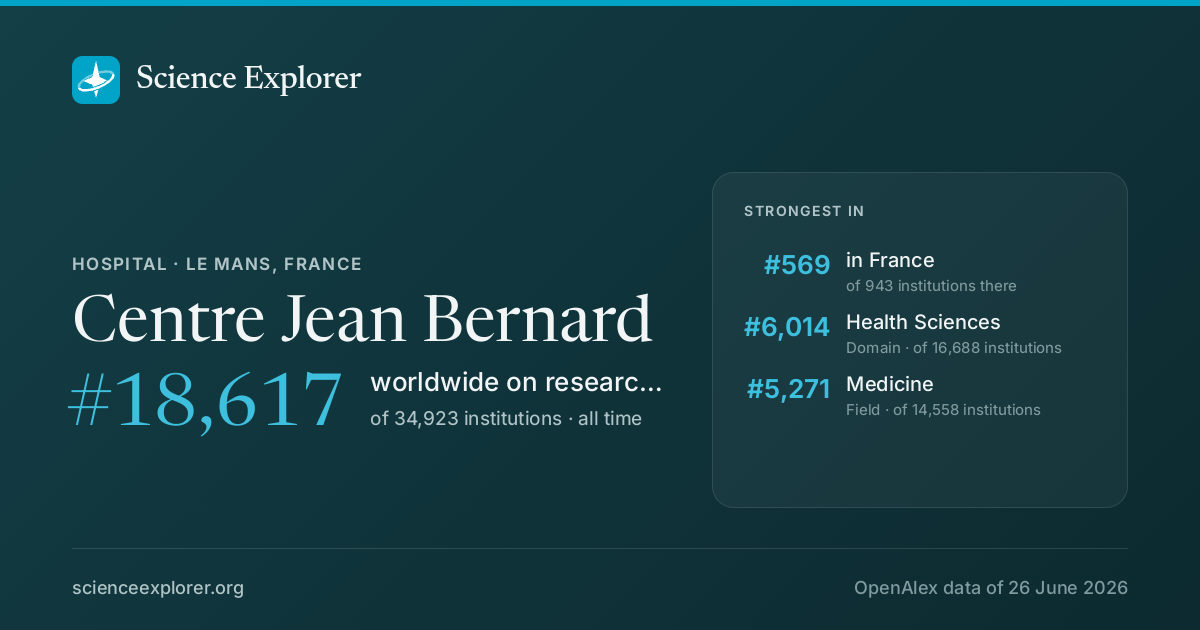
In research, Centre Jean Bernard stands highest in Health Sciences (#6,014 of 16,688 worldwide) and Medicine (#5,271 of 14,558 worldwide), over all time.

World rank, all time
#18,617
of 34,923
Rank in France
#569
of 943
Research works
406
▼ 30% vs 2018-21
Citations
9.9k
24.5 per fractional work
Top-10% rate
12.3%
all institutions 10.0%
vs its own fields
0.95×
1.00× is exactly expected
Open access
18%
world 40%
International
13%
world 18%

What is Centre Jean Bernard known for in research?

The fields where it stands highest, over all time, ranked among every institution above the floor in each field.

FieldWorld rankWhere that sitsTop-10% rateWorks
Health SciencesDomain #6,014 of 16,688 5.7%304
MedicineField #5,271 of 14,558 5.7%283

Each strip is that field's whole ranked pool, with the notch where Centre Jean Bernard sits in it, in the colour of the band that rank falls in. The track under the rate is the rate itself: it carries no average mark, because the average differs by field (from about 6% in Dentistry to 21% in Economics).

Which fields of science does Centre Jean Bernard work in?

In 2022-now, 61% of research at Centre Jean Bernard is in Health Sciences, 21% in Social Sciences. Its largest fields are Medicine (58%), Arts and Humanities (8%), Social Sciences (8%). It does 2.1× the world's share of Health Sciences.

Health Sciences: 17 fractional works · 61.2% of its workMedicine: 17 fractional works · 58.5% of its workPulmonary and Respiratory Medicine: 3 fractional works · 10.7% of its workOncology: 3 fractional works · 9.1% of its workSurgery: 2 fractional works · 5.8% of its workOtorhinolaryngology: 2 fractional works · 5.3% of its workPathology and Forensic Medicine: 1 fractional works · 4.8% of its workObstetrics and Gynecology: 1 fractional works · 2.4% of its workRadiology, Nuclear Medicine and Imaging: 1 fractional works · 2.1% of its workRheumatology: 1 fractional works · 2.1% of its workNeurology: 0 fractional works · 1.5% of its workReproductive Medicine: 0 fractional works · 1.5% of its workAnesthesiology and Pain Medicine: 0 fractional works · 1.4% of its workPharmacology: 0 fractional works · 1.4% of its workPsychiatry and Mental health: 0 fractional works · 1.2% of its workEpidemiology: 0 fractional works · 1.2% of its workInfectious Diseases: 0 fractional works · 1.1% of its workGeriatrics and Gerontology: 0 fractional works · 0.9% of its workPublic Health, Environmental and Occupational Health: 0 fractional works · 0.7% of its workEmergency Medicine: 0 fractional works · 0.7% of its workGenetics: 0 fractional works · 0.7% of its workCardiology and Cardiovascular Medicine: 0 fractional works · 0.6% of its workGastroenterology: 0 fractional works · 0.6% of its workPhysiology: 0 fractional works · 0.6% of its workPediatrics, Perinatology and Child Health: 0 fractional works · 0.5% of its workHepatology: 0 fractional works · 0.5% of its workImmunology and Allergy: 0 fractional works · 0.2% of its workDermatology: 0 fractional works · 0.2% of its workHematology: 0 fractional works · 0.2% of its workSmaller subfields together: 0 fractional works · 0.4% of its workHealth Professions: 1 fractional works · 2.2% of its workGeneral Health Professions: 1 fractional works · 2.0% of its workSmaller subfields together: 0 fractional works · 0.2% of its workDentistry: 0 fractional works · 0.5% of its workPeriodontics: 0 fractional works · 0.4% of its workSmaller subfields together: 0 fractional works · 0.1% of its workSocial Sciences: 6 fractional works · 20.8% of its workArts and Humanities: 2 fractional works · 8.4% of its workLiterature and Literary Theory: 1 fractional works · 3.5% of its workArcheology: 1 fractional works · 3.0% of its workHistory and Philosophy of Science: 0 fractional works · 1.2% of its workHistory: 0 fractional works · 0.4% of its workLanguage and Linguistics: 0 fractional works · 0.3% of its workSocial Sciences: 2 fractional works · 8.0% of its workEducation: 1 fractional works · 3.5% of its workSociology and Political Science: 1 fractional works · 1.9% of its workAnthropology: 0 fractional works · 1.5% of its workGender Studies: 0 fractional works · 0.8% of its workHealth: 0 fractional works · 0.3% of its workPsychology: 1 fractional works · 2.7% of its workClinical Psychology: 0 fractional works · 1.8% of its workApplied Psychology: 0 fractional works · 1.0% of its workEconomics, Econometrics and Finance: 0 fractional works · 1.6% of its workEconomics and Econometrics: 0 fractional works · 1.6% of its workPhysical Sciences: 3 fractional works · 9.7% of its workMathematics: 1 fractional works · 3.5% of its workAlgebra and Number Theory: 0 fractional works · 1.2% of its workApplied Mathematics: 0 fractional works · 1.2% of its workMathematical Physics: 0 fractional works · 1.2% of its workSmaller subfields together: 0 fractional works · 0.0% of its workPhysics and Astronomy: 1 fractional works · 1.9% of its workRadiation: 1 fractional works · 1.9% of its workMaterials Science: 0 fractional works · 1.5% of its workPolymers and Plastics: 0 fractional works · 1.2% of its workMaterials Chemistry: 0 fractional works · 0.2% of its workEngineering: 0 fractional works · 1.3% of its workAutomotive Engineering: 0 fractional works · 0.6% of its workAerospace Engineering: 0 fractional works · 0.5% of its workSmaller subfields together: 0 fractional works · 0.3% of its workComputer Science: 0 fractional works · 1.1% of its workInformation Systems: 0 fractional works · 0.8% of its workSmaller subfields together: 0 fractional works · 0.3% of its workChemical Engineering: 0 fractional works · 0.2% of its workEarth and Planetary Sciences: 0 fractional works · 0.1% of its workChemistry: 0 fractional works · 0.0% of its workLife Sciences: 2 fractional works · 8.4% of its workBiochemistry, Genetics and Molecular Biology: 2 fractional works · 5.9% of its workGenetics: 1 fractional works · 3.5% of its workMolecular Biology: 0 fractional works · 1.5% of its workCancer Research: 0 fractional works · 0.8% of its workSmaller subfields together: 0 fractional works · 0.1% of its workImmunology and Microbiology: 0 fractional works · 1.0% of its workImmunology: 0 fractional works · 1.0% of its workNeuroscience: 0 fractional works · 0.8% of its workCognitive Neuroscience: 0 fractional works · 0.7% of its workSmaller subfields together: 0 fractional works · 0.0% of its workPharmacology, Toxicology and Pharmaceutics: 0 fractional works · 0.6% of its workToxicology: 0 fractional works · 0.6% of its workAgricultural and Biological Sciences: 0 fractional works · 0.1% of its workALL ITS WORKCentre JeanBernard29fractional works, 2022-now
Life Sciences8%Physical Sciences10%Health Sciences61%Social Sciences21%

Each ring splits the one inside it: the four domains of science, their fields, their subfields. Size is fractional works in 2022-now. Every slice is a page; the interactive view zooms down to single topics and colours each by how much more of it this institution does than the world.

Its 4 domains and 20 fields, with their numbers
    1. Medicine1758.5%
    2. Health Professions12.2%
    3. Dentistry00.5%
    1. Arts and Humanities28.4%
    2. Social Sciences28.0%
    3. Psychology12.7%
    4. Economics, Econometrics and Finance01.6%
    1. Mathematics13.5%
    2. Physics and Astronomy11.9%
    3. Materials Science01.5%
    4. Engineering01.3%
    5. Computer Science01.1%
    6. Chemical Engineering00.2%
    7. Earth and Planetary Sciences00.1%
    8. Chemistry00.0%
    1. Biochemistry, Genetics and Molecular Biology25.9%
    2. Immunology and Microbiology01.0%
    3. Neuroscience00.8%
    4. Pharmacology, Toxicology and Pharmaceutics00.6%
    5. Agricultural and Biological Sciences00.1%
All of science, and how each field's share has moved since 1950: the Science domain explorer

Field profile

Location quotient across every field it publishes in: outside the ring is more than an institution of this size would be expected to publish, inside it is less.

Agricultural and Biological Sciences: 0.03× its world share, 0 worksAgricultural and Bio…Biochemistry, Genetics and Molecular Biology: 1.11× its world share, 2 worksBiochemistry, Geneti…Immunology and Microbiology: 0.97× its world share, 0 worksImmunology and Micro…Neuroscience: 0.48× its world share, 0 worksNeurosciencePharmacology, Toxicology and Pharmaceutics: 1.72× its world share, 0 worksPharmacology, Toxico…Chemical Engineering: 0.56× its world share, 0 worksChemical EngineeringChemistry: 0.02× its world share, 0 worksChemistryComputer Science: 0.14× its world share, 0 worksComputer ScienceEarth and Planetary Sciences: 0.08× its world share, 0 worksEarth and Planetary …Engineering: 0.09× its world share, 0 worksEngineeringMaterials Science: 0.42× its world share, 0 worksMaterials ScienceMathematics: 2.98× its world share, 1 worksMathematicsPhysics and Astronomy: 0.85× its world share, 0 worksPhysics and AstronomyDentistry: 1.05× its world share, 0 worksDentistryHealth Professions: 0.83× its world share, 1 worksHealth ProfessionsMedicine: 3.04× its world share, 17 worksMedicineArts and Humanities: 2.90× its world share, 2 worksArts and HumanitiesEconomics, Econometrics and Finance: 0.77× its world share, 0 worksEconomics, Econometr…Psychology: 0.90× its world share, 1 worksPsychologySocial Sciences: 0.63× its world share, 2 worksSocial Sciences1×world share
more than its size predictsabout as predictedless

Rings at 0.5×, 1× and 2×. Widest outward: Medicine, 3.0×. Every wedge is a field page.

All 20 fields, with their numbers
  1. Medicine3.04×17 works
  2. Mathematics2.98×1 works
  3. Arts and Humanities2.90×2 works
  4. Pharmacology, Toxicology and Pharmaceutics1.72×0 works
  5. Biochemistry, Genetics and Molecular Biology1.11×2 works
  6. Dentistry1.05×0 works
  7. Immunology and Microbiology0.97×0 works
  8. Psychology0.90×1 works
  9. Physics and Astronomy0.85×0 works
  10. Health Professions0.83×1 works
  11. Economics, Econometrics and Finance0.77×0 works
  12. Social Sciences0.63×2 works
  13. Chemical Engineering0.56×0 works
  14. Neuroscience0.48×0 works
  15. Materials Science0.42×0 works
  16. Computer Science0.14×0 works
  17. Engineering0.09×0 works
  18. Earth and Planetary Sciences0.08×0 works
  19. Agricultural and Biological Sciences0.03×0 works
  20. Chemistry0.02×0 works

Who are the top researchers at Centre Jean Bernard?

Ranked on the quality score, Philippe Solal‐Céligny, Fabrice Denis and Y. Pointreau lead among researchers whose main affiliation is Centre Jean Bernard.

  1. 1 Philippe Solal‐Céligny France · #285,821 worldwide 13k citations · 158 works
  2. 2 Fabrice Denis France · #778,851 worldwide 6.4k citations · 201 works
  3. 3 Y. Pointreau France · #878,702 worldwide 5.9k citations · 290 works
  4. 4 Anne-Lise Septans France · #1,013,740 worldwide 1.6k citations · 47 works
  5. 5 Gerard Ganem France · #1,032,240 worldwide 7k citations · 117 works
  6. 6 Jacques Barbier France · #2,753,279 worldwide 1.4k citations · 80 works
  7. 7 Z. Gaci France · #2,997,527 worldwide 332 citations · 17 works
  8. 8 Florian Le Goff France · #3,371,347 worldwide 132 citations · 26 works
  9. 9 E Benz-Lemoine France · #3,813,687 worldwide 620 citations · 32 works
  10. 10 Y. Métayer France · #4,875,632 worldwide 31 citations · 16 works
All ranked researchers at Centre Jean Bernard

What are the most cited papers from Centre Jean Bernard?

The most cited paper from Centre Jean Bernard is "FOLFIRI Followed by FOLFOX6 or the Reverse Sequence in Advanced Colorectal Cancer: A Randomized GERCOR Study" (Christophe Tournigand, Thierry André, Emmanuel Achille et al., 2003), with 2,930 citations. Next come "Follicular Lymphoma International Prognostic Index" (1,544) and "Avelumab Maintenance Therapy for Advanced or Metastatic Urothelial Carcinoma" (1,526).

Most cited papers
#PaperReleasedCitations
1 FOLFIRI Followed by FOLFOX6 or the Reverse Sequence in Advanced Colorectal Cancer: A Randomized GERCOR Study Christophe Tournigand, Thierry André, Emmanuel Achille et al. · Journal of Clinical Oncology 8 Dec 2003 2,930
2 Follicular Lymphoma International Prognostic Index P. Solal-Celigny · Blood Open access 11 May 2004 1,544
3 Avelumab Maintenance Therapy for Advanced or Metastatic Urothelial Carcinoma Thomas B. Powles et al. · New England Journal of Medicine Open access 18 Sep 2020 1,526
4 Long-Term Results of the R-CHOP Study in the Treatment of Elderly Patients With Diffuse Large B-Cell Lymphoma: A Study by the Groupe d'Etude des Lymphomes de l'Adulte Pierre Feugier, Ambro van Hoof, Catherine Sebban et al. · Journal of Clinical Oncology 2 May 2005 1,510
5 Follicular lymphoma international prognostic index P Solal-Céligny · Current Treatment Options in Oncology Aug 2006 1,340
All 59 most cited papers, with filters and sorting

Which keywords describe research at Centre Jean Bernard?

By fractional works in 2022-now, weighted toward what it does more of than the world: Chemotherapy, Radiotherapy, Clinical Trials, Cetuximab, Squamous Cell Carcinoma, Survival, Prognosis and Immunotherapy.

▲ more of its work than of the world's◆ about the world's share▼ less than the world's

Size is fractional works in 2022-now in the topics tagged with each word; colour is the word's share of this institution's work against its share of the world's. The 18 words are chosen for being large and distinctive. Each links to the topic it comes from most.

All 18 words, with their numbers
  1. Chemotherapy4▲ 21×14 topics
  2. Radiotherapy3▲ 30×10 topics
  3. Epidemiology2▲ 1.76×16 topics
  4. Cetuximab2▲ 76×2 topics
  5. Clinical Trials2▲ 9.7×5 topics
  6. Quality of Life2▲ 4.3×10 topics
  7. Squamous Cell Carcinoma2▲ 65×2 topics
  8. Immunotherapy2▲ 7.6×10 topics
  9. Prognosis2▲ 17×4 topics
  10. Survival2▲ 41×2 topics
  11. Human Papillomavirus2▲ 42×1 topic
  12. Oropharyngeal Cancer2▲ 101×1 topic
  13. Clinical Practice Guidelines1▲ 8.8×7 topics
  14. Biomarkers1▲ 6.1×5 topics
  15. Identity1▲ 5.2×2 topics
  16. Memory1▲ 16×2 topics
  17. French Literature1▲ 233×1 topic
  18. Philosophy1▲ 7.9×1 topic

Which research topics does Centre Jean Bernard publish most on?

By volume in 2022-now: Head and Neck Cancer Studies, French Literature and Critical Theory, Whipple's Disease and Interleukins and Prostate Cancer Treatment and Research.

  1. 1 Head and Neck Cancer Studies Otorhinolaryngology 2 works
  2. 2 French Literature and Critical Theory Literature and Literary Theory 1 works
  3. 3 Whipple's Disease and Interleukins Pathology and Forensic Medicine 1 works
  4. 4 Prostate Cancer Treatment and Research Pulmonary and Respiratory Medicine 1 works
  5. 5 PARP inhibition in cancer therapy Oncology 0 works
  6. 6 Italian Social Issues and Migration Sociology and Political Science 0 works
  7. 7 Psychoanalysis and Psychopathology Research Clinical Psychology 0 works
  8. 8 Cancer Immunotherapy and Biomarkers Oncology 0 works
  9. 9 Head and Neck Surgical Oncology Surgery 0 works
  10. 10 Classical Antiquity Studies Anthropology 0 works

How open and international is its research?

Against the world's own shares: the tick on each track. Both are shares of its output, so they sit on one scale and can be read against each other as well as against the world.

openly available18.3%not open81.7%

World: 40% of research is openly available.

with international co-authors12.7%domestic only87.3%

World: 18% is written across borders.

How has Centre Jean Bernard's research output changed?

Output in 2022-2025 was 30% lower than in 2018-2021.

still counting1990200020102020
grewheldshrank

The same series as a ribbon: one cell per year, darker for more. The line above answers how much; this answers when.

Its share of all research

Growing output can still be a shrinking share: all of science grows. This is Centre Jean Bernard as a percentage of every work published that year, 0.000052% in 2024.

still counting0.0010%0.0020%0.0030%Centre Jean Bernard0.00016% in 202519801990200020102020

Fractional works of Centre Jean Bernard over all fractional works that year. How the balance of science has shifted.

Other research institutions in Le Mans

All research institutions in Le Mans

Share Centre Jean Bernard's ranking

Centre Jean Bernard on Science Explorer

A card with Centre Jean Bernard's standing and the fields it leads in, for a post or a slide. A link to this page previews as the same card.

Download the card

1200 × 630 PNG, sized for social posts, drawn from the latest snapshot.

Badges for a website1Each links back here and updates with every snapshot

Research measures only: rankings here say nothing about teaching, admissions or student experience. Comparable institutions and collaboration partners have tabs of their own, above.

Discussion

Ask a question or share a note about Centre Jean Bernard. Posts are plain text and can be reported.