Science Explorer Back to mapMap
Discussion
University · Araçatuba · Brazil

Centro Universitario Toledo

In research, Centro Universitario Toledo stands highest in Health Sciences (#8,736 of 16,688 worldwide), over all time.

World rank, 2022-now
#19,922
of 22,385 · #16,764 all time
Rank in Brazil
#656
of 684
Research works
315
▼ 16% vs 2018-21
Citations
3.1k
9.9 per fractional work
Top-10% rate
6.2%
all institutions 10.0%
vs its own fields
1.00×
1.00× is exactly expected
Open access
64%
world 40%
International
11%
world 18%

What is Centro Universitario Toledo known for in research?

The fields where it stands highest, over all time, ranked among every institution above the floor in each field.

FieldWorld rankWhere that sitsTop-10% rateWorks
Health SciencesDomain #8,736 of 16,688 7.0%160

Each strip is that field's whole ranked pool, with the notch where Centro Universitario Toledo sits in it, in the colour of the band that rank falls in. The track under the rate is the rate itself: it carries no average mark, because the average differs by field (from about 6% in Dentistry to 21% in Economics).

Which fields of science does Centro Universitario Toledo work in?

In 2022-now, 54% of research at Centro Universitario Toledo is in Health Sciences, 26% in Social Sciences. Its largest fields are Medicine (33%), Social Sciences (20%), Dentistry (16%). It does 2.1× the world's share of Health Sciences.

Health Sciences: 38 fractional works · 54.4% of its workMedicine: 23 fractional works · 33.4% of its workSurgery: 4 fractional works · 5.4% of its workPulmonary and Respiratory Medicine: 3 fractional works · 3.8% of its workOncology: 2 fractional works · 2.2% of its workPublic Health, Environmental and Occupational Health: 1 fractional works · 2.1% of its workEpidemiology: 1 fractional works · 2.0% of its workDermatology: 1 fractional works · 1.8% of its workInfectious Diseases: 1 fractional works · 1.7% of its workPathology and Forensic Medicine: 1 fractional works · 1.6% of its workRheumatology: 1 fractional works · 1.6% of its workRadiology, Nuclear Medicine and Imaging: 1 fractional works · 1.5% of its workNeurology: 1 fractional works · 1.4% of its workPediatrics, Perinatology and Child Health: 1 fractional works · 1.1% of its workPhysiology: 1 fractional works · 1.0% of its workGeriatrics and Gerontology: 1 fractional works · 1.0% of its workPsychiatry and Mental health: 1 fractional works · 0.8% of its workHematology: 0 fractional works · 0.7% of its workOtorhinolaryngology: 0 fractional works · 0.6% of its workUrology: 0 fractional works · 0.6% of its workCritical Care and Intensive Care Medicine: 0 fractional works · 0.5% of its workPharmacology: 0 fractional works · 0.3% of its workOphthalmology: 0 fractional works · 0.3% of its workGenetics: 0 fractional works · 0.2% of its workHepatology: 0 fractional works · 0.2% of its workOrthopedics and Sports Medicine: 0 fractional works · 0.2% of its workSmaller subfields together: 0 fractional works · 0.7% of its workDentistry: 11 fractional works · 16.4% of its workOrthodontics: 5 fractional works · 6.8% of its workOral Surgery: 4 fractional works · 6.3% of its workPeriodontics: 1 fractional works · 1.8% of its workGeneral Dentistry: 1 fractional works · 1.5% of its workHealth Professions: 3 fractional works · 4.5% of its workEmergency Medical Services: 1 fractional works · 1.1% of its workGeneral Health Professions: 1 fractional works · 1.0% of its workComplementary and Manual Therapy: 0 fractional works · 0.7% of its workPharmacy: 0 fractional works · 0.5% of its workRadiological and Ultrasound Technology: 0 fractional works · 0.5% of its workSpeech and Hearing: 0 fractional works · 0.3% of its workHealth Information Management: 0 fractional works · 0.2% of its workOccupational Therapy: 0 fractional works · 0.2% of its workVeterinary: 0 fractional works · 0.1% of its workSocial Sciences: 18 fractional works · 25.8% of its workSocial Sciences: 14 fractional works · 19.5% of its workSociology and Political Science: 4 fractional works · 5.3% of its workEducation: 3 fractional works · 4.2% of its workLaw: 3 fractional works · 4.1% of its workUrban Studies: 2 fractional works · 2.5% of its workDemography: 1 fractional works · 1.7% of its workCultural Studies: 0 fractional works · 0.5% of its workDevelopment: 0 fractional works · 0.5% of its workPolitical Science and International Relations: 0 fractional works · 0.5% of its workCommunication: 0 fractional works · 0.2% of its workBusiness, Management and Accounting: 1 fractional works · 1.8% of its workStrategy and Management: 1 fractional works · 1.6% of its workOrganizational Behavior and Human Resource Management: 0 fractional works · 0.2% of its workPsychology: 1 fractional works · 1.2% of its workClinical Psychology: 0 fractional works · 0.6% of its workSocial Psychology: 0 fractional works · 0.5% of its workSmaller subfields together: 0 fractional works · 0.2% of its workEconomics, Econometrics and Finance: 1 fractional works · 1.2% of its workEconomics and Econometrics: 1 fractional works · 1.2% of its workDecision Sciences: 1 fractional works · 1.0% of its workInformation Systems and Management: 1 fractional works · 1.0% of its workArts and Humanities: 1 fractional works · 1.0% of its workPhilosophy: 0 fractional works · 0.5% of its workArcheology: 0 fractional works · 0.3% of its workSmaller subfields together: 0 fractional works · 0.1% of its workLife Sciences: 8 fractional works · 11.5% of its workBiochemistry, Genetics and Molecular Biology: 4 fractional works · 5.6% of its workMolecular Biology: 2 fractional works · 3.2% of its workGenetics: 1 fractional works · 1.6% of its workCell Biology: 0 fractional works · 0.4% of its workSmaller subfields together: 0 fractional works · 0.4% of its workAgricultural and Biological Sciences: 2 fractional works · 2.3% of its workForestry: 0 fractional works · 0.7% of its workPlant Science: 0 fractional works · 0.5% of its workInsect Science: 0 fractional works · 0.3% of its workSmaller subfields together: 1 fractional works · 0.8% of its workNeuroscience: 1 fractional works · 1.9% of its workCognitive Neuroscience: 0 fractional works · 0.7% of its workCellular and Molecular Neuroscience: 0 fractional works · 0.6% of its workNeurology: 0 fractional works · 0.2% of its workSmaller subfields together: 0 fractional works · 0.4% of its workImmunology and Microbiology: 1 fractional works · 1.6% of its workParasitology: 1 fractional works · 0.8% of its workImmunology: 0 fractional works · 0.5% of its workMicrobiology: 0 fractional works · 0.2% of its workPharmacology, Toxicology and Pharmaceutics: 0 fractional works · 0.1% of its workPhysical Sciences: 6 fractional works · 8.4% of its workEngineering: 3 fractional works · 3.9% of its workBiomedical Engineering: 1 fractional works · 1.7% of its workBuilding and Construction: 0 fractional works · 0.7% of its workCivil and Structural Engineering: 0 fractional works · 0.5% of its workMechanical Engineering: 0 fractional works · 0.5% of its workAutomotive Engineering: 0 fractional works · 0.4% of its workSmaller subfields together: 0 fractional works · 0.1% of its workEnvironmental Science: 2 fractional works · 2.3% of its workManagement, Monitoring, Policy and Law: 1 fractional works · 1.3% of its workNature and Landscape Conservation: 1 fractional works · 0.8% of its workSmaller subfields together: 0 fractional works · 0.2% of its workComputer Science: 1 fractional works · 0.8% of its workInformation Systems: 0 fractional works · 0.7% of its workSmaller subfields together: 0 fractional works · 0.2% of its workMaterials Science: 1 fractional works · 0.8% of its workMaterials Chemistry: 0 fractional works · 0.5% of its workBiomaterials: 0 fractional works · 0.3% of its workMathematics: 0 fractional works · 0.3% of its workModeling and Simulation: 0 fractional works · 0.3% of its workChemistry: 0 fractional works · 0.2% of its workOrganic Chemistry: 0 fractional works · 0.2% of its workALL ITS WORKCentroUniversitario…70fractional works, 2022-now
Life Sciences11%Physical Sciences8%Health Sciences54%Social Sciences26%

Each ring splits the one inside it: the four domains of science, their fields, their subfields. Size is fractional works in 2022-now. Every slice is a page; the interactive view zooms down to single topics and colours each by how much more of it this institution does than the world.

Its 4 domains and 21 fields, with their numbers
    1. Medicine2333.4%
    2. Dentistry1116.4%
    3. Health Professions34.5%
    4. Veterinary00.1%
    1. Social Sciences1419.5%
    2. Business, Management and Accounting11.8%
    3. Psychology11.2%
    4. Economics, Econometrics and Finance11.2%
    5. Decision Sciences11.0%
    6. Arts and Humanities11.0%
    1. Biochemistry, Genetics and Molecular Biology45.6%
    2. Agricultural and Biological Sciences22.3%
    3. Neuroscience11.9%
    4. Immunology and Microbiology11.6%
    5. Pharmacology, Toxicology and Pharmaceutics00.1%
    1. Engineering33.9%
    2. Environmental Science22.3%
    3. Computer Science10.8%
    4. Materials Science10.8%
    5. Mathematics00.3%
    6. Chemistry00.2%
All of science, and how each field's share has moved since 1950: the Science domain explorer

Field profile

Location quotient across every field it publishes in: outside the ring is more than an institution of this size would be expected to publish, inside it is less.

Agricultural and Biological Sciences: 0.49× its world share, 2 worksAgricultural and Bio…Biochemistry, Genetics and Molecular Biology: 1.05× its world share, 4 worksBiochemistry, Geneti…Immunology and Microbiology: 1.53× its world share, 1 worksImmunology and Micro…Neuroscience: 1.20× its world share, 1 worksNeurosciencePharmacology, Toxicology and Pharmaceutics: 0.34× its world share, 0 worksPharmacology, Toxico…Chemistry: 0.15× its world share, 0 worksChemistryComputer Science: 0.10× its world share, 1 worksComputer ScienceEngineering: 0.26× its world share, 3 worksEngineeringEnvironmental Science: 0.46× its world share, 2 worksEnvironmental ScienceMaterials Science: 0.23× its world share, 1 worksMaterials ScienceMathematics: 0.24× its world share, 0 worksMathematicsDentistry: 33.72× its world share, 11 worksDentistryHealth Professions: 1.70× its world share, 3 worksHealth ProfessionsMedicine: 1.74× its world share, 23 worksMedicineVeterinary: 0.98× its world share, 0 worksVeterinaryArts and Humanities: 0.34× its world share, 1 worksArts and HumanitiesBusiness, Management and Accounting: 0.57× its world share, 1 worksBusiness, Management…Decision Sciences: 1.03× its world share, 1 worksDecision SciencesEconomics, Econometrics and Finance: 0.56× its world share, 1 worksEconomics, Econometr…Psychology: 0.41× its world share, 1 worksPsychologySocial Sciences: 1.54× its world share, 14 worksSocial Sciences1×world share
more than its size predictsabout as predictedless

Rings at 0.5×, 1× and 2×. Widest outward: Dentistry, 33.7×. Every wedge is a field page.

All 21 fields, with their numbers
  1. Dentistry33.72×11 works
  2. Medicine1.74×23 works
  3. Health Professions1.70×3 works
  4. Social Sciences1.54×14 works
  5. Immunology and Microbiology1.53×1 works
  6. Neuroscience1.20×1 works
  7. Biochemistry, Genetics and Molecular Biology1.05×4 works
  8. Decision Sciences1.03×1 works
  9. Veterinary0.98×0 works
  10. Business, Management and Accounting0.57×1 works
  11. Economics, Econometrics and Finance0.56×1 works
  12. Agricultural and Biological Sciences0.49×2 works
  13. Environmental Science0.46×2 works
  14. Psychology0.41×1 works
  15. Pharmacology, Toxicology and Pharmaceutics0.34×0 works
  16. Arts and Humanities0.34×1 works
  17. Engineering0.26×3 works
  18. Mathematics0.24×0 works
  19. Materials Science0.23×1 works
  20. Chemistry0.15×0 works
  21. Computer Science0.10×1 works

Who are the top researchers at Centro Universitario Toledo?

Ranked on the quality score, Sérgio Ricardo Mazini, Jamilly Nicácio Nicolete and Ana Paula Cabral Sader lead among researchers whose main affiliation is Centro Universitario Toledo.

  1. 1 Sérgio Ricardo Mazini Brazil · #3,051,135 worldwide 9 citations · 19 works
  2. 2 Jamilly Nicácio Nicolete Brazil · #3,792,959 worldwide 14 citations · 15 works
  3. 3 Ana Paula Cabral Sader Brazil · #5,020,856 worldwide 0 citations · 28 works
  4. 4 Luciano Meneguetti Pereira Brazil · #5,124,132 worldwide 11 citations · 27 works
  5. 5 Luís Cláudio Pandini Brazil · #5,984,055 worldwide 113 citations · 42 works
All ranked researchers at Centro Universitario Toledo

What are the most cited papers from Centro Universitario Toledo?

The most cited paper from Centro Universitario Toledo is "Mechanisms of Action of Fluoride for Caries Control" (Marília Afonso Rabelo Buzalaf, Juliano Pelim Pessan, Heitor Marques Honório et al., 2011), with 552 citations. Next come "Effect of Er:YAG and Diode Laser Irradiation on the Root Surface: Morphological and Thermal Analysis" (256) and "Treatment of Ligature‐Induced Peri‐Implantitis by Lethal Photosensitization and Guided Bone Regeneration: A Preliminary Histologic Study in Dogs" (159).

Most cited papers
#PaperReleasedCitations
1 Mechanisms of Action of Fluoride for Caries Control Marília Afonso Rabelo Buzalaf, Juliano Pelim Pessan, Heitor Marques Honório et al. · Monographs in oral science Book chapter 2011 552
2 Effect of Er:YAG and Diode Laser Irradiation on the Root Surface: Morphological and Thermal Analysis Letícia Helena Theodoro, Patrícia Haypek, Luciano Bachmann et al. · Journal of Periodontology Open access Jun 2003 256
3 Treatment of Ligature‐Induced Peri‐Implantitis by Lethal Photosensitization and Guided Bone Regeneration: A Preliminary Histologic Study in Dogs Jamil Awad Shibli, Marília Compagnoni Martins, Francisco Humberto Nociti et al. · Journal of Periodontology Mar 2003 159
4 Piezosurgery Applied to Implant Dentistry: Clinical and Biological Aspects Cassiano Costa Silva Pereira, Walter Cristiano Gealh, Lamis Meorin-Nogueira et al. · Journal of Oral Implantology Jul 2014 151
5 Color stability of sealed composite resin restorative materials after ultraviolet artificial aging and immersion in staining solutions Anderson Catelan, André Luíz Fraga Briso, Renato Hermann Sundfeld et al. · Journal of Prosthetic Dentistry Apr 2011 149
All 60 most cited papers, with filters and sorting

Which keywords describe research at Centro Universitario Toledo?

By fractional works in 2022-now, weighted toward what it does more of than the world: Clinical Trials, Public Policy, Epidemiology, Bone Regeneration, Dental Materials, Restorative Dentistry, Legal Theory and Quality of Life.

▲ more of its work than of the world's◆ about the world's share▼ less than the world's

Size is fractional works in 2022-now in the topics tagged with each word; colour is the word's share of this institution's work against its share of the world's. The 40 words are chosen for being large and distinctive. Each links to the topic it comes from most.

All 40 words, with their numbers
  1. Epidemiology6▲ 2.0×28 topics
  2. Clinical Trials4▲ 7.5×4 topics
  3. Quality of Life3▲ 3.4×12 topics
  4. Public Policy3▲ 8.6×4 topics
  5. Qualitative Research3▲ 4.4×6 topics
  6. Bone Regeneration2▲ 31×2 topics
  7. Dental Materials2▲ 63×1 topic
  8. Online Learning2▲ 4.1×4 topics
  9. Restorative Dentistry2▲ 63×1 topic
  10. Human Rights2▲ 3.3×2 topics
  11. Legal Theory2▲ 49×2 topics
  12. Healthcare2▲ 2.8×5 topics
  13. Social Justice2▲ 5.2×2 topics
  14. Treatment2▲ 2.6×12 topics
  15. Chemotherapy2▲ 4.2×8 topics
  16. Environmental Justice2▲ 22×2 topics
  17. Social Movements2▲ 10×2 topics
  18. Teacher Training2▲ 4.9×5 topics
  19. Civil Rights2▲ 43×1 topic
  20. Constitutional Law2▲ 22×1 topic
  21. Territoriality2▲ 53×1 topic
  22. Urbanization2▲ 6.2×1 topic
  23. Dental Implants2▲ 48×1 topic
  24. Peri-implant Diseases2▲ 48×1 topic
  25. Healthcare Access2▲ 8.0×3 topics
  26. Infection Control2▲ 26×2 topics
  27. Social Determinants2▲ 10×3 topics
  28. Biomaterials1▲ 8.4×5 topics
  29. Dental Erosion1▲ 93×1 topic
  30. Revascularization1▲ 13×3 topics
  31. Tooth Whitening1▲ 93×1 topic
  32. Legislation1▲ 12×2 topics
  33. Mineral Trioxide Aggregate1▲ 47×1 topic
  34. Root Canal Irrigants1▲ 47×1 topic
  35. Wound Healing1▲ 7.1×4 topics
  36. Anatomy1▲ 23×3 topics
  37. Social Inequality1▲ 6.6×2 topics
  38. Dental Caries1▲ 16×2 topics
  39. Distance Education1▲ 8.4×1 topic
  40. Training1▲ 7.7×1 topic

Which research topics does Centro Universitario Toledo publish most on?

By volume in 2022-now: Dental materials and restorations, Brazilian Legal Issues, Urban Development and Societal Issues and Dental Implant Techniques and Outcomes.

  1. 1 Dental materials and restorations Orthodontics 2 works
  2. 2 Brazilian Legal Issues Law 2 works
  3. 3 Urban Development and Societal Issues Urban Studies 2 works
  4. 4 Dental Implant Techniques and Outcomes Oral Surgery 2 works
  5. 5 Dental Erosion and Treatment Orthodontics 1 works
  6. 6 Endodontics and Root Canal Treatments Oral Surgery 1 works
  7. 7 Dental Research and COVID-19 General Dentistry 1 works
  8. 8 Academic Research in Diverse Fields Education 1 works
  9. 9 Public Health in Brazil Sociology and Political Science 1 works
  10. 10 Orthodontics and Dentofacial Orthopedics Orthodontics 1 works

How open and international is its research?

Against the world's own shares: the tick on each track. Both are shares of its output, so they sit on one scale and can be read against each other as well as against the world.

openly available64.3%not open35.7%

World: 40% of research is openly available.

with international co-authors11.0%domestic only89.0%

World: 18% is written across borders.

How has Centro Universitario Toledo's research output changed?

Output in 2022-2025 was 16% lower than in 2018-2021.

still counting1990200020102020
grewheldshrank

The same series as a ribbon: one cell per year, darker for more. The line above answers how much; this answers when.

Its share of all research

Growing output can still be a shrinking share: all of science grows. This is Centro Universitario Toledo as a percentage of every work published that year, 0.00025% in 2024.

still counting0.00050%0.0010%Centro Universitario Toledo0.00039% in 202519801990200020102020

Fractional works of Centro Universitario Toledo over all fractional works that year. How the balance of science has shifted.

Other research institutions in Araçatuba

All research institutions in Araçatuba

Share Centro Universitario Toledo's ranking
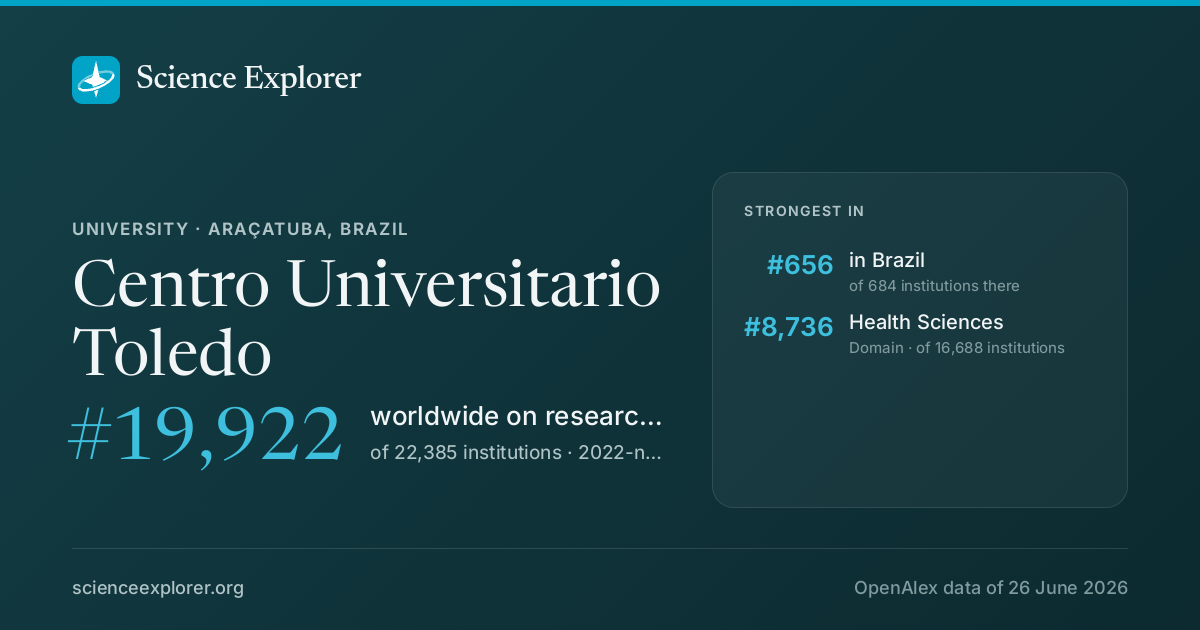
Centro Universitario Toledo on Science Explorer

A card with Centro Universitario Toledo's standing and the fields it leads in, for a post or a slide. A link to this page previews as the same card.

Download the card

1200 × 630 PNG, sized for social posts, drawn from the latest snapshot.

Badges for a website1Each links back here and updates with every snapshot

Research measures only: rankings here say nothing about teaching, admissions or student experience. Comparable institutions and collaboration partners have tabs of their own, above.

Discussion

Ask a question or share a note about Centro Universitario Toledo. Keep it to the research: no personal attacks, advertising or links. Any reader can report a post, which collapses it for everyone until it is opened.