China Information Technology Security Evaluation Center
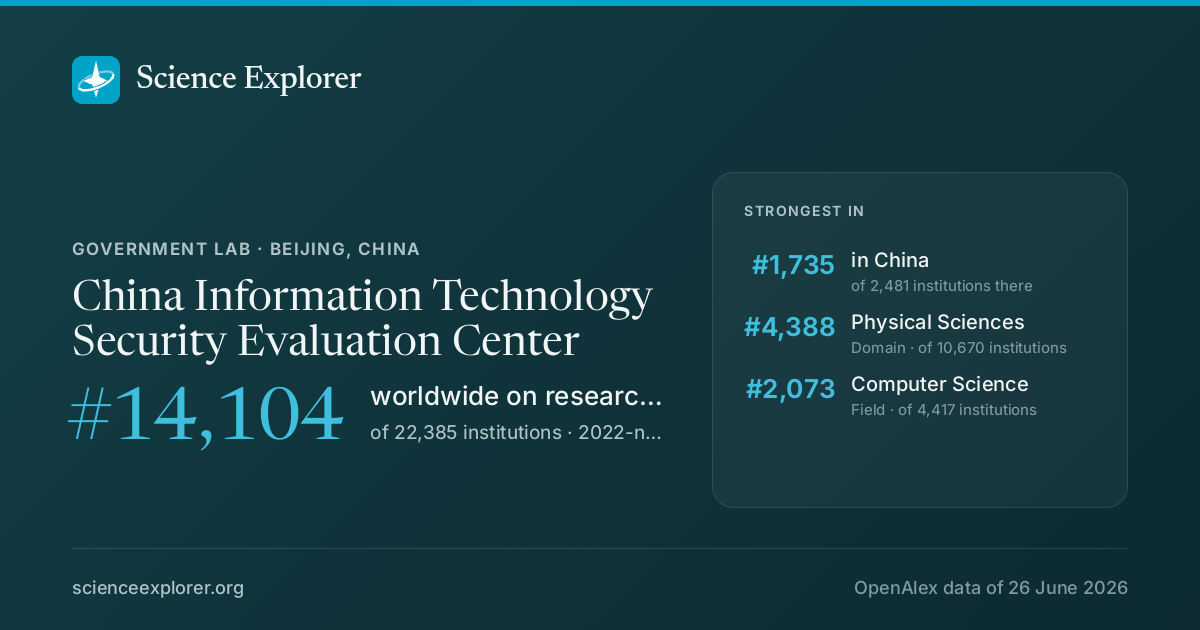
In research, China Information Technology Security Evaluation Center stands highest in Physical Sciences (#4,388 of 10,670 worldwide) and Computer Science (#2,073 of 4,417 worldwide), 2022-now. Relative to its size it is most specialised in Artificial Intelligence and Computer Science (Artificial Intelligence is 8.8× its share of world research).
- World rank, 2022-now
- #14,104 of 22,385 · #13,710 all time
- Rank in China
- #1,735 of 2,481
- Research works
- 806 ▼ 6% vs 2018-21
- Citations
- 4.7k 5.8 per fractional work
- Top-10% rate
- 10.1% all institutions 10.0%
- vs its own fields
- 1.07× 1.00× is exactly expected
- Open access
- 16% world 40%
- International
- 4% world 18%
What is China Information Technology Security Evaluation Center known for in research?
The fields where it stands highest, 2022-now, ranked among every institution above the floor in each field.
| Field | World rank | Where that sits | Top-10% rate | Works | All time |
|---|---|---|---|---|---|
| Physical SciencesDomain | #4,388 of 10,670 | 9.6% | 112 | #5649 | |
| Computer ScienceField | #2,073 of 4,417 | 9.1% | 69 | #2210 |
Each strip is that field's whole ranked pool, with the notch where China Information Technology Security Evaluation Center sits in it, in the colour of the band that rank falls in. The track under the rate is the rate itself: it carries no average mark, because the average differs by field (from about 6% in Dentistry to 21% in Economics).
Which fields of science does China Information Technology Security Evaluation Center work in?
In 2022-now, 88% of research at China Information Technology Security Evaluation Center is in Physical Sciences, 8% in Social Sciences. Its largest fields are Computer Science (55%), Engineering (27%), Business, Management and Accounting (3%). It does 2.2× the world's share of Physical Sciences.
Each ring splits the one inside it: the four domains of science, their fields, their subfields. Size is fractional works in 2022-now. Every slice is a page; the interactive view zooms down to single topics and colours each by how much more of it this institution does than the world.
Its 4 domains and 22 fields, with their numbers
- Physical Sciences12788.2%
- Computer Science7954.9%
- Engineering3927.4%
- Physics and Astronomy32.2%
- Materials Science31.7%
- Environmental Science21.1%
- Earth and Planetary Sciences10.4%
- Mathematics00.3%
- Chemical Engineering00.2%
- Energy00.2%
- Social Sciences117.9%
- Health Sciences32.0%
- Medicine21.7%
- Health Professions00.2%
- Dentistry00.1%
- Nursing00.0%
- Life Sciences31.9%
What does China Information Technology Security Evaluation Center specialise in?
Where its research is concentrated relative to its size: Artificial Intelligence takes 8.8× the share of its output that it takes of world research.
- Artificial IntelligenceSubfield · 30.7 works8.8×
- Computer ScienceField · 79.3 works7.1×
Location quotient, a volume reading rather than an impact one. It surfaces small, lopsided specialities.
Field profile
Location quotient across every field it publishes in: outside the ring is more than an institution of this size would be expected to publish, inside it is less.
Rings at 0.5×, 1× and 2×. Widest outward: Computer Science, 7.1×. Every wedge is a field page.
All 22 fields, with their numbers
- Computer Science7.06×79 works
- Decision Sciences2.37×3 works
- Engineering1.82×40 works
- Physics and Astronomy0.97×3 works
- Business, Management and Accounting0.84×4 works
- Chemical Engineering0.66×0 works
- Materials Science0.50×2 works
- Economics, Econometrics and Finance0.31×1 works
- Neuroscience0.26×1 works
- Earth and Planetary Sciences0.24×0 works
- Dentistry0.24×0 works
- Biochemistry, Genetics and Molecular Biology0.23×2 works
- Mathematics0.23×0 works
- Environmental Science0.21×2 works
- Energy0.18×0 works
- Social Sciences0.15×3 works
- Medicine0.09×2 works
- Nursing0.09×0 works
- Psychology0.08×0 works
- Health Professions0.07×0 works
- Agricultural and Biological Sciences0.05×0 works
- Arts and Humanities0.04×0 works
- Computer Science 7.1×
- Decision Sciences 2.4×
- Engineering 1.8×
- Physics and Astronomy 1.0×
- Business, Management and Accounting 0.8×
- Chemical Engineering 0.7×
- Materials Science 0.5×
- Economics, Econometrics and Finance 0.3×
- Neuroscience 0.3×
- Earth and Planetary Sciences 0.2×
- Dentistry 0.2×
- Biochemistry, Genetics and Molecular Biology 0.2×
- Mathematics 0.2×
- Environmental Science 0.2×
- Energy 0.2×
- Social Sciences 0.1×
- Medicine 0.1×
- Nursing 0.1×
- Psychology 0.1×
- Health Professions 0.1×
- Agricultural and Biological Sciences 0.1×
- Arts and Humanities 0.0×
Who are the top researchers at China Information Technology Security Evaluation Center?
Ranked on the quality score, Jiajie Wang, Yang Gao and Junfeng Xu lead among researchers whose main affiliation is China Information Technology Security Evaluation Center.
- 1
Jiajie Wang
 China · #1,120,938 worldwide
601 citations · 60 works
- 2
Yang Gao
China · #1,459,670 worldwide
1k citations · 94 works
- 3
Junfeng Xu
China · #1,742,745 worldwide
449 citations · 31 works
- 4
Zhonghua Dai
China · #2,133,719 worldwide
307 citations · 22 works
- 5
Tao Guo
China · #2,420,277 worldwide
914 citations · 88 works
- 6
Junjun Cheng
China · #2,597,577 worldwide
303 citations · 19 works
- 7
Feng Xie
China · #2,691,386 worldwide
545 citations · 102 works
- 8
Tong Xin
China · #2,717,109 worldwide
174 citations · 18 works
- 9
Shizhong Wu
China · #2,776,579 worldwide
269 citations · 26 works
- 10
Haihui Gao
China · #2,816,802 worldwide
238 citations · 32 works
Which keywords describe research at China Information Technology Security Evaluation Center?
By fractional works in 2022-now, weighted toward what it does more of than the world: Deep Learning, Machine Learning, Neural Networks, Security, IoT Security, Internet of Things, Anomaly Detection and Data Mining.
- Unsupervised
- Cryptography
- Smart Contracts
- Blockchain
- Time Series
- Permission Analysis
- Convolutional Neural Networks
- Cryptanalysis
- Healthcare
- Behavioral Analysis
- RF Fingerprinting
- Privacy
- DDoS Attacks
- Channel Estimation
- Intrusion Detection
- Cybersecurity
- Data Mining
- Internet of Things
- Security
- Machine Learning
- Deep Learning
- Neural Networks
- IoT Security
- Anomaly Detection
- Security Analysis
- Wireless Communications
- Big Data
- Massive MIMO
- Network Security
- Modulation Classification
- Detection
- Cloud Computing
- Energy Efficiency
- Supply Chain Management
- Android Malware
- Wireless Sensor Networks
- Decentralization
- Side-Channel Attacks
- High-Dimensional Data
- Outlier Detection
Size is fractional works in 2022-now in the topics tagged with each word; colour is the word's share of this institution's work against its share of the world's. The 40 words are chosen for being large and distinctive. Each links to the topic it comes from most.
All 40 words, with their numbers
- Deep Learning39▲ 7.9×45 topics
- Machine Learning24▲ 5.1×31 topics
- Neural Networks13▲ 5.9×20 topics
- Security10▲ 11×13 topics
- IoT Security10▲ 23×3 topics
- Internet of Things9▲ 7.5×15 topics
- Anomaly Detection9▲ 21×3 topics
- Data Mining8▲ 8.0×6 topics
- Security Analysis8▲ 31×4 topics
- Cybersecurity7▲ 20×3 topics
- Wireless Communications7▲ 28×5 topics
- Intrusion Detection7▲ 34×3 topics
- Big Data6▲ 4.7×11 topics
- Channel Estimation6▲ 46×4 topics
- Massive MIMO6▲ 50×3 topics
- DDoS Attacks5▲ 31×1 topic
- Network Security5▲ 28×1 topic
- Privacy5▲ 12×5 topics
- Modulation Classification5▲ 192×1 topic
- RF Fingerprinting5▲ 192×1 topic
- Detection5▲ 12×5 topics
- Behavioral Analysis5▲ 29×2 topics
- Cloud Computing5▲ 12×8 topics
- Healthcare5▲ 2.9×6 topics
- Energy Efficiency4▲ 3.3×10 topics
- Cryptanalysis4▲ 35×4 topics
- Supply Chain Management4▲ 3.2×4 topics
- Convolutional Neural Networks4▲ 3.7×10 topics
- Android Malware4▲ 35×1 topic
- Permission Analysis4▲ 35×1 topic
- Wireless Sensor Networks4▲ 6.0×7 topics
- Time Series3▲ 13×2 topics
- Decentralization3▲ 10×2 topics
- Blockchain3▲ 9.3×1 topic
- Side-Channel Attacks3▲ 40×3 topics
- Smart Contracts3▲ 13×1 topic
- High-Dimensional Data3▲ 13×2 topics
- Cryptography3▲ 15×3 topics
- Outlier Detection3▲ 14×1 topic
- Unsupervised3▲ 16×1 topic
Which research topics does China Information Technology Security Evaluation Center publish most on?
By volume in 2022-now: Network Security and Intrusion Detection, Wireless Signal Modulation Classification, Advanced Malware Detection Techniques and Blockchain Technology Applications and Security.
Area is fractional works; colour is the subfield each topic belongs to.
- 1 Network Security and Intrusion Detection Computer Networks and Communications 5 works
- 2 Wireless Signal Modulation Classification Artificial Intelligence 5 works
- 3 Advanced Malware Detection Techniques Signal Processing 4 works
- 4 Blockchain Technology Applications and Security Information Systems 3 works
- 5 Anomaly Detection Techniques and Applications Artificial Intelligence 3 works
- 6 Cryptography and Data Security Artificial Intelligence 2 works
- 7 Advanced Steganography and Watermarking Techniques Computer Vision and Pattern Recognition 2 works
- 8 E-commerce and Technology Innovations Business and International Management 2 works
- 9 Privacy-Preserving Technologies in Data Artificial Intelligence 2 works
- 10 Internet Traffic Analysis and Secure E-voting Artificial Intelligence 2 works
How open and international is its research?
Against the world's own shares: the tick on each track. Both are shares of its output, so they sit on one scale and can be read against each other as well as against the world.
World: 40% of research is openly available.
World: 18% is written across borders.
How has China Information Technology Security Evaluation Center's research output changed?
Output in 2022-2025 was 6% lower than in 2018-2021.
The same series as a ribbon: one cell per year, darker for more. The line above answers how much; this answers when.
Its share of all research
Growing output can still be a shrinking share: all of science grows. This is China Information Technology Security Evaluation Center as a percentage of every work published that year, 0.00047% in 2024.
Fractional works of China Information Technology Security Evaluation Center over all fractional works that year. How the balance of science has shifted.
How much of it reaches the world top 10%
Year by year, against all institutions in the same year.
Of each year's output, the share that reached the world's 10% most cited for its field and year. Peak 17.8% in 2023.
Other research institutions in Beijing
- Chinese Academy of Sciences
- Tsinghua University
- Peking University
- Chinese Academy of Agricultural Sciences
- University of Chinese Academy of Sciences
- Beihang University
- Beijing Institute of Technology
- Capital Medical University

Share China Information Technology Security Evaluation Center's ranking
Badges for a website1Each links back here and updates with every snapshot

Research measures only: rankings here say nothing about teaching, admissions or student experience. Comparable institutions and collaboration partners have tabs of their own, above.
Discussion
Ask a question or share a note about China Information Technology Security Evaluation Center. Keep it to the research: no personal attacks, advertising or links. Any reader can report a post, which collapses it for everyone until it is opened.