Science Explorer Back to mapMap
Discussion
Nonprofit · Tarnów · Poland

Cities On Internet Association

World rank, all time
#30,827
of 34,923
Rank in Poland
#386
of 436
Research works
127
▲ 68% vs 2018-21
Citations
117
0.9 per fractional work
Top-10% rate
6.9%
all institutions 10.0%
vs its own fields
0.94×
1.00× is exactly expected
Open access
46%
world 40%
International
14%
world 18%

Which fields of science does Cities On Internet Association work in?

In 2022-now, 67% of research at Cities On Internet Association is in Social Sciences, 18% in Health Sciences. Its largest fields are Social Sciences (40%), Arts and Humanities (18%), Medicine (14%). It does 2.3× the world's share of Social Sciences.

Social Sciences: 30 fractional works · 66.5% of its workSocial Sciences: 18 fractional works · 39.8% of its workPolitical Science and International Relations: 6 fractional works · 12.4% of its workEducation: 3 fractional works · 7.5% of its workUrban Studies: 2 fractional works · 5.5% of its workAnthropology: 2 fractional works · 3.3% of its workSociology and Political Science: 1 fractional works · 2.6% of its workLinguistics and Language: 1 fractional works · 2.2% of its workGeography, Planning and Development: 1 fractional works · 1.6% of its workGeneral Social Sciences: 1 fractional works · 1.4% of its workLaw: 0 fractional works · 1.1% of its workTransportation: 0 fractional works · 0.9% of its workGender Studies: 0 fractional works · 0.7% of its workCultural Studies: 0 fractional works · 0.4% of its workArts and Humanities: 8 fractional works · 18.1% of its workHistory: 4 fractional works · 8.8% of its workArcheology: 2 fractional works · 4.0% of its workPhilosophy: 1 fractional works · 3.0% of its workMuseology: 1 fractional works · 2.2% of its workSmaller subfields together: 0 fractional works · 0.2% of its workBusiness, Management and Accounting: 2 fractional works · 3.5% of its workAccounting: 1 fractional works · 2.1% of its workStrategy and Management: 1 fractional works · 1.4% of its workSmaller subfields together: 0 fractional works · 0.0% of its workPsychology: 1 fractional works · 2.9% of its workExperimental and Cognitive Psychology: 0 fractional works · 1.1% of its workNeuropsychology and Physiological Psychology: 0 fractional works · 0.7% of its workDevelopmental and Educational Psychology: 0 fractional works · 0.7% of its workClinical Psychology: 0 fractional works · 0.3% of its workEconomics, Econometrics and Finance: 1 fractional works · 1.7% of its workEconomics and Econometrics: 1 fractional works · 1.5% of its workFinance: 0 fractional works · 0.2% of its workDecision Sciences: 0 fractional works · 0.6% of its workHealth Sciences: 8 fractional works · 18.3% of its workMedicine: 6 fractional works · 14.0% of its workPublic Health, Environmental and Occupational Health: 1 fractional works · 2.2% of its workSurgery: 1 fractional works · 1.7% of its workPulmonary and Respiratory Medicine: 1 fractional works · 1.5% of its workRadiology, Nuclear Medicine and Imaging: 1 fractional works · 1.5% of its workCardiology and Cardiovascular Medicine: 0 fractional works · 1.1% of its workRheumatology: 0 fractional works · 1.0% of its workEpidemiology: 0 fractional works · 0.9% of its workComplementary and alternative medicine: 0 fractional works · 0.6% of its workInfectious Diseases: 0 fractional works · 0.6% of its workPharmacology: 0 fractional works · 0.4% of its workPsychiatry and Mental health: 0 fractional works · 0.4% of its workReproductive Medicine: 0 fractional works · 0.3% of its workCritical Care and Intensive Care Medicine: 0 fractional works · 0.2% of its workEndocrinology, Diabetes and Metabolism: 0 fractional works · 0.2% of its workImmunology and Allergy: 0 fractional works · 0.2% of its workPediatrics, Perinatology and Child Health: 0 fractional works · 0.2% of its workPhysiology: 0 fractional works · 0.2% of its workSmaller subfields together: 0 fractional works · 0.5% of its workHealth Professions: 1 fractional works · 2.6% of its workPhysical Therapy, Sports Therapy and Rehabilitation: 1 fractional works · 1.4% of its workGeneral Health Professions: 0 fractional works · 1.1% of its workSmaller subfields together: 0 fractional works · 0.1% of its workDentistry: 1 fractional works · 1.7% of its workOral Surgery: 0 fractional works · 1.0% of its workPeriodontics: 0 fractional works · 0.7% of its workSmaller subfields together: 0 fractional works · 0.0% of its workPhysical Sciences: 6 fractional works · 13.0% of its workComputer Science: 2 fractional works · 4.9% of its workInformation Systems: 1 fractional works · 3.0% of its workArtificial Intelligence: 0 fractional works · 0.7% of its workComputer Graphics and Computer-Aided Design: 0 fractional works · 0.4% of its workComputer Networks and Communications: 0 fractional works · 0.4% of its workSmaller subfields together: 0 fractional works · 0.4% of its workEngineering: 2 fractional works · 3.8% of its workControl and Systems Engineering: 0 fractional works · 1.1% of its workAerospace Engineering: 0 fractional works · 0.9% of its workBiomedical Engineering: 0 fractional works · 0.5% of its workBuilding and Construction: 0 fractional works · 0.5% of its workMechanical Engineering: 0 fractional works · 0.4% of its workCivil and Structural Engineering: 0 fractional works · 0.2% of its workSmaller subfields together: 0 fractional works · 0.2% of its workMathematics: 1 fractional works · 1.7% of its workAlgebra and Number Theory: 0 fractional works · 0.7% of its workDiscrete Mathematics and Combinatorics: 0 fractional works · 0.7% of its workSmaller subfields together: 0 fractional works · 0.2% of its workEnvironmental Science: 1 fractional works · 1.3% of its workNature and Landscape Conservation: 0 fractional works · 0.7% of its workManagement, Monitoring, Policy and Law: 0 fractional works · 0.4% of its workSmaller subfields together: 0 fractional works · 0.2% of its workEarth and Planetary Sciences: 0 fractional works · 0.7% of its workSpace and Planetary Science: 0 fractional works · 0.7% of its workMaterials Science: 0 fractional works · 0.4% of its workMaterials Chemistry: 0 fractional works · 0.4% of its workChemistry: 0 fractional works · 0.2% of its workLife Sciences: 1 fractional works · 2.2% of its workBiochemistry, Genetics and Molecular Biology: 1 fractional works · 1.4% of its workMolecular Biology: 0 fractional works · 0.6% of its workCancer Research: 0 fractional works · 0.4% of its workSmaller subfields together: 0 fractional works · 0.4% of its workImmunology and Microbiology: 0 fractional works · 0.5% of its workImmunology: 0 fractional works · 0.5% of its workNeuroscience: 0 fractional works · 0.4% of its workALL ITS WORKCities OnInternet…45fractional works, 2022-now
Life Sciences2%Physical Sciences13%Health Sciences18%Social Sciences67%

Each ring splits the one inside it: the four domains of science, their fields, their subfields. Size is fractional works in 2022-now. Every slice is a page; the interactive view zooms down to single topics and colours each by how much more of it this institution does than the world.

Its 4 domains and 19 fields, with their numbers
    1. Social Sciences1839.8%
    2. Arts and Humanities818.1%
    3. Business, Management and Accounting23.5%
    4. Psychology12.9%
    5. Economics, Econometrics and Finance11.7%
    6. Decision Sciences00.6%
    1. Medicine614.0%
    2. Health Professions12.6%
    3. Dentistry11.7%
    1. Computer Science24.9%
    2. Engineering23.8%
    3. Mathematics11.7%
    4. Environmental Science11.3%
    5. Earth and Planetary Sciences00.7%
    6. Materials Science00.4%
    7. Chemistry00.2%
    1. Biochemistry, Genetics and Molecular Biology11.4%
    2. Immunology and Microbiology00.5%
    3. Neuroscience00.4%
All of science, and how each field's share has moved since 1950: the Science domain explorer

Field profile

Location quotient across every field it publishes in: outside the ring is more than an institution of this size would be expected to publish, inside it is less.

Biochemistry, Genetics and Molecular Biology: 0.26× its world share, 1 worksBiochemistry, Geneti…Immunology and Microbiology: 0.48× its world share, 0 worksImmunology and Micro…Neuroscience: 0.22× its world share, 0 worksNeuroscienceChemistry: 0.12× its world share, 0 worksChemistryComputer Science: 0.63× its world share, 2 worksComputer ScienceEarth and Planetary Sciences: 0.47× its world share, 0 worksEarth and Planetary …Engineering: 0.25× its world share, 2 worksEngineeringEnvironmental Science: 0.27× its world share, 1 worksEnvironmental ScienceMaterials Science: 0.11× its world share, 0 worksMaterials ScienceMathematics: 1.42× its world share, 1 worksMathematicsDentistry: 3.56× its world share, 1 worksDentistryHealth Professions: 0.97× its world share, 1 worksHealth ProfessionsMedicine: 0.73× its world share, 6 worksMedicineArts and Humanities: 6.28× its world share, 8 worksArts and HumanitiesBusiness, Management and Accounting: 1.07× its world share, 2 worksBusiness, Management…Decision Sciences: 0.57× its world share, 0 worksDecision SciencesEconomics, Econometrics and Finance: 0.81× its world share, 1 worksEconomics, Econometr…Psychology: 0.94× its world share, 1 worksPsychologySocial Sciences: 3.14× its world share, 18 worksSocial Sciences1×world share
more than its size predictsabout as predictedless

Rings at 0.5×, 1× and 2×. Widest outward: Arts and Humanities, 6.3×. Every wedge is a field page.

All 19 fields, with their numbers
  1. Arts and Humanities6.28×8 works
  2. Dentistry3.56×1 works
  3. Social Sciences3.14×18 works
  4. Mathematics1.42×1 works
  5. Business, Management and Accounting1.07×2 works
  6. Health Professions0.97×1 works
  7. Psychology0.94×1 works
  8. Economics, Econometrics and Finance0.81×1 works
  9. Medicine0.73×6 works
  10. Computer Science0.63×2 works
  11. Decision Sciences0.57×0 works
  12. Immunology and Microbiology0.48×0 works
  13. Earth and Planetary Sciences0.47×0 works
  14. Environmental Science0.27×1 works
  15. Biochemistry, Genetics and Molecular Biology0.26×1 works
  16. Engineering0.25×2 works
  17. Neuroscience0.22×0 works
  18. Chemistry0.12×0 works
  19. Materials Science0.11×0 works

What are the most cited papers from Cities On Internet Association?

The most cited paper from Cities On Internet Association is "PM 7/129 (1) DNA barcoding as an identification tool for a number of regulated pests" (For a reliable test result to be obtained, the following external controls should be included for each series of nucleic ac, respectively:, 2016), with 88 citations. Next come "Incidence of mechanical complications following myocardial infarction during the first two months of the COVID-19 pandemic in the Southern Poland region: a multicenter study" (12) and "Ćwierć wieku polskich badań nad grami wideo" (7).

Most cited papers
#PaperReleasedCitations
1 PM 7/129 (1) DNA barcoding as an identification tool for a number of regulated pests For a reliable test result to be obtained, the following external controls should be included for each series of nucleic ac, respectively: · EPPO Bulletin Open access 28 Nov 2016 88
2 Incidence of mechanical complications following myocardial infarction during the first two months of the COVID-19 pandemic in the Southern Poland region: a multicenter study Magdalena A. Bryndza, Radosław Litwinowicz, Stanisław Bartuś et al. · Kardiologia Polska Open access 23 Oct 2020 12
3 Ćwierć wieku polskich badań nad grami wideo Maria B. Garda, Stanisław Krawczyk · Teksty Drugie Open access 2017 7
4 Multidimensional polynomial Szemerédi theorem in finite fields for polynomials of distinct degrees Borys Kuca · Israel Journal of Mathematics 9 Oct 2023 6
5 Implantable cardioverter-defibrillators in patients with long QT syndrome: a multicentre study Agnieszka Zienciuk‐Krajka, Maciej M. Sterlinski, Artur Filipecki et al. · Kardiologia Polska Open access 29 Aug 2018 6
All 69 most cited papers, with filters and sorting

Which keywords describe research at Cities On Internet Association?

By fractional works in 2022-now, weighted toward what it does more of than the world: Urban Development, Cultural Heritage, Education, Eastern European culture, Polish nobility, Polish history, Polish minority and Literature.

▲ more of its work than of the world's◆ about the world's share▼ less than the world's

Size is fractional works in 2022-now in the topics tagged with each word; colour is the word's share of this institution's work against its share of the world's. The 40 words are chosen for being large and distinctive. Each links to the topic it comes from most.

All 40 words, with their numbers
  1. Education4▲ 5.6×5 topics
  2. Urban Development4▲ 26×2 topics
  3. Cultural Heritage4▲ 16×4 topics
  4. Eastern European culture3▲ 599×1 topic
  5. Polish nobility3▲ 599×1 topic
  6. Polish history3▲ 286×1 topic
  7. Polish minority3▲ 286×1 topic
  8. Literature3▲ 12×4 topics
  9. Globalization3▲ 3.2×6 topics
  10. History3▲ 8.5×3 topics
  11. Community Participation2▲ 16×2 topics
  12. Ethnography2▲ 30×2 topics
  13. Narrative2▲ 33×2 topics
  14. Migration2▲ 15×3 topics
  15. Pedagogy2▲ 9.3×4 topics
  16. Memory2▲ 18×3 topics
  17. Cultural Studies2▲ 11×3 topics
  18. Cultural Tourism2▲ 671×1 topic
  19. Lifelong Learning2▲ 19×3 topics
  20. Social Change2▲ 33×2 topics
  21. Sustainable Urban Futures2▲ 671×1 topic
  22. Castle Construction2▲ 432×1 topic
  23. Community2▲ 31×2 topics
  24. Medieval Architecture2▲ 194×1 topic
  25. Postcolonialism2▲ 26×2 topics
  26. Economic Development2▲ 4.5×3 topics
  27. Higher Education2▲ 6.7×3 topics
  28. Anthropology2▲ 35×1 topic
  29. Development2▲ 9.3×1 topic
  30. Ethics2▲ 6.5×3 topics
  31. European Union Law2▲ 209×2 topics
  32. Public Administration2▲ 41×2 topics
  33. Authorship1▲ 105×2 topics
  34. Cultural1▲ 61×1 topic
  35. Cultural Identity1▲ 6.0×2 topics
  36. Culture1▲ 5.7×2 topics
  37. Entrepreneurship1▲ 7.2×2 topics
  38. Education Reform1▲ 102×2 topics
  39. Social Sciences1▲ 17×1 topic
  40. Translation1▲ 15×2 topics

Which research topics does Cities On Internet Association publish most on?

By volume in 2022-now: Historical and Cultural Studies of Poland, Polish Historical and Cultural Studies, Urban Development and Cultural Heritage and Medieval European History and Architecture.

  1. 1 Historical and Cultural Studies of Poland History 3 works
  2. 2 Polish Historical and Cultural Studies Political Science and International Relations 3 works
  3. 3 Urban Development and Cultural Heritage Urban Studies 2 works
  4. 4 Medieval European History and Architecture Archeology 2 works
  5. 5 Central European Literary Studies Anthropology 2 works
  6. 6 Polish-Jewish Holocaust Memory Studies Philosophy 1 works
  7. 7 Education and Cultural Studies Education 1 works
  8. 8 African cultural and philosophical studies Education 1 works
  9. 9 Libraries and Information Services Museology 1 works
  10. 10 Language and Culture Linguistics and Language 1 works

How open and international is its research?

Against the world's own shares: the tick on each track. Both are shares of its output, so they sit on one scale and can be read against each other as well as against the world.

openly available46.4%not open53.6%

World: 40% of research is openly available.

with international co-authors13.8%domestic only86.2%

World: 18% is written across borders.

How has Cities On Internet Association's research output changed?

Output in 2022-2025 was 68% higher than in 2018-2021.

still counting1990200020102020
grewheldshrank

The same series as a ribbon: one cell per year, darker for more. The line above answers how much; this answers when.

Its share of all research

Growing output can still be a shrinking share: all of science grows. This is Cities On Internet Association as a percentage of every work published that year, 0.00018% in 2024.

still counting0.00050%0.0010%0.0015%Cities On Internet Association0.00020% in 20251990200020102020

Fractional works of Cities On Internet Association over all fractional works that year. How the balance of science has shifted.

Other research institutions in Tarnów

All research institutions in Tarnów

Share Cities On Internet Association's ranking
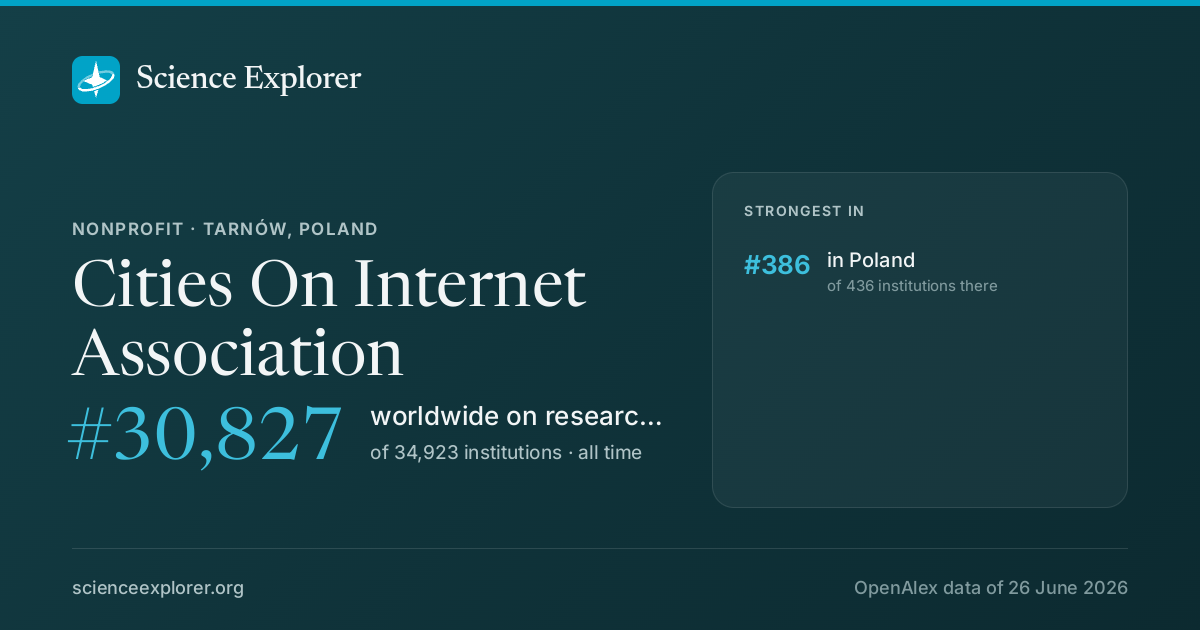
Cities On Internet Association on Science Explorer

A card with Cities On Internet Association's standing and the fields it leads in, for a post or a slide. A link to this page previews as the same card.

Download the card

1200 × 630 PNG, sized for social posts, drawn from the latest snapshot.

Badges for a website1Each links back here and updates with every snapshot

Research measures only: rankings here say nothing about teaching, admissions or student experience. Comparable institutions and collaboration partners have tabs of their own, above.

Discussion

Ask a question or share a note about Cities On Internet Association. Posts are plain text and can be reported.