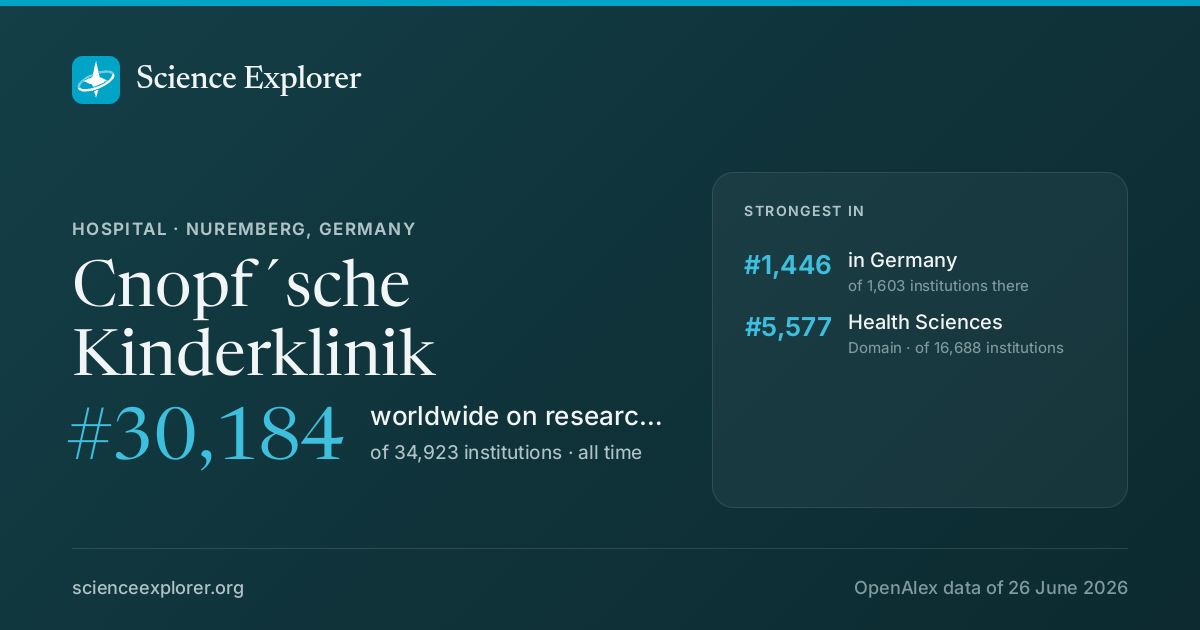
Cnopf´sche Kinderklinik
In research, Cnopf´sche Kinderklinik stands highest in Health Sciences (#5,577 of 16,688 worldwide), over all time.
- World rank, all time
- #30,184 of 34,923
- Rank in Germany
- #1,446 of 1,603
- Research works
- 162 ▼ 41% vs 2018-21
- Citations
- 1.7k 10.4 per fractional work
- Top-10% rate
- 4.7% all institutions 10.0%
- vs its own fields
- 1.06× 1.00× is exactly expected
- Open access
- 13% world 40%
- International
- 11% world 18%
What is Cnopf´sche Kinderklinik known for in research?
The fields where it stands highest, over all time, ranked among every institution above the floor in each field.
| Field | World rank | Where that sits | Top-10% rate | Works |
|---|---|---|---|---|
| Health SciencesDomain | #5,577 of 16,688 | 5.4% | 134 |
Each strip is that field's whole ranked pool, with the notch where Cnopf´sche Kinderklinik sits in it, in the colour of the band that rank falls in. The track under the rate is the rate itself: it carries no average mark, because the average differs by field (from about 6% in Dentistry to 21% in Economics).
Which fields of science does Cnopf´sche Kinderklinik work in?
In 2022-now, 93% of research at Cnopf´sche Kinderklinik is in Health Sciences, 4% in Social Sciences. Its largest fields are Medicine (86%), Health Professions (7%), Biochemistry, Genetics and Molecular Biology (2%). It does 3.3× the world's share of Health Sciences.
Each ring splits the one inside it: the four domains of science, their fields, their subfields. Size is fractional works in 2022-now. Every slice is a page; the interactive view zooms down to single topics and colours each by how much more of it this institution does than the world.
Its 4 domains and 12 fields, with their numbers
- Health Sciences3992.8%
- Medicine3686.0%
- Health Professions36.7%
- Nursing00.1%
- Social Sciences13.5%
- Life Sciences13.2%
- Physical Sciences00.4%
- Computer Science00.4%
Field profile
Location quotient across every field it publishes in: outside the ring is more than an institution of this size would be expected to publish, inside it is less.
Rings at 0.5×, 1× and 2×. Widest outward: Medicine, 4.5×. Every wedge is a field page.
All 12 fields, with their numbers
- Medicine4.47×36 works
- Health Professions2.54×3 works
- Neuroscience0.76×0 works
- Psychology0.49×1 works
- Immunology and Microbiology0.44×0 works
- Business, Management and Accounting0.30×0 works
- Biochemistry, Genetics and Molecular Biology0.29×1 works
- Nursing0.21×0 works
- Economics, Econometrics and Finance0.19×0 works
- Arts and Humanities0.13×0 works
- Computer Science0.06×0 works
- Social Sciences0.02×0 works
- Medicine 4.5×
- Health Professions 2.5×
- Neuroscience 0.8×
- Psychology 0.5×
- Immunology and Microbiology 0.4×
- Business, Management and Accounting 0.3×
- Biochemistry, Genetics and Molecular Biology 0.3×
- Nursing 0.2×
- Economics, Econometrics and Finance 0.2×
- Arts and Humanities 0.1×
- Computer Science 0.1×
- Social Sciences 0.0×
Who are the top researchers at Cnopf´sche Kinderklinik?
Ranked on the quality score, Irena Neustädter, Karin Becke and G. Hammersen lead among researchers whose main affiliation is Cnopf´sche Kinderklinik.
- 1
Irena Neustädter
 Germany · #1,120,841 worldwide
274 citations · 30 works
- 2
Karin Becke
Germany · #1,224,033 worldwide
4.1k citations · 148 works
- 3
G. Hammersen
Germany · #1,371,135 worldwide
1.6k citations · 41 works
- 4
H. U. Tietze
Germany · #2,321,364 worldwide
656 citations · 32 works
- 5
Michael Andreas Schroth
Germany · #2,952,525 worldwide
1.5k citations · 124 works
- 6
Elsa Hollatz-Galuschki
Germany · #3,320,046 worldwide
85 citations · 29 works
- 7
Frank‐Mattias Schäfer
Germany · #3,649,247 worldwide
564 citations · 51 works
- 8
Bernd Landsleitner
Germany · #3,677,068 worldwide
591 citations · 142 works
- 9
Michael Seybold
Germany · #4,695,099 worldwide
103 citations · 51 works
- 10
Ulrike Tietze
Germany · #4,869,550 worldwide
12 citations · 21 works
Which keywords describe research at Cnopf´sche Kinderklinik?
By fractional works in 2022-now, weighted toward what it does more of than the world: Epidemiology, Resuscitation, Anaesthesia, Medical Gases, Public Health, Prenatal Diagnosis, Genitourinary Development and Urotrauma.
- Acute Respiratory Distress Syndrome
- Tracheal Intubation
- Preterm Birth
- Lung Stem Cells
- Difficult Airway Society
- Bronchopulmonary Dysplasia
- Male Circumcision
- HIV Prevention
- Epidemiological Study
- Healthcare Utilization
- Preterm Infants
- Management
- Autoimmune Disease
- Surgical Management
- Maternal Mortality
- Neurodevelopmental Outcomes
- Genitourinary Development
- Medical Gases
- Resuscitation
- Inflammation
- Epidemiology
- Public Health
- Anaesthesia
- Prenatal Diagnosis
- Hypothermia
- Urotrauma
- Pain Management
- Complications
- Cardiac Arrest
- Out-of-Hospital
- Urinary Incontinence
- Chronic Diseases
- Germany
- Health Surveys
- Rehabilitation
- Chronic Pain
- Intrauterine Infection
- Mechanical Ventilation
- Robotic Surgery
- Acute Lung Injury
Size is fractional works in 2022-now in the topics tagged with each word; colour is the word's share of this institution's work against its share of the world's. The 40 words are chosen for being large and distinctive. Each links to the topic it comes from most.
All 40 words, with their numbers
- Epidemiology6▲ 3.9×29 topics
- Inflammation3▲ 3.0×14 topics
- Public Health3▲ 4.2×5 topics
- Resuscitation2▲ 42×4 topics
- Anaesthesia2▲ 614×1 topic
- Medical Gases2▲ 614×1 topic
- Prenatal Diagnosis2▲ 32×5 topics
- Genitourinary Development2▲ 143×1 topic
- Hypothermia2▲ 59×2 topics
- Neurodevelopmental Outcomes2▲ 22×6 topics
- Urotrauma2▲ 143×1 topic
- Maternal Mortality2▲ 19×3 topics
- Pain Management2▲ 18×5 topics
- Surgical Management2▲ 9.8×5 topics
- Complications2▲ 7.8×6 topics
- Autoimmune Disease2▲ 59×2 topics
- Cardiac Arrest2▲ 64×1 topic
- Management2▲ 4.5×8 topics
- Out-of-Hospital2▲ 64×1 topic
- Preterm Infants2▲ 30×3 topics
- Urinary Incontinence2▲ 46×2 topics
- Healthcare Utilization1▲ 41×2 topics
- Chronic Diseases1▲ 12×2 topics
- Epidemiological Study1▲ 45×2 topics
- Germany1▲ 162×1 topic
- HIV Prevention1▲ 54×1 topic
- Health Surveys1▲ 162×1 topic
- Male Circumcision1▲ 138×1 topic
- Rehabilitation1▲ 7.9×4 topics
- Bronchopulmonary Dysplasia1▲ 43×1 topic
- Chronic Pain1▲ 13×2 topics
- Difficult Airway Society1▲ 90×1 topic
- Intrauterine Infection1▲ 79×2 topics
- Lung Stem Cells1▲ 48×1 topic
- Mechanical Ventilation1▲ 25×2 topics
- Preterm Birth1▲ 42×2 topics
- Robotic Surgery1▲ 19×2 topics
- Tracheal Intubation1▲ 90×1 topic
- Acute Lung Injury1▲ 49×1 topic
- Acute Respiratory Distress Syndrome1▲ 49×1 topic
Which research topics does Cnopf´sche Kinderklinik publish most on?
By volume in 2022-now: Biomedical and Chemical Research, Urological Disorders and Treatments, Cardiac Arrest and Resuscitation and Health and Medical Studies.
Area is fractional works; colour is the subfield each topic belongs to.
- 1 Biomedical and Chemical Research Surgery 2 works
- 2 Urological Disorders and Treatments Urology 2 works
- 3 Cardiac Arrest and Resuscitation Emergency Medicine 2 works
- 4 Health and Medical Studies General Health Professions 1 works
- 5 Genital Health and Disease Surgery 1 works
- 6 Neonatal Respiratory Health Research Pulmonary and Respiratory Medicine 1 works
- 7 Airway Management and Intubation Techniques Anesthesiology and Pain Medicine 1 works
- 8 Pediatric Urology and Nephrology Studies Pediatrics, Perinatology and Child Health 1 works
- 9 Respiratory Support and Mechanisms Pulmonary and Respiratory Medicine 1 works
- 10 Preterm Birth and Chorioamnionitis Epidemiology 1 works
How open and international is its research?
Against the world's own shares: the tick on each track. Both are shares of its output, so they sit on one scale and can be read against each other as well as against the world.
World: 40% of research is openly available.
World: 18% is written across borders.
How has Cnopf´sche Kinderklinik's research output changed?
Output in 2022-2025 was 41% lower than in 2018-2021.
The same series as a ribbon: one cell per year, darker for more. The line above answers how much; this answers when.
Its share of all research
Growing output can still be a shrinking share: all of science grows. This is Cnopf´sche Kinderklinik as a percentage of every work published that year, 0.00016% in 2024.
Fractional works of Cnopf´sche Kinderklinik over all fractional works that year. How the balance of science has shifted.
Other research institutions in Nuremberg
- Georg Simon Ohm University of Applied Sciences Nuremberg
- Nuremberg Hospital
- Institut für Arbeitsmarkt und Berufsforschung
- Paracelsus Medizinische Privatuniversität
- Deutsche Gesellschaft für Anästhesiologie und Intensivmedizin
- Institut für Psychogerontologie
- Federal Employment Agency
- GfK (Germany)

Share Cnopf´sche Kinderklinik's ranking
Badges for a website1Each links back here and updates with every snapshot

Research measures only: rankings here say nothing about teaching, admissions or student experience. Comparable institutions and collaboration partners have tabs of their own, above.
Discussion
Ask a question or share a note about Cnopf´sche Kinderklinik. Posts are plain text and can be reported.