Science Explorer Back to mapMap
Company · Nuremberg · Germany

GfK (Germany)

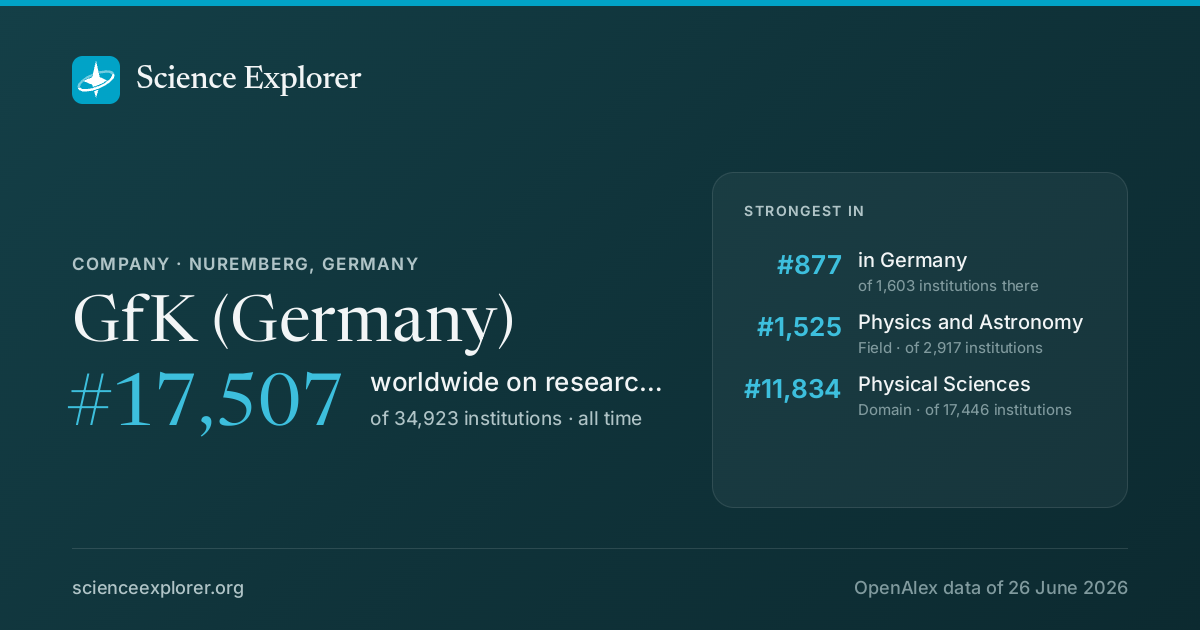
In research, GfK (Germany) stands highest in Physics and Astronomy (#1,525 of 2,917 worldwide) and Physical Sciences (#11,834 of 17,446 worldwide), over all time.

World rank, all time
#17,507
of 34,923
Rank in Germany
#877
of 1,603
Research works
373
▼ 55% vs 2018-21
Citations
9.5k
25.6 per fractional work
Top-10% rate
8.2%
all institutions 10.0%
vs its own fields
1.15×
1.00× is exactly expected
Open access
20%
world 40%
International
30%
world 18%

What is GfK (Germany) known for in research?

The fields where it stands highest, over all time, ranked among every institution above the floor in each field.

FieldWorld rankWhere that sitsTop-10% rateWorks
Physics and AstronomyField #1,525 of 2,917 12.1%146
Physical SciencesDomain #11,834 of 17,446 10.7%243

Each strip is that field's whole ranked pool, with the notch where GfK (Germany) sits in it, in the colour of the band that rank falls in. The track under the rate is the rate itself: it carries no average mark, because the average differs by field (from about 6% in Dentistry to 21% in Economics).

Which fields of science does GfK (Germany) work in?

In all years, 65% of research at GfK (Germany) is in Physical Sciences, 22% in Social Sciences. Its largest fields are Physics and Astronomy (39%), Engineering (12%), Business, Management and Accounting (9%). It does 1.6× the world's share of Physical Sciences.

Physical Sciences: 243 fractional works · 65.0% of its workPhysics and Astronomy: 146 fractional works · 39.1% of its workNuclear and High Energy Physics: 78 fractional works · 20.8% of its workAtomic and Molecular Physics, and Optics: 31 fractional works · 8.4% of its workRadiation: 26 fractional works · 6.9% of its workAstronomy and Astrophysics: 5 fractional works · 1.3% of its workStatistical and Nonlinear Physics: 4 fractional works · 1.2% of its workCondensed Matter Physics: 2 fractional works · 0.5% of its workEngineering: 43 fractional works · 11.6% of its workElectrical and Electronic Engineering: 12 fractional works · 3.2% of its workAerospace Engineering: 11 fractional works · 2.9% of its workComputational Mechanics: 7 fractional works · 2.0% of its workBiomedical Engineering: 4 fractional works · 1.1% of its workMechanics of Materials: 4 fractional works · 1.0% of its workAutomotive Engineering: 2 fractional works · 0.4% of its workMechanical Engineering: 1 fractional works · 0.2% of its workIndustrial and Manufacturing Engineering: 1 fractional works · 0.2% of its workSmaller subfields together: 2 fractional works · 0.5% of its workComputer Science: 23 fractional works · 6.1% of its workArtificial Intelligence: 10 fractional works · 2.8% of its workComputer Networks and Communications: 3 fractional works · 0.8% of its workInformation Systems: 3 fractional works · 0.7% of its workComputer Science Applications: 2 fractional works · 0.5% of its workSignal Processing: 2 fractional works · 0.4% of its workComputer Vision and Pattern Recognition: 1 fractional works · 0.3% of its workHuman-Computer Interaction: 1 fractional works · 0.2% of its workHardware and Architecture: 1 fractional works · 0.2% of its workSmaller subfields together: 1 fractional works · 0.1% of its workChemistry: 11 fractional works · 3.0% of its workSpectroscopy: 5 fractional works · 1.4% of its workOrganic Chemistry: 2 fractional works · 0.5% of its workInorganic Chemistry: 2 fractional works · 0.5% of its workPhysical and Theoretical Chemistry: 2 fractional works · 0.5% of its workSmaller subfields together: 1 fractional works · 0.2% of its workMaterials Science: 10 fractional works · 2.7% of its workMaterials Chemistry: 7 fractional works · 1.9% of its workSurfaces, Coatings and Films: 3 fractional works · 0.7% of its workSmaller subfields together: 0 fractional works · 0.1% of its workEarth and Planetary Sciences: 4 fractional works · 1.0% of its workGeophysics: 3 fractional works · 0.7% of its workSmaller subfields together: 1 fractional works · 0.2% of its workEnvironmental Science: 3 fractional works · 0.7% of its workGlobal and Planetary Change: 1 fractional works · 0.3% of its workEcology: 1 fractional works · 0.3% of its workSmaller subfields together: 1 fractional works · 0.2% of its workEnergy: 2 fractional works · 0.4% of its workRenewable Energy, Sustainability and the Environment: 1 fractional works · 0.2% of its workSmaller subfields together: 1 fractional works · 0.2% of its workMathematics: 1 fractional works · 0.3% of its workStatistics and Probability: 1 fractional works · 0.2% of its workSmaller subfields together: 0 fractional works · 0.1% of its workChemical Engineering: 0 fractional works · 0.1% of its workSocial Sciences: 84 fractional works · 22.4% of its workBusiness, Management and Accounting: 35 fractional works · 9.3% of its workStrategy and Management: 11 fractional works · 2.9% of its workManagement of Technology and Innovation: 10 fractional works · 2.6% of its workMarketing: 8 fractional works · 2.1% of its workManagement Information Systems: 3 fractional works · 0.8% of its workOrganizational Behavior and Human Resource Management: 3 fractional works · 0.7% of its workSmaller subfields together: 1 fractional works · 0.3% of its workSocial Sciences: 20 fractional works · 5.3% of its workSociology and Political Science: 12 fractional works · 3.1% of its workPolitical Science and International Relations: 3 fractional works · 0.8% of its workUrban Studies: 1 fractional works · 0.3% of its workEducation: 1 fractional works · 0.3% of its workSafety Research: 1 fractional works · 0.2% of its workSmaller subfields together: 2 fractional works · 0.7% of its workArts and Humanities: 10 fractional works · 2.6% of its workHistory and Philosophy of Science: 4 fractional works · 1.2% of its workArcheology: 1 fractional works · 0.3% of its workClassics: 1 fractional works · 0.3% of its workReligious studies: 1 fractional works · 0.3% of its workMuseology: 1 fractional works · 0.2% of its workSmaller subfields together: 1 fractional works · 0.4% of its workPsychology: 8 fractional works · 2.1% of its workExperimental and Cognitive Psychology: 3 fractional works · 0.8% of its workSocial Psychology: 2 fractional works · 0.6% of its workDevelopmental and Educational Psychology: 1 fractional works · 0.3% of its workApplied Psychology: 1 fractional works · 0.2% of its workSmaller subfields together: 1 fractional works · 0.2% of its workEconomics, Econometrics and Finance: 7 fractional works · 1.8% of its workEconomics and Econometrics: 6 fractional works · 1.6% of its workSmaller subfields together: 1 fractional works · 0.2% of its workDecision Sciences: 5 fractional works · 1.3% of its workManagement Science and Operations Research: 2 fractional works · 0.6% of its workStatistics, Probability and Uncertainty: 1 fractional works · 0.4% of its workInformation Systems and Management: 1 fractional works · 0.3% of its workHealth Sciences: 24 fractional works · 6.3% of its workMedicine: 20 fractional works · 5.3% of its workPulmonary and Respiratory Medicine: 4 fractional works · 1.0% of its workRadiology, Nuclear Medicine and Imaging: 2 fractional works · 0.6% of its workOncology: 2 fractional works · 0.6% of its workPublic Health, Environmental and Occupational Health: 2 fractional works · 0.5% of its workEpidemiology: 1 fractional works · 0.4% of its workCardiology and Cardiovascular Medicine: 1 fractional works · 0.4% of its workSurgery: 1 fractional works · 0.3% of its workPediatrics, Perinatology and Child Health: 1 fractional works · 0.2% of its workPharmacology: 1 fractional works · 0.2% of its workSmaller subfields together: 4 fractional works · 1.2% of its workHealth Professions: 4 fractional works · 1.0% of its workGeneral Health Professions: 3 fractional works · 0.9% of its workSmaller subfields together: 0 fractional works · 0.0% of its workNursing: 0 fractional works · 0.1% of its workLife Sciences: 24 fractional works · 6.3% of its workBiochemistry, Genetics and Molecular Biology: 16 fractional works · 4.2% of its workMolecular Biology: 11 fractional works · 2.9% of its workGenetics: 1 fractional works · 0.3% of its workCancer Research: 1 fractional works · 0.2% of its workBiophysics: 1 fractional works · 0.2% of its workSmaller subfields together: 2 fractional works · 0.5% of its workAgricultural and Biological Sciences: 3 fractional works · 0.8% of its workFood Science: 1 fractional works · 0.4% of its workPlant Science: 1 fractional works · 0.2% of its workSmaller subfields together: 1 fractional works · 0.2% of its workNeuroscience: 3 fractional works · 0.8% of its workCognitive Neuroscience: 2 fractional works · 0.6% of its workSmaller subfields together: 1 fractional works · 0.2% of its workImmunology and Microbiology: 1 fractional works · 0.2% of its workImmunology: 1 fractional works · 0.2% of its workPharmacology, Toxicology and Pharmaceutics: 1 fractional works · 0.2% of its workALL ITS WORKGfK (Germany)373fractional works, all years
Life Sciences6%Physical Sciences65%Health Sciences6%Social Sciences22%

Each ring splits the one inside it: the four domains of science, their fields, their subfields. Size is fractional works in all years. Every slice is a page; the interactive view zooms down to single topics and colours each by how much more of it this institution does than the world.

Its 4 domains and 24 fields, with their numbers
    1. Physics and Astronomy14639.1%
    2. Engineering4311.6%
    3. Computer Science236.1%
    4. Chemistry113.0%
    5. Materials Science102.7%
    6. Earth and Planetary Sciences41.0%
    7. Environmental Science30.7%
    8. Energy20.4%
    9. Mathematics10.3%
    10. Chemical Engineering00.1%
    1. Business, Management and Accounting359.3%
    2. Social Sciences205.3%
    3. Arts and Humanities102.6%
    4. Psychology82.1%
    5. Economics, Econometrics and Finance71.8%
    6. Decision Sciences51.3%
    1. Medicine205.3%
    2. Health Professions41.0%
    3. Nursing00.1%
    1. Biochemistry, Genetics and Molecular Biology164.2%
    2. Agricultural and Biological Sciences30.8%
    3. Neuroscience30.8%
    4. Immunology and Microbiology10.2%
    5. Pharmacology, Toxicology and Pharmaceutics10.2%
All of science, and how each field's share has moved since 1950: the Science domain explorer

Field profile

Location quotient across every field it publishes in: outside the ring is more than an institution of this size would be expected to publish, inside it is less.

Agricultural and Biological Sciences: 0.15× its world share, 0 worksAgricultural and Bio…Biochemistry, Genetics and Molecular Biology: 0.24× its world share, 0 worksBiochemistry, Geneti…Neuroscience: 2.34× its world share, 1 worksNeuroscienceChemistry: 0.12× its world share, 0 worksChemistryComputer Science: 1.17× its world share, 2 worksComputer ScienceEarth and Planetary Sciences: 0.17× its world share, 0 worksEarth and Planetary …Energy: 5.94× its world share, 1 worksEnergyEngineering: 0.95× its world share, 3 worksEngineeringEnvironmental Science: 0.23× its world share, 0 worksEnvironmental ScienceMaterials Science: 0.45× its world share, 0 worksMaterials ScienceMathematics: 1.03× its world share, 0 worksMathematicsPhysics and Astronomy: 1.23× its world share, 0 worksPhysics and AstronomyHealth Professions: 0.79× its world share, 0 worksHealth ProfessionsMedicine: 0.45× its world share, 2 worksMedicineArts and Humanities: 1.89× its world share, 1 worksArts and HumanitiesBusiness, Management and Accounting: 1.43× its world share, 1 worksBusiness, Management…Decision Sciences: 1.10× its world share, 0 worksDecision SciencesEconomics, Econometrics and Finance: 1.28× its world share, 0 worksEconomics, Econometr…Psychology: 3.29× its world share, 2 worksPsychologySocial Sciences: 1.86× its world share, 4 worksSocial Sciences1×world share
more than its size predictsabout as predictedless

Rings at 0.5×, 1× and 2×. Widest outward: Energy, 5.9×. Every wedge is a field page.

All 20 fields, with their numbers
  1. Energy5.94×1 works
  2. Psychology3.29×2 works
  3. Neuroscience2.34×1 works
  4. Arts and Humanities1.89×1 works
  5. Social Sciences1.86×4 works
  6. Business, Management and Accounting1.43×1 works
  7. Economics, Econometrics and Finance1.28×0 works
  8. Physics and Astronomy1.23×0 works
  9. Computer Science1.17×2 works
  10. Decision Sciences1.10×0 works
  11. Mathematics1.03×0 works
  12. Engineering0.95×3 works
  13. Health Professions0.79×0 works
  14. Materials Science0.45×0 works
  15. Medicine0.45×2 works
  16. Biochemistry, Genetics and Molecular Biology0.24×0 works
  17. Environmental Science0.23×0 works
  18. Earth and Planetary Sciences0.17×0 works
  19. Agricultural and Biological Sciences0.15×0 works
  20. Chemistry0.12×0 works

Who are the top researchers at GfK (Germany)?

Ranked on the quality score, Seren Yenikent lead among researchers whose main affiliation is GfK (Germany).

  1. 1 Seren Yenikent Germany · #4,868,965 worldwide 93 citations · 19 works
All ranked researchers at GfK (Germany)

What are the most cited papers from GfK (Germany)?

The most cited paper from GfK (Germany) is "Fast Ignition by Intense Laser-Accelerated Proton Beams" (M. Roth, T. E. Cowan, Michael H. Key et al., 2001), with 1,347 citations. Next come "On the interpretation of evaporation residue mass distributions in heavy-ion induced fusion reactions" (1,018) and "The relativistic mean-field description of nuclei and nuclear dynamics" (937).

Most cited papers
#PaperReleasedCitations
1 Fast Ignition by Intense Laser-Accelerated Proton Beams M. Roth, T. E. Cowan, Michael H. Key et al. · Physical Review Letters 15 Jan 2001 1,347
2 On the interpretation of evaporation residue mass distributions in heavy-ion induced fusion reactions F. Pühlhofer · Nuclear Physics A Apr 1977 1,018
3 The relativistic mean-field description of nuclei and nuclear dynamics P.‐G. Reinhard · Reports on Progress in Physics Apr 1989 937
4 Theory of core-collapse supernovae Hans‐Thomas Janka, Karlheinz Langanke, Alexander Marek et al. · Physics Reports Open access 18 Feb 2007 907
5 Nuclear Fireball Model for Proton Inclusive Spectra from Relativistic Heavy-Ion Collisions Gary D. Westfall, J. Gösset, P. J. Johansen et al. · Physical Review Letters Nov 1976 472
All 60 most cited papers, with filters and sorting

Which keywords describe research at GfK (Germany)?

By fractional works in all years, weighted toward what it does more of than the world: Nucleosynthesis, Lattice QCD, Nuclear Forces, Nuclear Structure, DNA Strand Breaks, Low-Energy Electrons, Heavy-Ion Collisions and Quark-Gluon Plasma.

▲ more of its work than of the world's◆ about the world's share▼ less than the world's

Size is fractional works in all years in the topics tagged with each word; colour is the word's share of this institution's work against its share of the world's. The 40 words are chosen for being large and distinctive. Each links to the topic it comes from most.

All 40 words, with their numbers
  1. Nucleosynthesis29▲ 77×3 topics
  2. Lattice QCD28▲ 57×2 topics
  3. Nuclear Forces24▲ 114×1 topic
  4. Nuclear Structure24▲ 114×1 topic
  5. DNA Strand Breaks17▲ 72×1 topic
  6. Low-Energy Electrons17▲ 72×1 topic
  7. Heavy-Ion Collisions15▲ 79×1 topic
  8. Quark-Gluon Plasma15▲ 79×1 topic
  9. Tomography15▲ 15×4 topics
  10. QCD13▲ 44×1 topic
  11. charmonium13▲ 44×1 topic
  12. Small-Angle Scattering13▲ 27×2 topics
  13. E-commerce13▲ 12×3 topics
  14. Big Data12▲ 6.2×5 topics
  15. Data Analysis12▲ 10×2 topics
  16. Customer Relationship Management12▲ 33×2 topics
  17. Neutron Activation Analysis12▲ 40×1 topic
  18. Neutron Imaging12▲ 40×1 topic
  19. Artificial Intelligence12▲ 3.8×5 topics
  20. Spectroscopy12▲ 9.8×6 topics
  21. Digital Transformation11▲ 11×5 topics
  22. Information Technology10▲ 9.0×3 topics
  23. Customer Experience10▲ 31×3 topics
  24. Dark Matter10▲ 14×2 topics
  25. Particle Physics10▲ 21×2 topics
  26. Business Models9▲ 33×2 topics
  27. Mobile Health9▲ 31×3 topics
  28. Omni-Channel Strategy9▲ 124×1 topic
  29. Technology Innovation9▲ 77×1 topic
  30. Strategic Marketing9▲ 65×2 topics
  31. Digital Capital9▲ 79×1 topic
  32. Value Chains9▲ 79×1 topic
  33. Higgs Boson9▲ 24×1 topic
  34. High-Energy Collider9▲ 24×1 topic
  35. Consumer Behavior8▲ 5.7×8 topics
  36. Quantitative Analysis8▲ 12×3 topics
  37. X-ray Absorption7▲ 50×1 topic
  38. X-ray Emission7▲ 61×1 topic
  39. Surface Engineering7▲ 16×2 topics
  40. Molecular Imaging7▲ 13×2 topics

Which research topics does GfK (Germany) publish most on?

By volume in 2022-now: Medieval European History and Architecture, Sociology and Education Studies, Innovation, Technology, and Society and Innovative Teaching and Learning Methods.

  1. 1 Medieval European History and Architecture Archeology 1 works
  2. 2 Sociology and Education Studies Sociology and Political Science 1 works
  3. 3 Innovation, Technology, and Society Sociology and Political Science 0 works
  4. 4 Innovative Teaching and Learning Methods Developmental and Educational Psychology 0 works
  5. 5 French Urban and Social Studies Sociology and Political Science 0 works
  6. 6 Historical Geography and Geographical Thought Geography, Planning and Development 0 works
  7. 7 Public-Private Partnership Projects Strategy and Management 0 works
  8. 8 Insurance and Financial Risk Management Economics and Econometrics 0 works
  9. 9 Global Energy and Sustainability Research Renewable Energy, Sustainability and the Environment 0 works
  10. 10 Advanced Chemical Sensor Technologies Biomedical Engineering 0 works

How open and international is its research?

Against the world's own shares: the tick on each track. Both are shares of its output, so they sit on one scale and can be read against each other as well as against the world.

openly available19.7%not open80.3%

World: 40% of research is openly available.

with international co-authors30.2%domestic only69.8%

World: 18% is written across borders.

How has GfK (Germany)'s research output changed?

Output in 2022-2025 was 55% lower than in 2018-2021.

still counting1990200020102020
grewheldshrank

The same series as a ribbon: one cell per year, darker for more. The line above answers how much; this answers when.

Its share of all research

Growing output can still be a shrinking share: all of science grows. This is GfK (Germany) as a percentage of every work published that year, 0.000098% in 2024.

still counting0.0010%0.0020%0.0030%GfK (Germany)0.000058% in 202519801990200020102020

Fractional works of GfK (Germany) over all fractional works that year. How the balance of science has shifted.

Other research institutions in Nuremberg

All research institutions in Nuremberg

Share GfK (Germany)'s ranking

GfK (Germany) on Science Explorer

A card with GfK (Germany)'s standing and the fields it leads in, for a post or a slide. A link to this page previews as the same card.

Download the card

1200 × 630 PNG, sized for social posts, drawn from the latest snapshot.

Badges for a website1Each links back here and updates with every snapshot

Research measures only: rankings here say nothing about teaching, admissions or student experience. Comparable institutions and collaboration partners have tabs of their own, above.

Discussion

Ask a question or share a note about GfK (Germany). Posts are plain text and can be reported.