CollegeAmerica
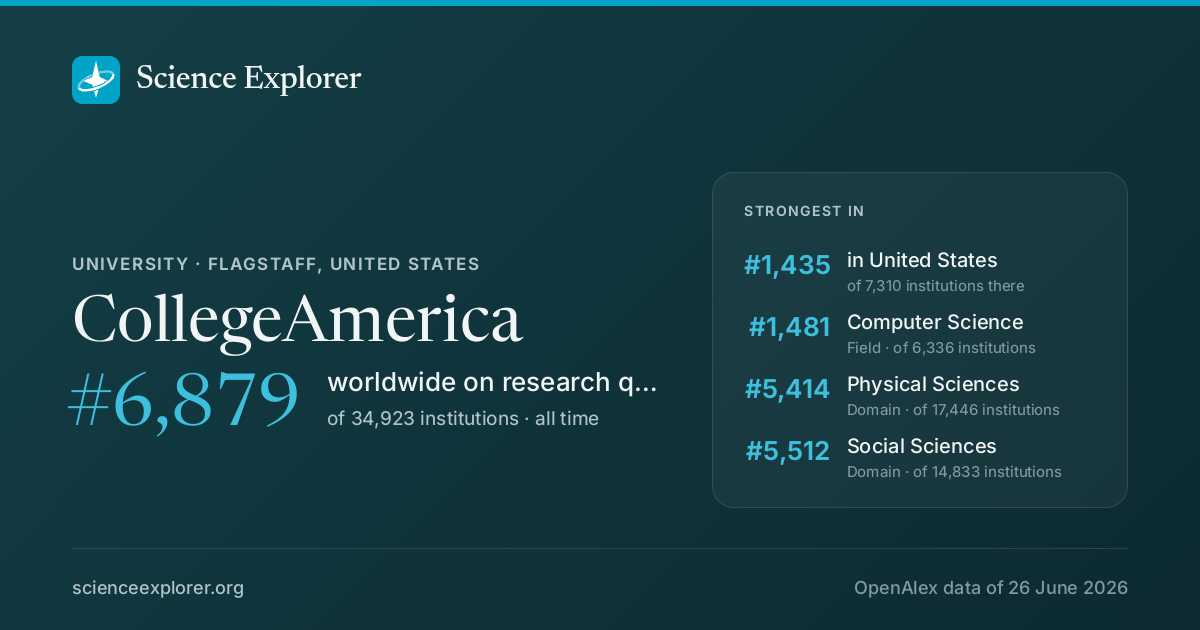
In research, CollegeAmerica stands highest in Computer Science (#1,481 of 6,336 worldwide), Physical Sciences (#5,414 of 17,446 worldwide) and Social Sciences (#5,512 of 14,833 worldwide), over all time.
- World rank, all time
- #6,879 of 34,923
- Rank in United States
- #1,435 of 7,310
- Research works
- 1.1k ▼ 3% vs 2018-21
- Citations
- 2.8k 2.5 per fractional work
- Top-10% rate
- 7.4% all institutions 10.0%
- vs its own fields
- 0.97× 1.00× is exactly expected
- Open access
- 10% world 40%
- International
- 2% world 18%
What is CollegeAmerica known for in research?
The fields where it stands highest, over all time, ranked among every institution above the floor in each field.
| Field | World rank | Where that sits | Top-10% rate | Works |
|---|---|---|---|---|
| Computer ScienceField | #1,481 of 6,336 | 0.7% | 495 | |
| Physical SciencesDomain | #5,414 of 17,446 | 1.6% | 641 | |
| Social SciencesDomain | #5,512 of 14,833 | 1.0% | 416 | |
| Information SystemsSubfield | #1,117 of 2,566 | 0.8% | 202 | |
| Business, Management and AccountingField | #2,613 of 3,886 | 0.2% | 126 | |
| Social SciencesField | #6,465 of 9,330 | 0.8% | 133 |
Each strip is that field's whole ranked pool, with the notch where CollegeAmerica sits in it, in the colour of the band that rank falls in. The track under the rate is the rate itself: it carries no average mark, because the average differs by field (from about 6% in Dentistry to 21% in Economics).
Which fields of science does CollegeAmerica work in?
In all years, 57% of research at CollegeAmerica is in Physical Sciences, 37% in Social Sciences. Its largest fields are Computer Science (44%), Social Sciences (12%), Business, Management and Accounting (11%). It does 1.8× the world's share of Social Sciences.
Each ring splits the one inside it: the four domains of science, their fields, their subfields. Size is fractional works in all years. Every slice is a page; the interactive view zooms down to single topics and colours each by how much more of it this institution does than the world.
Its 4 domains and 25 fields, with their numbers
- Physical Sciences64157.1%
- Computer Science49544.1%
- Engineering11210.0%
- Earth and Planetary Sciences141.3%
- Physics and Astronomy60.6%
- Environmental Science40.4%
- Mathematics30.3%
- Materials Science30.2%
- Chemistry20.2%
- Chemical Engineering10.1%
- Energy00.0%
- Social Sciences41637.1%
- Social Sciences13311.8%
- Business, Management and Accounting12611.2%
- Economics, Econometrics and Finance716.3%
- Decision Sciences443.9%
- Arts and Humanities242.2%
- Psychology191.7%
- Health Sciences464.1%
- Medicine333.0%
- Health Professions121.0%
- Nursing10.1%
- Dentistry00.0%
- Life Sciences191.7%
Field profile
Location quotient across every field it publishes in: outside the ring is more than an institution of this size would be expected to publish, inside it is less.
Rings at 0.5×, 1× and 2×. Widest outward: Nursing, 8.5×. Every wedge is a field page.
All 17 fields, with their numbers
- Nursing8.48×0 works
- Earth and Planetary Sciences5.74×1 works
- Decision Sciences2.76×0 works
- Neuroscience1.68×0 works
- Psychology1.43×0 works
- Biochemistry, Genetics and Molecular Biology1.37×1 works
- Medicine1.37×3 works
- Computer Science1.30×1 works
- Health Professions1.28×0 works
- Economics, Econometrics and Finance0.97×0 works
- Social Sciences0.90×1 works
- Business, Management and Accounting0.86×0 works
- Environmental Science0.74×0 works
- Engineering0.49×1 works
- Agricultural and Biological Sciences0.38×0 works
- Arts and Humanities0.24×0 works
- Immunology and Microbiology0.23×0 works
- Nursing 8.5×
- Earth and Planetary Sciences 5.7×
- Decision Sciences 2.8×
- Neuroscience 1.7×
- Psychology 1.4×
- Biochemistry, Genetics and Molecular Biology 1.4×
- Medicine 1.4×
- Computer Science 1.3×
- Health Professions 1.3×
- Economics, Econometrics and Finance 1.0×
- Social Sciences 0.9×
- Business, Management and Accounting 0.9×
- Environmental Science 0.7×
- Engineering 0.5×
- Agricultural and Biological Sciences 0.4×
- Arts and Humanities 0.2×
- Immunology and Microbiology 0.2×
Who are the top researchers at CollegeAmerica?
Ranked on the quality score, Sue Anne Batey Blackman, Tyler Smith and Keith R. Wald lead among researchers whose main affiliation is CollegeAmerica.
- 1
Sue Anne Batey Blackman
 United States · #1,258,931 worldwide
1.2k citations · 78 works
- 2
Tyler Smith
United States · #1,417,729 worldwide
498 citations · 40 works
- 3
Keith R. Wald
United States · #1,465,648 worldwide
461 citations · 24 works
- 4
Matthew E. Campbell
United States · #2,053,508 worldwide
6.3k citations · 100 works
- 5
Richard L. Petersen
United States · #2,094,765 worldwide
433 citations · 122 works
- 6
Rémi Arnaud
United States · #2,122,657 worldwide
211 citations · 27 works
- 7
Jason Lengstorf
United States · #2,230,066 worldwide
33 citations · 74 works
- 8
Joan Horvath
United States · #2,244,784 worldwide
91 citations · 107 works
- 9
Rich Cameron
United States · #2,254,705 worldwide
87 citations · 103 works
- 10
M. Casey Murdock
United States · #2,376,547 worldwide
35 citations · 102 works
Which keywords describe research at CollegeAmerica?
By fractional works in all years, weighted toward what it does more of than the world: Performance Evaluation, Cross-Platform Development, Mobile Application Development, Distributed Systems, Supply Chain Management, Big Data, Workflow Management and Machine Learning.
- User Interaction
- Geomorphology
- Statistical Modeling
- Reproducibility
- Socio-Economic Impact
- Garment Industry
- Labor Conditions
- Applications
- Grid Computing
- Tax Avoidance
- Software Development
- Analytics
- Data Science
- Artificial Intelligence
- Resource Management
- Education
- Big Data
- Sustainability
- Machine Learning
- Cross-Platform Development
- Performance Evaluation
- Mobile Application Development
- Distributed Systems
- Supply Chain Management
- Workflow Management
- High-Performance Computing
- Innovation
- Semantic Web Services
- Firm Performance
- Business Intelligence
- Financial Reporting
- Visualization
- Task Scheduling
- Security
- Corporate Tax
- Incentives
- Bioinformatics
- Scientific Workflows
- Anomaly Detection
- Python
Size is fractional works in all years in the topics tagged with each word; colour is the word's share of this institution's work against its share of the world's. The 40 words are chosen for being large and distinctive. Each links to the topic it comes from most.
All 40 words, with their numbers
- Performance Evaluation124▲ 199×2 topics
- Cross-Platform Development124▲ 1084×1 topic
- Mobile Application Development124▲ 1084×1 topic
- Machine Learning70▲ 2.9×31 topics
- Distributed Systems64▲ 23×6 topics
- Sustainability61▲ 3.0×29 topics
- Supply Chain Management61▲ 11×8 topics
- Big Data59▲ 9.8×17 topics
- Workflow Management46▲ 42×2 topics
- Education34▲ 2.4×23 topics
- High-Performance Computing34▲ 21×2 topics
- Resource Management34▲ 17×2 topics
- Innovation32▲ 3.1×26 topics
- Artificial Intelligence32▲ 3.5×20 topics
- Semantic Web Services32▲ 31×2 topics
- Data Science32▲ 41×2 topics
- Firm Performance32▲ 19×2 topics
- Analytics31▲ 52×1 topic
- Business Intelligence31▲ 52×1 topic
- Software Development31▲ 47×3 topics
- Financial Reporting26▲ 21×3 topics
- Tax Avoidance25▲ 52×2 topics
- Visualization25▲ 38×2 topics
- Grid Computing24▲ 34×1 topic
- Task Scheduling24▲ 34×1 topic
- Applications24▲ 10×3 topics
- Security24▲ 5.0×14 topics
- Labor Conditions22▲ 56×2 topics
- Corporate Tax22▲ 75×1 topic
- Garment Industry22▲ 436×1 topic
- Incentives22▲ 26×1 topic
- Socio-Economic Impact22▲ 436×1 topic
- Bioinformatics22▲ 17×2 topics
- Reproducibility21▲ 57×1 topic
- Scientific Workflows21▲ 57×1 topic
- Statistical Modeling20▲ 46×2 topics
- Anomaly Detection18▲ 10×4 topics
- Geomorphology18▲ 64×2 topics
- Python18▲ 79×1 topic
- User Interaction18▲ 33×2 topics
Which research topics does CollegeAmerica publish most on?
By volume in 2022-now: Viral gastroenteritis research and epidemiology, Lipoproteins and Cardiovascular Health, Nutrition, Health and Food Behavior and Health Education and Validation.
Area is fractional works; colour is the subfield each topic belongs to.
- 1 Viral gastroenteritis research and epidemiology Infectious Diseases 0 works
- 2 Lipoproteins and Cardiovascular Health Surgery 0 works
- 3 Nutrition, Health and Food Behavior Nutrition and Dietetics 0 works
- 4 Health Education and Validation Education 0 works
- 5 Hearing Impairment and Communication Developmental and Educational Psychology 0 works
- 6 Geological formations and processes Earth-Surface Processes 0 works
- 7 Geology and Paleoclimatology Research Atmospheric Science 0 works
- 8 Geological and Geophysical Studies Geology 0 works
- 9 Assistive Technology in Communication and Mobility Occupational Therapy 0 works
- 10 Service-Oriented Architecture and Web Services Information Systems 0 works
How open and international is its research?
Against the world's own shares: the tick on each track. Both are shares of its output, so they sit on one scale and can be read against each other as well as against the world.
World: 40% of research is openly available.
World: 18% is written across borders.
How has CollegeAmerica's research output changed?
Output in 2022-2025 was 3% lower than in 2018-2021.
The same series as a ribbon: one cell per year, darker for more. The line above answers how much; this answers when.
Its share of all research
Growing output can still be a shrinking share: all of science grows. This is CollegeAmerica as a percentage of every work published that year, 0.000036% in 2024.
Fractional works of CollegeAmerica over all fractional works that year. How the balance of science has shifted.
Other research institutions in Flagstaff
- Northern Arizona University
- Lowell Observatory
- Flagstaff Medical Center
- Museum Of Northern Arizona
- Coconino Community College Foundation
- The Arboretum at Flagstaff
- Native Americans for Community Action
Share CollegeAmerica's ranking
Badges for a website1Each links back here and updates with every snapshot

Research measures only: rankings here say nothing about teaching, admissions or student experience. Comparable institutions and collaboration partners have tabs of their own, above.
Discussion
Ask a question or share a note about CollegeAmerica. Posts are plain text and can be reported.