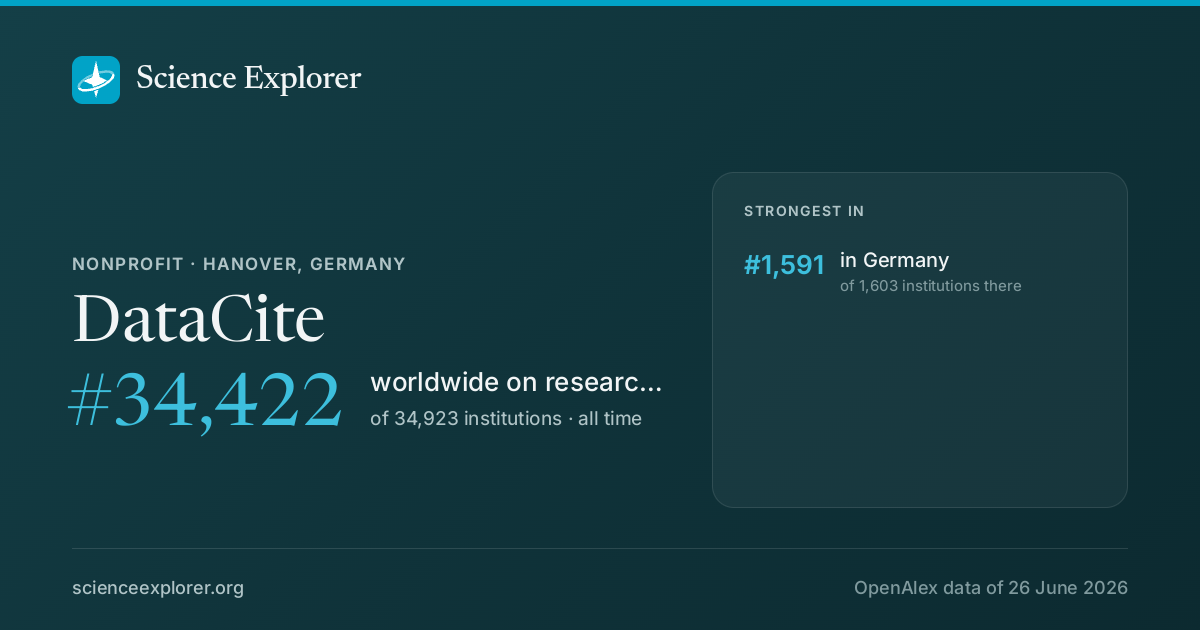
- World rank, all time
- #34,422 of 34,923
- Rank in Germany
- #1,591 of 1,603
- Research works
- 184 ▲ 4% vs 2018-21
- Citations
- 258 1.4 per fractional work
- Top-10% rate
- 4.3% all institutions 10.0%
- vs its own fields
- 0.81× 1.00× is exactly expected
- Open access
- 99% world 40%
- International
- 16% world 18%
Which fields of science does DataCite work in?
In 2022-now, 54% of research at DataCite is in Physical Sciences, 40% in Social Sciences. Its largest fields are Computer Science (48%), Decision Sciences (30%), Business, Management and Accounting (4%). It does 1.5× the world's share of Social Sciences.
Each ring splits the one inside it: the four domains of science, their fields, their subfields. Size is fractional works in 2022-now. Every slice is a page; the interactive view zooms down to single topics and colours each by how much more of it this institution does than the world.
Its 4 domains and 12 fields, with their numbers
- Physical Sciences5654.0%
- Computer Science5048.2%
- Earth and Planetary Sciences32.9%
- Environmental Science21.8%
- Mathematics11.1%
- Social Sciences4139.5%
- Decision Sciences3129.8%
- Business, Management and Accounting44.2%
- Arts and Humanities43.8%
- Social Sciences21.7%
- Life Sciences66.0%
- Health Sciences00.5%
- Medicine00.3%
- Health Professions00.2%
What does DataCite specialise in?
Where its research is concentrated relative to its size: Information Systems and Management takes 81.4× the share of its output that it takes of world research.
- Information Systems and ManagementSubfield · 24.2 works81×
- Decision SciencesField · 30.9 works31×
- Information SystemsSubfield · 42.2 works23×
Location quotient, a volume reading rather than an impact one. It surfaces small, lopsided specialities.
Field profile
Location quotient across every field it publishes in: outside the ring is more than an institution of this size would be expected to publish, inside it is less.
Rings at 0.5×, 1× and 2×. Widest outward: Decision Sciences, 30.8×. Every wedge is a field page.
All 12 fields, with their numbers
- Decision Sciences30.78×31 works
- Computer Science6.20×50 works
- Earth and Planetary Sciences1.84×3 works
- Arts and Humanities1.33×4 works
- Business, Management and Accounting1.32×4 works
- Mathematics0.95×1 works
- Biochemistry, Genetics and Molecular Biology0.76×4 works
- Agricultural and Biological Sciences0.40×2 works
- Environmental Science0.36×2 works
- Social Sciences0.13×2 works
- Health Professions0.07×0 works
- Medicine0.01×0 works
- Decision Sciences 30.8×
- Computer Science 6.2×
- Earth and Planetary Sciences 1.8×
- Arts and Humanities 1.3×
- Business, Management and Accounting 1.3×
- Mathematics 0.9×
- Biochemistry, Genetics and Molecular Biology 0.8×
- Agricultural and Biological Sciences 0.4×
- Environmental Science 0.4×
- Social Sciences 0.1×
- Health Professions 0.1×
- Medicine 0.0×
Who are the top researchers at DataCite?
Ranked on the quality score, Helena Cousijn, Sara El-Gebali and Kelly Stathis lead among researchers whose main affiliation is DataCite.
- 1
Helena Cousijn
 Germany · #525,452 worldwide
2.9k citations · 93 works
- 2
Sara El-Gebali
Germany · #1,621,941 worldwide
8.6k citations · 37 works
- 3
Kelly Stathis
Germany · #2,692,486 worldwide
17 citations · 24 works
- 4
Xiaoli Chen
Germany · #2,875,664 worldwide
778 citations · 124 works
- 5
Paul Vierkant
Germany · #2,944,396 worldwide
415 citations · 155 works
- 6
Matthew Buys
Germany · #2,962,997 worldwide
85 citations · 32 works
- 7
Maria Levchenko
Germany · #3,141,221 worldwide
1 citations · 16 works
- 8
Mohamad Mostafa
Germany · #3,328,870 worldwide
6 citations · 37 works
- 9
Tom Demeranville
Germany · #4,059,207 worldwide
49 citations · 49 works
- 10
Rorie Edmunds
Germany · #4,064,977 worldwide
836 citations · 65 works
Which keywords describe research at DataCite?
By fractional works in 2022-now, weighted toward what it does more of than the world: Digital Repositories, Data Citation, Data Sharing, Open Science, Scientific Data Management, Bioinformatics, Workflow Management and Reproducibility.
- Text Mining
- Archives
- Indigenous Knowledge
- Environmental Observations
- Research Information Systems
- Knowledge Management
- Data Cleaning
- Resource Description and Access
- Bibliographic Framework
- Statistical Analysis
- Data Integration
- Preprints
- Peer Review
- Research Integrity
- Semantic Web
- Big Data
- Reproducibility
- Bioinformatics
- Open Science
- Data Citation
- Digital Repositories
- Data Sharing
- Scientific Data Management
- Workflow Management
- Scientific Workflows
- Data Visualization
- COVID-19
- Open Access
- Machine Learning
- Science Communication
- Linked Data
- Parallel Computing
- R language
- Time Series Analysis
- Record Linkage
- Grey Literature
- Metadata Standards
- Hydroinformatics
- Interdisciplinary Research
- Digital Preservation
Size is fractional works in 2022-now in the topics tagged with each word; colour is the word's share of this institution's work against its share of the world's. The 40 words are chosen for being large and distinctive. Each links to the topic it comes from most.
All 40 words, with their numbers
- Digital Repositories40▲ 1106×2 topics
- Data Citation35▲ 664×2 topics
- Data Sharing34▲ 1035×2 topics
- Open Science34▲ 1235×1 topic
- Scientific Data Management34▲ 1235×1 topic
- Bioinformatics18▲ 148×2 topics
- Workflow Management16▲ 215×2 topics
- Reproducibility16▲ 391×1 topic
- Scientific Workflows16▲ 391×1 topic
- Big Data14▲ 14×7 topics
- Data Visualization9▲ 158×3 topics
- Semantic Web8▲ 79×3 topics
- COVID-198▲ 5.8×3 topics
- Research Integrity8▲ 227×2 topics
- Open Access8▲ 73×2 topics
- Peer Review8▲ 209×2 topics
- Machine Learning8▲ 2.2×8 topics
- Preprints8▲ 406×1 topic
- Science Communication8▲ 87×1 topic
- Data Integration7▲ 39×3 topics
- Linked Data6▲ 147×2 topics
- Statistical Analysis6▲ 34×2 topics
- Parallel Computing6▲ 48×2 topics
- Bibliographic Framework6▲ 683×1 topic
- R language6▲ 651×1 topic
- Resource Description and Access6▲ 683×1 topic
- Time Series Analysis6▲ 33×1 topic
- Data Cleaning5▲ 156×1 topic
- Record Linkage5▲ 156×1 topic
- Knowledge Management4▲ 7.8×3 topics
- Grey Literature4▲ 1072×1 topic
- Research Information Systems4▲ 1072×1 topic
- Metadata Standards3▲ 136×2 topics
- Environmental Observations3▲ 492×1 topic
- Hydroinformatics3▲ 492×1 topic
- Indigenous Knowledge3▲ 25×2 topics
- Interdisciplinary Research3▲ 29×2 topics
- Archives2▲ 177×1 topic
- Digital Preservation2▲ 155×1 topic
- Text Mining2▲ 16×2 topics
Which research topics does DataCite publish most on?
By volume in 2022-now: Research Data Management Practices, Scientific Computing and Data Management, Academic Publishing and Open Access and Data Analysis with R.
Area is fractional works; colour is the subfield each topic belongs to.
- 1 Research Data Management Practices Information Systems 34 works
- 2 Scientific Computing and Data Management Information Systems and Management 16 works
- 3 Academic Publishing and Open Access Information Systems and Management 8 works
- 4 Data Analysis with R Artificial Intelligence 6 works
- 5 Library Science and Information Systems Information Systems 6 works
- 6 Data Quality and Management Management Science and Operations Research 5 works
- 7 Optics and Image Analysis Management Information Systems 4 works
- 8 Environmental Monitoring and Data Management Geology 3 works
- 9 Digital and Traditional Archives Management Conservation 2 works
- 10 scientometrics and bibliometrics research Statistics, Probability and Uncertainty 2 works
How open and international is its research?
Against the world's own shares: the tick on each track. Both are shares of its output, so they sit on one scale and can be read against each other as well as against the world.
World: 40% of research is openly available.
World: 18% is written across borders.
How has DataCite's research output changed?
Output in 2022-2025 was 4% higher than in 2018-2021.
The same series as a ribbon: one cell per year, darker for more. The line above answers how much; this answers when.
Its share of all research
Growing output can still be a shrinking share: all of science grows. This is DataCite as a percentage of every work published that year, 0.000054% in 2024.
Fractional works of DataCite over all fractional works that year. How the balance of science has shifted.
Other research institutions in Hanover
- Medizinische Hochschule Hannover
- Leibniz University Hannover
- University of Veterinary Medicine Hannover, Foundation
- Federal Institute for Geosciences and Natural Resources
- Laser Zentrum Hannover
- Hochschule Hannover
- Hannover Re (Germany)
- Continental (Germany)

Share DataCite's ranking
Badges for a website1Each links back here and updates with every snapshot

Research measures only: rankings here say nothing about teaching, admissions or student experience. Comparable institutions and collaboration partners have tabs of their own, above.
Discussion
Ask a question or share a note about DataCite. Posts are plain text and can be reported.