Science Explorer Back to mapMap
Discussion
Government institution · Matlock · United Kingdom

Derbyshire County Council

In research, Derbyshire County Council stands highest in Social Sciences (#6,596 of 14,833 worldwide), Health Sciences (#9,680 of 16,688 worldwide) and Medicine (#8,784 of 14,558 worldwide), over all time.

World rank, all time
#10,482
of 34,923
Rank in United Kingdom
#542
of 1,844
Research works
677
▲ 27% vs 2018-21
Citations
9.3k
13.8 per fractional work
Top-10% rate
4.6%
all institutions 10.0%
vs its own fields
0.92×
1.00× is exactly expected
Open access
15%
world 40%
International
8%
world 18%

What is Derbyshire County Council known for in research?

The fields where it stands highest, over all time, ranked among every institution above the floor in each field.

FieldWorld rankWhere that sitsTop-10% rateWorks
Social SciencesDomain #6,596 of 14,833 6.7%218
Health SciencesDomain #9,680 of 16,688 5.8%311
MedicineField #8,784 of 14,558 7.0%197

Each strip is that field's whole ranked pool, with the notch where Derbyshire County Council sits in it, in the colour of the band that rank falls in. The track under the rate is the rate itself: it carries no average mark, because the average differs by field (from about 6% in Dentistry to 21% in Economics).

Which fields of science does Derbyshire County Council work in?

In 2022-now, 44% of research at Derbyshire County Council is in Physical Sciences, 27% in Social Sciences. Its largest fields are Engineering (16%), Computer Science (13%), Health Professions (12%).

Physical Sciences: 16 fractional works · 43.7% of its workEngineering: 6 fractional works · 16.4% of its workMechanical Engineering: 2 fractional works · 5.0% of its workBiomedical Engineering: 1 fractional works · 3.3% of its workMechanics of Materials: 1 fractional works · 1.9% of its workCivil and Structural Engineering: 1 fractional works · 1.7% of its workElectrical and Electronic Engineering: 1 fractional works · 1.4% of its workArchitecture: 0 fractional works · 0.9% of its workAutomotive Engineering: 0 fractional works · 0.9% of its workBuilding and Construction: 0 fractional works · 0.9% of its workOcean Engineering: 0 fractional works · 0.3% of its workComputer Science: 5 fractional works · 12.9% of its workInformation Systems: 2 fractional works · 5.6% of its workComputer Networks and Communications: 1 fractional works · 3.7% of its workArtificial Intelligence: 0 fractional works · 1.3% of its workSignal Processing: 0 fractional works · 0.9% of its workSoftware: 0 fractional works · 0.9% of its workHuman-Computer Interaction: 0 fractional works · 0.3% of its workEnvironmental Science: 3 fractional works · 7.3% of its workHealth, Toxicology and Mutagenesis: 1 fractional works · 3.0% of its workIndustrial and Manufacturing Engineering: 0 fractional works · 1.3% of its workNature and Landscape Conservation: 0 fractional works · 1.1% of its workEcology: 0 fractional works · 0.6% of its workManagement, Monitoring, Policy and Law: 0 fractional works · 0.5% of its workEnvironmental Engineering: 0 fractional works · 0.5% of its workSmaller subfields together: 0 fractional works · 0.2% of its workEarth and Planetary Sciences: 1 fractional works · 3.9% of its workEarth-Surface Processes: 0 fractional works · 1.3% of its workGeophysics: 0 fractional works · 1.2% of its workPaleontology: 0 fractional works · 0.6% of its workAtmospheric Science: 0 fractional works · 0.4% of its workGeology: 0 fractional works · 0.3% of its workSmaller subfields together: 0 fractional works · 0.0% of its workMaterials Science: 1 fractional works · 1.9% of its workMaterials Chemistry: 0 fractional works · 0.9% of its workMetals and Alloys: 0 fractional works · 0.5% of its workPolymers and Plastics: 0 fractional works · 0.5% of its workEnergy: 0 fractional works · 0.6% of its workEnergy Engineering and Power Technology: 0 fractional works · 0.3% of its workRenewable Energy, Sustainability and the Environment: 0 fractional works · 0.3% of its workChemistry: 0 fractional works · 0.5% of its workOrganic Chemistry: 0 fractional works · 0.5% of its workPhysics and Astronomy: 0 fractional works · 0.3% of its workAtomic and Molecular Physics, and Optics: 0 fractional works · 0.3% of its workSocial Sciences: 10 fractional works · 26.9% of its workSocial Sciences: 3 fractional works · 8.7% of its workSociology and Political Science: 1 fractional works · 3.8% of its workDevelopment: 0 fractional works · 1.4% of its workPolitical Science and International Relations: 0 fractional works · 1.4% of its workGeography, Planning and Development: 0 fractional works · 0.9% of its workAnthropology: 0 fractional works · 0.5% of its workTransportation: 0 fractional works · 0.5% of its workSmaller subfields together: 0 fractional works · 0.2% of its workEconomics, Econometrics and Finance: 2 fractional works · 5.1% of its workFinance: 1 fractional works · 2.8% of its workEconomics and Econometrics: 1 fractional works · 2.3% of its workPsychology: 2 fractional works · 5.0% of its workClinical Psychology: 1 fractional works · 2.6% of its workSocial Psychology: 0 fractional works · 1.2% of its workDevelopmental and Educational Psychology: 0 fractional works · 0.5% of its workApplied Psychology: 0 fractional works · 0.5% of its workExperimental and Cognitive Psychology: 0 fractional works · 0.3% of its workArts and Humanities: 1 fractional works · 4.0% of its workHistory: 1 fractional works · 1.9% of its workArcheology: 0 fractional works · 1.4% of its workLiterature and Literary Theory: 0 fractional works · 0.5% of its workPhilosophy: 0 fractional works · 0.3% of its workBusiness, Management and Accounting: 1 fractional works · 2.8% of its workManagement Information Systems: 1 fractional works · 2.8% of its workDecision Sciences: 0 fractional works · 1.2% of its workInformation Systems and Management: 0 fractional works · 0.9% of its workManagement Science and Operations Research: 0 fractional works · 0.3% of its workHealth Sciences: 9 fractional works · 24.5% of its workHealth Professions: 4 fractional works · 12.2% of its workGeneral Health Professions: 3 fractional works · 8.2% of its workEmergency Medical Services: 0 fractional works · 1.2% of its workOccupational Therapy: 0 fractional works · 1.0% of its workHealth Information Management: 0 fractional works · 0.9% of its workPharmacy: 0 fractional works · 0.5% of its workSpeech and Hearing: 0 fractional works · 0.5% of its workMedicine: 4 fractional works · 12.0% of its workPediatrics, Perinatology and Child Health: 0 fractional works · 1.3% of its workInfectious Diseases: 0 fractional works · 1.0% of its workPhysiology: 0 fractional works · 1.0% of its workPublic Health, Environmental and Occupational Health: 0 fractional works · 1.0% of its workEpidemiology: 0 fractional works · 0.8% of its workEmergency Medicine: 0 fractional works · 0.7% of its workSurgery: 0 fractional works · 0.6% of its workRadiology, Nuclear Medicine and Imaging: 0 fractional works · 0.5% of its workGeriatrics and Gerontology: 0 fractional works · 0.5% of its workOncology: 0 fractional works · 0.5% of its workOrthopedics and Sports Medicine: 0 fractional works · 0.5% of its workPharmacology: 0 fractional works · 0.5% of its workPsychiatry and Mental health: 0 fractional works · 0.5% of its workPulmonary and Respiratory Medicine: 0 fractional works · 0.5% of its workRheumatology: 0 fractional works · 0.4% of its workEndocrinology, Diabetes and Metabolism: 0 fractional works · 0.4% of its workNeurology: 0 fractional works · 0.4% of its workFamily Practice: 0 fractional works · 0.3% of its workOphthalmology: 0 fractional works · 0.3% of its workSmaller subfields together: 0 fractional works · 0.6% of its workDentistry: 0 fractional works · 0.2% of its workPeriodontics: 0 fractional works · 0.2% of its workVeterinary: 0 fractional works · 0.1% of its workLife Sciences: 2 fractional works · 4.8% of its workAgricultural and Biological Sciences: 1 fractional works · 2.9% of its workPlant Science: 0 fractional works · 1.2% of its workEcology, Evolution, Behavior and Systematics: 0 fractional works · 1.0% of its workForestry: 0 fractional works · 0.4% of its workFood Science: 0 fractional works · 0.2% of its workSmaller subfields together: 0 fractional works · 0.2% of its workBiochemistry, Genetics and Molecular Biology: 1 fractional works · 1.6% of its workGenetics: 0 fractional works · 0.6% of its workBiotechnology: 0 fractional works · 0.5% of its workMolecular Biology: 0 fractional works · 0.5% of its workNeuroscience: 0 fractional works · 0.3% of its workALL ITS WORKDerbyshire CountyCouncil36fractional works, 2022-now
Life Sciences5%Physical Sciences44%Health Sciences25%Social Sciences27%

Each ring splits the one inside it: the four domains of science, their fields, their subfields. Size is fractional works in 2022-now. Every slice is a page; the interactive view zooms down to single topics and colours each by how much more of it this institution does than the world.

Its 4 domains and 21 fields, with their numbers
    1. Engineering616.4%
    2. Computer Science512.9%
    3. Environmental Science37.3%
    4. Earth and Planetary Sciences13.9%
    5. Materials Science11.9%
    6. Energy00.6%
    7. Chemistry00.5%
    8. Physics and Astronomy00.3%
    1. Social Sciences38.7%
    2. Economics, Econometrics and Finance25.1%
    3. Psychology25.0%
    4. Arts and Humanities14.0%
    5. Business, Management and Accounting12.8%
    6. Decision Sciences01.2%
    1. Health Professions412.2%
    2. Medicine412.0%
    3. Dentistry00.2%
    4. Veterinary00.1%
    1. Agricultural and Biological Sciences12.9%
    2. Biochemistry, Genetics and Molecular Biology11.6%
    3. Neuroscience00.3%
All of science, and how each field's share has moved since 1950: the Science domain explorer

Field profile

Location quotient across every field it publishes in: outside the ring is more than an institution of this size would be expected to publish, inside it is less.

Agricultural and Biological Sciences: 0.62× its world share, 1 worksAgricultural and Bio…Biochemistry, Genetics and Molecular Biology: 0.29× its world share, 1 worksBiochemistry, Geneti…Neuroscience: 0.19× its world share, 0 worksNeuroscienceChemistry: 0.30× its world share, 0 worksChemistryComputer Science: 1.66× its world share, 5 worksComputer ScienceEarth and Planetary Sciences: 2.48× its world share, 1 worksEarth and Planetary …Energy: 0.68× its world share, 0 worksEnergyEngineering: 1.09× its world share, 6 worksEngineeringEnvironmental Science: 1.46× its world share, 3 worksEnvironmental ScienceMaterials Science: 0.54× its world share, 1 worksMaterials SciencePhysics and Astronomy: 0.14× its world share, 0 worksPhysics and AstronomyDentistry: 0.48× its world share, 0 worksDentistryHealth Professions: 4.64× its world share, 4 worksHealth ProfessionsMedicine: 0.62× its world share, 4 worksMedicineVeterinary: 0.57× its world share, 0 worksVeterinaryArts and Humanities: 1.40× its world share, 1 worksArts and HumanitiesBusiness, Management and Accounting: 0.87× its world share, 1 worksBusiness, Management…Decision Sciences: 1.29× its world share, 0 worksDecision SciencesEconomics, Econometrics and Finance: 2.38× its world share, 2 worksEconomics, Econometr…Psychology: 1.66× its world share, 2 worksPsychologySocial Sciences: 0.69× its world share, 3 worksSocial Sciences1×world share
more than its size predictsabout as predictedless

Rings at 0.5×, 1× and 2×. Widest outward: Health Professions, 4.6×. Every wedge is a field page.

All 21 fields, with their numbers
  1. Health Professions4.64×4 works
  2. Earth and Planetary Sciences2.48×1 works
  3. Economics, Econometrics and Finance2.38×2 works
  4. Computer Science1.66×5 works
  5. Psychology1.66×2 works
  6. Environmental Science1.46×3 works
  7. Arts and Humanities1.40×1 works
  8. Decision Sciences1.29×0 works
  9. Engineering1.09×6 works
  10. Business, Management and Accounting0.87×1 works
  11. Social Sciences0.69×3 works
  12. Energy0.68×0 works
  13. Agricultural and Biological Sciences0.62×1 works
  14. Medicine0.62×4 works
  15. Veterinary0.57×0 works
  16. Materials Science0.54×1 works
  17. Dentistry0.48×0 works
  18. Chemistry0.30×0 works
  19. Biochemistry, Genetics and Molecular Biology0.29×1 works
  20. Neuroscience0.19×0 works
  21. Physics and Astronomy0.14×0 works

Who are the top researchers at Derbyshire County Council?

Ranked on the quality score, Patrick B. Heffernan, Matt Carr and Sidney Barwise lead among researchers whose main affiliation is Derbyshire County Council.

  1. 1 Patrick B. Heffernan United Kingdom · #2,662,958 worldwide 451 citations · 56 works
  2. 2 Matt Carr United Kingdom · #2,816,244 worldwide 276 citations · 19 works
  3. 3 Sidney Barwise United Kingdom · #2,968,046 worldwide 49 citations · 25 works
  4. 4 H. A. L. Howell United Kingdom · #3,123,040 worldwide 6 citations · 23 works
  5. 5 Alister D. Burnett United Kingdom · #3,318,214 worldwide 118 citations · 42 works
  6. 6 Douglas A. Sloan United Kingdom · #3,390,485 worldwide 73 citations · 22 works
  7. 7 Bob Whyte United Kingdom · #3,578,442 worldwide 69 citations · 27 works
  8. 8 Janet Farrell Smith United Kingdom · #4,621,545 worldwide 370 citations · 49 works
  9. 9 David S. Buist United Kingdom · #4,714,025 worldwide 62 citations · 19 works
  10. 10 Ralph Lawrence United Kingdom · #4,844,071 worldwide 25 citations · 22 works
All ranked researchers at Derbyshire County Council

What are the most cited papers from Derbyshire County Council?

The most cited paper from Derbyshire County Council is "The UK Prospective Diabetes Study (UKPDS): clinical and therapeutic implications for type 2 diabetes" (Paromita King, Ian Peacock, Richard Donnelly, 1999), with 707 citations. Next come "Newly identified genetic risk variants for celiac disease related to the immune response" (695) and "Rail defects: an overview" (438).

Most cited papers
#PaperReleasedCitations
1 The UK Prospective Diabetes Study (UKPDS): clinical and therapeutic implications for type 2 diabetes Paromita King, Ian Peacock, Richard Donnelly · British Journal of Clinical Pharmacology Open access Nov 1999 707
2 Newly identified genetic risk variants for celiac disease related to the immune response Karen A. Hunt et al. · Nature Genetics Open access 2 Mar 2008 695
3 Rail defects: an overview D. F. Cannon, Karl-Otto Edel, Stuart L. Grassie et al. · Fatigue & Fracture of Engineering Materials & Structures Oct 2003 438
4 Effectiveness of early orthodontic treatment with the twin-block appliance: A multicenter, randomized, controlled trial. Part 1: Dental and skeletal effects Kevin D O'Brien et al. · American Journal of Orthodontics and Dentofacial Orthopedics Sep 2003 375
5 URTICARIA, DEAFNESS, AND AMYLOIDOSIS: A NEW HEREDO-FAMILIAL SYNDROME Thomas J. Muckle, WELLSM · QJM Apr 1962 373
All 59 most cited papers, with filters and sorting

Which keywords describe research at Derbyshire County Council?

By fractional works in 2022-now, weighted toward what it does more of than the world: Distributed Systems, Big Data, Resource Management, Cloud Computing, MapReduce, Sustainability, Analytics and Business Intelligence.

▲ more of its work than of the world's◆ about the world's share▼ less than the world's

Size is fractional works in 2022-now in the topics tagged with each word; colour is the word's share of this institution's work against its share of the world's. The 15 words are chosen for being large and distinctive. Each links to the topic it comes from most.

All 15 words, with their numbers
  1. Big Data2▲ 6.8×2 topics
  2. Distributed Systems2▲ 38×4 topics
  3. Sustainability2▲ 2.5×8 topics
  4. Resource Management2▲ 28×2 topics
  5. Climate Change1▲ 1.39×10 topics
  6. Cloud Computing1▲ 13×1 topic
  7. MapReduce1▲ 63×1 topic
  8. History1▲ 4.7×4 topics
  9. Mechanical Properties1▲ 3.2×5 topics
  10. Analytics1▲ 32×1 topic
  11. Business Intelligence1▲ 32×1 topic
  12. Epidemiology1▼ 0.73×11 topics
  13. Financialization1▲ 29×1 topic
  14. Primary Care1▲ 7.6×4 topics
  15. Shareholder Value1▲ 26×1 topic

Which research topics does Derbyshire County Council publish most on?

By volume in 2022-now: Cloud Computing and Resource Management, Housing, Finance, and Neoliberalism, Big Data and Business Intelligence and Air Quality and Health Impacts.

  1. 1 Cloud Computing and Resource Management Information Systems 1 works
  2. 2 Housing, Finance, and Neoliberalism Finance 1 works
  3. 3 Big Data and Business Intelligence Management Information Systems 1 works
  4. 4 Air Quality and Health Impacts Health, Toxicology and Mutagenesis 1 works
  5. 5 Cultural Heritage Management and Preservation Archeology 0 works
  6. 6 Health Policy Implementation Science General Health Professions 0 works
  7. 7 Recycling and Waste Management Techniques Industrial and Manufacturing Engineering 0 works
  8. 8 International Development and Aid Development 0 works
  9. 9 World Systems and Global Transformations Political Science and International Relations 0 works
  10. 10 Travel Writing and Literature History 0 works

How open and international is its research?

Against the world's own shares: the tick on each track. Both are shares of its output, so they sit on one scale and can be read against each other as well as against the world.

openly available14.9%not open85.1%

World: 40% of research is openly available.

with international co-authors8.0%domestic only92.0%

World: 18% is written across borders.

How has Derbyshire County Council's research output changed?

Output in 2022-2025 was 27% higher than in 2018-2021.

still counting1990200020102020
grewheldshrank

The same series as a ribbon: one cell per year, darker for more. The line above answers how much; this answers when.

Its share of all research

Growing output can still be a shrinking share: all of science grows. This is Derbyshire County Council as a percentage of every work published that year, 0.00015% in 2024.

still counting0.0020%0.0040%0.0060%Derbyshire County Council0.00014% in 202519801990200020102020

Fractional works of Derbyshire County Council over all fractional works that year. How the balance of science has shifted.

How much of it reaches the world top 10%

Year by year, against all institutions in the same year.

5%10%15%all institutions10.0% in 2010Derbyshire County Council4.8% in 201020002010

Of each year's output, the share that reached the world's 10% most cited for its field and year. Peak 8.6% in 1990.

Other research institutions in Matlock

All research institutions in Matlock

Share Derbyshire County Council's ranking
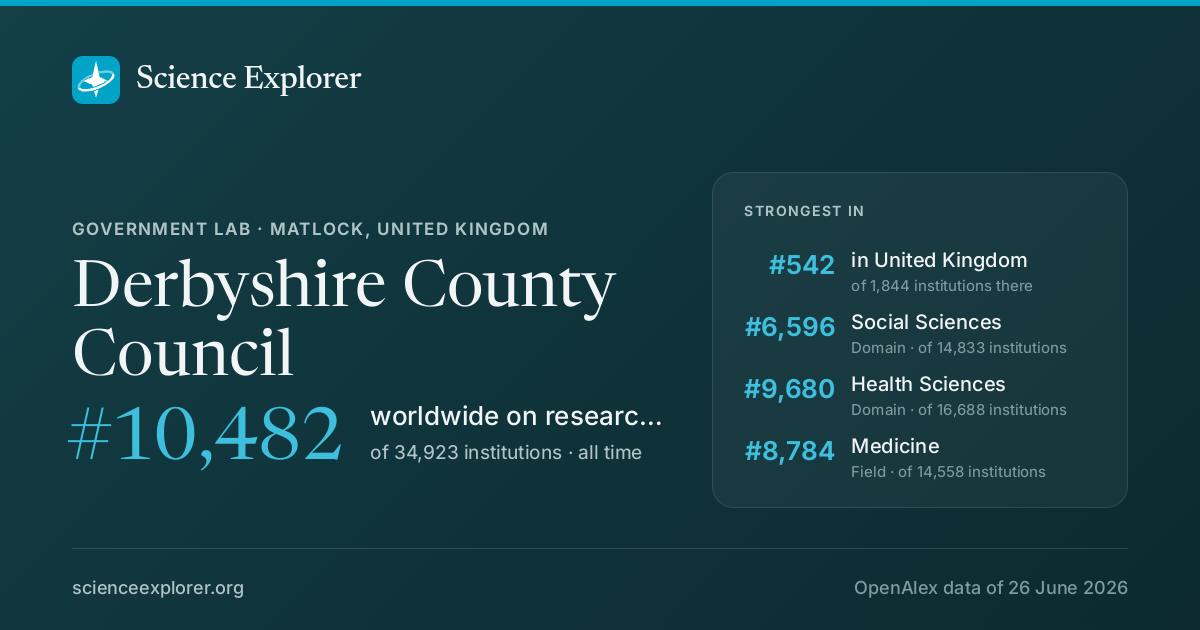
Derbyshire County Council on Science Explorer

A card with Derbyshire County Council's standing and the fields it leads in, for a post or a slide. A link to this page previews as the same card.

Download the card

1200 × 630 PNG, sized for social posts, drawn from the latest snapshot.

Badges for a website1Each links back here and updates with every snapshot

Research measures only: rankings here say nothing about teaching, admissions or student experience. Comparable institutions and collaboration partners have tabs of their own, above.

Discussion

Ask a question or share a note about Derbyshire County Council. Keep it to the research: no personal attacks, advertising or links. Any reader can report a post, which collapses it for everyone until it is opened.
