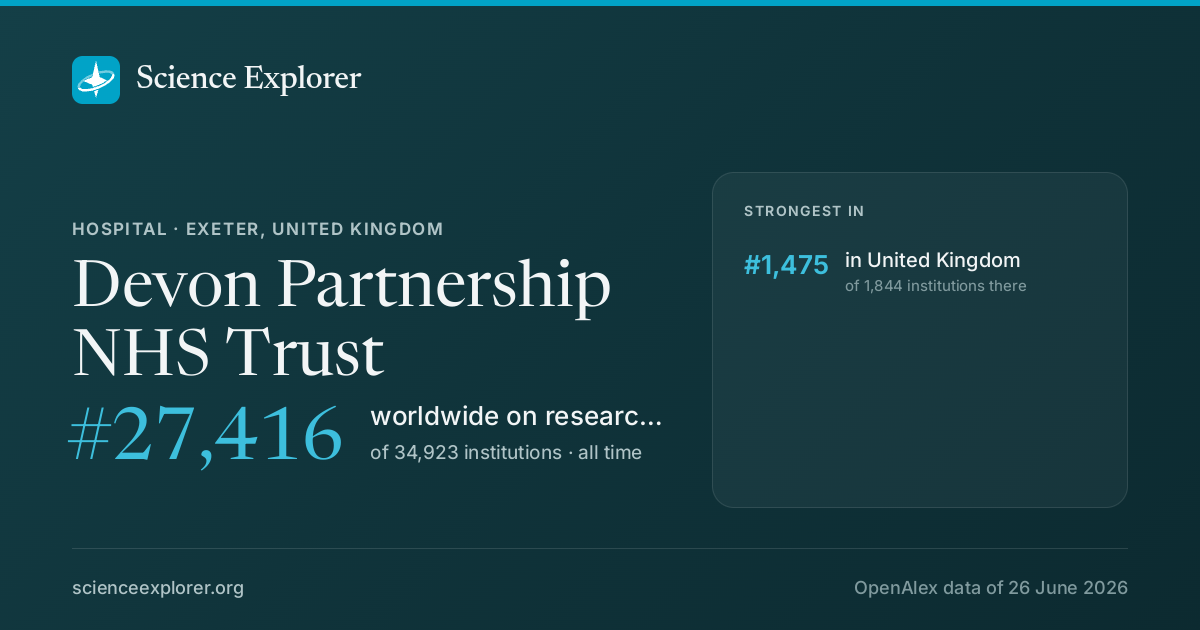
Devon Partnership NHS Trust
- World rank, all time
- #27,416 of 34,923
- Rank in United Kingdom
- #1,475 of 1,844
- Research works
- 217 ▲ 12% vs 2018-21
- Citations
- 2.8k 12.7 per fractional work
- Top-10% rate
- 6.9% all institutions 10.0%
- vs its own fields
- 0.86× 1.00× is exactly expected
- Open access
- 40% world 40%
- International
- 10% world 18%
Which fields of science does Devon Partnership NHS Trust work in?
In 2022-now, 57% of research at Devon Partnership NHS Trust is in Health Sciences, 34% in Social Sciences. Its largest fields are Medicine (42%), Psychology (26%), Health Professions (14%). It does 2.2× the world's share of Health Sciences.
Each ring splits the one inside it: the four domains of science, their fields, their subfields. Size is fractional works in 2022-now. Every slice is a page; the interactive view zooms down to single topics and colours each by how much more of it this institution does than the world.
Its 4 domains and 18 fields, with their numbers
- Health Sciences2857.3%
- Medicine2042.5%
- Health Professions713.9%
- Veterinary00.7%
- Nursing00.2%
- Social Sciences1734.3%
- Psychology1225.5%
- Social Sciences23.2%
- Decision Sciences12.2%
- Arts and Humanities11.7%
- Business, Management and Accounting11.6%
- Life Sciences24.4%
- Physical Sciences24.0%
- Environmental Science12.2%
- Engineering01.0%
- Computer Science00.7%
- Chemistry00.1%
Field profile
Location quotient across every field it publishes in: outside the ring is more than an institution of this size would be expected to publish, inside it is less.
Rings at 0.5×, 1× and 2×. Widest outward: Psychology, 8.4×. Every wedge is a field page.
All 18 fields, with their numbers
- Psychology8.38×12 works
- Health Professions5.29×7 works
- Veterinary5.09×0 works
- Pharmacology, Toxicology and Pharmaceutics4.58×1 works
- Decision Sciences2.27×1 works
- Medicine2.21×20 works
- Neuroscience0.60×0 works
- Arts and Humanities0.60×1 works
- Business, Management and Accounting0.50×1 works
- Environmental Science0.44×1 works
- Nursing0.35×0 works
- Social Sciences0.26×2 works
- Agricultural and Biological Sciences0.19×0 works
- Biochemistry, Genetics and Molecular Biology0.15×0 works
- Computer Science0.09×0 works
- Immunology and Microbiology0.08×0 works
- Engineering0.07×0 works
- Chemistry0.06×0 works
- Psychology 8.4×
- Health Professions 5.3×
- Veterinary 5.1×
- Pharmacology, Toxicology and Pharmaceutics 4.6×
- Decision Sciences 2.3×
- Medicine 2.2×
- Neuroscience 0.6×
- Arts and Humanities 0.6×
- Business, Management and Accounting 0.5×
- Environmental Science 0.4×
- Nursing 0.3×
- Social Sciences 0.3×
- Agricultural and Biological Sciences 0.2×
- Biochemistry, Genetics and Molecular Biology 0.1×
- Computer Science 0.1×
- Immunology and Microbiology 0.1×
- Engineering 0.1×
- Chemistry 0.1×
Who are the top researchers at Devon Partnership NHS Trust?
Ranked on the quality score, Stephen Pearson, Tobit Emmens and Leo A. Russell lead among researchers whose main affiliation is Devon Partnership NHS Trust.
- 1
Stephen Pearson
 United Kingdom · #443,618 worldwide
1.2k citations · 41 works
- 2
Tobit Emmens
United Kingdom · #1,478,563 worldwide
676 citations · 20 works
- 3
Leo A. Russell
United Kingdom · #1,970,658 worldwide
270 citations · 20 works
- 4
Elina Baker
United Kingdom · #2,150,017 worldwide
850 citations · 25 works
- 5
Phil S. Moore
United Kingdom · #3,711,461 worldwide
115 citations · 16 works
- 6
Hamilton Fairfax
United Kingdom · #4,181,464 worldwide
144 citations · 18 works
- 7
Mark Mordue
United Kingdom · #4,272,620 worldwide
6 citations · 15 works
- 8
Gwyn Grout
United Kingdom · #4,746,199 worldwide
25 citations · 23 works
- 9
Bill Wahl
United Kingdom · #5,604,336 worldwide
1 citations · 45 works
Which keywords describe research at Devon Partnership NHS Trust?
By fractional works in 2022-now, weighted toward what it does more of than the world: Depression, Prevalence, Cognitive Function, Metabolic Syndrome, Anxiety, Cardiovascular Disease, Social Cognition and Genetics.
- Primary Care
- Evidence-Based Practice
- Breast Cancer
- Health Policy
- Aging
- Help-Seeking Behavior
- Treatment Guidelines
- Health Services
- Clinical Trials
- Mental Disorders
- Adolescents
- Neurobiology
- Public Health
- Crisis Resolution
- Antipsychotic Drugs
- Cognitive Therapy
- Inflammation
- Anxiety
- Cardiovascular Disease
- Prevalence
- Depression
- Cognitive Function
- Metabolic Syndrome
- Genetics
- Social Cognition
- Neuroimaging
- Neurocognitive Deficits
- Home Treatment
- Mental Health
- Psychological Distress
- Menopause
- Bipolar Spectrum Disorder
- Global Burden
- Stigma
- Ethical Considerations
- Public Attitudes
- Bone Mineral Density
- Psychological Interventions
- Estrogen
- Hormone Therapy
Size is fractional works in 2022-now in the topics tagged with each word; colour is the word's share of this institution's work against its share of the world's. The 40 words are chosen for being large and distinctive. Each links to the topic it comes from most.
All 40 words, with their numbers
- Depression7▲ 16×8 topics
- Prevalence5▲ 25×8 topics
- Cognitive Function4▲ 41×3 topics
- Cardiovascular Disease4▲ 6.3×6 topics
- Metabolic Syndrome3▲ 8.5×5 topics
- Anxiety3▲ 14×5 topics
- Genetics3▲ 9.1×6 topics
- Inflammation3▲ 3.1×7 topics
- Social Cognition3▲ 36×3 topics
- Cognitive Therapy3▲ 56×3 topics
- Neuroimaging3▲ 22×3 topics
- Antipsychotic Drugs3▲ 144×1 topic
- Neurocognitive Deficits3▲ 144×1 topic
- Crisis Resolution3▲ 418×1 topic
- Home Treatment3▲ 418×1 topic
- Public Health2▲ 3.5×8 topics
- Mental Health2▲ 3.2×12 topics
- Neurobiology2▲ 18×3 topics
- Psychological Distress2▲ 18×4 topics
- Adolescents2▲ 11×5 topics
- Menopause2▲ 78×2 topics
- Mental Disorders2▲ 33×2 topics
- Bipolar Spectrum Disorder2▲ 165×1 topic
- Clinical Trials2▲ 5.4×4 topics
- Global Burden2▲ 6.7×2 topics
- Health Services2▲ 42×2 topics
- Stigma2▲ 27×2 topics
- Treatment Guidelines2▲ 17×1 topic
- Ethical Considerations2▲ 10.0×3 topics
- Help-Seeking Behavior2▲ 74×1 topic
- Public Attitudes2▲ 74×1 topic
- Aging2▲ 6.2×4 topics
- Bone Mineral Density2▲ 43×2 topics
- Health Policy2▲ 22×2 topics
- Psychological Interventions2▲ 24×3 topics
- Breast Cancer2▲ 12×1 topic
- Estrogen2▲ 74×1 topic
- Evidence-Based Practice2▲ 24×3 topics
- Hormone Therapy2▲ 37×2 topics
- Primary Care2▲ 8.5×5 topics
Which research topics does Devon Partnership NHS Trust publish most on?
By volume in 2022-now: Schizophrenia research and treatment, Psychiatric care and mental health services, Bipolar Disorder and Treatment and Mental Health Treatment and Access.
Area is fractional works; colour is the subfield each topic belongs to.
- 1 Schizophrenia research and treatment Psychiatry and Mental health 3 works
- 2 Psychiatric care and mental health services Clinical Psychology 3 works
- 3 Bipolar Disorder and Treatment Psychiatry and Mental health 2 works
- 4 Mental Health Treatment and Access Social Psychology 2 works
- 5 Menopause: Health Impacts and Treatments Endocrinology, Diabetes and Metabolism 2 works
- 6 Electroconvulsive Therapy Studies Psychiatry and Mental health 1 works
- 7 Global Health Workforce Issues Emergency Medical Services 1 works
- 8 Sex and Gender in Healthcare Public Health, Environmental and Occupational Health 1 works
- 9 Psychosomatic Disorders and Their Treatments Psychiatry and Mental health 1 works
- 10 Psychotherapy Techniques and Applications Clinical Psychology 1 works
How open and international is its research?
Against the world's own shares: the tick on each track. Both are shares of its output, so they sit on one scale and can be read against each other as well as against the world.
World: 40% of research is openly available.
World: 18% is written across borders.
How has Devon Partnership NHS Trust's research output changed?
Output in 2022-2025 was 12% higher than in 2018-2021.
The same series as a ribbon: one cell per year, darker for more. The line above answers how much; this answers when.
Its share of all research
Growing output can still be a shrinking share: all of science grows. This is Devon Partnership NHS Trust as a percentage of every work published that year, 0.00013% in 2024.
Fractional works of Devon Partnership NHS Trust over all fractional works that year. How the balance of science has shifted.
Other research institutions in Exeter
- University of Exeter
- Met Office
- Royal Devon & Exeter NHS Foundation Trust
- Exeter Primary Care
- Princess Elizabeth Orthopaedic Centre
- Exeter Hospital
- South Western Ambulance Service NHS Foundation Trust
- Heavitree Hospital

Share Devon Partnership NHS Trust's ranking
Badges for a website1Each links back here and updates with every snapshot

Research measures only: rankings here say nothing about teaching, admissions or student experience. Comparable institutions and collaboration partners have tabs of their own, above.
Discussion
Ask a question or share a note about Devon Partnership NHS Trust. Posts are plain text and can be reported.