Royal Devon & Exeter NHS Foundation Trust
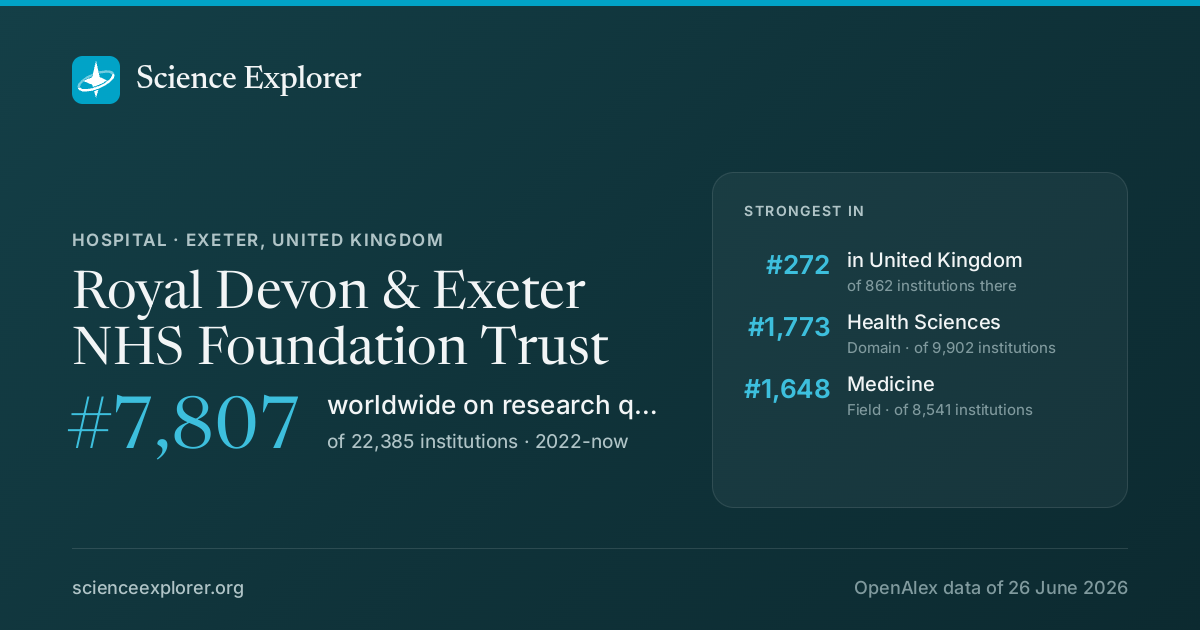
In research, Royal Devon & Exeter NHS Foundation Trust stands highest in Health Sciences (#1,773 of 9,902 worldwide) and Medicine (#1,648 of 8,541 worldwide), 2022-now. Relative to its size it is most specialised in Surgery and Genetics (Surgery is 7.5× its share of world research).
- World rank, 2022-now
- #7,807 of 22,385 · #5,781 all time
- Rank in United Kingdom
- #272 of 862
- Research works
- 1.2k ▲ 21% vs 2018-21
- Citations
- 22k 19.0 per fractional work
- Top-10% rate
- 11.2% all institutions 10.0%
- vs its own fields
- 0.97× 1.00× is exactly expected
- Open access
- 54% world 40%
- International
- 18% world 18%
What is Royal Devon & Exeter NHS Foundation Trust known for in research?
The fields where it stands highest, 2022-now, ranked among every institution above the floor in each field.
| Field | World rank | Where that sits | Top-10% rate | Works | All time |
|---|---|---|---|---|---|
| Health SciencesDomain | #1,773 of 9,902 | 10.5% | 254 | #1947 | |
| MedicineField | #1,648 of 8,541 | 10.4% | 231 | #1803 |
Each strip is that field's whole ranked pool, with the notch where Royal Devon & Exeter NHS Foundation Trust sits in it, in the colour of the band that rank falls in. The track under the rate is the rate itself: it carries no average mark, because the average differs by field (from about 6% in Dentistry to 21% in Economics).
Which fields of science does Royal Devon & Exeter NHS Foundation Trust work in?
In 2022-now, 78% of research at Royal Devon & Exeter NHS Foundation Trust is in Health Sciences, 13% in Life Sciences. Its largest fields are Medicine (71%), Biochemistry, Genetics and Molecular Biology (10%), Health Professions (6%). It does 3.3× the world's share of Health Sciences.
Each ring splits the one inside it: the four domains of science, their fields, their subfields. Size is fractional works in 2022-now. Every slice is a page; the interactive view zooms down to single topics and colours each by how much more of it this institution does than the world.
Its 4 domains and 23 fields, with their numbers
- Health Sciences28677.9%
- Medicine26071.0%
- Health Professions236.3%
- Dentistry10.3%
- Nursing10.3%
- Life Sciences4913.5%
- Social Sciences215.7%
- Physical Sciences112.9%
- Engineering51.4%
- Environmental Science20.6%
- Computer Science20.5%
- Physics and Astronomy10.3%
- Chemistry00.1%
- Materials Science00.0%
- Energy00.0%
- Mathematics00.0%
What does Royal Devon & Exeter NHS Foundation Trust specialise in?
Where its research is concentrated relative to its size: Surgery takes 7.5× the share of its output that it takes of world research.
Location quotient, a volume reading rather than an impact one. It surfaces small, lopsided specialities.
Field profile
Location quotient across every field it publishes in: outside the ring is more than an institution of this size would be expected to publish, inside it is less.
Rings at 0.5×, 1× and 2×. Widest outward: Medicine, 3.7×. Every wedge is a field page.
All 23 fields, with their numbers
- Medicine3.69×260 works
- Health Professions2.39×23 works
- Biochemistry, Genetics and Molecular Biology1.86×36 works
- Immunology and Microbiology1.50×6 works
- Neuroscience1.12×7 works
- Psychology0.73×8 works
- Dentistry0.64×1 works
- Economics, Econometrics and Finance0.62×5 works
- Nursing0.60×1 works
- Pharmacology, Toxicology and Pharmaceutics0.28×0 works
- Physics and Astronomy0.15×1 works
- Decision Sciences0.14×0 works
- Environmental Science0.12×2 works
- Social Sciences0.12×6 works
- Business, Management and Accounting0.10×1 works
- Engineering0.09×5 works
- Chemistry0.06×0 works
- Computer Science0.06×2 works
- Arts and Humanities0.06×1 works
- Agricultural and Biological Sciences0.03×0 works
- Energy0.02×0 works
- Materials Science0.01×0 works
- Mathematics0.01×0 works
- Medicine 3.7×
- Health Professions 2.4×
- Biochemistry, Genetics and Molecular Biology 1.9×
- Immunology and Microbiology 1.5×
- Neuroscience 1.1×
- Psychology 0.7×
- Dentistry 0.6×
- Economics, Econometrics and Finance 0.6×
- Nursing 0.6×
- Pharmacology, Toxicology and Pharmaceutics 0.3×
- Physics and Astronomy 0.1×
- Decision Sciences 0.1×
- Environmental Science 0.1×
- Social Sciences 0.1×
- Business, Management and Accounting 0.1×
- Engineering 0.1×
- Chemistry 0.1×
- Computer Science 0.1×
- Arts and Humanities 0.1×
- Agricultural and Biological Sciences 0.0×
- Energy 0.0×
- Materials Science 0.0×
- Mathematics 0.0×
Who are the top researchers at Royal Devon & Exeter NHS Foundation Trust?
Ranked on the quality score, Kevin Colclough, Julia Rankin and Nicholas Alexander Kennedy lead among researchers whose main affiliation is Royal Devon & Exeter NHS Foundation Trust.
- 1
Kevin Colclough
 United Kingdom · #58,688 worldwide
7.1k citations · 164 works
- 2
Julia Rankin
United Kingdom · #69,078 worldwide
8.5k citations · 124 works
- 3
Nicholas Alexander Kennedy
United Kingdom · #77,319 worldwide
17k citations · 394 works
- 4
Michael Gibbons
United Kingdom · #99,109 worldwide
5.6k citations · 157 works
- 5
John Samuel McGrath
United Kingdom · #121,101 worldwide
8.2k citations · 245 works
- 6
Tariq Ahmad
United Kingdom · #129,952 worldwide
32k citations · 332 works
- 7
Frank D. McDermott
United Kingdom · #188,595 worldwide
4k citations · 93 works
- 8
Emma Wesley
United Kingdom · #205,564 worldwide
3.4k citations · 41 works
- 9
Rachel Nice
United Kingdom · #259,795 worldwide
3k citations · 73 works
- 10
Emma C. Kivuva
United Kingdom · #278,947 worldwide
2.6k citations · 42 works
Which keywords describe research at Royal Devon & Exeter NHS Foundation Trust?
By fractional works in 2022-now, weighted toward what it does more of than the world: Epidemiology, Complications, Mortality, Quality of Life, Guidelines, Diagnosis, Patient Satisfaction and Management.
- Sequence Interpretation
- TGF-ß
- Immunology
- Elderly Patients
- Type 1 Diabetes
- Glycemic Control
- Survival Analysis
- Genetic Variants
- Fibrosis
- Surgical Management
- Revision Surgery
- Rehabilitation
- Radiotherapy
- Immunotherapy
- Patient Satisfaction
- Genetics
- Management
- Diagnosis
- Inflammation
- Complications
- Epidemiology
- Quality of Life
- Treatment
- Mortality
- Guidelines
- Risk Factors
- Cardiovascular Disease
- Clinical Practice Guidelines
- Chemotherapy
- Clinical Guidelines
- Total Hip Replacement
- Pathogenesis
- Diabetes
- Inflammatory Bowel Disease
- Arthroplasty
- Interstitial Lung Disease
- Diabetes Mellitus
- Insulin Therapy
- Quality Improvement
- Clinical Genomics
Size is fractional works in 2022-now in the topics tagged with each word; colour is the word's share of this institution's work against its share of the world's. The 40 words are chosen for being large and distinctive. Each links to the topic it comes from most.
All 40 words, with their numbers
- Epidemiology51▲ 3.5×99 topics
- Complications20▲ 11×16 topics
- Quality of Life19▲ 3.5×34 topics
- Inflammation17▲ 2.2×49 topics
- Treatment15▲ 3.4×39 topics
- Diagnosis14▲ 4.2×32 topics
- Mortality14▲ 6.6×11 topics
- Management13▲ 4.5×24 topics
- Guidelines13▲ 7.3×13 topics
- Genetics11▲ 4.2×17 topics
- Risk Factors10▲ 2.6×21 topics
- Patient Satisfaction10▲ 8.9×9 topics
- Cardiovascular Disease10▲ 2.4×25 topics
- Immunotherapy10▲ 3.8×16 topics
- Clinical Practice Guidelines10▲ 4.7×14 topics
- Radiotherapy9▲ 6.3×11 topics
- Chemotherapy9▲ 3.4×18 topics
- Rehabilitation9▲ 6.0×10 topics
- Clinical Guidelines9▲ 7.9×9 topics
- Revision Surgery9▲ 19×2 topics
- Total Hip Replacement9▲ 19×2 topics
- Surgical Management8▲ 5.7×17 topics
- Pathogenesis8▲ 4.2×14 topics
- Fibrosis8▲ 11×7 topics
- Diabetes8▲ 4.0×11 topics
- Genetic Variants7▲ 11×6 topics
- Inflammatory Bowel Disease7▲ 16×5 topics
- Survival Analysis7▲ 6.9×6 topics
- Arthroplasty7▲ 19×2 topics
- Glycemic Control6▲ 11×4 topics
- Interstitial Lung Disease6▲ 27×2 topics
- Type 1 Diabetes6▲ 21×2 topics
- Diabetes Mellitus6▲ 8.5×4 topics
- Elderly Patients6▲ 9.9×4 topics
- Insulin Therapy6▲ 13×3 topics
- Immunology6▲ 14×2 topics
- Quality Improvement6▲ 7.9×8 topics
- TGF-ß6▲ 9.5×4 topics
- Clinical Genomics6▲ 39×1 topic
- Sequence Interpretation6▲ 39×1 topic
Which research topics does Royal Devon & Exeter NHS Foundation Trust publish most on?
By volume in 2022-now: Genomics and Rare Diseases, Total Knee Arthroplasty Outcomes, Pancreatic function and diabetes and Interstitial Lung Diseases and Idiopathic Pulmonary Fibrosis.
Area is fractional works; colour is the subfield each topic belongs to.
- 1 Genomics and Rare Diseases Genetics 6 works
- 2 Total Knee Arthroplasty Outcomes Surgery 5 works
- 3 Pancreatic function and diabetes Surgery 5 works
- 4 Interstitial Lung Diseases and Idiopathic Pulmonary Fibrosis Pulmonary and Respiratory Medicine 5 works
- 5 Inflammatory Bowel Disease Genetics 4 works
- 6 Health Systems, Economic Evaluations, Quality of Life Economics and Econometrics 4 works
- 7 Cystic Fibrosis Research Advances Pulmonary and Respiratory Medicine 4 works
- 8 Diabetes and associated disorders Genetics 4 works
- 9 Orthopaedic implants and arthroplasty Surgery 4 works
- 10 Gastrointestinal Bleeding Diagnosis and Treatment Gastroenterology 4 works
How open and international is its research?
Against the world's own shares: the tick on each track. Both are shares of its output, so they sit on one scale and can be read against each other as well as against the world.
World: 40% of research is openly available.
World: 18% is written across borders.
How has Royal Devon & Exeter NHS Foundation Trust's research output changed?
Output in 2022-2025 was 21% higher than in 2018-2021.
The same series as a ribbon: one cell per year, darker for more. The line above answers how much; this answers when.
Its share of all research
Growing output can still be a shrinking share: all of science grows. This is Royal Devon & Exeter NHS Foundation Trust as a percentage of every work published that year, 0.0015% in 2024.
Fractional works of Royal Devon & Exeter NHS Foundation Trust over all fractional works that year. How the balance of science has shifted.
How much of it reaches the world top 10%
Year by year, against all institutions in the same year.
Of each year's output, the share that reached the world's 10% most cited for its field and year. Peak 15.5% in 2010.
Other research institutions in Exeter
- University of Exeter
- Met Office
- Exeter Primary Care
- Princess Elizabeth Orthopaedic Centre
- Exeter Hospital
- South Western Ambulance Service NHS Foundation Trust
- Devon Partnership NHS Trust
- Heavitree Hospital

Share Royal Devon & Exeter NHS Foundation Trust's ranking
Badges for a website1Each links back here and updates with every snapshot

Research measures only: rankings here say nothing about teaching, admissions or student experience. Comparable institutions and collaboration partners have tabs of their own, above.
Discussion
Ask a question or share a note about Royal Devon & Exeter NHS Foundation Trust. Posts are plain text and can be reported.