Science Explorer Back to mapMap
Company · Chester · United Kingdom

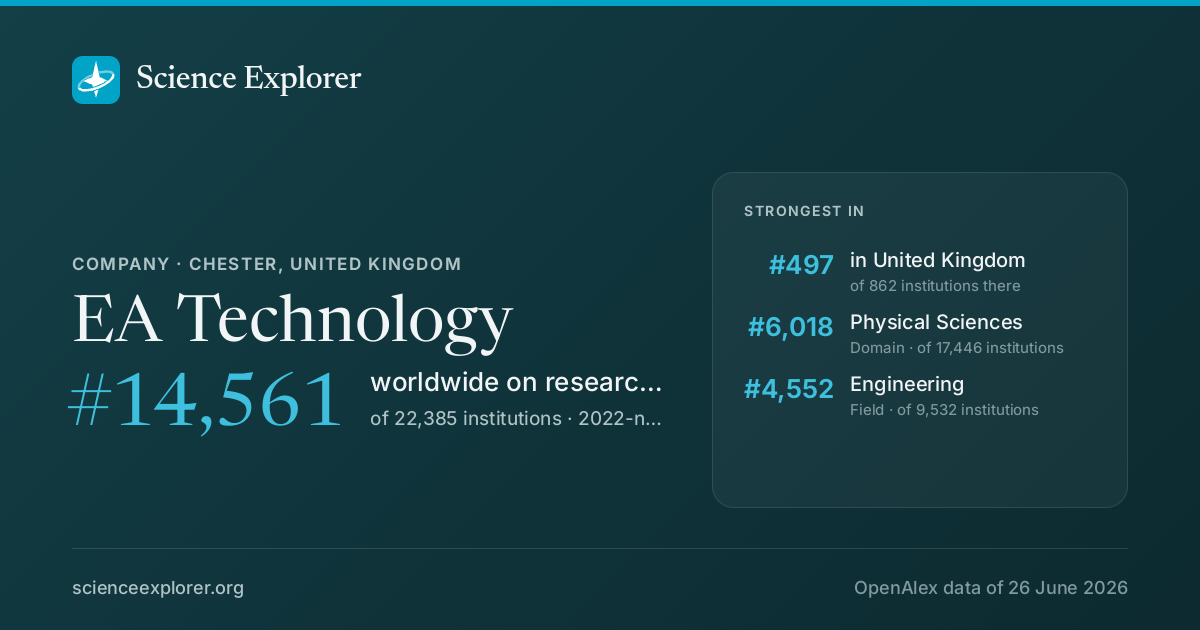
EA Technology

In research, EA Technology stands highest in Physical Sciences (#6,018 of 17,446 worldwide) and Engineering (#4,552 of 9,532 worldwide), over all time.

World rank, 2022-now
#14,561
of 22,385 · #8,392 all time
Rank in United Kingdom
#497
of 862
Research works
643
▲ 104% vs 2018-21
Citations
8.5k
13.2 per fractional work
Top-10% rate
8.4%
all institutions 10.0%
vs its own fields
1.01×
1.00× is exactly expected
Open access
22%
world 40%
International
29%
world 18%

What is EA Technology known for in research?

The fields where it stands highest, over all time, ranked among every institution above the floor in each field.

FieldWorld rankWhere that sitsTop-10% rateWorks
Physical SciencesDomain #6,018 of 17,446 9.4%441
EngineeringField #4,552 of 9,532 8.1%284

Each strip is that field's whole ranked pool, with the notch where EA Technology sits in it, in the colour of the band that rank falls in. The track under the rate is the rate itself: it carries no average mark, because the average differs by field (from about 6% in Dentistry to 21% in Economics).

Which fields of science does EA Technology work in?

In 2022-now, 61% of research at EA Technology is in Physical Sciences, 18% in Social Sciences. Its largest fields are Engineering (35%), Computer Science (9%), Social Sciences (8%). It does 1.5× the world's share of Physical Sciences.

Physical Sciences: 73 fractional works · 60.5% of its workEngineering: 42 fractional works · 34.7% of its workElectrical and Electronic Engineering: 14 fractional works · 11.7% of its workMechanical Engineering: 6 fractional works · 5.0% of its workControl and Systems Engineering: 4 fractional works · 2.9% of its workAutomotive Engineering: 3 fractional works · 2.5% of its workBiomedical Engineering: 3 fractional works · 2.4% of its workComputational Mechanics: 2 fractional works · 1.9% of its workAerospace Engineering: 2 fractional works · 1.6% of its workMechanics of Materials: 2 fractional works · 1.6% of its workIndustrial and Manufacturing Engineering: 2 fractional works · 1.5% of its workSafety, Risk, Reliability and Quality: 1 fractional works · 1.1% of its workCivil and Structural Engineering: 1 fractional works · 0.9% of its workMedia Technology: 1 fractional works · 0.6% of its workBuilding and Construction: 1 fractional works · 0.5% of its workOcean Engineering: 1 fractional works · 0.4% of its workComputer Science: 11 fractional works · 9.5% of its workArtificial Intelligence: 5 fractional works · 4.3% of its workComputer Vision and Pattern Recognition: 2 fractional works · 1.7% of its workInformation Systems: 1 fractional works · 1.1% of its workComputer Networks and Communications: 1 fractional works · 0.9% of its workComputational Theory and Mathematics: 1 fractional works · 0.5% of its workSignal Processing: 0 fractional works · 0.3% of its workSoftware: 0 fractional works · 0.3% of its workComputer Graphics and Computer-Aided Design: 0 fractional works · 0.2% of its workSmaller subfields together: 0 fractional works · 0.2% of its workMaterials Science: 8 fractional works · 6.5% of its workMaterials Chemistry: 4 fractional works · 3.5% of its workBiomaterials: 1 fractional works · 0.7% of its workElectronic, Optical and Magnetic Materials: 1 fractional works · 0.6% of its workPolymers and Plastics: 1 fractional works · 0.5% of its workGeneral Materials Science: 1 fractional works · 0.5% of its workCeramics and Composites: 0 fractional works · 0.4% of its workSurfaces, Coatings and Films: 0 fractional works · 0.3% of its workEnvironmental Science: 6 fractional works · 4.5% of its workEcology: 1 fractional works · 1.2% of its workWater Science and Technology: 1 fractional works · 0.7% of its workPollution: 1 fractional works · 0.7% of its workEnvironmental Engineering: 1 fractional works · 0.6% of its workIndustrial and Manufacturing Engineering: 1 fractional works · 0.5% of its workGlobal and Planetary Change: 0 fractional works · 0.3% of its workSmaller subfields together: 1 fractional works · 0.5% of its workEnergy: 2 fractional works · 1.5% of its workRenewable Energy, Sustainability and the Environment: 2 fractional works · 1.5% of its workEarth and Planetary Sciences: 2 fractional works · 1.4% of its workGeology: 1 fractional works · 0.9% of its workSmaller subfields together: 1 fractional works · 0.5% of its workPhysics and Astronomy: 1 fractional works · 1.2% of its workAtomic and Molecular Physics, and Optics: 1 fractional works · 0.9% of its workSmaller subfields together: 0 fractional works · 0.3% of its workChemistry: 1 fractional works · 0.9% of its workAnalytical Chemistry: 0 fractional works · 0.4% of its workOrganic Chemistry: 0 fractional works · 0.2% of its workSmaller subfields together: 0 fractional works · 0.2% of its workChemical Engineering: 0 fractional works · 0.2% of its workMathematics: 0 fractional works · 0.1% of its workSocial Sciences: 22 fractional works · 18.3% of its workSocial Sciences: 10 fractional works · 8.4% of its workSociology and Political Science: 4 fractional works · 3.0% of its workGender Studies: 1 fractional works · 0.8% of its workEducation: 1 fractional works · 0.7% of its workPolitical Science and International Relations: 1 fractional works · 0.6% of its workUrban Studies: 1 fractional works · 0.6% of its workGeneral Social Sciences: 0 fractional works · 0.4% of its workLaw: 0 fractional works · 0.4% of its workTransportation: 0 fractional works · 0.4% of its workCultural Studies: 0 fractional works · 0.3% of its workDemography: 0 fractional works · 0.3% of its workAnthropology: 0 fractional works · 0.3% of its workPublic Administration: 0 fractional works · 0.3% of its workSmaller subfields together: 0 fractional works · 0.3% of its workBusiness, Management and Accounting: 6 fractional works · 4.8% of its workStrategy and Management: 1 fractional works · 1.2% of its workManagement Information Systems: 1 fractional works · 1.0% of its workOrganizational Behavior and Human Resource Management: 1 fractional works · 1.0% of its workManagement of Technology and Innovation: 1 fractional works · 0.7% of its workAccounting: 1 fractional works · 0.6% of its workSmaller subfields together: 0 fractional works · 0.4% of its workPsychology: 2 fractional works · 1.9% of its workSocial Psychology: 2 fractional works · 1.4% of its workSmaller subfields together: 1 fractional works · 0.5% of its workArts and Humanities: 2 fractional works · 1.9% of its workPhilosophy: 1 fractional works · 0.6% of its workHistory: 1 fractional works · 0.5% of its workLiterature and Literary Theory: 0 fractional works · 0.3% of its workLanguage and Linguistics: 0 fractional works · 0.3% of its workMuseology: 0 fractional works · 0.2% of its workSmaller subfields together: 0 fractional works · 0.1% of its workDecision Sciences: 1 fractional works · 1.0% of its workManagement Science and Operations Research: 1 fractional works · 0.7% of its workInformation Systems and Management: 0 fractional works · 0.3% of its workEconomics, Econometrics and Finance: 0 fractional works · 0.3% of its workGeneral Economics, Econometrics and Finance: 0 fractional works · 0.2% of its workSmaller subfields together: 0 fractional works · 0.1% of its workLife Sciences: 14 fractional works · 11.2% of its workAgricultural and Biological Sciences: 8 fractional works · 6.8% of its workPlant Science: 3 fractional works · 2.5% of its workFood Science: 2 fractional works · 1.6% of its workSoil Science: 1 fractional works · 1.1% of its workEcology, Evolution, Behavior and Systematics: 1 fractional works · 0.9% of its workInsect Science: 0 fractional works · 0.3% of its workAquatic Science: 0 fractional works · 0.3% of its workSmaller subfields together: 0 fractional works · 0.2% of its workBiochemistry, Genetics and Molecular Biology: 4 fractional works · 3.1% of its workMolecular Biology: 2 fractional works · 1.8% of its workGenetics: 0 fractional works · 0.4% of its workCancer Research: 0 fractional works · 0.3% of its workCell Biology: 0 fractional works · 0.2% of its workSmaller subfields together: 1 fractional works · 0.4% of its workImmunology and Microbiology: 1 fractional works · 0.7% of its workImmunology: 0 fractional works · 0.4% of its workMicrobiology: 0 fractional works · 0.3% of its workNeuroscience: 1 fractional works · 0.5% of its workPharmacology, Toxicology and Pharmaceutics: 0 fractional works · 0.1% of its workHealth Sciences: 12 fractional works · 9.9% of its workMedicine: 8 fractional works · 6.9% of its workRadiology, Nuclear Medicine and Imaging: 2 fractional works · 1.3% of its workCardiology and Cardiovascular Medicine: 1 fractional works · 1.0% of its workPulmonary and Respiratory Medicine: 1 fractional works · 0.8% of its workSurgery: 1 fractional works · 0.6% of its workDermatology: 1 fractional works · 0.5% of its workPharmacology: 0 fractional works · 0.4% of its workEpidemiology: 0 fractional works · 0.3% of its workPhysiology: 0 fractional works · 0.3% of its workComplementary and alternative medicine: 0 fractional works · 0.2% of its workSmaller subfields together: 2 fractional works · 1.5% of its workHealth Professions: 3 fractional works · 2.2% of its workHealth Information Management: 1 fractional works · 0.9% of its workGeneral Health Professions: 1 fractional works · 0.8% of its workMedical Laboratory Technology: 0 fractional works · 0.3% of its workSpeech and Hearing: 0 fractional works · 0.2% of its workDentistry: 1 fractional works · 0.5% of its workPeriodontics: 0 fractional works · 0.3% of its workSmaller subfields together: 0 fractional works · 0.2% of its workNursing: 1 fractional works · 0.4% of its workNutrition and Dietetics: 0 fractional works · 0.3% of its workSmaller subfields together: 0 fractional works · 0.1% of its workALL ITS WORKEA Technology121fractional works, 2022-now
Life Sciences11%Physical Sciences61%Health Sciences10%Social Sciences18%

Each ring splits the one inside it: the four domains of science, their fields, their subfields. Size is fractional works in 2022-now. Every slice is a page; the interactive view zooms down to single topics and colours each by how much more of it this institution does than the world.

Its 4 domains and 25 fields, with their numbers
    1. Engineering4234.7%
    2. Computer Science119.5%
    3. Materials Science86.5%
    4. Environmental Science64.5%
    5. Energy21.5%
    6. Earth and Planetary Sciences21.4%
    7. Physics and Astronomy11.2%
    8. Chemistry10.9%
    9. Chemical Engineering00.2%
    10. Mathematics00.1%
    1. Social Sciences108.4%
    2. Business, Management and Accounting64.8%
    3. Psychology21.9%
    4. Arts and Humanities21.9%
    5. Decision Sciences11.0%
    6. Economics, Econometrics and Finance00.3%
    1. Agricultural and Biological Sciences86.8%
    2. Biochemistry, Genetics and Molecular Biology43.1%
    3. Immunology and Microbiology10.7%
    4. Neuroscience10.5%
    5. Pharmacology, Toxicology and Pharmaceutics00.1%
    1. Medicine86.9%
    2. Health Professions32.2%
    3. Dentistry10.5%
    4. Nursing10.4%
All of science, and how each field's share has moved since 1950: the Science domain explorer

Field profile

Location quotient across every field it publishes in: outside the ring is more than an institution of this size would be expected to publish, inside it is less.

Agricultural and Biological Sciences: 1.43× its world share, 8 worksAgricultural and Bio…Biochemistry, Genetics and Molecular Biology: 0.58× its world share, 4 worksBiochemistry, Geneti…Immunology and Microbiology: 0.69× its world share, 1 worksImmunology and Micro…Neuroscience: 0.32× its world share, 1 worksNeurosciencePharmacology, Toxicology and Pharmaceutics: 0.29× its world share, 0 worksPharmacology, Toxico…Chemical Engineering: 0.54× its world share, 0 worksChemical EngineeringChemistry: 0.55× its world share, 1 worksChemistryComputer Science: 1.22× its world share, 12 worksComputer ScienceEarth and Planetary Sciences: 0.86× its world share, 2 worksEarth and Planetary …Energy: 1.66× its world share, 2 worksEnergyEngineering: 2.32× its world share, 42 worksEngineeringEnvironmental Science: 0.91× its world share, 6 worksEnvironmental ScienceMaterials Science: 1.87× its world share, 8 worksMaterials ScienceMathematics: 0.12× its world share, 0 worksMathematicsPhysics and Astronomy: 0.54× its world share, 1 worksPhysics and AstronomyDentistry: 0.95× its world share, 1 worksDentistryHealth Professions: 0.82× its world share, 3 worksHealth ProfessionsMedicine: 0.36× its world share, 8 worksMedicineNursing: 0.88× its world share, 0 worksNursingArts and Humanities: 0.67× its world share, 2 worksArts and HumanitiesBusiness, Management and Accounting: 1.49× its world share, 6 worksBusiness, Management…Decision Sciences: 1.01× its world share, 1 worksDecision SciencesEconomics, Econometrics and Finance: 0.14× its world share, 0 worksEconomics, Econometr…Psychology: 0.64× its world share, 2 worksPsychologySocial Sciences: 0.66× its world share, 10 worksSocial Sciences1×world share
more than its size predictsabout as predictedless

Rings at 0.5×, 1× and 2×. Widest outward: Engineering, 2.3×. Every wedge is a field page.

All 25 fields, with their numbers
  1. Engineering2.32×42 works
  2. Materials Science1.87×8 works
  3. Energy1.66×2 works
  4. Business, Management and Accounting1.49×6 works
  5. Agricultural and Biological Sciences1.43×8 works
  6. Computer Science1.22×12 works
  7. Decision Sciences1.01×1 works
  8. Dentistry0.95×1 works
  9. Environmental Science0.91×6 works
  10. Nursing0.88×0 works
  11. Earth and Planetary Sciences0.86×2 works
  12. Health Professions0.82×3 works
  13. Immunology and Microbiology0.69×1 works
  14. Arts and Humanities0.67×2 works
  15. Social Sciences0.66×10 works
  16. Psychology0.64×2 works
  17. Biochemistry, Genetics and Molecular Biology0.58×4 works
  18. Chemistry0.55×1 works
  19. Chemical Engineering0.54×0 works
  20. Physics and Astronomy0.54×1 works
  21. Medicine0.36×8 works
  22. Neuroscience0.32×1 works
  23. Pharmacology, Toxicology and Pharmaceutics0.29×0 works
  24. Economics, Econometrics and Finance0.14×0 works
  25. Mathematics0.12×0 works

Who are the top researchers at EA Technology?

Ranked on the quality score, Robert M. Fielding, Andrew T. Rowley and R.D. Naybour lead among researchers whose main affiliation is EA Technology.

  1. 1 Robert M. Fielding United Kingdom · #1,469,827 worldwide 2.1k citations · 37 works
  2. 2 Andrew T. Rowley United Kingdom · #2,968,473 worldwide 577 citations · 20 works
  3. 3 R.D. Naybour United Kingdom · #3,336,248 worldwide 301 citations · 27 works
  4. 4 J. R. Brailsford United Kingdom · #3,782,943 worldwide 282 citations · 17 works
  5. 5 Richard L. Bechtold United Kingdom · #3,914,166 worldwide 664 citations · 43 works
  6. 6 D.A. McIntyre United Kingdom · #4,802,434 worldwide 511 citations · 32 works
  7. 7 T A McCalden United Kingdom · #5,152,981 worldwide 42 citations · 19 works
  8. 8 David J. Daniels United Kingdom · #5,203,208 worldwide 2.9k citations · 117 works
  9. 9 Rdm Cotgrove United Kingdom · #6,380,150 worldwide 21 citations · 58 works
All ranked researchers at EA Technology

What are the most cited papers from EA Technology?

The most cited paper from EA Technology is "Liposomes containing synthetic lipid derivatives of poly(ethylene glycol) show prolonged circulation half-lives in vivo" (Theresa M. Allen, Cecilie Cetti Hansen, Francisco J. Plaza Martín et al., 1991), with 1,397 citations. Next come "Liquid crystal display and organic light-emitting diode display: present status and future perspectives" (1,060) and "Sterically stabilized liposomes: a hypothesis on the molecular origin of the extended circulation times" (545).

Most cited papers
#PaperReleasedCitations
1 Liposomes containing synthetic lipid derivatives of poly(ethylene glycol) show prolonged circulation half-lives in vivo Theresa M. Allen, Cecilie Cetti Hansen, Francisco J. Plaza Martín et al. · Biochimica et Biophysica Acta (BBA) - Biomembranes Jul 1991 1,397
2 Liquid crystal display and organic light-emitting diode display: present status and future perspectives Hai-Wei Chen, Jiun‐Haw Lee, Bo‐Yen Lin et al. · Light Science & Applications Open access Dec 2017 1,060
3 Sterically stabilized liposomes: a hypothesis on the molecular origin of the extended circulation times Dan D. Lasic, Francisco J. Plaza Martín, Alberto Gabizón et al. · Biochimica et Biophysica Acta (BBA) - Biomembranes Nov 1991 545
4 Functionalized Poly(ethylene glycols) for Preparation of Biologically Relevant Conjugates Samuel Zalipsky · Bioconjugate Chemistry Mar 1995 468
5 The water vapor sorption behavior of natural fibers Callum A. S. Hill, Andrew J. Norton, Gary R. Newman · Journal of Applied Polymer Science 5 Feb 2009 449
All 60 most cited papers, with filters and sorting

Which keywords describe research at EA Technology?

By fractional works in 2022-now, weighted toward what it does more of than the world: Deep Learning, Smart Grid, Neural Networks, Machine Learning, Lithium-ion Batteries, Electric Vehicles, Power System and Energy Storage.

▲ more of its work than of the world's◆ about the world's share▼ less than the world's

Size is fractional works in 2022-now in the topics tagged with each word; colour is the word's share of this institution's work against its share of the world's. The 40 words are chosen for being large and distinctive. Each links to the topic it comes from most.

All 40 words, with their numbers
  1. Deep Learning8▲ 1.83×35 topics
  2. Machine Learning6▲ 1.55×25 topics
  3. Neural Networks5▲ 2.7×16 topics
  4. Sustainability4▲ 1.19×13 topics
  5. Smart Grid3▲ 7.9×5 topics
  6. Mechanical Properties3▲ 2.8×20 topics
  7. Energy Storage3▲ 4.1×6 topics
  8. Environmental Impact3▲ 1.45×17 topics
  9. Lithium-ion Batteries3▲ 5.7×3 topics
  10. Nanoparticles3▲ 1.83×17 topics
  11. Renewable Energy3▲ 1.53×10 topics
  12. Cathode Materials2▲ 5.3×3 topics
  13. Electric Vehicles2▲ 7.2×3 topics
  14. Thermal Management2▲ 6.5×4 topics
  15. Battery Technology2▲ 7.1×2 topics
  16. Healthcare2▲ 1.73×6 topics
  17. Power System2▲ 23×4 topics
  18. Renewable Energy Integration2▲ 6.0×5 topics
  19. Identity2▲ 2.5×7 topics
  20. Brazil2▲ 19×4 topics
  21. Risk Assessment2▲ 2.5×6 topics
  22. Wavelet Transform2▲ 7.2×5 topics
  23. Heat Transfer2▲ 3.3×7 topics
  24. Rechargeable Batteries2▲ 5.2×2 topics
  25. Structural Analysis2▲ 14×4 topics
  26. Numerical Simulation1▲ 4.1×4 topics
  27. Soil Fertility1▲ 5.0×4 topics
  28. Fiber Lasers1▲ 11×3 topics
  29. Reliability Evaluation1▲ 21×2 topics
  30. Artificial Neural Network1▲ 10×2 topics
  31. Assembly Planning1▲ 14×1 topic
  32. Battery Materials1▲ 6.1×1 topic
  33. Charging Infrastructure1▲ 13×1 topic
  34. Design for Manufacture1▲ 14×1 topic
  35. Distributed Generation1▲ 12×2 topics
  36. Nanostructured Anodes1▲ 6.1×1 topic
  37. Vehicle-to-Grid1▲ 13×1 topic
  38. Management Control Systems1▲ 58×1 topic
  39. Nitrogen Cycle1▲ 13×1 topic
  40. Soil Carbon Sequestration1▲ 11×1 topic

Which research topics does EA Technology publish most on?

By volume in 2022-now: Electric Vehicles and Infrastructure, Advancements in Battery Materials, Manufacturing Process and Optimization and Advanced Battery Technologies Research.

  1. 1 Electric Vehicles and Infrastructure Electrical and Electronic Engineering 1 works
  2. 2 Advancements in Battery Materials Electrical and Electronic Engineering 1 works
  3. 3 Manufacturing Process and Optimization Industrial and Manufacturing Engineering 1 works
  4. 4 Advanced Battery Technologies Research Automotive Engineering 1 works
  5. 5 Accounting and Organizational Management Management Information Systems 1 works
  6. 6 Soil Carbon and Nitrogen Dynamics Soil Science 1 works
  7. 7 Artificial Intelligence in Healthcare Health Information Management 1 works
  8. 8 Power System Reliability and Maintenance Safety, Risk, Reliability and Quality 1 works
  9. 9 Cultural Differences and Values Social Psychology 1 works
  10. 10 Research studies in Vietnam Ecology 1 works

How open and international is its research?

Against the world's own shares: the tick on each track. Both are shares of its output, so they sit on one scale and can be read against each other as well as against the world.

openly available22.2%not open77.8%

World: 40% of research is openly available.

with international co-authors28.9%domestic only71.1%

World: 18% is written across borders.

How has EA Technology's research output changed?

Output in 2022-2025 was 104% higher than in 2018-2021.

still counting1990200020102020
grewheldshrank

The same series as a ribbon: one cell per year, darker for more. The line above answers how much; this answers when.

Its share of all research

Growing output can still be a shrinking share: all of science grows. This is EA Technology as a percentage of every work published that year, 0.00029% in 2024.

still counting0.0010%0.0020%0.0030%EA Technology0.00073% in 202519801990200020102020

Fractional works of EA Technology over all fractional works that year. How the balance of science has shifted.

How much of it reaches the world top 10%

Year by year, against all institutions in the same year.

still counting5%10%15%all institutions10.0% in 2025EA Technology7.8% in 2025200020102020

Of each year's output, the share that reached the world's 10% most cited for its field and year. Peak 13.0% in 1996.

Other research institutions in Chester

All research institutions in Chester

Share EA Technology's ranking

EA Technology on Science Explorer

A card with EA Technology's standing and the fields it leads in, for a post or a slide. A link to this page previews as the same card.

Download the card

1200 × 630 PNG, sized for social posts, drawn from the latest snapshot.

Badges for a website1Each links back here and updates with every snapshot

Research measures only: rankings here say nothing about teaching, admissions or student experience. Comparable institutions and collaboration partners have tabs of their own, above.

Discussion

Ask a question or share a note about EA Technology. Keep it to the research: no personal attacks, advertising or links. Any reader can report a post, which collapses it for everyone until it is opened.