Science Explorer Back to mapMap
World rank, all time
#31,571
of 34,923
Rank in Portugal
#203
of 209
Research works
122
▼ 30% vs 2018-21
Citations
1.2k
9.5 per fractional work
Top-10% rate
7.9%
all institutions 10.0%
vs its own fields
0.95×
1.00× is exactly expected
Open access
33%
world 40%
International
26%
world 18%

Which fields of science does Efacec (Portugal) work in?

In 2022-now, 60% of research at Efacec (Portugal) is in Physical Sciences, 36% in Health Sciences. Its largest fields are Engineering (39%), Medicine (32%), Materials Science (6%). It does 1.4× the world's share of Physical Sciences.

Physical Sciences: 17 fractional works · 59.6% of its workEngineering: 11 fractional works · 39.3% of its workElectrical and Electronic Engineering: 5 fractional works · 17.9% of its workMechanical Engineering: 2 fractional works · 5.2% of its workControl and Systems Engineering: 1 fractional works · 4.7% of its workAutomotive Engineering: 1 fractional works · 2.6% of its workIndustrial and Manufacturing Engineering: 1 fractional works · 2.6% of its workAerospace Engineering: 1 fractional works · 1.9% of its workBuilding and Construction: 0 fractional works · 1.4% of its workBiomedical Engineering: 0 fractional works · 1.1% of its workCivil and Structural Engineering: 0 fractional works · 0.8% of its workComputational Mechanics: 0 fractional works · 0.4% of its workMechanics of Materials: 0 fractional works · 0.4% of its workMedia Technology: 0 fractional works · 0.4% of its workMaterials Science: 2 fractional works · 5.9% of its workMaterials Chemistry: 2 fractional works · 5.2% of its workPolymers and Plastics: 0 fractional works · 0.6% of its workSmaller subfields together: 0 fractional works · 0.2% of its workComputer Science: 2 fractional works · 5.3% of its workArtificial Intelligence: 1 fractional works · 2.2% of its workComputer Networks and Communications: 0 fractional works · 1.4% of its workComputational Theory and Mathematics: 0 fractional works · 0.4% of its workComputer Vision and Pattern Recognition: 0 fractional works · 0.4% of its workHardware and Architecture: 0 fractional works · 0.4% of its workSignal Processing: 0 fractional works · 0.3% of its workSoftware: 0 fractional works · 0.2% of its workSmaller subfields together: 0 fractional works · 0.0% of its workPhysics and Astronomy: 1 fractional works · 4.8% of its workAstronomy and Astrophysics: 1 fractional works · 2.8% of its workStatistical and Nonlinear Physics: 0 fractional works · 1.0% of its workAtomic and Molecular Physics, and Optics: 0 fractional works · 0.3% of its workInstrumentation: 0 fractional works · 0.2% of its workRadiation: 0 fractional works · 0.2% of its workSmaller subfields together: 0 fractional works · 0.3% of its workEnergy: 1 fractional works · 2.0% of its workEnergy Engineering and Power Technology: 0 fractional works · 1.1% of its workRenewable Energy, Sustainability and the Environment: 0 fractional works · 0.9% of its workEnvironmental Science: 1 fractional works · 1.7% of its workPollution: 0 fractional works · 0.7% of its workIndustrial and Manufacturing Engineering: 0 fractional works · 0.4% of its workWater Science and Technology: 0 fractional works · 0.3% of its workSmaller subfields together: 0 fractional works · 0.4% of its workEarth and Planetary Sciences: 0 fractional works · 0.5% of its workGeology: 0 fractional works · 0.4% of its workSmaller subfields together: 0 fractional works · 0.2% of its workHealth Sciences: 10 fractional works · 35.9% of its workMedicine: 9 fractional works · 31.9% of its workSurgery: 4 fractional works · 13.6% of its workDermatology: 2 fractional works · 5.9% of its workOtorhinolaryngology: 1 fractional works · 3.8% of its workNeurology: 1 fractional works · 2.8% of its workPublic Health, Environmental and Occupational Health: 0 fractional works · 1.5% of its workEpidemiology: 0 fractional works · 0.7% of its workRadiology, Nuclear Medicine and Imaging: 0 fractional works · 0.6% of its workImmunology and Allergy: 0 fractional works · 0.6% of its workPhysiology: 0 fractional works · 0.6% of its workReproductive Medicine: 0 fractional works · 0.6% of its workPharmacology: 0 fractional works · 0.4% of its workPulmonary and Respiratory Medicine: 0 fractional works · 0.3% of its workCardiology and Cardiovascular Medicine: 0 fractional works · 0.2% of its workSmaller subfields together: 0 fractional works · 0.3% of its workDentistry: 1 fractional works · 1.8% of its workOrthodontics: 0 fractional works · 1.0% of its workPeriodontics: 0 fractional works · 0.6% of its workOral Surgery: 0 fractional works · 0.2% of its workHealth Professions: 0 fractional works · 1.7% of its workGeneral Health Professions: 0 fractional works · 0.6% of its workHealth Information Management: 0 fractional works · 0.6% of its workOccupational Therapy: 0 fractional works · 0.4% of its workSmaller subfields together: 0 fractional works · 0.2% of its workVeterinary: 0 fractional works · 0.3% of its workSmall Animals: 0 fractional works · 0.3% of its workNursing: 0 fractional works · 0.2% of its workLife Sciences: 1 fractional works · 2.7% of its workBiochemistry, Genetics and Molecular Biology: 1 fractional works · 1.7% of its workGenetics: 1 fractional works · 1.7% of its workAgricultural and Biological Sciences: 0 fractional works · 0.7% of its workAgronomy and Crop Science: 0 fractional works · 0.3% of its workAnimal Science and Zoology: 0 fractional works · 0.3% of its workSmaller subfields together: 0 fractional works · 0.2% of its workNeuroscience: 0 fractional works · 0.3% of its workSensory Systems: 0 fractional works · 0.3% of its workSocial Sciences: 1 fractional works · 1.7% of its workBusiness, Management and Accounting: 0 fractional works · 0.9% of its workOrganizational Behavior and Human Resource Management: 0 fractional works · 0.6% of its workManagement Information Systems: 0 fractional works · 0.3% of its workDecision Sciences: 0 fractional works · 0.4% of its workManagement Science and Operations Research: 0 fractional works · 0.4% of its workSocial Sciences: 0 fractional works · 0.4% of its workEducation: 0 fractional works · 0.4% of its workALL ITS WORKEfacec (Portugal)29fractional works, 2022-now
Life Sciences3%Physical Sciences60%Health Sciences36%Social Sciences2%

Each ring splits the one inside it: the four domains of science, their fields, their subfields. Size is fractional works in 2022-now. Every slice is a page; the interactive view zooms down to single topics and colours each by how much more of it this institution does than the world.

Its 4 domains and 18 fields, with their numbers
    1. Engineering1139.3%
    2. Materials Science25.9%
    3. Computer Science25.3%
    4. Physics and Astronomy14.8%
    5. Energy12.0%
    6. Environmental Science11.7%
    7. Earth and Planetary Sciences00.5%
    1. Medicine931.9%
    2. Dentistry11.8%
    3. Health Professions01.7%
    4. Veterinary00.3%
    5. Nursing00.2%
    1. Biochemistry, Genetics and Molecular Biology11.7%
    2. Agricultural and Biological Sciences00.7%
    3. Neuroscience00.3%
    1. Business, Management and Accounting00.9%
    2. Decision Sciences00.4%
    3. Social Sciences00.4%
All of science, and how each field's share has moved since 1950: the Science domain explorer

Field profile

Location quotient across every field it publishes in: outside the ring is more than an institution of this size would be expected to publish, inside it is less.

Agricultural and Biological Sciences: 0.15× its world share, 0 worksAgricultural and Bio…Biochemistry, Genetics and Molecular Biology: 0.33× its world share, 0 worksBiochemistry, Geneti…Neuroscience: 0.18× its world share, 0 worksNeuroscienceComputer Science: 0.68× its world share, 2 worksComputer ScienceEarth and Planetary Sciences: 0.35× its world share, 0 worksEarth and Planetary …Energy: 2.17× its world share, 1 worksEnergyEngineering: 2.62× its world share, 12 worksEngineeringEnvironmental Science: 0.35× its world share, 0 worksEnvironmental ScienceMaterials Science: 1.70× its world share, 2 worksMaterials SciencePhysics and Astronomy: 2.13× its world share, 1 worksPhysics and AstronomyDentistry: 3.76× its world share, 0 worksDentistryHealth Professions: 0.65× its world share, 0 worksHealth ProfessionsMedicine: 1.66× its world share, 9 worksMedicineNursing: 0.33× its world share, 0 worksNursingVeterinary: 2.10× its world share, 0 worksVeterinaryBusiness, Management and Accounting: 0.28× its world share, 0 worksBusiness, Management…Decision Sciences: 0.47× its world share, 0 worksDecision SciencesSocial Sciences: 0.03× its world share, 0 worksSocial Sciences1×world share
more than its size predictsabout as predictedless

Rings at 0.5×, 1× and 2×. Widest outward: Dentistry, 3.8×. Every wedge is a field page.

All 18 fields, with their numbers
  1. Dentistry3.76×0 works
  2. Engineering2.62×12 works
  3. Energy2.17×1 works
  4. Physics and Astronomy2.13×1 works
  5. Veterinary2.10×0 works
  6. Materials Science1.70×2 works
  7. Medicine1.66×9 works
  8. Computer Science0.68×2 works
  9. Health Professions0.65×0 works
  10. Decision Sciences0.47×0 works
  11. Earth and Planetary Sciences0.35×0 works
  12. Environmental Science0.35×0 works
  13. Biochemistry, Genetics and Molecular Biology0.33×0 works
  14. Nursing0.33×0 works
  15. Business, Management and Accounting0.28×0 works
  16. Neuroscience0.18×0 works
  17. Agricultural and Biological Sciences0.15×0 works
  18. Social Sciences0.03×0 works

Who are the top researchers at Efacec (Portugal)?

Ranked on the quality score, José Carlos Neves, Hugo Campelo and A. Carrapatoso lead among researchers whose main affiliation is Efacec (Portugal).

  1. 1 José Carlos Neves Portugal · #2,166,926 worldwide 336 citations · 33 works
  2. 2 Hugo Campelo Portugal · #3,696,739 worldwide 153 citations · 16 works
  3. 3 A. Carrapatoso Portugal · #4,543,793 worldwide 186 citations · 22 works
  4. 4 Cassiano C. Linhares Portugal · #5,027,831 worldwide 40 citations · 16 works
  5. 5 Tiago Sousa Portugal · #5,119,203 worldwide 200 citations · 32 works
All ranked researchers at Efacec (Portugal)

What are the most cited papers from Efacec (Portugal)?

The most cited paper from Efacec (Portugal) is "A Review on HVDC Circuit Breakers" (Ataollah Mokhberdoran, Hélder Leite, Adriano Carvalho et al., 2014), with 128 citations. Next come "Multiport Hybrid HVDC Circuit Breaker" (123) and "Incorporation of electrochemical advanced oxidation processes in a multistage treatment system for sanitary landfill leachate" (114).

Most cited papers
#PaperReleasedCitations
1 A Review on HVDC Circuit Breakers Ataollah Mokhberdoran, Hélder Leite, Adriano Carvalho et al. Conference paper 2014 128
2 Multiport Hybrid HVDC Circuit Breaker Ataollah Mokhberdoran, Dirk Van Hertem, Nuno M Silva et al. · IEEE Transactions on Industrial Electronics Open access 23 Jun 2017 123
3 Incorporation of electrochemical advanced oxidation processes in a multistage treatment system for sanitary landfill leachate Francisca C. Moreira, Juán M. Soler, Amélia Fonseca et al. · Water Research 29 May 2015 114
4 Treatment of a sanitary landfill leachate using combined solar photo-Fenton and biological immobilized biomass reactor at a pilot scale Vítor J.P. Vilar, Elisângela Maria Rodrigues Rocha, Francisco Suetônio Bastos Mota et al. · Water Research Open access 23 Feb 2011 109
5 Landfill leachate treatment by solar-driven AOPs Elisângela Maria Rodrigues Rocha, Vítor J.P. Vilar, Amélia Fonseca et al. · Solar Energy 10 Dec 2010 106
All 60 most cited papers, with filters and sorting

Which keywords describe research at Efacec (Portugal)?

By fractional works in 2022-now, weighted toward what it does more of than the world: Anatomy, Nasal Surgery, Rhinoplasty, Epidemiology, Dermal Fillers, Hyaluronic Acid, Craniofacial and Reconstruction.

▲ more of its work than of the world's◆ about the world's share▼ less than the world's

Size is fractional works in 2022-now in the topics tagged with each word; colour is the word's share of this institution's work against its share of the world's. The 16 words are chosen for being large and distinctive. Each links to the topic it comes from most.

All 16 words, with their numbers
  1. Anatomy3▲ 140×2 topics
  2. Epidemiology3▲ 2.5×11 topics
  3. Nasal Surgery2▲ 373×1 topic
  4. Rhinoplasty2▲ 373×1 topic
  5. Dermal Fillers2▲ 228×1 topic
  6. Hyaluronic Acid2▲ 228×1 topic
  7. Craniofacial2▲ 216×1 topic
  8. Quality of Life2▲ 3.6×7 topics
  9. Reconstruction2▲ 30×1 topic
  10. Smart Grid2▲ 14×6 topics
  11. Energy Efficiency1▲ 5.1×7 topics
  12. Renewable Energy Integration1▲ 14×4 topics
  13. Machine Learning1▲ 1.22×9 topics
  14. Power Electronics1▲ 12×2 topics
  15. Nanocomposites1▲ 4.3×2 topics
  16. Thermal Management1▲ 11×3 topics

Which research topics does Efacec (Portugal) publish most on?

By volume in 2022-now: Nasal Surgery and Airway Studies, Facial Rejuvenation and Surgery Techniques, Reconstructive Facial Surgery Techniques and Power Transformer Diagnostics and Insulation.

  1. 1 Nasal Surgery and Airway Studies Surgery 2 works
  2. 2 Facial Rejuvenation and Surgery Techniques Dermatology 2 works
  3. 3 Reconstructive Facial Surgery Techniques Surgery 2 works
  4. 4 Power Transformer Diagnostics and Insulation Electrical and Electronic Engineering 1 works
  5. 5 Advanced DC-DC Converters Electrical and Electronic Engineering 1 works
  6. 6 Sinusitis and nasal conditions Otorhinolaryngology 1 works
  7. 7 High voltage insulation and dielectric phenomena Materials Chemistry 1 works
  8. 8 Cerebrovascular and genetic disorders Neurology 0 works
  9. 9 Cleft Lip and Palate Research Genetics 0 works
  10. 10 Power Systems and Technologies Electrical and Electronic Engineering 0 works

How open and international is its research?

Against the world's own shares: the tick on each track. Both are shares of its output, so they sit on one scale and can be read against each other as well as against the world.

openly available33.1%not open66.9%

World: 40% of research is openly available.

with international co-authors25.7%domestic only74.3%

World: 18% is written across borders.

How has Efacec (Portugal)'s research output changed?

Output in 2022-2025 was 30% lower than in 2018-2021.

still counting1990200020102020
grewheldshrank

The same series as a ribbon: one cell per year, darker for more. The line above answers how much; this answers when.

Its share of all research

Growing output can still be a shrinking share: all of science grows. This is Efacec (Portugal) as a percentage of every work published that year, 0.00014% in 2024.

still counting0.00020%0.00040%Efacec (Portugal)0.00011% in 20251990200020102020

Fractional works of Efacec (Portugal) over all fractional works that year. How the balance of science has shifted.

Other research institutions in Matosinhos Municipality

All research institutions in Matosinhos Municipality

Share Efacec (Portugal)'s ranking
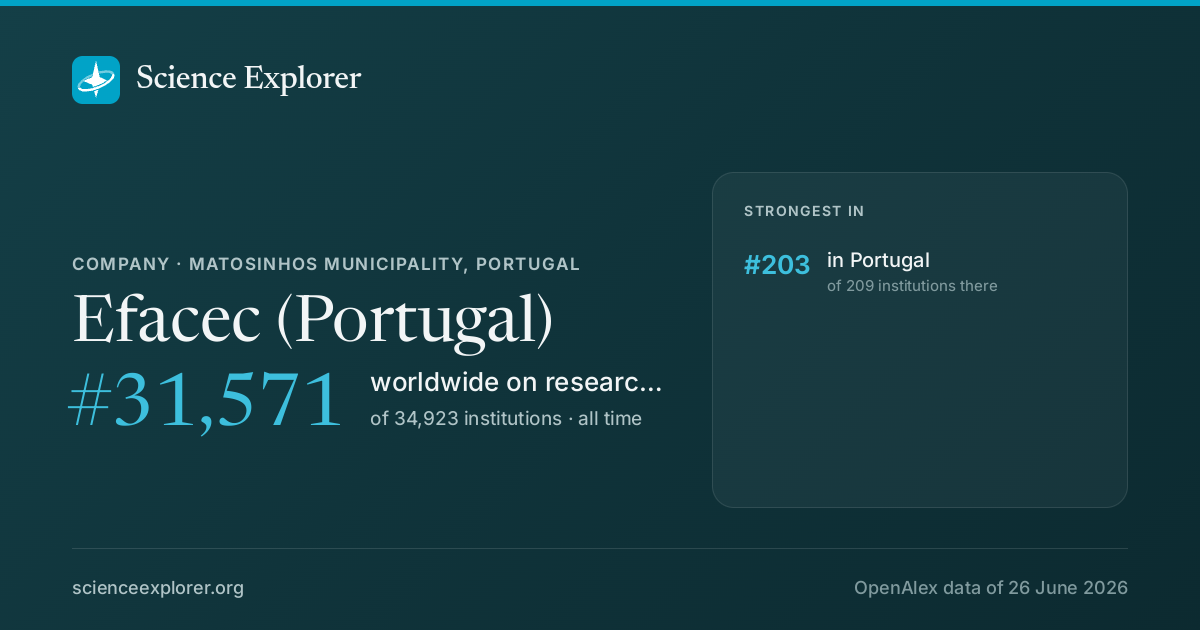
Efacec (Portugal) on Science Explorer

A card with Efacec (Portugal)'s standing and the fields it leads in, for a post or a slide. A link to this page previews as the same card.

Download the card

1200 × 630 PNG, sized for social posts, drawn from the latest snapshot.

Badges for a website1Each links back here and updates with every snapshot

Research measures only: rankings here say nothing about teaching, admissions or student experience. Comparable institutions and collaboration partners have tabs of their own, above.

Discussion

Ask a question or share a note about Efacec (Portugal). Posts are plain text and can be reported.