- World rank, all time
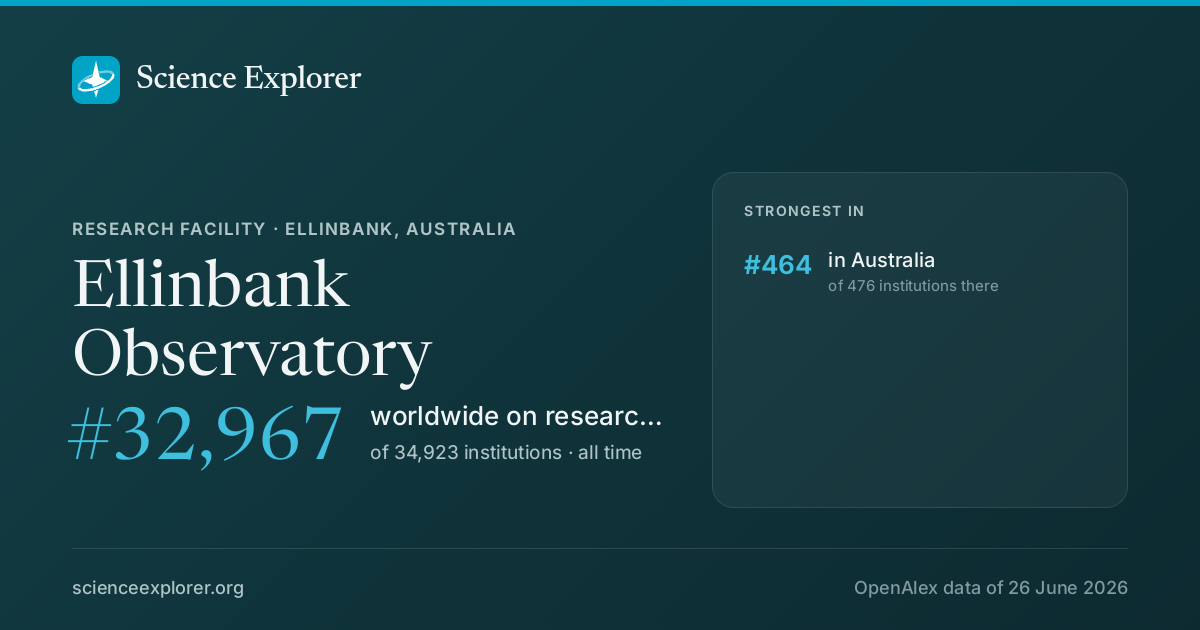
- #32,967 of 34,923
- Rank in Australia
- #464 of 476
- Research works
- 144 ▲ 16% vs 2018-21
- Citations
- 4.5k 31.1 per fractional work
- Top-10% rate
- 8.9% all institutions 10.0%
- vs its own fields
- 1.08× 1.00× is exactly expected
- Open access
- 42% world 40%
- International
- 37% world 18%
Which fields of science does Ellinbank Observatory work in?
In all years, 48% of research at Ellinbank Observatory is in Life Sciences, 42% in Physical Sciences. Its largest fields are Agricultural and Biological Sciences (39%), Environmental Science (24%), Physics and Astronomy (11%). It does 2.9× the world's share of Life Sciences.
Each ring splits the one inside it: the four domains of science, their fields, their subfields. Size is fractional works in all years. Every slice is a page; the interactive view zooms down to single topics and colours each by how much more of it this institution does than the world.
Its 4 domains and 21 fields, with their numbers
- Life Sciences7048.3%
- Physical Sciences6142.0%
- Environmental Science3423.9%
- Physics and Astronomy1510.6%
- Engineering53.7%
- Chemical Engineering21.1%
- Computer Science21.1%
- Earth and Planetary Sciences10.9%
- Chemistry10.6%
- Materials Science00.1%
- Health Sciences117.4%
- Veterinary43.0%
- Medicine32.0%
- Nursing21.7%
- Health Professions10.7%
- Social Sciences32.3%
- Decision Sciences21.4%
- Social Sciences10.7%
- Arts and Humanities00.2%
- Psychology00.0%
- Economics, Econometrics and Finance00.0%
Field profile
Location quotient across every field it publishes in: outside the ring is more than an institution of this size would be expected to publish, inside it is less.
Rings at 0.5×, 1× and 2×. Widest outward: Veterinary, 19.9×. Every wedge is a field page.
All 12 fields, with their numbers
- Veterinary19.95×0 works
- Agricultural and Biological Sciences10.93×9 works
- Nursing6.32×0 works
- Physics and Astronomy4.39×2 works
- Environmental Science3.37×3 works
- Biochemistry, Genetics and Molecular Biology1.83×2 works
- Chemical Engineering1.54×0 works
- Chemistry0.79×0 works
- Earth and Planetary Sciences0.55×0 works
- Engineering0.16×0 works
- Computer Science0.09×0 works
- Medicine0.02×0 works
Who are the top researchers at Ellinbank Observatory?
Ranked on the quality score, Christopher I. Grainger, Peter J. Moate and Matthew H. Deighton lead among researchers whose main affiliation is Ellinbank Observatory.
- 1
Christopher I. Grainger
 Australia · #470,406 worldwide
4.7k citations · 63 works
- 2
Peter J. Moate
Australia · #711,537 worldwide
7.7k citations · 192 works
- 3
Matthew H. Deighton
Australia · #819,357 worldwide
1.8k citations · 49 works
- 4
Fiona A. Robertson
Australia · #1,152,608 worldwide
1.4k citations · 34 works
- 5
T. Clarke
Australia · #1,839,600 worldwide
1.4k citations · 35 works
- 6
M.C. Hannah
Australia · #1,840,023 worldwide
4.4k citations · 133 works
- 7
Sharon R. Aarons
Australia · #1,847,972 worldwide
1.2k citations · 48 works
- 8
Kirsten M. Barlow
Australia · #1,909,051 worldwide
1.6k citations · 33 works
- 9
Cameron J. P. Gourley
Australia · #1,989,634 worldwide
2k citations · 68 works
- 10
David M. Nash
Australia · #2,079,134 worldwide
3.1k citations · 110 works
Which keywords describe research at Ellinbank Observatory?
By fractional works in all years, weighted toward what it does more of than the world: Milk Composition, Microbial Community, Climate Change, Fatty Acid Composition, Methane Production, Ruminant Nutrition, Dairy Cattle and Water Quality.
- Metabolic Adaptations
- Perennial Pastures
- Grazing Management
- Water Use Efficiency
- Heat Stress
- Nitrogen Cycle
- Ecosystem Functioning
- Microbial Communities
- Uterine Disease
- Oxidative Stress
- Land Use Change
- Genomic Selection
- Animal Breeding
- Population Genetics
- Marker-Assisted Selection
- Hyporheic Zone
- Water Quality
- Ruminant Nutrition
- Fatty Acid Composition
- Milk Composition
- Climate Change
- Microbial Community
- Methane Production
- Dairy Cattle
- Eutrophication
- Nutrient Cycling
- Plant Breeding
- Genetic Diversity
- Genome-Wide Association
- Energy Balance
- Livestock Production
- Reproductive Loss
- Animal Welfare
- Soil Carbon Sequestration
- Biochar Application
- Sediment Transport
- Soil Degradation
- Water Resources
- Hydrological Modeling
- Agricultural Sustainability
Size is fractional works in all years in the topics tagged with each word; colour is the word's share of this institution's work against its share of the world's. The 40 words are chosen for being large and distinctive. Each links to the topic it comes from most.
All 40 words, with their numbers
- Climate Change22▲ 5.8×22 topics
- Milk Composition20▲ 250×2 topics
- Microbial Community20▲ 146×3 topics
- Fatty Acid Composition18▲ 158×2 topics
- Methane Production18▲ 309×1 topic
- Ruminant Nutrition18▲ 309×1 topic
- Dairy Cattle12▲ 124×2 topics
- Water Quality12▲ 19×8 topics
- Eutrophication10▲ 47×2 topics
- Hyporheic Zone10▲ 218×1 topic
- Nutrient Cycling10▲ 86×1 topic
- Marker-Assisted Selection9▲ 66×2 topics
- Plant Breeding9▲ 58×3 topics
- Population Genetics9▲ 38×4 topics
- Genetic Diversity9▲ 12×3 topics
- Animal Breeding9▲ 103×1 topic
- Genome-Wide Association9▲ 72×2 topics
- Genomic Selection9▲ 103×1 topic
- Energy Balance8▲ 63×2 topics
- Land Use Change8▲ 19×3 topics
- Livestock Production8▲ 90×2 topics
- Oxidative Stress8▲ 3.0×4 topics
- Reproductive Loss8▲ 121×1 topic
- Uterine Disease8▲ 121×1 topic
- Animal Welfare7▲ 41×3 topics
- Microbial Communities6▲ 13×3 topics
- Soil Carbon Sequestration6▲ 62×2 topics
- Ecosystem Functioning6▲ 19×2 topics
- Biochar Application6▲ 47×1 topic
- Nitrogen Cycle6▲ 69×1 topic
- Sediment Transport5▲ 20×2 topics
- Heat Stress5▲ 36×2 topics
- Soil Degradation5▲ 55×2 topics
- Water Use Efficiency5▲ 94×2 topics
- Water Resources4▲ 14×2 topics
- Grazing Management4▲ 461×1 topic
- Hydrological Modeling4▲ 15×2 topics
- Perennial Pastures4▲ 461×1 topic
- Agricultural Sustainability4▲ 31×2 topics
- Metabolic Adaptations4▲ 128×1 topic
Which research topics does Ellinbank Observatory publish most on?
By volume in 2022-now: Ruminant Nutrition and Digestive Physiology, Reproductive Physiology in Livestock, Effects of Environmental Stressors on Livestock and Genetic and phenotypic traits in livestock.
Area is fractional works; colour is the subfield each topic belongs to.
- 1 Ruminant Nutrition and Digestive Physiology Agronomy and Crop Science 2 works
- 2 Reproductive Physiology in Livestock Agronomy and Crop Science 1 works
- 3 Effects of Environmental Stressors on Livestock Animal Science and Zoology 1 works
- 4 Genetic and phenotypic traits in livestock Genetics 1 works
- 5 Remote Sensing in Agriculture Ecology 1 works
- 6 Stellar, planetary, and galactic studies Astronomy and Astrophysics 0 works
- 7 Pasture and Agricultural Systems Forestry 0 works
- 8 Soil Carbon and Nitrogen Dynamics Soil Science 0 works
- 9 Bioenergy crop production and management Agronomy and Crop Science 0 works
- 10 Astronomy and Astrophysical Research Instrumentation 0 works
How open and international is its research?
Against the world's own shares: the tick on each track. Both are shares of its output, so they sit on one scale and can be read against each other as well as against the world.
World: 40% of research is openly available.
World: 18% is written across borders.
How has Ellinbank Observatory's research output changed?
Output in 2022-2025 was 16% higher than in 2018-2021.
The same series as a ribbon: one cell per year, darker for more. The line above answers how much; this answers when.
Its share of all research
Growing output can still be a shrinking share: all of science grows. This is Ellinbank Observatory as a percentage of every work published that year, 0.000028% in 2024.
Fractional works of Ellinbank Observatory over all fractional works that year. How the balance of science has shifted.
Share Ellinbank Observatory's ranking
Badges for a website1Each links back here and updates with every snapshot

Research measures only: rankings here say nothing about teaching, admissions or student experience. Comparable institutions and collaboration partners have tabs of their own, above.
Discussion
Ask a question or share a note about Ellinbank Observatory. Keep it to the research: no personal attacks, advertising or links. Any reader can report a post, which collapses it for everyone until it is opened.