
Science Explorer Back to mapMap
Discussion
Company · Koš · Slovakia

Environmental Institute

In research, Environmental Institute stands highest in Physical Sciences (#5,545 of 17,446 worldwide), over all time.

World rank, all time
#12,568
of 34,923
Rank in Slovakia
#17
of 60
Research works
364
▼ 7% vs 2018-21
Citations
17k
45.9 per fractional work
Top-10% rate
14.5%
all institutions 10.0%
vs its own fields
1.23×
1.00× is exactly expected
Open access
33%
world 40%
International
64%
world 18%

What is Environmental Institute known for in research?

The fields where it stands highest, over all time, ranked among every institution above the floor in each field.

FieldWorld rankWhere that sitsTop-10% rateWorks
Physical SciencesDomain #5,545 of 17,446 17.0%277

Each strip is that field's whole ranked pool, with the notch where Environmental Institute sits in it, in the colour of the band that rank falls in. The track under the rate is the rate itself: it carries no average mark, because the average differs by field (from about 6% in Dentistry to 21% in Economics).

Which fields of science does Environmental Institute work in?

In 2022-now, 61% of research at Environmental Institute is in Physical Sciences, 23% in Life Sciences. Its largest fields are Environmental Science (36%), Biochemistry, Genetics and Molecular Biology (12%), Earth and Planetary Sciences (9%). It does 1.4× the world's share of Physical Sciences.

Physical Sciences: 17 fractional works · 61.3% of its workEnvironmental Science: 10 fractional works · 35.9% of its workGlobal and Planetary Change: 2 fractional works · 9.1% of its workHealth, Toxicology and Mutagenesis: 2 fractional works · 7.9% of its workPollution: 2 fractional works · 5.7% of its workEcology: 1 fractional works · 4.4% of its workWater Science and Technology: 1 fractional works · 2.7% of its workEnvironmental Chemistry: 1 fractional works · 2.2% of its workIndustrial and Manufacturing Engineering: 0 fractional works · 1.8% of its workEnvironmental Engineering: 0 fractional works · 1.0% of its workManagement, Monitoring, Policy and Law: 0 fractional works · 0.6% of its workNature and Landscape Conservation: 0 fractional works · 0.3% of its workEarth and Planetary Sciences: 2 fractional works · 8.5% of its workAtmospheric Science: 1 fractional works · 4.9% of its workOceanography: 1 fractional works · 2.9% of its workGeochemistry and Petrology: 0 fractional works · 0.5% of its workEarth-Surface Processes: 0 fractional works · 0.3% of its workEngineering: 2 fractional works · 7.0% of its workBiomedical Engineering: 1 fractional works · 4.0% of its workOcean Engineering: 0 fractional works · 1.1% of its workCivil and Structural Engineering: 0 fractional works · 0.9% of its workBuilding and Construction: 0 fractional works · 0.4% of its workMedia Technology: 0 fractional works · 0.3% of its workComputational Mechanics: 0 fractional works · 0.2% of its workSmaller subfields together: 0 fractional works · 0.2% of its workChemistry: 1 fractional works · 3.9% of its workSpectroscopy: 1 fractional works · 2.1% of its workOrganic Chemistry: 0 fractional works · 1.5% of its workAnalytical Chemistry: 0 fractional works · 0.3% of its workSmaller subfields together: 0 fractional works · 0.0% of its workMathematics: 0 fractional works · 1.9% of its workModeling and Simulation: 0 fractional works · 1.1% of its workApplied Mathematics: 0 fractional works · 0.3% of its workNumerical Analysis: 0 fractional works · 0.3% of its workStatistics and Probability: 0 fractional works · 0.3% of its workMaterials Science: 0 fractional works · 1.6% of its workBiomaterials: 0 fractional works · 0.6% of its workSurfaces, Coatings and Films: 0 fractional works · 0.6% of its workMaterials Chemistry: 0 fractional works · 0.4% of its workComputer Science: 0 fractional works · 1.0% of its workComputational Theory and Mathematics: 0 fractional works · 0.7% of its workInformation Systems: 0 fractional works · 0.3% of its workEnergy: 0 fractional works · 0.9% of its workRenewable Energy, Sustainability and the Environment: 0 fractional works · 0.9% of its workPhysics and Astronomy: 0 fractional works · 0.6% of its workAstronomy and Astrophysics: 0 fractional works · 0.6% of its workLife Sciences: 6 fractional works · 23.3% of its workBiochemistry, Genetics and Molecular Biology: 3 fractional works · 11.8% of its workMolecular Biology: 2 fractional works · 7.0% of its workGenetics: 1 fractional works · 2.8% of its workBiotechnology: 0 fractional works · 0.6% of its workCell Biology: 0 fractional works · 0.6% of its workMolecular Medicine: 0 fractional works · 0.4% of its workCancer Research: 0 fractional works · 0.3% of its workSmaller subfields together: 0 fractional works · 0.1% of its workAgricultural and Biological Sciences: 2 fractional works · 7.5% of its workFood Science: 1 fractional works · 2.7% of its workPlant Science: 0 fractional works · 1.3% of its workAnimal Science and Zoology: 0 fractional works · 1.2% of its workEcology, Evolution, Behavior and Systematics: 0 fractional works · 0.9% of its workAgronomy and Crop Science: 0 fractional works · 0.8% of its workInsect Science: 0 fractional works · 0.4% of its workSmaller subfields together: 0 fractional works · 0.2% of its workNeuroscience: 1 fractional works · 2.7% of its workCellular and Molecular Neuroscience: 1 fractional works · 2.3% of its workNeurology: 0 fractional works · 0.4% of its workImmunology and Microbiology: 0 fractional works · 1.3% of its workMicrobiology: 0 fractional works · 0.8% of its workImmunology: 0 fractional works · 0.3% of its workParasitology: 0 fractional works · 0.3% of its workHealth Sciences: 3 fractional works · 9.8% of its workMedicine: 2 fractional works · 8.5% of its workEpidemiology: 1 fractional works · 2.0% of its workInfectious Diseases: 0 fractional works · 1.8% of its workPediatrics, Perinatology and Child Health: 0 fractional works · 1.0% of its workPublic Health, Environmental and Occupational Health: 0 fractional works · 0.9% of its workNeurology: 0 fractional works · 0.6% of its workPulmonary and Respiratory Medicine: 0 fractional works · 0.6% of its workSurgery: 0 fractional works · 0.6% of its workPhysiology: 0 fractional works · 0.5% of its workRadiology, Nuclear Medicine and Imaging: 0 fractional works · 0.4% of its workHealth Professions: 0 fractional works · 1.0% of its workGeneral Health Professions: 0 fractional works · 0.8% of its workSmaller subfields together: 0 fractional works · 0.1% of its workNursing: 0 fractional works · 0.4% of its workNutrition and Dietetics: 0 fractional works · 0.4% of its workSocial Sciences: 2 fractional works · 5.6% of its workSocial Sciences: 1 fractional works · 2.4% of its workSociology and Political Science: 0 fractional works · 1.5% of its workEducation: 0 fractional works · 0.3% of its workSafety Research: 0 fractional works · 0.3% of its workSmaller subfields together: 0 fractional works · 0.3% of its workEconomics, Econometrics and Finance: 0 fractional works · 1.3% of its workEconomics and Econometrics: 0 fractional works · 1.3% of its workDecision Sciences: 0 fractional works · 0.9% of its workInformation Systems and Management: 0 fractional works · 0.3% of its workManagement Science and Operations Research: 0 fractional works · 0.3% of its workStatistics, Probability and Uncertainty: 0 fractional works · 0.3% of its workSmaller subfields together: 0 fractional works · 0.0% of its workBusiness, Management and Accounting: 0 fractional works · 0.7% of its workAccounting: 0 fractional works · 0.7% of its workPsychology: 0 fractional works · 0.3% of its workClinical Psychology: 0 fractional works · 0.3% of its workALL ITS WORKEnvironmentalInstitute27fractional works, 2022-now
Life Sciences23%Physical Sciences61%Health Sciences10%Social Sciences6%

Each ring splits the one inside it: the four domains of science, their fields, their subfields. Size is fractional works in 2022-now. Every slice is a page; the interactive view zooms down to single topics and colours each by how much more of it this institution does than the world.

Its 4 domains and 21 fields, with their numbers
    1. Environmental Science1035.9%
    2. Earth and Planetary Sciences28.5%
    3. Engineering27.0%
    4. Chemistry13.9%
    5. Mathematics01.9%
    6. Materials Science01.6%
    7. Computer Science01.0%
    8. Energy00.9%
    9. Physics and Astronomy00.6%
    1. Biochemistry, Genetics and Molecular Biology311.8%
    2. Agricultural and Biological Sciences27.5%
    3. Neuroscience12.7%
    4. Immunology and Microbiology01.3%
    1. Medicine28.5%
    2. Health Professions01.0%
    3. Nursing00.4%
    1. Social Sciences12.4%
    2. Economics, Econometrics and Finance01.3%
    3. Decision Sciences00.9%
    4. Business, Management and Accounting00.7%
    5. Psychology00.3%
All of science, and how each field's share has moved since 1950: the Science domain explorer

Field profile

Location quotient across every field it publishes in: outside the ring is more than an institution of this size would be expected to publish, inside it is less.

Agricultural and Biological Sciences: 1.59× its world share, 2 worksAgricultural and Bio…Biochemistry, Genetics and Molecular Biology: 2.21× its world share, 3 worksBiochemistry, Geneti…Immunology and Microbiology: 1.30× its world share, 0 worksImmunology and Micro…Neuroscience: 1.65× its world share, 1 worksNeuroscienceChemistry: 2.50× its world share, 1 worksChemistryComputer Science: 0.13× its world share, 0 worksComputer ScienceEarth and Planetary Sciences: 5.43× its world share, 2 worksEarth and Planetary …Energy: 1.01× its world share, 0 worksEnergyEngineering: 0.47× its world share, 2 worksEngineeringEnvironmental Science: 7.22× its world share, 10 worksEnvironmental ScienceMaterials Science: 0.47× its world share, 0 worksMaterials ScienceMathematics: 1.58× its world share, 0 worksMathematicsPhysics and Astronomy: 0.28× its world share, 0 worksPhysics and AstronomyHealth Professions: 0.36× its world share, 0 worksHealth ProfessionsMedicine: 0.44× its world share, 2 worksMedicineNursing: 0.84× its world share, 0 worksNursingBusiness, Management and Accounting: 0.23× its world share, 0 worksBusiness, Management…Decision Sciences: 0.96× its world share, 0 worksDecision SciencesEconomics, Econometrics and Finance: 0.58× its world share, 0 worksEconomics, Econometr…Psychology: 0.09× its world share, 0 worksPsychologySocial Sciences: 0.19× its world share, 1 worksSocial Sciences1×world share
more than its size predictsabout as predictedless

Rings at 0.5×, 1× and 2×. Widest outward: Environmental Science, 7.2×. Every wedge is a field page.

All 21 fields, with their numbers
  1. Environmental Science7.22×10 works
  2. Earth and Planetary Sciences5.43×2 works
  3. Chemistry2.50×1 works
  4. Biochemistry, Genetics and Molecular Biology2.21×3 works
  5. Neuroscience1.65×1 works
  6. Agricultural and Biological Sciences1.59×2 works
  7. Mathematics1.58×0 works
  8. Immunology and Microbiology1.30×0 works
  9. Energy1.01×0 works
  10. Decision Sciences0.96×0 works
  11. Nursing0.84×0 works
  12. Economics, Econometrics and Finance0.58×0 works
  13. Engineering0.47×2 works
  14. Materials Science0.47×0 works
  15. Medicine0.44×2 works
  16. Health Professions0.36×0 works
  17. Physics and Astronomy0.28×0 works
  18. Business, Management and Accounting0.23×0 works
  19. Social Sciences0.19×1 works
  20. Computer Science0.13×0 works
  21. Psychology0.09×0 works

Who are the top researchers at Environmental Institute?

Ranked on the quality score, Jaroslav Slobodnı́k, Peter Oswald and Natalia Głowacka lead among researchers whose main affiliation is Environmental Institute.

  1. 1 Jaroslav Slobodnı́k Slovakia · #109,193 worldwide 9.8k citations · 232 works
  2. 2 Peter Oswald Slovakia · #741,891 worldwide 2.5k citations · 62 works
  3. 3 Natalia Głowacka Slovakia · #3,436,676 worldwide 451 citations · 33 works
All ranked researchers at Environmental Institute

What are the most cited papers from Environmental Institute?

The most cited paper from Environmental Institute is "Reduced calcification of marine plankton in response to increased atmospheric CO2" (Ulf Riebesell, Ingrid Zondervan, Björn Rost et al., 2000), with 1,537 citations. Next come "Trade-offs across Space, Time, and Ecosystem Services" (1,433) and "Global patterns of marine nitrogen fixation and denitrification" (1,373).

Most cited papers
#PaperReleasedCitations
1 Reduced calcification of marine plankton in response to increased atmospheric CO2 Ulf Riebesell, Ingrid Zondervan, Björn Rost et al. · Nature Sep 2000 1,537
2 Trade-offs across Space, Time, and Ecosystem Services Jon Paul Rodrı́guez, T. Douglas Beard, Elena M. Bennett et al. · Ecology and Society Open access 2006 1,433
3 Global patterns of marine nitrogen fixation and denitrification Nicolas Gruber, Jorge Louis Sarmiento · Global Biogeochemical Cycles Open access Jun 1997 1,373
4 Activated Ras requires autophagy to maintain oxidative metabolism and tumorigenesis Jessie Yanxiang Guo, Hsin-Yi Chen, Robin Mathew et al. · Genes & Development Open access 11 Feb 2011 1,337
5 Redfield ratios of remineralization determined by nutrient data analysis Laurence A. Anderson, Jorge Louis Sarmiento · Global Biogeochemical Cycles Mar 1994 1,291
All 60 most cited papers, with filters and sorting

Which keywords describe research at Environmental Institute?

By fractional works in 2022-now, weighted toward what it does more of than the world: Climate Change, Global Warming, Global Distribution, Bioaccumulation, Microbial Communities, Environmental Impact, Toxicity and Mass Spectrometry.

▲ more of its work than of the world's◆ about the world's share▼ less than the world's

Size is fractional works in 2022-now in the topics tagged with each word; colour is the word's share of this institution's work against its share of the world's. The 14 words are chosen for being large and distinctive. Each links to the topic it comes from most.

All 14 words, with their numbers
  1. Climate Change4▲ 5.3×22 topics
  2. Global Warming2▲ 16×7 topics
  3. Environmental Impact2▲ 3.9×9 topics
  4. Epidemiology2▲ 1.56×15 topics
  5. Bioaccumulation2▲ 61×3 topics
  6. Global Distribution2▲ 82×2 topics
  7. Microbial Communities1▲ 12×5 topics
  8. Health Effects1▲ 7.2×5 topics
  9. Mass Spectrometry1▲ 28×3 topics
  10. Toxicity1▲ 11×4 topics
  11. Antibiotics1▲ 50×1 topic
  12. Environmental Exposure1▲ 37×3 topics
  13. Resistance Genes1▲ 82×1 topic
  14. Greenhouse Gas Emissions1▲ 14×2 topics

Which research topics does Environmental Institute publish most on?

By volume in 2022-now: Pharmaceutical and Antibiotic Environmental Impacts, Toxic Organic Pollutants Impact, Climate variability and models and Per- and polyfluoroalkyl substances research.

  1. 1 Pharmaceutical and Antibiotic Environmental Impacts Pollution 1 works
  2. 2 Toxic Organic Pollutants Impact Health, Toxicology and Mutagenesis 1 works
  3. 3 Climate variability and models Global and Planetary Change 1 works
  4. 4 Per- and polyfluoroalkyl substances research Environmental Chemistry 1 works
  5. 5 Pesticide Residue Analysis and Safety Food Science 0 works
  6. 6 Biofuel production and bioconversion Biomedical Engineering 0 works
  7. 7 Photoreceptor and optogenetics research Cellular and Molecular Neuroscience 0 works
  8. 8 Microbial Metabolic Engineering and Bioproduction Molecular Biology 0 works
  9. 9 Tropical and Extratropical Cyclones Research Atmospheric Science 0 works
  10. 10 Metabolomics and Mass Spectrometry Studies Molecular Biology 0 works

How open and international is its research?

Against the world's own shares: the tick on each track. Both are shares of its output, so they sit on one scale and can be read against each other as well as against the world.

openly available32.7%not open67.3%

World: 40% of research is openly available.

with international co-authors63.7%domestic only36.3%

World: 18% is written across borders.

How has Environmental Institute's research output changed?

Output in 2022-2025 was 7% lower than in 2018-2021.

still counting1990200020102020
grewheldshrank

The same series as a ribbon: one cell per year, darker for more. The line above answers how much; this answers when.

Its share of all research

Growing output can still be a shrinking share: all of science grows. This is Environmental Institute as a percentage of every work published that year, 0.000058% in 2024.

still counting0.0010%0.0020%Environmental Institute0.00011% in 202519801990200020102020

Fractional works of Environmental Institute over all fractional works that year. How the balance of science has shifted.

Share Environmental Institute's ranking
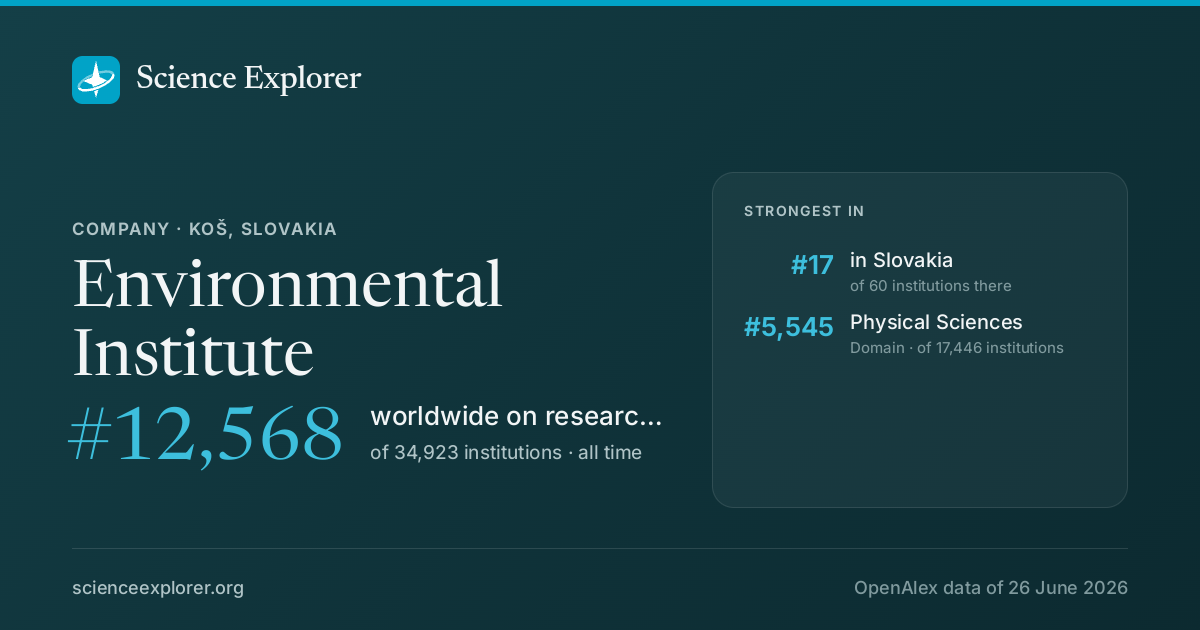
Environmental Institute on Science Explorer

A card with Environmental Institute's standing and the fields it leads in, for a post or a slide. A link to this page previews as the same card.

Download the card

1200 × 630 PNG, sized for social posts, drawn from the latest snapshot.

Badges for a website1Each links back here and updates with every snapshot

Research measures only: rankings here say nothing about teaching, admissions or student experience. Comparable institutions and collaboration partners have tabs of their own, above.

Discussion

Ask a question or share a note about Environmental Institute. Keep it to the research: no personal attacks, advertising or links. Any reader can report a post, which collapses it for everyone until it is opened.