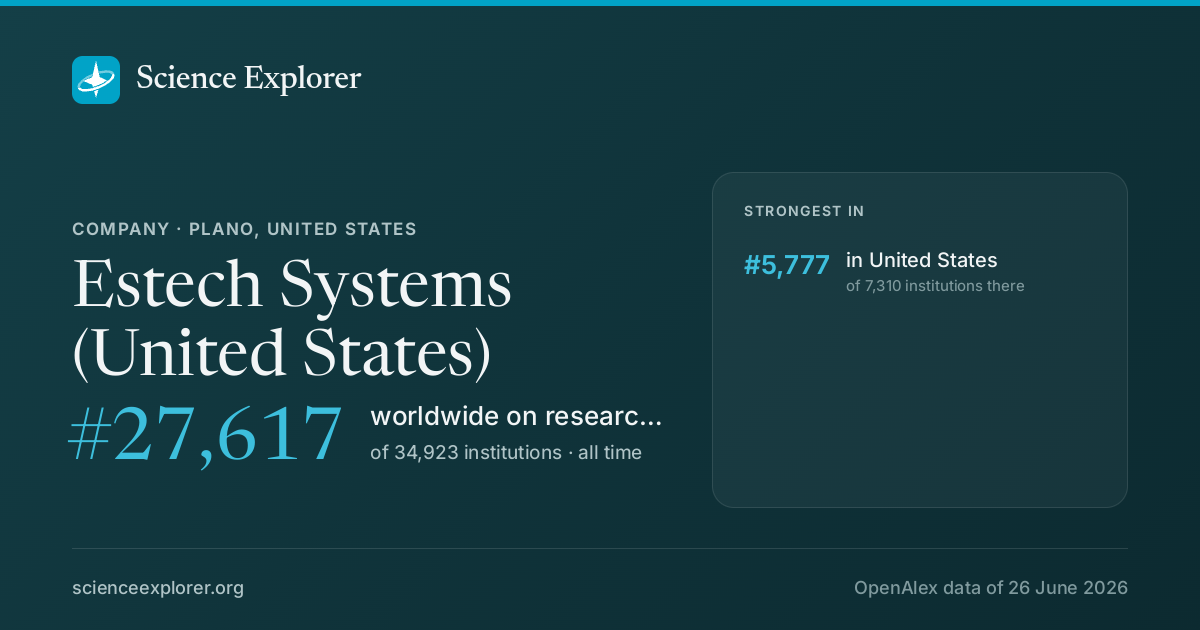
World rank, all time #27,617
of 34,923
Rank in United States #5,777
of 7,310 Research works 156
▲ 24% vs 2018-21
Citations 749 4.8 per fractional work
Top-10% rate 8.4%
all institutions 10.0%
vs its own fields 0.93×
1.00× is exactly expected
Open access 44%
world 40%
International 28%
world 18%
Which fields of science does Estech Systems (United States) work in?
In all years, 67% of research at Estech Systems (United States) is in Physical Sciences , 24% in Social Sciences. Its largest fields are Engineering (38%), Social Sciences (16%), Computer Science (15%). It does 1.6× the world's share of Physical Sciences.
Physical Sciences: 104 fractional works · 66.5% of its work Engineering: 58 fractional works · 37.5% of its work Electrical and Electronic Engineering: 15 fractional works · 9.7% of its work Civil and Structural Engineering: 9 fractional works · 5.9% of its work Mechanical Engineering: 7 fractional works · 4.2% of its work Aerospace Engineering: 6 fractional works · 4.0% of its work Media Technology: 4 fractional works · 2.4% of its work Control and Systems Engineering: 3 fractional works · 2.1% of its work Computational Mechanics: 3 fractional works · 2.1% of its work Automotive Engineering: 3 fractional works · 1.7% of its work Biomedical Engineering: 2 fractional works · 1.4% of its work Mechanics of Materials: 2 fractional works · 1.2% of its work Ocean Engineering: 1 fractional works · 0.9% of its work Building and Construction: 1 fractional works · 0.6% of its work Industrial and Manufacturing Engineering: 1 fractional works · 0.6% of its work Safety, Risk, Reliability and Quality: 1 fractional works · 0.5% of its work Computer Science: 23 fractional works · 15.1% of its work Computer Vision and Pattern Recognition: 9 fractional works · 5.7% of its work Computer Networks and Communications: 4 fractional works · 2.7% of its work Artificial Intelligence: 3 fractional works · 1.6% of its work Hardware and Architecture: 2 fractional works · 1.5% of its work Information Systems: 2 fractional works · 1.3% of its work Signal Processing: 2 fractional works · 1.1% of its work Software: 1 fractional works · 0.8% of its work Computational Theory and Mathematics: 0 fractional works · 0.2% of its work Smaller subfields together: 0 fractional works · 0.1% of its work Physics and Astronomy: 7 fractional works · 4.4% of its work Atomic and Molecular Physics, and Optics: 5 fractional works · 3.0% of its work Astronomy and Astrophysics: 1 fractional works · 0.6% of its work Radiation: 1 fractional works · 0.4% of its work Statistical and Nonlinear Physics: 0 fractional works · 0.3% of its work Smaller subfields together: 0 fractional works · 0.1% of its work Environmental Science: 6 fractional works · 3.8% of its work Management, Monitoring, Policy and Law: 2 fractional works · 1.0% of its work Water Science and Technology: 1 fractional works · 0.7% of its work Ecology: 1 fractional works · 0.6% of its work Global and Planetary Change: 1 fractional works · 0.6% of its work Industrial and Manufacturing Engineering: 1 fractional works · 0.6% of its work Smaller subfields together: 0 fractional works · 0.3% of its work Materials Science: 3 fractional works · 2.1% of its work Materials Chemistry: 3 fractional works · 1.9% of its work Smaller subfields together: 0 fractional works · 0.3% of its work Earth and Planetary Sciences: 2 fractional works · 1.6% of its work Atmospheric Science: 1 fractional works · 0.6% of its work Geology: 1 fractional works · 0.4% of its work Geochemistry and Petrology: 0 fractional works · 0.3% of its work Smaller subfields together: 0 fractional works · 0.2% of its work Chemistry: 2 fractional works · 1.2% of its work Physical and Theoretical Chemistry: 1 fractional works · 0.7% of its work Analytical Chemistry: 0 fractional works · 0.3% of its work Smaller subfields together: 0 fractional works · 0.1% of its work Energy: 0 fractional works · 0.3% of its work Renewable Energy, Sustainability and the Environment: 0 fractional works · 0.3% of its work Mathematics: 0 fractional works · 0.3% of its work Applied Mathematics: 0 fractional works · 0.3% of its work Chemical Engineering: 0 fractional works · 0.3% of its work Bioengineering: 0 fractional works · 0.2% of its work Smaller subfields together: 0 fractional works · 0.1% of its work Social Sciences: 38 fractional works · 24.3% of its work Social Sciences: 24 fractional works · 15.6% of its work Political Science and International Relations: 9 fractional works · 5.5% of its work Law: 5 fractional works · 3.3% of its work Sociology and Political Science: 3 fractional works · 2.2% of its work Education: 2 fractional works · 1.6% of its work Geography, Planning and Development: 1 fractional works · 0.6% of its work Demography: 1 fractional works · 0.4% of its work Urban Studies: 1 fractional works · 0.4% of its work Development: 0 fractional works · 0.3% of its work Safety Research: 0 fractional works · 0.3% of its work Cultural Studies: 0 fractional works · 0.2% of its work Transportation: 0 fractional works · 0.2% of its work Smaller subfields together: 1 fractional works · 0.5% of its work Arts and Humanities: 6 fractional works · 4.0% of its work Literature and Literary Theory: 2 fractional works · 1.3% of its work Philosophy: 2 fractional works · 1.0% of its work History: 1 fractional works · 0.7% of its work Religious studies: 1 fractional works · 0.4% of its work Visual Arts and Performing Arts: 1 fractional works · 0.3% of its work Language and Linguistics: 0 fractional works · 0.2% of its work Smaller subfields together: 0 fractional works · 0.1% of its work Psychology: 3 fractional works · 2.1% of its work Social Psychology: 1 fractional works · 0.9% of its work Experimental and Cognitive Psychology: 1 fractional works · 0.5% of its work Clinical Psychology: 1 fractional works · 0.4% of its work Applied Psychology: 0 fractional works · 0.2% of its work Smaller subfields together: 0 fractional works · 0.1% of its work Business, Management and Accounting: 3 fractional works · 1.8% of its work Accounting: 1 fractional works · 0.8% of its work Organizational Behavior and Human Resource Management: 1 fractional works · 0.4% of its work Strategy and Management: 1 fractional works · 0.4% of its work Smaller subfields together: 0 fractional works · 0.1% of its work Decision Sciences: 1 fractional works · 0.6% of its work Statistics, Probability and Uncertainty: 0 fractional works · 0.3% of its work Information Systems and Management: 0 fractional works · 0.2% of its work Smaller subfields together: 0 fractional works · 0.1% of its work Economics, Econometrics and Finance: 0 fractional works · 0.2% of its work Economics and Econometrics: 0 fractional works · 0.2% of its work Health Sciences: 9 fractional works · 6.0% of its work Medicine: 8 fractional works · 5.0% of its work Public Health, Environmental and Occupational Health: 2 fractional works · 1.6% of its work Pulmonary and Respiratory Medicine: 2 fractional works · 1.0% of its work Cardiology and Cardiovascular Medicine: 1 fractional works · 0.5% of its work Pharmacology: 1 fractional works · 0.4% of its work Radiology, Nuclear Medicine and Imaging: 1 fractional works · 0.3% of its work Pediatrics, Perinatology and Child Health: 0 fractional works · 0.3% of its work Physiology: 0 fractional works · 0.2% of its work Psychiatry and Mental health: 0 fractional works · 0.2% of its work Smaller subfields together: 1 fractional works · 0.5% of its work Health Professions: 2 fractional works · 1.0% of its work General Health Professions: 1 fractional works · 0.7% of its work Speech and Hearing: 0 fractional works · 0.3% of its work Life Sciences: 5 fractional works · 3.2% of its work Agricultural and Biological Sciences: 2 fractional works · 1.6% of its work Food Science: 1 fractional works · 0.4% of its work Plant Science: 1 fractional works · 0.4% of its work Animal Science and Zoology: 0 fractional works · 0.3% of its work Agronomy and Crop Science: 0 fractional works · 0.2% of its work Soil Science: 0 fractional works · 0.2% of its work Smaller subfields together: 0 fractional works · 0.1% of its work Biochemistry, Genetics and Molecular Biology: 1 fractional works · 0.8% of its work Molecular Biology: 1 fractional works · 0.4% of its work Genetics: 1 fractional works · 0.4% of its work Smaller subfields together: 0 fractional works · 0.0% of its work Neuroscience: 1 fractional works · 0.8% of its work Cognitive Neuroscience: 1 fractional works · 0.7% of its work Smaller subfields together: 0 fractional works · 0.0% of its work Physical Sciences Engineering Computer Science Physics a… Environme… Materials… Earth and… Social Sciences Social Sciences Arts and… Psychology Business Medicine Agricultu… ALL ITS WORK Estech Systems (United States) 156 fractional works, all years 3% 67% 6% 24%
Each ring splits the one inside it: the four domains of science, their fields, their subfields. Size is fractional works in all years. Every slice is a page; the interactive view zooms down to single topics and colours each by how much more of it this institution does than the world.
Its 4 domains and 22 fields, with their numbers 58 37.5% 23 15.1% 7 4.4% 6 3.8% 3 2.1% 2 1.6% 2 1.2% 0 0.3% 0 0.3% 0 0.3% 24 15.6% 6 4.0% 3 2.1% 3 1.8% 1 0.6% 0 0.2% 8 5.0% 2 1.0% 2 1.6% 1 0.8% 1 0.8% 0 0.0% All of science, and how each field's share has moved since 1950: the Science domain explorer
Field profile
Location quotient across every field it publishes in: outside the ring is more than an institution of this size would be expected to publish, inside it is less.
Agricultural and Biological Sciences: 0.09× its world share, 0 works Agricultural and Bio… Biochemistry, Genetics and Molecular Biology: 0.42× its world share, 0 works Biochemistry, Geneti… Neuroscience: 3.09× its world share, 1 works Neuroscience Chemistry: 0.13× its world share, 0 works Chemistry Computer Science: 0.48× its world share, 1 works Computer Science Earth and Planetary Sciences: 0.27× its world share, 0 works Earth and Planetary … Engineering: 0.42× its world share, 1 works Engineering Environmental Science: 0.87× its world share, 1 works Environmental Science Materials Science: 0.36× its world share, 0 works Materials Science Physics and Astronomy: 0.25× its world share, 0 works Physics and Astronomy Health Professions: 0.63× its world share, 0 works Health Professions Medicine: 0.36× its world share, 1 works Medicine Arts and Humanities: 5.25× its world share, 3 works Arts and Humanities Business, Management and Accounting: 1.55× its world share, 1 works Business, Management… Psychology: 3.07× its world share, 2 works Psychology Social Sciences: 2.95× its world share, 8 works Social Sciences 1× world share
Rings at 0.5×, 1× and 2×. Widest outward: Arts and Humanities , 5.2×. Every wedge is a field page.
All 16 fields, with their numbers Arts and Humanities 5.25× 3 works Neuroscience 3.09× 1 works Psychology 3.07× 2 works Social Sciences 2.95× 8 works Business, Management and Accounting 1.55× 1 works Environmental Science 0.87× 1 works Health Professions 0.63× 0 works Computer Science 0.48× 1 works Biochemistry, Genetics and Molecular Biology 0.42× 0 works Engineering 0.42× 1 works Materials Science 0.36× 0 works Medicine 0.36× 1 works Earth and Planetary Sciences 0.27× 0 works Physics and Astronomy 0.25× 0 works Chemistry 0.13× 0 works Agricultural and Biological Sciences 0.09× 0 works
What are the most cited papers from Estech Systems (United States)?
The most cited paper from Estech Systems (United States) is "Fetal Electrocardiogram Enhancement by Time-Sequenced Adaptive Filtering" (E. Ferrara, Bernard Widraw, 1982), with 173 citations. Next come "Multistate Block Diagrams and Fault Trees" (81) and "Longitudinal Study of Young Children's Responses to Challenging Achievement Situations" (47).
All 64 most cited papers, with filters and sorting
Which keywords describe research at Estech Systems (United States)?
By fractional works in all years, weighted toward what it does more of than the world: Human Rights, Deep Learning, Sustainable Development , Latin America, Social Rights, Nonlinear Dynamics, Judicial Review and Constitutionalism.
Size is fractional works in all years in the topics tagged with each word; colour is the word's share of this institution's work against its share of the world's. The 40 words are chosen for being large and distinctive. Each links to the topic it comes from most.
All 40 words, with their numbers Deep Learning 9 ▲ 2.8× 11 topics Human Rights 7 ▲ 5.1× 13 topics Sustainable Development 6 ▲ 3.5× 5 topics Globalization 6 ▲ 2.0× 11 topics Neural Networks 5 ▲ 3.0× 6 topics Remote Sensing 4 ▲ 2.5× 8 topics Latin America 4 ▲ 13× 6 topics Social Rights 4 ▲ 69× 2 topics Nonlinear Dynamics 4 ▲ 9.6× 3 topics Judicial Review 4 ▲ 22× 3 topics Constitutionalism 4 ▲ 20× 4 topics European Union 3 ▲ 8.6× 6 topics Machine Vision 3 ▲ 11× 4 topics Numerical Simulation 3 ▲ 6.2× 4 topics Environmental Effects 3 ▲ 18× 2 topics Vibration-based Damage Identification 3 ▲ 28× 1 topic Wireless Sensors 3 ▲ 28× 1 topic Sparse Representation 3 ▲ 9.7× 4 topics Constitutional Rights 3 ▲ 74× 1 topic International Law 3 ▲ 6.1× 3 topics Legal Theory 3 ▲ 26× 1 topic Thermal Analysis 3 ▲ 11× 3 topics Waste Management 3 ▲ 6.5× 2 topics Criminal Justice 2 ▲ 10× 4 topics Near-Infrared 2 ▲ 26× 2 topics Rheological Properties 2 ▲ 10× 2 topics Material Properties 2 ▲ 12× 3 topics Acousto-Optic 2 ▲ 97× 1 topic Crystals 2 ▲ 97× 1 topic Environmental Impacts 2 ▲ 6.9× 1 topic Failure Analysis 2 ▲ 11× 3 topics Finite Element Method 2 ▲ 11× 3 topics Optical Modulators 2 ▲ 7.2× 2 topics Product Development 2 ▲ 24× 2 topics Tailings Dams 2 ▲ 262× 1 topic Texture Analysis 2 ▲ 10× 2 topics Constitutional Law 2 ▲ 11× 2 topics Depth Estimation 2 ▲ 15× 2 topics Design Optimization 2 ▲ 32× 2 topics Mechanical Engineering 2 ▲ 32× 2 topics
Which research topics does Estech Systems (United States) publish most on?
By volume in 2022-now: Emotion and Mood Recognition , Finance, Taxation, and Governance , Historical Studies in Latin America and Employment, Labor, and Gender Studies .
Emotion and Mood Recogni… 1 Emotion and Mood Recognition: 1 fractional works Finance, Taxation, and G… 1 Finance, Taxation, and Governance: 1 fractional works Historical Studies in La… 0 Historical Studies in Latin America: 0 fractional works Employment, Labor, and G… 0 Employment, Labor, and Gender Studies: 0 fractional works International Relations and Autism: 0 fractional works Criminal Justice and Penology: 0 fractional works Comparative Internationa… 0 Comparative International Legal Studies: 0 fractional works Attention Deficit Hyperactivity Disorder: 0 fractional works Nutrition, Genetics, and Disease: 0 fractional works Neural Networks and Applications: 0 fractional works
Area is fractional works; colour is the subfield each topic belongs to.
1
Experimental and Cognitive Psychology 1 works
2
Management, Monitoring, Policy and Law 1 works
3
Demography 0 works
4
Safety Research 0 works
5
Urban Studies 0 works
6
Law 0 works
7
Political Science and International Relations 0 works
8
Psychiatry and Mental health 0 works
9
Genetics 0 works
10
Artificial Intelligence 0 works
How open and international is its research?
Against the world's own shares: the tick on each track. Both are shares of its output, so they
sit on one scale and can be read against each other as well as against the world.
44% 56%
44.2% 55.8%
World: 40% of research is openly available.
28% 72%
28.0% 72.0%
World: 18% is written across borders.
How has Estech Systems (United States)'s research output changed?
Output in 2022-2025 was 24% higher than in 2018-2021.
still counting 1990 2000 2010 2020
The same series as a ribbon: one cell per year, darker for more. The line above answers how much ; this answers when .
Its share of all research
still counting 0.0010% 0.0020% 0.0030% Estech Systems (United States) 0.000091% in 2025 1980 1990 2000 2010 2020 Fractional works of Estech Systems (United States) over all fractional works that year. How the balance of science has shifted .
Share Estech Systems (United States)'s ranking
A card with Estech Systems (United States)'s standing and the fields it leads in, for a post or a slide. A link to this page previews as the same card.
Badges for a website 1 Each links back here and updates with every snapshot
 United States · #3,280,453 worldwide
249 citations · 16 works