Science Explorer Back to mapMap
Discussion
Company · Espoo · Finland

Fortum (Finland)

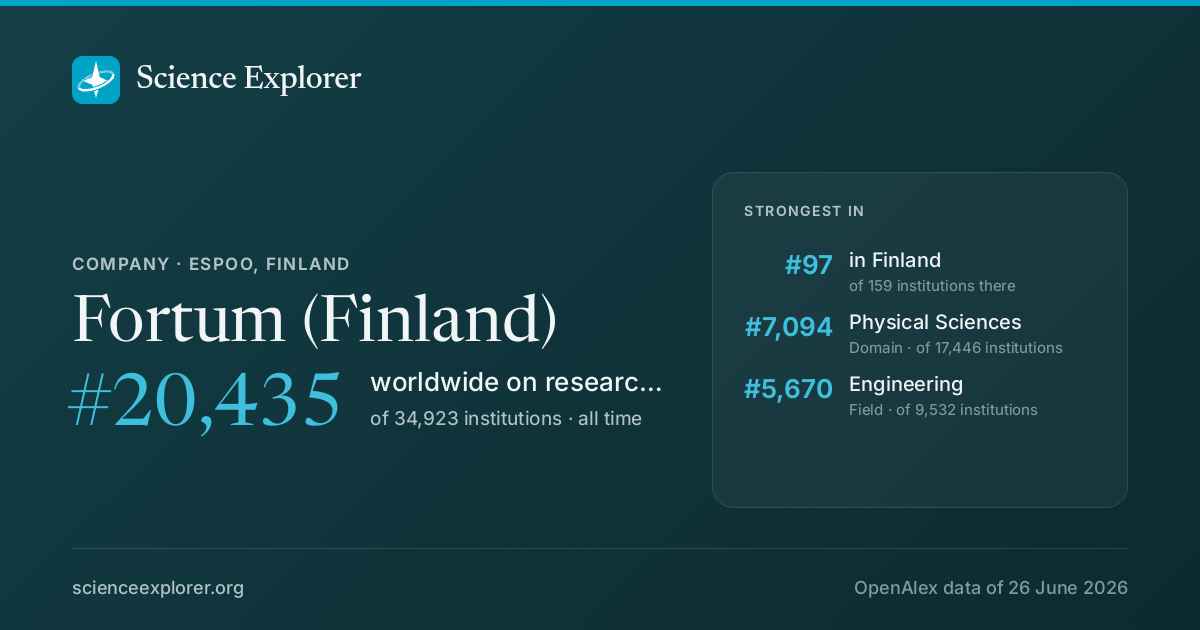
In research, Fortum (Finland) stands highest in Physical Sciences (#7,094 of 17,446 worldwide) and Engineering (#5,670 of 9,532 worldwide), over all time.

World rank, all time
#20,435
of 34,923
Rank in Finland
#97
of 159
Research works
339
▼ 34% vs 2018-21
Citations
4.9k
14.4 per fractional work
Top-10% rate
11.1%
all institutions 10.0%
vs its own fields
0.93×
1.00× is exactly expected
Open access
18%
world 40%
International
16%
world 18%

What is Fortum (Finland) known for in research?

The fields where it stands highest, over all time, ranked among every institution above the floor in each field.

FieldWorld rankWhere that sitsTop-10% rateWorks
Physical SciencesDomain #7,094 of 17,446 7.4%295
EngineeringField #5,670 of 9,532 6.9%176

Each strip is that field's whole ranked pool, with the notch where Fortum (Finland) sits in it, in the colour of the band that rank falls in. The track under the rate is the rate itself: it carries no average mark, because the average differs by field (from about 6% in Dentistry to 21% in Economics).

Which fields of science does Fortum (Finland) work in?

In 2022-now, 65% of research at Fortum (Finland) is in Physical Sciences, 24% in Social Sciences. Its largest fields are Engineering (48%), Social Sciences (7%), Medicine (6%). It does 1.5× the world's share of Physical Sciences.

Physical Sciences: 20 fractional works · 64.5% of its workEngineering: 15 fractional works · 48.0% of its workElectrical and Electronic Engineering: 8 fractional works · 26.0% of its workSafety, Risk, Reliability and Quality: 2 fractional works · 5.9% of its workBuilding and Construction: 1 fractional works · 3.7% of its workBiomedical Engineering: 1 fractional works · 3.5% of its workAerospace Engineering: 1 fractional works · 2.4% of its workMechanical Engineering: 1 fractional works · 2.0% of its workIndustrial and Manufacturing Engineering: 1 fractional works · 1.8% of its workCivil and Structural Engineering: 0 fractional works · 0.7% of its workMechanics of Materials: 0 fractional works · 0.7% of its workControl and Systems Engineering: 0 fractional works · 0.7% of its workAutomotive Engineering: 0 fractional works · 0.6% of its workMaterials Science: 1 fractional works · 3.3% of its workMaterials Chemistry: 1 fractional works · 2.2% of its workGeneral Materials Science: 0 fractional works · 0.4% of its workMetals and Alloys: 0 fractional works · 0.4% of its workSmaller subfields together: 0 fractional works · 0.4% of its workEnvironmental Science: 1 fractional works · 3.0% of its workIndustrial and Manufacturing Engineering: 0 fractional works · 0.9% of its workEcology: 0 fractional works · 0.8% of its workWater Science and Technology: 0 fractional works · 0.6% of its workEnvironmental Chemistry: 0 fractional works · 0.3% of its workGlobal and Planetary Change: 0 fractional works · 0.3% of its workManagement, Monitoring, Policy and Law: 0 fractional works · 0.2% of its workChemical Engineering: 1 fractional works · 2.7% of its workBioengineering: 1 fractional works · 2.2% of its workCatalysis: 0 fractional works · 0.6% of its workEnergy: 1 fractional works · 2.5% of its workRenewable Energy, Sustainability and the Environment: 0 fractional works · 1.4% of its workEnergy Engineering and Power Technology: 0 fractional works · 1.0% of its workComputer Science: 1 fractional works · 2.3% of its workSoftware: 0 fractional works · 1.1% of its workInformation Systems: 0 fractional works · 0.6% of its workHuman-Computer Interaction: 0 fractional works · 0.4% of its workHardware and Architecture: 0 fractional works · 0.3% of its workChemistry: 1 fractional works · 2.2% of its workSpectroscopy: 1 fractional works · 2.2% of its workMathematics: 0 fractional works · 0.6% of its workStatistics and Probability: 0 fractional works · 0.6% of its workSocial Sciences: 7 fractional works · 23.7% of its workSocial Sciences: 2 fractional works · 6.9% of its workPolitical Science and International Relations: 1 fractional works · 2.7% of its workSociology and Political Science: 1 fractional works · 1.8% of its workGender Studies: 0 fractional works · 1.1% of its workDemography: 0 fractional works · 0.9% of its workHealth: 0 fractional works · 0.4% of its workPsychology: 2 fractional works · 5.9% of its workSocial Psychology: 1 fractional works · 3.6% of its workExperimental and Cognitive Psychology: 0 fractional works · 1.6% of its workNeuropsychology and Physiological Psychology: 0 fractional works · 0.4% of its workClinical Psychology: 0 fractional works · 0.3% of its workSmaller subfields together: 0 fractional works · 0.0% of its workBusiness, Management and Accounting: 2 fractional works · 5.3% of its workMarketing: 1 fractional works · 3.3% of its workStrategy and Management: 0 fractional works · 1.4% of its workOrganizational Behavior and Human Resource Management: 0 fractional works · 0.6% of its workDecision Sciences: 1 fractional works · 3.5% of its workStatistics, Probability and Uncertainty: 1 fractional works · 3.1% of its workManagement Science and Operations Research: 0 fractional works · 0.4% of its workSmaller subfields together: 0 fractional works · 0.0% of its workEconomics, Econometrics and Finance: 1 fractional works · 2.2% of its workEconomics and Econometrics: 0 fractional works · 1.1% of its workFinance: 0 fractional works · 1.1% of its workSmaller subfields together: 0 fractional works · 0.0% of its workHealth Sciences: 2 fractional works · 6.6% of its workMedicine: 2 fractional works · 6.0% of its workComplementary and alternative medicine: 1 fractional works · 2.0% of its workImmunology and Allergy: 0 fractional works · 1.1% of its workPublic Health, Environmental and Occupational Health: 0 fractional works · 1.1% of its workEpidemiology: 0 fractional works · 0.8% of its workBiochemistry: 0 fractional works · 0.4% of its workPharmacology: 0 fractional works · 0.3% of its workPulmonary and Respiratory Medicine: 0 fractional works · 0.2% of its workSmaller subfields together: 0 fractional works · 0.2% of its workHealth Professions: 0 fractional works · 0.6% of its workGeneral Health Professions: 0 fractional works · 0.6% of its workSmaller subfields together: 0 fractional works · 0.0% of its workLife Sciences: 2 fractional works · 5.1% of its workAgricultural and Biological Sciences: 1 fractional works · 3.7% of its workPlant Science: 1 fractional works · 3.5% of its workEcology, Evolution, Behavior and Systematics: 0 fractional works · 0.2% of its workBiochemistry, Genetics and Molecular Biology: 0 fractional works · 0.9% of its workBiotechnology: 0 fractional works · 0.6% of its workCell Biology: 0 fractional works · 0.4% of its workNeuroscience: 0 fractional works · 0.6% of its workCognitive Neuroscience: 0 fractional works · 0.6% of its workALL ITS WORKFortum (Finland)31fractional works, 2022-now
Life Sciences5%Physical Sciences65%Health Sciences7%Social Sciences24%

Each ring splits the one inside it: the four domains of science, their fields, their subfields. Size is fractional works in 2022-now. Every slice is a page; the interactive view zooms down to single topics and colours each by how much more of it this institution does than the world.

Its 4 domains and 18 fields, with their numbers
    1. Engineering1548.0%
    2. Materials Science13.3%
    3. Environmental Science13.0%
    4. Chemical Engineering12.7%
    5. Energy12.5%
    6. Computer Science12.3%
    7. Chemistry12.2%
    8. Mathematics00.6%
    1. Social Sciences26.9%
    2. Psychology25.9%
    3. Business, Management and Accounting25.3%
    4. Decision Sciences13.5%
    5. Economics, Econometrics and Finance12.2%
    1. Medicine26.0%
    2. Health Professions00.6%
    1. Agricultural and Biological Sciences13.7%
    2. Biochemistry, Genetics and Molecular Biology00.9%
    3. Neuroscience00.6%
All of science, and how each field's share has moved since 1950: the Science domain explorer

Field profile

Location quotient across every field it publishes in: outside the ring is more than an institution of this size would be expected to publish, inside it is less.

Agricultural and Biological Sciences: 0.77× its world share, 1 worksAgricultural and Bio…Biochemistry, Genetics and Molecular Biology: 0.17× its world share, 0 worksBiochemistry, Geneti…Neuroscience: 0.34× its world share, 0 worksNeuroscienceChemical Engineering: 7.80× its world share, 1 worksChemical EngineeringChemistry: 1.39× its world share, 1 worksChemistryComputer Science: 0.29× its world share, 1 worksComputer ScienceEnergy: 2.67× its world share, 1 worksEnergyEngineering: 3.20× its world share, 15 worksEngineeringEnvironmental Science: 0.61× its world share, 1 worksEnvironmental ScienceMaterials Science: 0.94× its world share, 1 worksMaterials ScienceMathematics: 0.46× its world share, 0 worksMathematicsHealth Professions: 0.22× its world share, 0 worksHealth ProfessionsMedicine: 0.31× its world share, 2 worksMedicineBusiness, Management and Accounting: 1.64× its world share, 2 worksBusiness, Management…Decision Sciences: 3.57× its world share, 1 worksDecision SciencesEconomics, Econometrics and Finance: 1.02× its world share, 1 worksEconomics, Econometr…Psychology: 1.94× its world share, 2 worksPsychologySocial Sciences: 0.54× its world share, 2 worksSocial Sciences1×world share
more than its size predictsabout as predictedless

Rings at 0.5×, 1× and 2×. Widest outward: Chemical Engineering, 7.8×. Every wedge is a field page.

All 18 fields, with their numbers
  1. Chemical Engineering7.80×1 works
  2. Decision Sciences3.57×1 works
  3. Engineering3.20×15 works
  4. Energy2.67×1 works
  5. Psychology1.94×2 works
  6. Business, Management and Accounting1.64×2 works
  7. Chemistry1.39×1 works
  8. Economics, Econometrics and Finance1.02×1 works
  9. Materials Science0.94×1 works
  10. Agricultural and Biological Sciences0.77×1 works
  11. Environmental Science0.61×1 works
  12. Social Sciences0.54×2 works
  13. Mathematics0.46×0 works
  14. Neuroscience0.34×0 works
  15. Medicine0.31×2 works
  16. Computer Science0.29×1 works
  17. Health Professions0.22×0 works
  18. Biochemistry, Genetics and Molecular Biology0.17×0 works

Who are the top researchers at Fortum (Finland)?

Ranked on the quality score, Olli Kymäläinen, V. Niemi and Harri Tuomisto lead among researchers whose main affiliation is Fortum (Finland).

  1. 1 Olli Kymäläinen Finland · #1,296,469 worldwide 962 citations · 17 works
  2. 2 V. Niemi Finland · #1,843,095 worldwide 918 citations · 30 works
  3. 3 Harri Tuomisto Finland · #2,657,095 worldwide 721 citations · 51 works
  4. 4 Kati Savolainen Finland · #3,133,723 worldwide 261 citations · 18 works
  5. 5 Timo Toppila Finland · #3,384,024 worldwide 234 citations · 27 works
  6. 6 Jukka Kähkönen Finland · #4,581,988 worldwide 23 citations · 18 works
  7. 7 Aimo Rautiainen Finland · #4,639,516 worldwide 454 citations · 17 works
  8. 8 Tarja Jäppinen Finland · #4,785,639 worldwide 5 citations · 15 works
  9. 9 Pentti Varpasuo Finland · #6,173,727 worldwide 116 citations · 60 works
All ranked researchers at Fortum (Finland)

What are the most cited papers from Fortum (Finland)?

The most cited paper from Fortum (Finland) is "Natural fibres as reinforcement in polylactic acid (PLA) composites" (Kristiina Oksman, Mikael Skrifvars, Johan‐Fredrik Selin, 2003), with 1,551 citations. Next come "Impact of weighted average cost of capital, capital expenditure, and other parameters on future utility‐scale PV levelised cost of electricity" (495) and "Recycling potential of post-consumer plastic packaging waste in Finland" (362).

Most cited papers
#PaperReleasedCitations
1 Natural fibres as reinforcement in polylactic acid (PLA) composites Kristiina Oksman, Mikael Skrifvars, Johan‐Fredrik Selin · Composites Science and Technology 19 May 2003 1,551
2 Impact of weighted average cost of capital, capital expenditure, and other parameters on future utility‐scale PV levelised cost of electricity Eero Vartiainen, Gaëtan Masson, Christian Breyer et al. · Progress in Photovoltaics Research and Applications Open access 29 Aug 2019 495
3 Recycling potential of post-consumer plastic packaging waste in Finland Helena Dahlbo, Valeria Poliakova, Ville Mylläri et al. · Waste Management 31 Oct 2017 362
4 Biodegradation of polylactide in aerobic and anaerobic thermophilic conditions Merja Itävaara, Sari Karjomaa, Johan‐Fredrik Selin · Chemosphere Feb 2002 265
5 Simulation of the population balances for liquid–liquid systems in a nonideal stirred tank. Part 2—parameter fitting and the use of the multiblock model for dense dispersions Ville Alopaeus, Jukka Koskinen, Kari I. Keskinen et al. · Chemical Engineering Science May 2002 215
All 60 most cited papers, with filters and sorting

Which keywords describe research at Fortum (Finland)?

By fractional works in 2022-now, weighted toward what it does more of than the world: Renewable Energy, Biosensors, Optical Interconnects, Semiconductor Lasers, Optical Modulators, Silicon Photonics, Game Theory and Sustainability.

▲ more of its work than of the world's◆ about the world's share▼ less than the world's

Size is fractional works in 2022-now in the topics tagged with each word; colour is the word's share of this institution's work against its share of the world's. The 14 words are chosen for being large and distinctive. Each links to the topic it comes from most.

All 14 words, with their numbers
  1. Renewable Energy3▲ 7.1×8 topics
  2. Biosensors2▲ 14×2 topics
  3. Optical Interconnects2▲ 207×1 topic
  4. Semiconductor Lasers2▲ 105×1 topic
  5. Sustainability2▲ 2.5×11 topics
  6. Optical Modulators2▲ 35×1 topic
  7. Silicon Photonics2▲ 49×1 topic
  8. Game Theory1▲ 22×3 topics
  9. Cassava1▲ 180×1 topic
  10. Cyanogenic Glycosides1▲ 180×1 topic
  11. Electric Discharge1▲ 313×1 topic
  12. Interactional Expertise1▲ 303×1 topic
  13. Laser Oscillation1▲ 313×1 topic
  14. Tacit Knowledge1▲ 70×1 topic

Which research topics does Fortum (Finland) publish most on?

By volume in 2022-now: Semiconductor Lasers and Optical Devices, Photonic and Optical Devices, Laser Design and Applications and Education, Healthcare and Sociology Research.

  1. 1 Semiconductor Lasers and Optical Devices Electrical and Electronic Engineering 2 works
  2. 2 Photonic and Optical Devices Electrical and Electronic Engineering 2 works
  3. 3 Laser Design and Applications Electrical and Electronic Engineering 1 works
  4. 4 Education, Healthcare and Sociology Research Social Psychology 1 works
  5. 5 Cassava research and cyanide Plant Science 1 works
  6. 6 Risk and Safety Analysis Statistics, Probability and Uncertainty 1 works
  7. 7 Smart Grid Energy Management Electrical and Electronic Engineering 1 works
  8. 8 Integrated Energy Systems Optimization Electrical and Electronic Engineering 1 works
  9. 9 Anaerobic Digestion and Biogas Production Building and Construction 1 works
  10. 10 Spectroscopy and Laser Applications Spectroscopy 1 works

How open and international is its research?

Against the world's own shares: the tick on each track. Both are shares of its output, so they sit on one scale and can be read against each other as well as against the world.

openly available18.3%not open81.7%

World: 40% of research is openly available.

with international co-authors15.9%domestic only84.1%

World: 18% is written across borders.

How has Fortum (Finland)'s research output changed?

Output in 2022-2025 was 34% lower than in 2018-2021.

still counting1990200020102020
grewheldshrank

The same series as a ribbon: one cell per year, darker for more. The line above answers how much; this answers when.

Its share of all research

Growing output can still be a shrinking share: all of science grows. This is Fortum (Finland) as a percentage of every work published that year, 0.00013% in 2024.

still counting0.0010%0.0020%Fortum (Finland)0.00011% in 20251990200020102020

Fractional works of Fortum (Finland) over all fractional works that year. How the balance of science has shifted.

Other research institutions in Espoo

All research institutions in Espoo

Share Fortum (Finland)'s ranking

Fortum (Finland) on Science Explorer

A card with Fortum (Finland)'s standing and the fields it leads in, for a post or a slide. A link to this page previews as the same card.

Download the card

1200 × 630 PNG, sized for social posts, drawn from the latest snapshot.

Badges for a website1Each links back here and updates with every snapshot

Research measures only: rankings here say nothing about teaching, admissions or student experience. Comparable institutions and collaboration partners have tabs of their own, above.

Discussion

Ask a question or share a note about Fortum (Finland). Posts are plain text and can be reported.