Framatome (Germany)
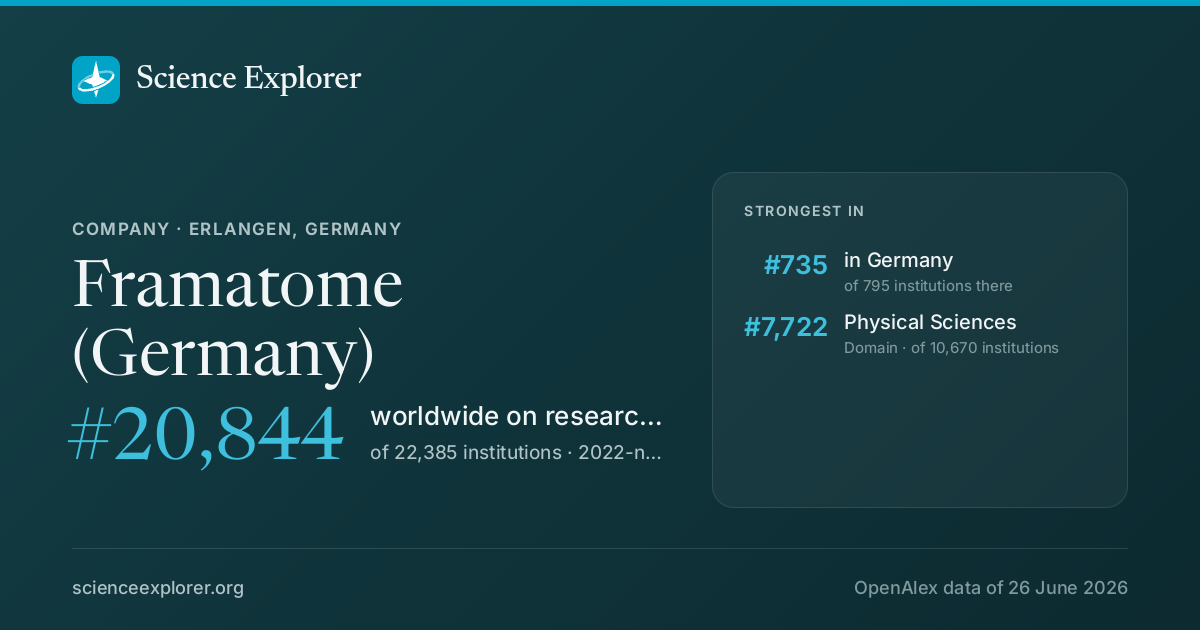
In research, Framatome (Germany) stands highest in Physical Sciences (#7,722 of 10,670 worldwide), 2022-now.
- World rank, 2022-now
- #20,844 of 22,385 · #19,168 all time
- Rank in Germany
- #735 of 795
- Research works
- 450 ▲ 27% vs 2018-21
- Citations
- 2.3k 5.1 per fractional work
- Top-10% rate
- 2.0% all institutions 10.0%
- vs its own fields
- 0.96× 1.00× is exactly expected
- Open access
- 17% world 40%
- International
- 34% world 18%
What is Framatome (Germany) known for in research?
The fields where it stands highest, 2022-now, ranked among every institution above the floor in each field.
| Field | World rank | Where that sits | Top-10% rate | Works | All time |
|---|---|---|---|---|---|
| Physical SciencesDomain | #7,722 of 10,670 | 1.5% | 76 | #7299 |
Each strip is that field's whole ranked pool, with the notch where Framatome (Germany) sits in it, in the colour of the band that rank falls in. The track under the rate is the rate itself: it carries no average mark, because the average differs by field (from about 6% in Dentistry to 21% in Economics).
Which fields of science does Framatome (Germany) work in?
In 2022-now, 93% of research at Framatome (Germany) is in Physical Sciences, 5% in Social Sciences. Its largest fields are Engineering (60%), Materials Science (19%), Computer Science (10%). It does 2.3× the world's share of Physical Sciences.
Each ring splits the one inside it: the four domains of science, their fields, their subfields. Size is fractional works in 2022-now. Every slice is a page; the interactive view zooms down to single topics and colours each by how much more of it this institution does than the world.
Its 4 domains and 19 fields, with their numbers
- Physical Sciences8293.2%
- Engineering5360.3%
- Materials Science1718.9%
- Computer Science99.8%
- Physics and Astronomy22.8%
- Energy00.4%
- Chemical Engineering00.4%
- Environmental Science00.3%
- Earth and Planetary Sciences00.2%
- Chemistry00.1%
- Social Sciences44.5%
- Health Sciences21.9%
- Medicine11.3%
- Health Professions00.4%
- Nursing00.2%
- Life Sciences00.3%
Field profile
Location quotient across every field it publishes in: outside the ring is more than an institution of this size would be expected to publish, inside it is less.
Rings at 0.5×, 1× and 2×. Widest outward: Materials Science, 5.4×. Every wedge is a field page.
All 19 fields, with their numbers
- Materials Science5.42×17 works
- Engineering4.02×53 works
- Decision Sciences1.75×2 works
- Physics and Astronomy1.27×2 works
- Computer Science1.25×9 works
- Chemical Engineering1.06×0 works
- Energy0.44×0 works
- Nursing0.39×0 works
- Business, Management and Accounting0.39×1 works
- Health Professions0.16×0 works
- Earth and Planetary Sciences0.13×0 works
- Social Sciences0.11×1 works
- Chemistry0.08×0 works
- Medicine0.07×1 works
- Environmental Science0.06×0 works
- Biochemistry, Genetics and Molecular Biology0.04×0 works
- Economics, Econometrics and Finance0.04×0 works
- Arts and Humanities0.03×0 works
- Agricultural and Biological Sciences0.02×0 works
- Materials Science 5.4×
- Engineering 4.0×
- Decision Sciences 1.8×
- Physics and Astronomy 1.3×
- Computer Science 1.2×
- Chemical Engineering 1.1×
- Energy 0.4×
- Nursing 0.4×
- Business, Management and Accounting 0.4×
- Health Professions 0.2×
- Earth and Planetary Sciences 0.1×
- Social Sciences 0.1×
- Chemistry 0.1×
- Medicine 0.1×
- Environmental Science 0.1×
- Biochemistry, Genetics and Molecular Biology 0.0×
- Economics, Econometrics and Finance 0.0×
- Arts and Humanities 0.0×
- Agricultural and Biological Sciences 0.0×
Who are the top researchers at Framatome (Germany)?
Ranked on the quality score, Erkin Kirdan, A. Hoefer and Dietmar Bittermann lead among researchers whose main affiliation is Framatome (Germany).
- 1
Erkin Kirdan
 Germany · #2,508,770 worldwide
176 citations · 15 works
- 2
A. Hoefer
Germany · #2,687,016 worldwide
336 citations · 26 works
- 3
Dietmar Bittermann
Germany · #2,718,989 worldwide
383 citations · 27 works
- 4
Y. Meyzaud
Germany · #3,494,064 worldwide
101 citations · 19 works
- 5
Uwe Stoll
Germany · #3,779,153 worldwide
242 citations · 26 works
- 6
Thomas Mull
Germany · #3,918,410 worldwide
88 citations · 17 works
- 7
Oliver Herbst
Germany · #3,957,200 worldwide
55 citations · 17 works
- 8
Armin Roth
Germany · #4,008,891 worldwide
217 citations · 27 works
- 9
Jürgen Rudolph
Germany · #4,256,309 worldwide
3k citations · 176 works
- 10
Jean-Bernard Thevenon
Germany · #4,543,315 worldwide
20 citations · 18 works
Which keywords describe research at Framatome (Germany)?
By fractional works in 2022-now, weighted toward what it does more of than the world: Hydrogen Embrittlement, Oxidation Resistance, Accident Tolerant Fuels, Fuel Cladding, Molten Salt, Nuclear Reactor, Microstructure and Machine Learning.
- Failure Analysis
- fusion materials
- Loosening Mechanism
- Laser Welding
- Martensite Transformation
- Nuclear Graphite
- Welding
- Nuclear Fuel
- Phase Stability
- High-Temperature Alloys
- Thermal Properties
- Microstructural Evolution
- Numerical Simulation
- Fatigue Crack Closure
- Passive Systems
- Mechanical Properties
- Microstructure
- Molten Salt
- Accident Tolerant Fuels
- Machine Learning
- Hydrogen Embrittlement
- Oxidation Resistance
- Fuel Cladding
- Nuclear Reactor
- Deep Learning
- Finite Element Analysis
- Thermal-Hydraulic Analysis
- Fracture Toughness Testing
- Heat Transfer
- Constitutive Modeling
- Grain Refinement
- Oxidation Behavior
- Superalloys
- Radiation Protection
- Microstructural Characterization
- High-Strength Steels
- Anomaly Detection
- Residual Stress
- Threaded Fasteners
- radiation damage
Size is fractional works in 2022-now in the topics tagged with each word; colour is the word's share of this institution's work against its share of the world's. The 40 words are chosen for being large and distinctive. Each links to the topic it comes from most.
All 40 words, with their numbers
- Hydrogen Embrittlement9▲ 120×3 topics
- Machine Learning8▲ 2.8×15 topics
- Oxidation Resistance7▲ 78×2 topics
- Accident Tolerant Fuels7▲ 233×1 topic
- Fuel Cladding7▲ 233×1 topic
- Molten Salt7▲ 257×1 topic
- Nuclear Reactor7▲ 257×1 topic
- Microstructure6▲ 14×10 topics
- Deep Learning6▲ 1.87×13 topics
- Mechanical Properties5▲ 5.6×15 topics
- Finite Element Analysis4▲ 23×5 topics
- Passive Systems4▲ 323×1 topic
- Thermal-Hydraulic Analysis4▲ 323×1 topic
- Fatigue Crack Closure4▲ 160×1 topic
- Fracture Toughness Testing4▲ 160×1 topic
- Numerical Simulation4▲ 15×8 topics
- Heat Transfer3▲ 7.5×7 topics
- Microstructural Evolution3▲ 24×3 topics
- Constitutive Modeling3▲ 49×2 topics
- Thermal Properties3▲ 24×2 topics
- Grain Refinement2▲ 24×2 topics
- High-Temperature Alloys2▲ 137×1 topic
- Oxidation Behavior2▲ 46×2 topics
- Phase Stability2▲ 39×2 topics
- Superalloys2▲ 137×1 topic
- Nuclear Fuel2▲ 170×1 topic
- Radiation Protection2▲ 170×1 topic
- Welding2▲ 42×2 topics
- Microstructural Characterization2▲ 122×1 topic
- Nuclear Graphite2▲ 122×1 topic
- High-Strength Steels2▲ 71×1 topic
- Martensite Transformation2▲ 71×1 topic
- Anomaly Detection2▲ 7.5×2 topics
- Laser Welding2▲ 46×1 topic
- Residual Stress2▲ 39×1 topic
- Loosening Mechanism2▲ 214×1 topic
- Threaded Fasteners2▲ 214×1 topic
- fusion materials2▲ 106×1 topic
- radiation damage2▲ 106×1 topic
- Failure Analysis2▲ 21×2 topics
Which research topics does Framatome (Germany) publish most on?
By volume in 2022-now: Nuclear Materials and Properties, Nuclear reactor physics and engineering, Nuclear Engineering Thermal-Hydraulics and Fatigue and fracture mechanics.
Area is fractional works; colour is the subfield each topic belongs to.
- 1 Nuclear Materials and Properties Materials Chemistry 7 works
- 2 Nuclear reactor physics and engineering Aerospace Engineering 7 works
- 3 Nuclear Engineering Thermal-Hydraulics Aerospace Engineering 4 works
- 4 Fatigue and fracture mechanics Mechanics of Materials 4 works
- 5 High Temperature Alloys and Creep Mechanical Engineering 2 works
- 6 Nuclear and radioactivity studies Safety, Risk, Reliability and Quality 2 works
- 7 Graphite, nuclear technology, radiation studies Materials Chemistry 2 works
- 8 Microstructure and Mechanical Properties of Steels Mechanical Engineering 2 works
- 9 Welding Techniques and Residual Stresses Mechanical Engineering 2 works
- 10 Engineering Structural Analysis Methods Mechanical Engineering 2 works
How open and international is its research?
Against the world's own shares: the tick on each track. Both are shares of its output, so they sit on one scale and can be read against each other as well as against the world.
World: 40% of research is openly available.
World: 18% is written across borders.
How has Framatome (Germany)'s research output changed?
Output in 2022-2025 was 27% higher than in 2018-2021.
The same series as a ribbon: one cell per year, darker for more. The line above answers how much; this answers when.
Its share of all research
Growing output can still be a shrinking share: all of science grows. This is Framatome (Germany) as a percentage of every work published that year, 0.00035% in 2024.
Fractional works of Framatome (Germany) over all fractional works that year. How the balance of science has shifted.
How much of it reaches the world top 10%
Year by year, against all institutions in the same year.
Of each year's output, the share that reached the world's 10% most cited for its field and year. Peak 8.3% in 2005.
Other research institutions in Erlangen
- Friedrich-Alexander-Universität Erlangen-Nürnberg
- Bayerisches Landesamt für Gesundheit und Lebensmittelsicherheit
- Comprehensive Cancer Center Erlangen
- Institut für Frauengesundheit
- Malteser Waldkrankenhaus Erlangen
- FMP Technology (Germany)
- Molecular Networks (Germany)
- Cerbomed (Germany)
Share Framatome (Germany)'s ranking
Badges for a website1Each links back here and updates with every snapshot

Research measures only: rankings here say nothing about teaching, admissions or student experience. Comparable institutions and collaboration partners have tabs of their own, above.
Discussion
Ask a question or share a note about Framatome (Germany). Posts are plain text and can be reported.