Fukui CardioVascular Center
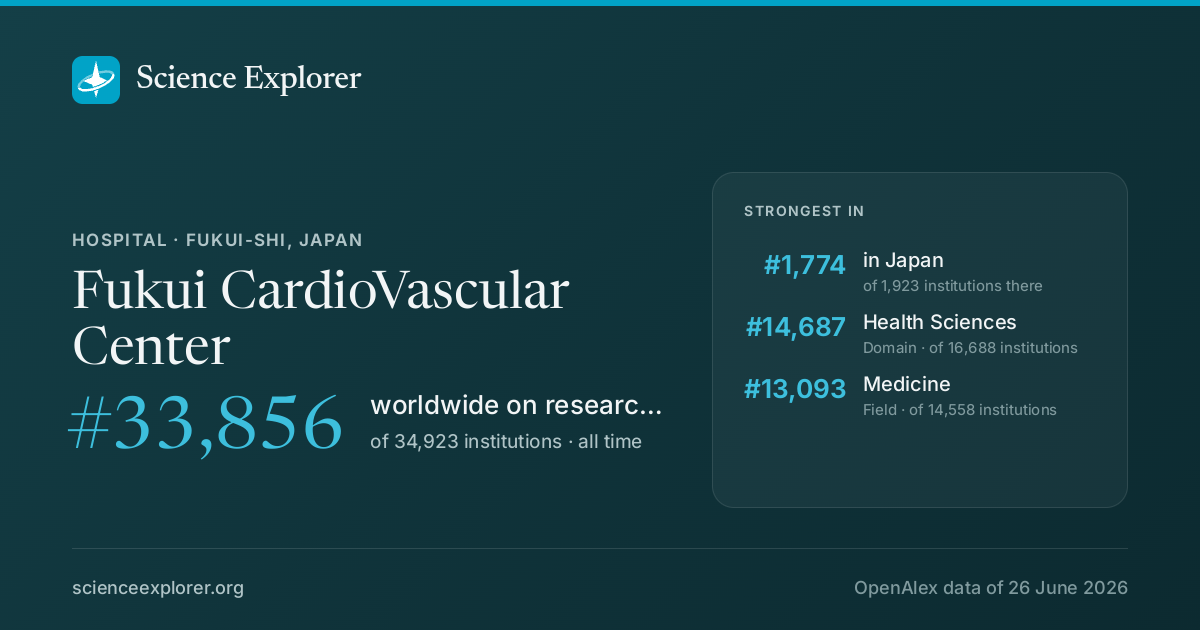
In research, Fukui CardioVascular Center stands highest in Health Sciences (#14,687 of 16,688 worldwide) and Medicine (#13,093 of 14,558 worldwide), over all time. Relative to its size it is most specialised in Medicine and Health Sciences (Medicine is 4.0× its share of world research).
- World rank, all time
- #33,856 of 34,923
- Rank in Japan
- #1,774 of 1,923
- Research works
- 216 ▲ 16% vs 2018-21
- Citations
- 1.9k 9.0 per fractional work
- Top-10% rate
- 4.9% all institutions 10.0%
- vs its own fields
- 0.76× 1.00× is exactly expected
- Open access
- 45% world 40%
- International
- 4% world 18%
What is Fukui CardioVascular Center known for in research?
The fields where it stands highest, over all time, ranked among every institution above the floor in each field.
| Field | World rank | Where that sits | Top-10% rate | Works |
|---|---|---|---|---|
| Health SciencesDomain | #14,687 of 16,688 | 3.8% | 185 | |
| MedicineField | #13,093 of 14,558 | 3.7% | 181 |
Each strip is that field's whole ranked pool, with the notch where Fukui CardioVascular Center sits in it, in the colour of the band that rank falls in. The track under the rate is the rate itself: it carries no average mark, because the average differs by field (from about 6% in Dentistry to 21% in Economics).
Which fields of science does Fukui CardioVascular Center work in?
In 2022-now, 79% of research at Fukui CardioVascular Center is in Health Sciences, 13% in Physical Sciences. Its largest fields are Medicine (76%), Engineering (8%), Biochemistry, Genetics and Molecular Biology (3%). It does 2.7× the world's share of Health Sciences.
Each ring splits the one inside it: the four domains of science, their fields, their subfields. Size is fractional works in 2022-now. Every slice is a page; the interactive view zooms down to single topics and colours each by how much more of it this institution does than the world.
Its 4 domains and 16 fields, with their numbers
- Health Sciences2378.9%
- Medicine2275.8%
- Health Professions13.0%
- Physical Sciences412.7%
- Engineering27.7%
- Computer Science01.2%
- Materials Science01.2%
- Environmental Science00.9%
- Physics and Astronomy00.9%
- Earth and Planetary Sciences00.7%
- Energy00.1%
- Life Sciences14.8%
- Social Sciences13.7%
- Psychology12.8%
- Social Sciences00.7%
- Economics, Econometrics and Finance00.1%
What does Fukui CardioVascular Center specialise in?
Where its research is concentrated relative to its size: Medicine takes 4.0× the share of its output that it takes of world research.
- MedicineField · 21.6 works4.0×
- Health SciencesDomain · 22.5 works3.4×
Location quotient, a volume reading rather than an impact one. It surfaces small, lopsided specialities.
Field profile
Location quotient across every field it publishes in: outside the ring is more than an institution of this size would be expected to publish, inside it is less.
Rings at 0.5×, 1× and 2×. Widest outward: Medicine, 4.0×. Every wedge is a field page.
All 16 fields, with their numbers
- Medicine3.95×22 works
- Health Professions1.16×1 works
- Psychology0.93×1 works
- Immunology and Microbiology0.85×0 works
- Biochemistry, Genetics and Molecular Biology0.62×1 works
- Engineering0.51×2 works
- Earth and Planetary Sciences0.45×0 works
- Physics and Astronomy0.39×0 works
- Materials Science0.33×0 works
- Neuroscience0.27×0 works
- Environmental Science0.19×0 works
- Computer Science0.15×0 works
- Energy0.14×0 works
- Social Sciences0.06×0 works
- Economics, Econometrics and Finance0.05×0 works
- Agricultural and Biological Sciences0.03×0 works
- Medicine 4.0×
- Health Professions 1.2×
- Psychology 0.9×
- Immunology and Microbiology 0.8×
- Biochemistry, Genetics and Molecular Biology 0.6×
- Engineering 0.5×
- Earth and Planetary Sciences 0.5×
- Physics and Astronomy 0.4×
- Materials Science 0.3×
- Neuroscience 0.3×
- Environmental Science 0.2×
- Computer Science 0.1×
- Energy 0.1×
- Social Sciences 0.1×
- Economics, Econometrics and Finance 0.1×
- Agricultural and Biological Sciences 0.0×
Who are the top researchers at Fukui CardioVascular Center?
Ranked on the quality score, Kuniaki Taga, Sumio Mizuno and Hiromasa Kokado lead among researchers whose main affiliation is Fukui CardioVascular Center.
- 1
Kuniaki Taga
 Japan · #3,810,613 worldwide
131 citations · 28 works
- 2
Sumio Mizuno
Japan · #3,878,374 worldwide
725 citations · 66 works
- 3
Hiromasa Kokado
Japan · #4,370,700 worldwide
230 citations · 17 works
- 4
Y Tsutsumi
Japan · #4,938,658 worldwide
38 citations · 24 works
- 5
Takahiro Kawai
Japan · #4,943,976 worldwide
598 citations · 66 works
- 6
Ikuo Moriuchi
Japan · #5,295,804 worldwide
162 citations · 39 works
- 7
Junichiro Mifune
Japan · #5,528,323 worldwide
620 citations · 82 works
- 8
Masateru Ohnaka
Japan · #5,722,465 worldwide
244 citations · 39 works
- 9
Kazuo Ohsato
Japan · #5,907,873 worldwide
405 citations · 59 works
- 10
Tatsuaki Murakami
Japan · #6,313,389 worldwide
349 citations · 97 works
Which keywords describe research at Fukui CardioVascular Center?
By fractional works in 2022-now, weighted toward what it does more of than the world: Epidemiology, Surgical Aortic-Valve Replacement, Transcatheter Aortic-Valve Replacement, Diagnosis, Treatment, Endovascular Repair, Risk Factors and Complications.
- Perivascular Adipose Tissue
- Epicardial Fat
- Atherosclerosis
- Dilated Cardiomyopathy
- Bicuspid Aortic Valve
- Surgery
- Infective Endocarditis
- Bacteremia
- Echocardiography
- Inflammation
- Diagnosis
- Treatment
- Surgical Aortic-Valve Replacement
- Epidemiology
- Transcatheter Aortic-Valve Replacement
- Risk Factors
- Endovascular Repair
- Complications
- Prophylaxis
- Cardiovascular Disease
- Obesity
- Aortic Dissection
- Biomechanics
- Percutaneous Coronary Intervention
- Endothelial Dysfunction
- Myocardial Infarction
- Statins
Size is fractional works in 2022-now in the topics tagged with each word; colour is the word's share of this institution's work against its share of the world's. The 27 words are chosen for being large and distinctive. Each links to the topic it comes from most.
All 27 words, with their numbers
- Epidemiology4▲ 4.0×19 topics
- Surgical Aortic-Valve Replacement2▲ 105×1 topic
- Transcatheter Aortic-Valve Replacement2▲ 105×1 topic
- Treatment2▲ 6.3×7 topics
- Risk Factors2▲ 6.5×7 topics
- Diagnosis2▲ 7.6×6 topics
- Endovascular Repair2▲ 78×2 topics
- Inflammation2▲ 3.0×10 topics
- Complications2▲ 11×3 topics
- Echocardiography1▲ 17×3 topics
- Prophylaxis1▲ 36×2 topics
- Bacteremia1▲ 56×1 topic
- Cardiovascular Disease1▲ 3.6×5 topics
- Infective Endocarditis1▲ 115×1 topic
- Obesity1▲ 5.5×3 topics
- Surgery1▲ 12×2 topics
- Aortic Dissection1▲ 90×1 topic
- Bicuspid Aortic Valve1▲ 90×1 topic
- Biomechanics1▲ 12×4 topics
- Dilated Cardiomyopathy1▲ 56×2 topics
- Percutaneous Coronary Intervention1▲ 29×2 topics
- Atherosclerosis1▲ 13×3 topics
- Endothelial Dysfunction1▲ 15×2 topics
- Epicardial Fat1▲ 79×1 topic
- Myocardial Infarction1▲ 15×2 topics
- Perivascular Adipose Tissue1▲ 79×1 topic
- Statins1▲ 51×2 topics
Which research topics does Fukui CardioVascular Center publish most on?
By volume in 2022-now: Cardiac Valve Diseases and Treatments, Infective Endocarditis Diagnosis and Management, Aortic Disease and Treatment Approaches and Cardiovascular Disease and Adiposity.
Area is fractional works; colour is the subfield each topic belongs to.
- 1 Cardiac Valve Diseases and Treatments Cardiology and Cardiovascular Medicine 2 works
- 2 Infective Endocarditis Diagnosis and Management Epidemiology 1 works
- 3 Aortic Disease and Treatment Approaches Pulmonary and Respiratory Medicine 1 works
- 4 Cardiovascular Disease and Adiposity Cardiology and Cardiovascular Medicine 1 works
- 5 Cardiac Structural Anomalies and Repair Surgery 1 works
- 6 Aortic aneurysm repair treatments Pulmonary and Respiratory Medicine 1 works
- 7 Coronary Artery Anomalies Pulmonary and Respiratory Medicine 1 works
- 8 Kawasaki Disease and Coronary Complications Surgery 1 works
- 9 Vascular Procedures and Complications Pulmonary and Respiratory Medicine 1 works
- 10 Lipoproteins and Cardiovascular Health Surgery 0 works
How open and international is its research?
Against the world's own shares: the tick on each track. Both are shares of its output, so they sit on one scale and can be read against each other as well as against the world.
World: 40% of research is openly available.
World: 18% is written across borders.
How has Fukui CardioVascular Center's research output changed?
Output in 2022-2025 was 16% higher than in 2018-2021.
The same series as a ribbon: one cell per year, darker for more. The line above answers how much; this answers when.
Its share of all research
Growing output can still be a shrinking share: all of science grows. This is Fukui CardioVascular Center as a percentage of every work published that year, 0.00017% in 2024.
Fractional works of Fukui CardioVascular Center over all fractional works that year. How the balance of science has shifted.
Other research institutions in Fukui-shi
- University of Fukui
- Fukui University of Technology
- Fukui Prefectural University
- Fukui-ken Saiseikai Hospital
- Fukui Prefectural Hospital
- Fukui Red Cross Hospital
- Jin-ai University
- Fukui Prefecture Special Education Center
Share Fukui CardioVascular Center's ranking
Badges for a website1Each links back here and updates with every snapshot

Research measures only: rankings here say nothing about teaching, admissions or student experience. Comparable institutions and collaboration partners have tabs of their own, above.
Discussion
Ask a question or share a note about Fukui CardioVascular Center. Posts are plain text and can be reported.