Science Explorer Back to mapMap
Discussion
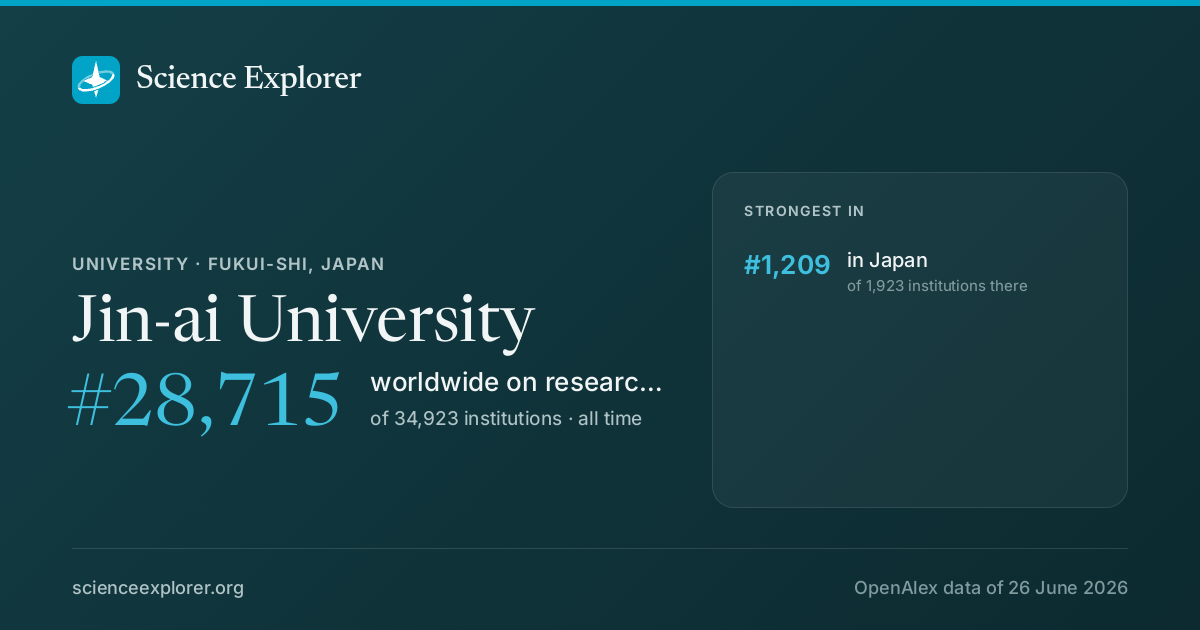
University · Fukui-shi · Japan

Jin-ai University

World rank, all time
#28,715
of 34,923
Rank in Japan
#1,209
of 1,923
Research works
154
▲ 55% vs 2018-21
Citations
993
6.5 per fractional work
Top-10% rate
8.1%
all institutions 10.0%
vs its own fields
0.88×
1.00× is exactly expected
Open access
66%
world 40%
International
12%
world 18%

Which fields of science does Jin-ai University work in?

In 2022-now, 38% of research at Jin-ai University is in Social Sciences, 30% in Health Sciences. Its largest fields are Medicine (18%), Psychology (15%), Computer Science (11%). It does 1.4× the world's share of Social Sciences.

Social Sciences: 11 fractional works · 37.5% of its workPsychology: 5 fractional works · 15.3% of its workSocial Psychology: 2 fractional works · 6.6% of its workClinical Psychology: 2 fractional works · 5.0% of its workExperimental and Cognitive Psychology: 1 fractional works · 2.3% of its workDevelopmental and Educational Psychology: 0 fractional works · 0.6% of its workNeuropsychology and Physiological Psychology: 0 fractional works · 0.4% of its workSmaller subfields together: 0 fractional works · 0.4% of its workSocial Sciences: 3 fractional works · 9.7% of its workSafety Research: 1 fractional works · 2.9% of its workSociology and Political Science: 1 fractional works · 2.5% of its workAnthropology: 0 fractional works · 1.1% of its workHuman Factors and Ergonomics: 0 fractional works · 1.1% of its workPolitical Science and International Relations: 0 fractional works · 1.1% of its workTransportation: 0 fractional works · 0.6% of its workHealth: 0 fractional works · 0.4% of its workArts and Humanities: 1 fractional works · 4.7% of its workLanguage and Linguistics: 1 fractional works · 2.2% of its workLiterature and Literary Theory: 1 fractional works · 2.2% of its workHistory and Philosophy of Science: 0 fractional works · 0.2% of its workBusiness, Management and Accounting: 1 fractional works · 4.4% of its workOrganizational Behavior and Human Resource Management: 1 fractional works · 4.4% of its workEconomics, Econometrics and Finance: 1 fractional works · 2.3% of its workEconomics and Econometrics: 0 fractional works · 1.2% of its workFinance: 0 fractional works · 1.1% of its workDecision Sciences: 0 fractional works · 1.1% of its workManagement Science and Operations Research: 0 fractional works · 1.1% of its workHealth Sciences: 9 fractional works · 29.9% of its workMedicine: 5 fractional works · 18.1% of its workPhysiology: 1 fractional works · 3.7% of its workPediatrics, Perinatology and Child Health: 1 fractional works · 2.2% of its workPublic Health, Environmental and Occupational Health: 1 fractional works · 1.9% of its workInfectious Diseases: 0 fractional works · 1.7% of its workPulmonary and Respiratory Medicine: 0 fractional works · 1.6% of its workEpidemiology: 0 fractional works · 1.0% of its workSurgery: 0 fractional works · 0.9% of its workNeurology: 0 fractional works · 0.8% of its workNephrology: 0 fractional works · 0.7% of its workRheumatology: 0 fractional works · 0.7% of its workEndocrinology, Diabetes and Metabolism: 0 fractional works · 0.7% of its workOrthopedics and Sports Medicine: 0 fractional works · 0.6% of its workPathology and Forensic Medicine: 0 fractional works · 0.5% of its workPsychiatry and Mental health: 0 fractional works · 0.4% of its workHematology: 0 fractional works · 0.4% of its workRadiology, Nuclear Medicine and Imaging: 0 fractional works · 0.3% of its workGeriatrics and Gerontology: 0 fractional works · 0.2% of its workVeterinary: 2 fractional works · 5.0% of its workSmall Animals: 2 fractional works · 5.0% of its workHealth Professions: 1 fractional works · 4.8% of its workGeneral Health Professions: 1 fractional works · 3.3% of its workEmergency Medical Services: 0 fractional works · 0.7% of its workSpeech and Hearing: 0 fractional works · 0.4% of its workSmaller subfields together: 0 fractional works · 0.3% of its workNursing: 1 fractional works · 1.9% of its workNutrition and Dietetics: 0 fractional works · 1.1% of its workLeadership and Management: 0 fractional works · 0.4% of its workResearch and Theory: 0 fractional works · 0.4% of its workDentistry: 0 fractional works · 0.2% of its workPhysical Sciences: 7 fractional works · 23.2% of its workComputer Science: 3 fractional works · 11.3% of its workArtificial Intelligence: 2 fractional works · 5.7% of its workComputer Networks and Communications: 1 fractional works · 2.9% of its workInformation Systems: 1 fractional works · 2.4% of its workComputer Vision and Pattern Recognition: 0 fractional works · 0.3% of its workEnvironmental Science: 2 fractional works · 6.8% of its workHealth, Toxicology and Mutagenesis: 1 fractional works · 2.4% of its workWater Science and Technology: 0 fractional works · 1.7% of its workEcology: 0 fractional works · 0.8% of its workGlobal and Planetary Change: 0 fractional works · 0.7% of its workEnvironmental Chemistry: 0 fractional works · 0.6% of its workManagement, Monitoring, Policy and Law: 0 fractional works · 0.4% of its workPollution: 0 fractional works · 0.3% of its workPhysics and Astronomy: 1 fractional works · 2.3% of its workAstronomy and Astrophysics: 1 fractional works · 1.9% of its workAtomic and Molecular Physics, and Optics: 0 fractional works · 0.4% of its workEngineering: 1 fractional works · 1.9% of its workAerospace Engineering: 0 fractional works · 0.7% of its workMedia Technology: 0 fractional works · 0.6% of its workCivil and Structural Engineering: 0 fractional works · 0.4% of its workSmaller subfields together: 0 fractional works · 0.3% of its workEnergy: 0 fractional works · 0.6% of its workRenewable Energy, Sustainability and the Environment: 0 fractional works · 0.6% of its workMaterials Science: 0 fractional works · 0.4% of its workElectronic, Optical and Magnetic Materials: 0 fractional works · 0.4% of its workLife Sciences: 3 fractional works · 9.3% of its workAgricultural and Biological Sciences: 1 fractional works · 4.4% of its workAgronomy and Crop Science: 1 fractional works · 2.2% of its workPlant Science: 0 fractional works · 1.7% of its workAnimal Science and Zoology: 0 fractional works · 0.6% of its workBiochemistry, Genetics and Molecular Biology: 1 fractional works · 2.4% of its workMolecular Biology: 0 fractional works · 1.1% of its workBiochemistry: 0 fractional works · 0.6% of its workCell Biology: 0 fractional works · 0.6% of its workSmaller subfields together: 0 fractional works · 0.1% of its workImmunology and Microbiology: 1 fractional works · 1.9% of its workImmunology: 0 fractional works · 1.7% of its workMicrobiology: 0 fractional works · 0.3% of its workNeuroscience: 0 fractional works · 0.6% of its workCognitive Neuroscience: 0 fractional works · 0.3% of its workSmaller subfields together: 0 fractional works · 0.3% of its workALL ITS WORKJin-ai University30fractional works, 2022-now
Life Sciences9%Physical Sciences23%Health Sciences30%Social Sciences38%

Each ring splits the one inside it: the four domains of science, their fields, their subfields. Size is fractional works in 2022-now. Every slice is a page; the interactive view zooms down to single topics and colours each by how much more of it this institution does than the world.

Its 4 domains and 21 fields, with their numbers
    1. Psychology515.3%
    2. Social Sciences39.7%
    3. Arts and Humanities14.7%
    4. Business, Management and Accounting14.4%
    5. Economics, Econometrics and Finance12.3%
    6. Decision Sciences01.1%
    1. Medicine518.1%
    2. Veterinary25.0%
    3. Health Professions14.8%
    4. Nursing11.9%
    5. Dentistry00.2%
    1. Computer Science311.3%
    2. Environmental Science26.8%
    3. Physics and Astronomy12.3%
    4. Engineering11.9%
    5. Energy00.6%
    6. Materials Science00.4%
    1. Agricultural and Biological Sciences14.4%
    2. Biochemistry, Genetics and Molecular Biology12.4%
    3. Immunology and Microbiology11.9%
    4. Neuroscience00.6%
All of science, and how each field's share has moved since 1950: the Science domain explorer

Field profile

Location quotient across every field it publishes in: outside the ring is more than an institution of this size would be expected to publish, inside it is less.

Agricultural and Biological Sciences: 0.93× its world share, 1 worksAgricultural and Bio…Biochemistry, Genetics and Molecular Biology: 0.45× its world share, 1 worksBiochemistry, Geneti…Immunology and Microbiology: 1.93× its world share, 1 worksImmunology and Micro…Neuroscience: 0.35× its world share, 0 worksNeuroscienceComputer Science: 1.45× its world share, 3 worksComputer ScienceEnergy: 0.60× its world share, 0 worksEnergyEngineering: 0.13× its world share, 1 worksEngineeringEnvironmental Science: 1.36× its world share, 2 worksEnvironmental ScienceMaterials Science: 0.11× its world share, 0 worksMaterials SciencePhysics and Astronomy: 1.02× its world share, 1 worksPhysics and AstronomyDentistry: 0.38× its world share, 0 worksDentistryHealth Professions: 1.81× its world share, 1 worksHealth ProfessionsMedicine: 0.94× its world share, 5 worksMedicineNursing: 3.83× its world share, 1 worksNursingVeterinary: 36.78× its world share, 2 worksVeterinaryArts and Humanities: 1.62× its world share, 1 worksArts and HumanitiesBusiness, Management and Accounting: 1.38× its world share, 1 worksBusiness, Management…Decision Sciences: 1.15× its world share, 0 worksDecision SciencesEconomics, Econometrics and Finance: 1.08× its world share, 1 worksEconomics, Econometr…Psychology: 5.02× its world share, 5 worksPsychologySocial Sciences: 0.77× its world share, 3 worksSocial Sciences1×world share
more than its size predictsabout as predictedless

Rings at 0.5×, 1× and 2×. Widest outward: Veterinary, 36.8×. Every wedge is a field page.

All 21 fields, with their numbers
  1. Veterinary36.78×2 works
  2. Psychology5.02×5 works
  3. Nursing3.83×1 works
  4. Immunology and Microbiology1.93×1 works
  5. Health Professions1.81×1 works
  6. Arts and Humanities1.62×1 works
  7. Computer Science1.45×3 works
  8. Business, Management and Accounting1.38×1 works
  9. Environmental Science1.36×2 works
  10. Decision Sciences1.15×0 works
  11. Economics, Econometrics and Finance1.08×1 works
  12. Physics and Astronomy1.02×1 works
  13. Medicine0.94×5 works
  14. Agricultural and Biological Sciences0.93×1 works
  15. Social Sciences0.77×3 works
  16. Energy0.60×0 works
  17. Biochemistry, Genetics and Molecular Biology0.45×1 works
  18. Dentistry0.38×0 works
  19. Neuroscience0.35×0 works
  20. Engineering0.13×1 works
  21. Materials Science0.11×0 works

Who are the top researchers at Jin-ai University?

Ranked on the quality score, Takahiro Kagoya, Kimiko Mizukami and 昭義 石川 lead among researchers whose main affiliation is Jin-ai University.

  1. 1 Takahiro Kagoya Japan · #3,194,592 worldwide 0 citations · 21 works
  2. 2 Kimiko Mizukami Japan · #3,274,432 worldwide 427 citations · 35 works
  3. 3 昭義 石川 Japan · #3,284,215 worldwide 0 citations · 18 works
  4. 4 Toshiro Mizuta Japan · #3,420,625 worldwide 3 citations · 24 works
  5. 5 Fumihito Morimoto Japan · #3,430,400 worldwide 0 citations · 22 works
  6. 6 知之 伊東 Japan · #3,620,667 worldwide 0 citations · 15 works
  7. 7 Ryouko Ikeda Japan · #3,831,987 worldwide 17 citations · 18 works
  8. 8 Takeshi Hashimoto Japan · #3,929,769 worldwide 0 citations · 31 works
  9. 9 Sakurako Hasegawa Japan · #3,989,831 worldwide 30 citations · 15 works
  10. 10 Akiko Takemura Japan · #4,184,296 worldwide 64 citations · 30 works
All ranked researchers at Jin-ai University

What are the most cited papers from Jin-ai University?

The most cited paper from Jin-ai University is "Sound alters activity in human V1 in association with illusory visual perception" (Susanne Watkins, Ladan Shams, Shigeki Tanaka et al., 2006), with 348 citations. Next come "Age-related variation in EEG complexity to photic stimulation: A multiscale entropy analysis" (135) and "Serum undercarboxylated osteocalcin levels are inversely associated with glycemic status and insulin resistance in an elderly Japanese male population: Fujiwara-kyo Osteoporosis Risk in Men (FORMEN) Study" (132).

Most cited papers
#PaperReleasedCitations
1 Sound alters activity in human V1 in association with illusory visual perception Susanne Watkins, Ladan Shams, Shigeki Tanaka et al. · NeuroImage 24 Mar 2006 348
2 Age-related variation in EEG complexity to photic stimulation: A multiscale entropy analysis Tetsuya Takahashi, Raymond Y. Cho, Tetsuhito Murata et al. · Clinical Neurophysiology Open access 24 Feb 2009 135
3 Serum undercarboxylated osteocalcin levels are inversely associated with glycemic status and insulin resistance in an elderly Japanese male population: Fujiwara-kyo Osteoporosis Risk in Men (FORMEN) Study Masayuki Iki, Junko Tamaki, Yuki Fujita et al. · Osteoporosis International 24 Mar 2011 132
4 Cortical involvement for action imitation of hand/arm postures versus finger configurations: an fMRI study Shigeki Tanaka, Toshio Inui · Neuroreport Sep 2002 112
5 Smaller insula and inferior frontal volumes in young adults with pervasive developmental disorders Hirotaka Kosaka, Masao Omori, Toshio Munesue et al. · NeuroImage 2 Feb 2010 109
All 60 most cited papers, with filters and sorting

Which keywords describe research at Jin-ai University?

By fractional works in 2022-now, weighted toward what it does more of than the world: Mental Health, Depression, Intersectionality, Inflammation, Job Satisfaction, Social Support, Drug Resistance and Health Disparities.

▲ more of its work than of the world's◆ about the world's share▼ less than the world's

Size is fractional works in 2022-now in the topics tagged with each word; colour is the word's share of this institution's work against its share of the world's. The 22 words are chosen for being large and distinctive. Each links to the topic it comes from most.

All 22 words, with their numbers
  1. Mental Health3▲ 6.4×6 topics
  2. Inflammation2▲ 3.1×12 topics
  3. Epidemiology2▲ 1.61×10 topics
  4. Depression2▲ 6.0×6 topics
  5. Quality of Life1▲ 3.2×6 topics
  6. Intersectionality1▲ 23×2 topics
  7. Oxidative Stress1▲ 2.7×7 topics
  8. Job Satisfaction1▲ 9.2×4 topics
  9. Social Support1▲ 7.4×5 topics
  10. Anxiety1▲ 7.4×2 topics
  11. Drug Resistance1▲ 13×2 topics
  12. Genetics1▲ 5.0×2 topics
  13. Health Disparities1▲ 14×2 topics
  14. Self-Efficacy1▲ 14×4 topics
  15. Anthelmintic Resistance1▲ 215×1 topic
  16. COVID-191▲ 2.6×1 topic
  17. IoT1▲ 8.8×2 topics
  18. LGBTQ+1▲ 82×1 topic
  19. Nematodes1▲ 68×1 topic
  20. Pandemic1▲ 3.4×1 topic
  21. Social Isolation1▲ 18×2 topics
  22. Stigma1▲ 24×1 topic

Which research topics does Jin-ai University publish most on?

By volume in 2022-now: LGBTQ Health, Identity, and Policy, Helminth infection and control, COVID-19 and Mental Health and Education, Safety, and Science Studies.

  1. 1 LGBTQ Health, Identity, and Policy Social Psychology 1 works
  2. 2 Helminth infection and control Small Animals 1 works
  3. 3 COVID-19 and Mental Health Clinical Psychology 1 works
  4. 4 Education, Safety, and Science Studies Safety Research 1 works
  5. 5 Educational Research and Pedagogy Computer Networks and Communications 1 works
  6. 6 Job Satisfaction and Organizational Behavior Organizational Behavior and Human Resource Management 1 works
  7. 7 Educational Robotics and Engineering Artificial Intelligence 1 works
  8. 8 Employee Welfare and Language Studies Organizational Behavior and Human Resource Management 1 works
  9. 9 Nutrition and Health in Aging Physiology 0 works
  10. 10 Global Maternal and Child Health Pediatrics, Perinatology and Child Health 0 works

How open and international is its research?

Against the world's own shares: the tick on each track. Both are shares of its output, so they sit on one scale and can be read against each other as well as against the world.

openly available65.5%not open34.5%

World: 40% of research is openly available.

with international co-authors12.5%domestic only87.5%

World: 18% is written across borders.

How has Jin-ai University's research output changed?

Output in 2022-2025 was 55% higher than in 2018-2021.

still counting200020102020
grewheldshrank

The same series as a ribbon: one cell per year, darker for more. The line above answers how much; this answers when.

Its share of all research

Growing output can still be a shrinking share: all of science grows. This is Jin-ai University as a percentage of every work published that year, 0.00015% in 2024.

still counting0.00020%0.00040%0.00060%Jin-ai University0.00016% in 2025200020102020

Fractional works of Jin-ai University over all fractional works that year. How the balance of science has shifted.

Other research institutions in Fukui-shi

All research institutions in Fukui-shi

Share Jin-ai University's ranking

Jin-ai University on Science Explorer

A card with Jin-ai University's standing and the fields it leads in, for a post or a slide. A link to this page previews as the same card.

Download the card

1200 × 630 PNG, sized for social posts, drawn from the latest snapshot.

Badges for a website1Each links back here and updates with every snapshot

Research measures only: rankings here say nothing about teaching, admissions or student experience. Comparable institutions and collaboration partners have tabs of their own, above.

Discussion

Ask a question or share a note about Jin-ai University. Posts are plain text and can be reported.