Science Explorer Back to mapMap
Discussion
Research facility · Sheffield · United Kingdom

Glass Technology Services

World rank, all time
#32,302
of 34,923
Rank in United Kingdom
#1,742
of 1,844
Research works
128
▲ 138% vs 2018-21
Citations
3.6k
27.9 per fractional work
Top-10% rate
3.8%
all institutions 10.0%
vs its own fields
1.01×
1.00× is exactly expected
Open access
15%
world 40%
International
23%
world 18%

Which fields of science does Glass Technology Services work in?

In all years, 86% of research at Glass Technology Services is in Physical Sciences, 6% in Social Sciences. Its largest fields are Engineering (37%), Materials Science (27%), Chemistry (5%). It does 2.1× the world's share of Physical Sciences.

Physical Sciences: 110 fractional works · 86.2% of its workEngineering: 47 fractional works · 37.0% of its workElectrical and Electronic Engineering: 13 fractional works · 9.8% of its workMechanical Engineering: 12 fractional works · 9.3% of its workBiomedical Engineering: 4 fractional works · 3.2% of its workComputational Mechanics: 4 fractional works · 3.2% of its workBuilding and Construction: 3 fractional works · 2.6% of its workMechanics of Materials: 2 fractional works · 1.7% of its workCivil and Structural Engineering: 2 fractional works · 1.4% of its workAerospace Engineering: 1 fractional works · 1.1% of its workAutomotive Engineering: 1 fractional works · 1.0% of its workSafety, Risk, Reliability and Quality: 1 fractional works · 0.9% of its workMedia Technology: 1 fractional works · 0.9% of its workIndustrial and Manufacturing Engineering: 1 fractional works · 0.8% of its workOcean Engineering: 1 fractional works · 0.8% of its workSmaller subfields together: 0 fractional works · 0.3% of its workMaterials Science: 35 fractional works · 27.4% of its workMaterials Chemistry: 14 fractional works · 10.9% of its workCeramics and Composites: 13 fractional works · 10.1% of its workPolymers and Plastics: 4 fractional works · 3.1% of its workGeneral Materials Science: 1 fractional works · 1.0% of its workBiomaterials: 1 fractional works · 1.0% of its workElectronic, Optical and Magnetic Materials: 1 fractional works · 0.7% of its workSurfaces, Coatings and Films: 1 fractional works · 0.5% of its workChemistry: 6 fractional works · 5.1% of its workInorganic Chemistry: 2 fractional works · 1.8% of its workPhysical and Theoretical Chemistry: 2 fractional works · 1.4% of its workOrganic Chemistry: 1 fractional works · 1.1% of its workSpectroscopy: 1 fractional works · 0.6% of its workSmaller subfields together: 0 fractional works · 0.2% of its workEarth and Planetary Sciences: 6 fractional works · 4.6% of its workGeochemistry and Petrology: 2 fractional works · 1.6% of its workEarth-Surface Processes: 2 fractional works · 1.3% of its workGeophysics: 1 fractional works · 1.0% of its workAtmospheric Science: 0 fractional works · 0.4% of its workGeology: 0 fractional works · 0.3% of its workSmaller subfields together: 0 fractional works · 0.1% of its workEnvironmental Science: 5 fractional works · 3.9% of its workWater Science and Technology: 1 fractional works · 1.1% of its workGlobal and Planetary Change: 1 fractional works · 0.9% of its workEnvironmental Engineering: 1 fractional works · 0.8% of its workEcology: 1 fractional works · 0.5% of its workEnvironmental Chemistry: 0 fractional works · 0.3% of its workNature and Landscape Conservation: 0 fractional works · 0.3% of its workSmaller subfields together: 0 fractional works · 0.1% of its workPhysics and Astronomy: 4 fractional works · 3.2% of its workAtomic and Molecular Physics, and Optics: 2 fractional works · 1.9% of its workAstronomy and Astrophysics: 1 fractional works · 0.5% of its workRadiation: 0 fractional works · 0.3% of its workCondensed Matter Physics: 0 fractional works · 0.2% of its workSmaller subfields together: 0 fractional works · 0.3% of its workMathematics: 2 fractional works · 1.9% of its workModeling and Simulation: 1 fractional works · 0.8% of its workGeometry and Topology: 1 fractional works · 0.5% of its workApplied Mathematics: 0 fractional works · 0.3% of its workMathematical Physics: 0 fractional works · 0.3% of its workChemical Engineering: 2 fractional works · 1.5% of its workFluid Flow and Transfer Processes: 1 fractional works · 0.6% of its workBioengineering: 1 fractional works · 0.5% of its workCatalysis: 0 fractional works · 0.3% of its workSmaller subfields together: 0 fractional works · 0.1% of its workComputer Science: 2 fractional works · 1.2% of its workComputer Vision and Pattern Recognition: 0 fractional works · 0.4% of its workComputational Theory and Mathematics: 0 fractional works · 0.3% of its workHuman-Computer Interaction: 0 fractional works · 0.3% of its workSmaller subfields together: 0 fractional works · 0.3% of its workEnergy: 0 fractional works · 0.3% of its workRenewable Energy, Sustainability and the Environment: 0 fractional works · 0.3% of its workSocial Sciences: 7 fractional works · 5.7% of its workArts and Humanities: 4 fractional works · 3.3% of its workHistory: 2 fractional works · 1.6% of its workArcheology: 1 fractional works · 0.9% of its workMusic: 0 fractional works · 0.4% of its workPhilosophy: 0 fractional works · 0.3% of its workSmaller subfields together: 0 fractional works · 0.1% of its workSocial Sciences: 1 fractional works · 1.1% of its workEducation: 1 fractional works · 0.6% of its workSociology and Political Science: 0 fractional works · 0.4% of its workSmaller subfields together: 0 fractional works · 0.1% of its workDecision Sciences: 1 fractional works · 0.9% of its workManagement Science and Operations Research: 1 fractional works · 0.5% of its workStatistics, Probability and Uncertainty: 1 fractional works · 0.5% of its workBusiness, Management and Accounting: 0 fractional works · 0.4% of its workManagement Information Systems: 0 fractional works · 0.4% of its workPsychology: 0 fractional works · 0.1% of its workHealth Sciences: 7 fractional works · 5.6% of its workMedicine: 5 fractional works · 4.2% of its workRadiology, Nuclear Medicine and Imaging: 1 fractional works · 1.1% of its workSurgery: 1 fractional works · 0.7% of its workOphthalmology: 1 fractional works · 0.7% of its workPublic Health, Environmental and Occupational Health: 1 fractional works · 0.4% of its workNeurology: 0 fractional works · 0.3% of its workPathology and Forensic Medicine: 0 fractional works · 0.2% of its workSmaller subfields together: 1 fractional works · 0.8% of its workDentistry: 1 fractional works · 0.9% of its workOral Surgery: 1 fractional works · 0.5% of its workOrthodontics: 0 fractional works · 0.3% of its workVeterinary: 0 fractional works · 0.3% of its workSmall Animals: 0 fractional works · 0.3% of its workHealth Professions: 0 fractional works · 0.1% of its workNursing: 0 fractional works · 0.1% of its workLife Sciences: 3 fractional works · 2.6% of its workBiochemistry, Genetics and Molecular Biology: 2 fractional works · 1.8% of its workMolecular Biology: 2 fractional works · 1.2% of its workGenetics: 0 fractional works · 0.3% of its workSmaller subfields together: 0 fractional works · 0.3% of its workNeuroscience: 0 fractional works · 0.4% of its workCellular and Molecular Neuroscience: 0 fractional works · 0.3% of its workSmaller subfields together: 0 fractional works · 0.1% of its workAgricultural and Biological Sciences: 0 fractional works · 0.3% of its workInsect Science: 0 fractional works · 0.3% of its workImmunology and Microbiology: 0 fractional works · 0.1% of its workPharmacology, Toxicology and Pharmaceutics: 0 fractional works · 0.0% of its workALL ITS WORKGlass TechnologyServices128fractional works, all years
Life Sciences3%Physical Sciences86%Health Sciences6%Social Sciences6%

Each ring splits the one inside it: the four domains of science, their fields, their subfields. Size is fractional works in all years. Every slice is a page; the interactive view zooms down to single topics and colours each by how much more of it this institution does than the world.

Its 4 domains and 25 fields, with their numbers
    1. Engineering4737.0%
    2. Materials Science3527.4%
    3. Chemistry65.1%
    4. Earth and Planetary Sciences64.6%
    5. Environmental Science53.9%
    6. Physics and Astronomy43.2%
    7. Mathematics21.9%
    8. Chemical Engineering21.5%
    9. Computer Science21.2%
    10. Energy00.3%
    1. Arts and Humanities43.3%
    2. Social Sciences11.1%
    3. Decision Sciences10.9%
    4. Business, Management and Accounting00.4%
    5. Psychology00.1%
    1. Medicine54.2%
    2. Dentistry10.9%
    3. Veterinary00.3%
    4. Health Professions00.1%
    5. Nursing00.1%
    1. Biochemistry, Genetics and Molecular Biology21.8%
    2. Neuroscience00.4%
    3. Agricultural and Biological Sciences00.3%
    4. Immunology and Microbiology00.1%
    5. Pharmacology, Toxicology and Pharmaceutics00.0%
All of science, and how each field's share has moved since 1950: the Science domain explorer

Field profile

Location quotient across every field it publishes in: outside the ring is more than an institution of this size would be expected to publish, inside it is less.

Biochemistry, Genetics and Molecular Biology: 0.90× its world share, 1 worksBiochemistry, Geneti…Chemistry: 1.29× its world share, 0 worksChemistryComputer Science: 0.11× its world share, 0 worksComputer ScienceEarth and Planetary Sciences: 0.36× its world share, 0 worksEarth and Planetary …Energy: 1.83× its world share, 0 worksEnergyEngineering: 3.31× its world share, 10 worksEngineeringEnvironmental Science: 0.79× its world share, 1 worksEnvironmental ScienceMaterials Science: 6.32× its world share, 4 worksMaterials ScienceMathematics: 0.29× its world share, 0 worksMathematicsPhysics and Astronomy: 1.51× its world share, 1 worksPhysics and AstronomyDentistry: 0.69× its world share, 0 worksDentistryMedicine: 0.35× its world share, 1 worksMedicineNursing: 1.72× its world share, 0 worksNursingVeterinary: 12.40× its world share, 0 worksVeterinaryArts and Humanities: 0.39× its world share, 0 worksArts and Humanities1×world share
more than its size predictsabout as predictedless

Rings at 0.5×, 1× and 2×. Widest outward: Veterinary, 12.4×. Every wedge is a field page.

All 15 fields, with their numbers
  1. Veterinary12.40×0 works
  2. Materials Science6.32×4 works
  3. Engineering3.31×10 works
  4. Energy1.83×0 works
  5. Nursing1.72×0 works
  6. Physics and Astronomy1.51×1 works
  7. Chemistry1.29×0 works
  8. Biochemistry, Genetics and Molecular Biology0.90×1 works
  9. Environmental Science0.79×1 works
  10. Dentistry0.69×0 works
  11. Arts and Humanities0.39×0 works
  12. Earth and Planetary Sciences0.36×0 works
  13. Medicine0.35×1 works
  14. Mathematics0.29×0 works
  15. Computer Science0.11×0 works

Who are the top researchers at Glass Technology Services?

Ranked on the quality score, William Ernest Stephen Turner, Martyn Marshall and Robert G. Ireson lead among researchers whose main affiliation is Glass Technology Services.

  1. 1 William Ernest Stephen Turner United Kingdom · #3,718,647 worldwide 347 citations · 69 works
  2. 2 Martyn Marshall United Kingdom · #4,799,272 worldwide 515 citations · 38 works
  3. 3 Robert G. Ireson United Kingdom · #5,029,975 worldwide 142 citations · 23 works
All ranked researchers at Glass Technology Services

What are the most cited papers from Glass Technology Services?

The most cited paper from Glass Technology Services is "Complexes of alkali metal ions with poly(ethylene oxide)" (David E. Fenton, John M. Parker, Peter V. Wright, 1973), with 2,676 citations. Next come "The mixed alkali effect in glass" (572) and "Reactions of Glasses with Aqueous Solutions" (284).

Most cited papers
#PaperReleasedCitations
1 Complexes of alkali metal ions with poly(ethylene oxide) David E. Fenton, John M. Parker, Peter V. Wright · Polymer Nov 1973 2,676
2 The mixed alkali effect in glass J.O. Isard · Journal of Non-Crystalline Solids Apr 1969 572
3 Reactions of Glasses with Aqueous Solutions Roy Douglas, T.M. El-Shamy · Journal of the American Ceramic Society 1967 284
4 Electronic conduction in vanadium phosphate glasses G.S. Linsley, Albert Edward Owen, F.M. Hayatee · Journal of Non-Crystalline Solids Apr 1970 244
5 The optical properties of thallium, lead and bismuth in oxide glasses S. Parke, R S Webb · Journal of Physics and Chemistry of Solids 1973 113
All 61 most cited papers, with filters and sorting

Which keywords describe research at Glass Technology Services?

By fractional works in all years, weighted toward what it does more of than the world: Optical Properties, Fiber Lasers, Structural Analysis, Glass Science, Rare-Earth Doped Materials, Failure Analysis, Laminated Glass and Structural Adhesives.

▲ more of its work than of the world's◆ about the world's share▼ less than the world's

Size is fractional works in all years in the topics tagged with each word; colour is the word's share of this institution's work against its share of the world's. The 40 words are chosen for being large and distinctive. Each links to the topic it comes from most.

All 40 words, with their numbers
  1. Optical Properties14▲ 99×4 topics
  2. Fiber Lasers12▲ 67×3 topics
  3. Structural Analysis12▲ 60×2 topics
  4. Glass Science12▲ 206×1 topic
  5. Rare-Earth Doped Materials12▲ 206×1 topic
  6. Failure Analysis6▲ 34×2 topics
  7. Laminated Glass6▲ 242×1 topic
  8. Structural Adhesives6▲ 242×1 topic
  9. Nanoparticles5▲ 3.1×14 topics
  10. Luminescent Materials5▲ 39×3 topics
  11. Nanocrystal Synthesis4▲ 66×1 topic
  12. Upconversion Nanoparticles4▲ 66×1 topic
  13. Circular Economy4▲ 16×4 topics
  14. Mechanical Properties4▲ 3.2×14 topics
  15. Recycling4▲ 12×5 topics
  16. Ceramic Materials4▲ 27×2 topics
  17. Cultural Heritage4▲ 6.3×5 topics
  18. Raman Spectroscopy3▲ 11×4 topics
  19. Nanocomposites3▲ 3.2×13 topics
  20. Ceramics3▲ 22×3 topics
  21. Colloidal Suspensions3▲ 39×2 topics
  22. Polymer Films3▲ 24×2 topics
  23. Supercooled Liquids2▲ 29×2 topics
  24. Utilization2▲ 61×1 topic
  25. Waste Materials2▲ 88×1 topic
  26. Additive Manufacturing2▲ 8.9×4 topics
  27. Glass Transition2▲ 41×1 topic
  28. Materials2▲ 11×3 topics
  29. Structural Relaxation2▲ 41×1 topic
  30. Composite Materials2▲ 7.5×5 topics
  31. Metallurgy2▲ 25×2 topics
  32. Polymer Composites2▲ 9.5×5 topics
  33. Crystal Structure2▲ 6.8×4 topics
  34. Polymers2▲ 18×3 topics
  35. Sintering2▲ 11×3 topics
  36. Bioremediation2▲ 10×2 topics
  37. Electrical Properties2▲ 9.7×3 topics
  38. Gemstones2▲ 103×1 topic
  39. Geochemistry2▲ 23×1 topic
  40. Micromachining2▲ 29×2 topics

Which research topics does Glass Technology Services publish most on?

By volume in 2022-now: Glass properties and applications, Structural Analysis of Composite Materials, Recycling and utilization of industrial and municipal waste in materials production and Laser Material Processing Techniques.

  1. 1 Glass properties and applications Ceramics and Composites 2 works
  2. 2 Structural Analysis of Composite Materials Mechanical Engineering 1 works
  3. 3 Recycling and utilization of industrial and municipal waste in materials production Building and Construction 1 works
  4. 4 Laser Material Processing Techniques Computational Mechanics 1 works
  5. 5 Optical Systems and Laser Technology Electrical and Electronic Engineering 0 works
  6. 6 Integrated Energy Systems Optimization Electrical and Electronic Engineering 0 works
  7. 7 Luminescence Properties of Advanced Materials Materials Chemistry 0 works
  8. 8 Material Dynamics and Properties Materials Chemistry 0 works
  9. 9 Solid State Laser Technologies Electrical and Electronic Engineering 0 works
  10. 10 Magnetic Field Sensors Techniques Electrical and Electronic Engineering 0 works

How open and international is its research?

Against the world's own shares: the tick on each track. Both are shares of its output, so they sit on one scale and can be read against each other as well as against the world.

openly available14.7%not open85.3%

World: 40% of research is openly available.

with international co-authors22.7%domestic only77.3%

World: 18% is written across borders.

How has Glass Technology Services's research output changed?

Output in 2022-2025 was 138% higher than in 2018-2021.

still counting1990200020102020
grewheldshrank

The same series as a ribbon: one cell per year, darker for more. The line above answers how much; this answers when.

Its share of all research

Growing output can still be a shrinking share: all of science grows. This is Glass Technology Services as a percentage of every work published that year, 0.000062% in 2024.

still counting0.0010%0.0020%0.0030%Glass Technology Services0.00015% in 202519801990200020102020

Fractional works of Glass Technology Services over all fractional works that year. How the balance of science has shifted.

Other research institutions in Sheffield

All research institutions in Sheffield

Share Glass Technology Services's ranking
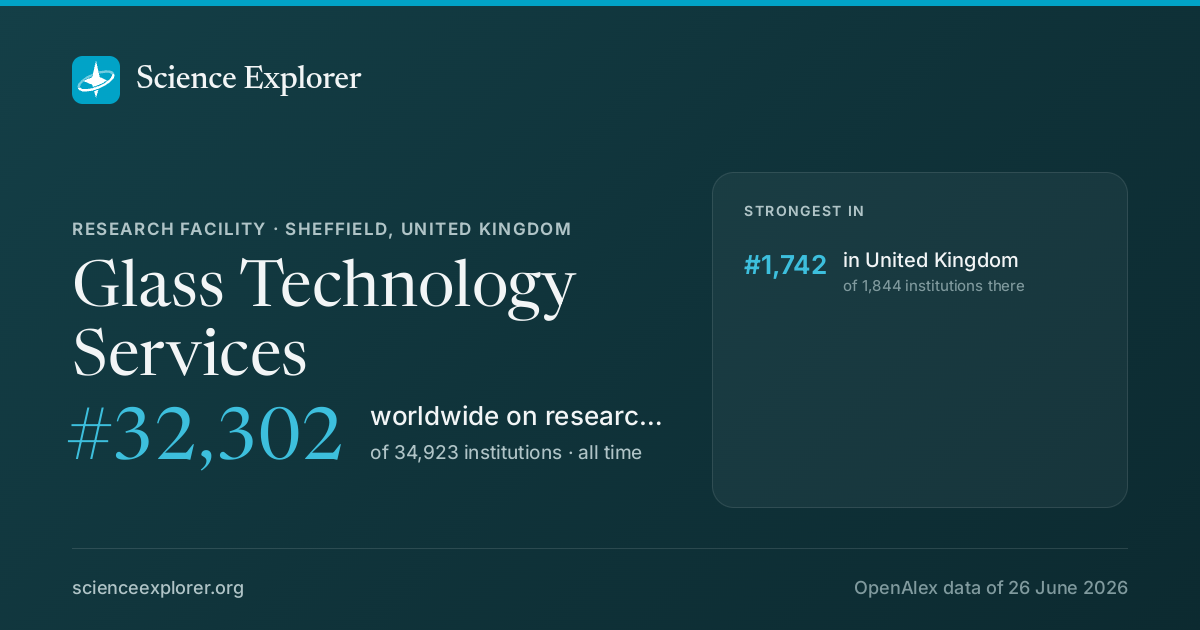
Glass Technology Services on Science Explorer

A card with Glass Technology Services's standing and the fields it leads in, for a post or a slide. A link to this page previews as the same card.

Download the card

1200 × 630 PNG, sized for social posts, drawn from the latest snapshot.

Badges for a website1Each links back here and updates with every snapshot

Research measures only: rankings here say nothing about teaching, admissions or student experience. Comparable institutions and collaboration partners have tabs of their own, above.

Discussion

Ask a question or share a note about Glass Technology Services. Posts are plain text and can be reported.