Science Explorer Back to mapMap
Hospital / health system · Norderstedt · Germany

HNO-Praxis

World rank, all time
#26,092
of 34,923
Rank in Germany
#1,271
of 1,603
Research works
189
▼ 18% vs 2018-21
Citations
842
4.4 per fractional work
Top-10% rate
3.7%
all institutions 10.0%
vs its own fields
0.89×
1.00× is exactly expected
Open access
20%
world 40%
International
18%
world 18%

Which fields of science does HNO-Praxis work in?

In 2022-now, 66% of research at HNO-Praxis is in Health Sciences, 19% in Life Sciences. Its largest fields are Medicine (53%), Health Professions (11%), Neuroscience (10%). It does 2.3× the world's share of Health Sciences.

Health Sciences: 19 fractional works · 65.9% of its workMedicine: 15 fractional works · 52.6% of its workPublic Health, Environmental and Occupational Health: 2 fractional works · 7.5% of its workSurgery: 2 fractional works · 5.8% of its workOtorhinolaryngology: 1 fractional works · 5.1% of its workPulmonary and Respiratory Medicine: 1 fractional works · 3.7% of its workPhysiology: 1 fractional works · 3.5% of its workEpidemiology: 1 fractional works · 3.2% of its workNeurology: 1 fractional works · 3.1% of its workPsychiatry and Mental health: 1 fractional works · 2.6% of its workRheumatology: 1 fractional works · 2.6% of its workDermatology: 1 fractional works · 1.9% of its workInfectious Diseases: 0 fractional works · 1.6% of its workGenetics: 0 fractional works · 1.5% of its workImmunology and Allergy: 0 fractional works · 1.3% of its workComplementary and alternative medicine: 0 fractional works · 1.2% of its workCritical Care and Intensive Care Medicine: 0 fractional works · 1.2% of its workHematology: 0 fractional works · 1.2% of its workHepatology: 0 fractional works · 1.2% of its workPediatrics, Perinatology and Child Health: 0 fractional works · 1.2% of its workOrthopedics and Sports Medicine: 0 fractional works · 0.9% of its workRehabilitation: 0 fractional works · 0.5% of its workOphthalmology: 0 fractional works · 0.5% of its workNephrology: 0 fractional works · 0.4% of its workRadiology, Nuclear Medicine and Imaging: 0 fractional works · 0.4% of its workAnesthesiology and Pain Medicine: 0 fractional works · 0.3% of its workOncology: 0 fractional works · 0.3% of its workSmaller subfields together: 0 fractional works · 0.3% of its workHealth Professions: 3 fractional works · 10.7% of its workPhysical Therapy, Sports Therapy and Rehabilitation: 2 fractional works · 5.5% of its workGeneral Health Professions: 1 fractional works · 2.0% of its workPharmacy: 0 fractional works · 1.8% of its workSpeech and Hearing: 0 fractional works · 1.5% of its workDentistry: 0 fractional works · 1.2% of its workOral Surgery: 0 fractional works · 1.2% of its workNursing: 0 fractional works · 1.0% of its workNutrition and Dietetics: 0 fractional works · 1.0% of its workVeterinary: 0 fractional works · 0.4% of its workSmall Animals: 0 fractional works · 0.4% of its workLife Sciences: 5 fractional works · 18.8% of its workNeuroscience: 3 fractional works · 10.1% of its workSensory Systems: 1 fractional works · 3.7% of its workCognitive Neuroscience: 1 fractional works · 3.2% of its workCellular and Molecular Neuroscience: 1 fractional works · 2.4% of its workEndocrine and Autonomic Systems: 0 fractional works · 0.6% of its workNeurology: 0 fractional works · 0.2% of its workBiochemistry, Genetics and Molecular Biology: 2 fractional works · 5.9% of its workGenetics: 1 fractional works · 3.1% of its workCell Biology: 0 fractional works · 1.5% of its workMolecular Biology: 0 fractional works · 0.6% of its workBiochemistry: 0 fractional works · 0.4% of its workClinical Biochemistry: 0 fractional works · 0.4% of its workImmunology and Microbiology: 0 fractional works · 1.7% of its workImmunology: 0 fractional works · 1.4% of its workVirology: 0 fractional works · 0.2% of its workSmaller subfields together: 0 fractional works · 0.0% of its workPharmacology, Toxicology and Pharmaceutics: 0 fractional works · 1.2% of its workPharmacology: 0 fractional works · 1.2% of its workSocial Sciences: 3 fractional works · 10.1% of its workPsychology: 2 fractional works · 6.2% of its workDevelopmental and Educational Psychology: 1 fractional works · 3.8% of its workClinical Psychology: 1 fractional works · 2.0% of its workExperimental and Cognitive Psychology: 0 fractional works · 0.3% of its workSmaller subfields together: 0 fractional works · 0.1% of its workArts and Humanities: 0 fractional works · 1.8% of its workHistory: 0 fractional works · 1.1% of its workVisual Arts and Performing Arts: 0 fractional works · 0.6% of its workSmaller subfields together: 0 fractional works · 0.0% of its workEconomics, Econometrics and Finance: 0 fractional works · 1.4% of its workEconomics and Econometrics: 0 fractional works · 1.4% of its workSocial Sciences: 0 fractional works · 0.5% of its workSociology and Political Science: 0 fractional works · 0.4% of its workSmaller subfields together: 0 fractional works · 0.1% of its workBusiness, Management and Accounting: 0 fractional works · 0.1% of its workPhysical Sciences: 1 fractional works · 5.1% of its workEngineering: 1 fractional works · 4.9% of its workBiomedical Engineering: 1 fractional works · 1.9% of its workBuilding and Construction: 0 fractional works · 1.8% of its workCivil and Structural Engineering: 0 fractional works · 0.4% of its workMechanics of Materials: 0 fractional works · 0.4% of its workOcean Engineering: 0 fractional works · 0.4% of its workSmaller subfields together: 0 fractional works · 0.0% of its workEnvironmental Science: 0 fractional works · 0.2% of its workALL ITS WORKHNO-Praxis28fractional works, 2022-now
Life Sciences19%Physical Sciences5%Health Sciences66%Social Sciences10%

Each ring splits the one inside it: the four domains of science, their fields, their subfields. Size is fractional works in 2022-now. Every slice is a page; the interactive view zooms down to single topics and colours each by how much more of it this institution does than the world.

Its 4 domains and 16 fields, with their numbers
    1. Medicine1552.6%
    2. Health Professions310.7%
    3. Dentistry01.2%
    4. Nursing01.0%
    5. Veterinary00.4%
    1. Neuroscience310.1%
    2. Biochemistry, Genetics and Molecular Biology25.9%
    3. Immunology and Microbiology01.7%
    4. Pharmacology, Toxicology and Pharmaceutics01.2%
    1. Psychology26.2%
    2. Arts and Humanities01.8%
    3. Economics, Econometrics and Finance01.4%
    4. Social Sciences00.5%
    5. Business, Management and Accounting00.1%
    1. Engineering14.9%
    2. Environmental Science00.2%
All of science, and how each field's share has moved since 1950: the Science domain explorer

Field profile

Location quotient across every field it publishes in: outside the ring is more than an institution of this size would be expected to publish, inside it is less.

Biochemistry, Genetics and Molecular Biology: 1.11× its world share, 2 worksBiochemistry, Geneti…Immunology and Microbiology: 1.66× its world share, 0 worksImmunology and Micro…Neuroscience: 6.23× its world share, 3 worksNeurosciencePharmacology, Toxicology and Pharmaceutics: 3.36× its world share, 0 worksPharmacology, Toxico…Engineering: 0.33× its world share, 1 worksEngineeringEnvironmental Science: 0.05× its world share, 0 worksEnvironmental ScienceDentistry: 2.44× its world share, 0 worksDentistryHealth Professions: 4.07× its world share, 3 worksHealth ProfessionsMedicine: 2.73× its world share, 15 worksMedicineNursing: 2.11× its world share, 0 worksNursingVeterinary: 2.90× its world share, 0 worksVeterinaryArts and Humanities: 0.61× its world share, 0 worksArts and HumanitiesBusiness, Management and Accounting: 0.05× its world share, 0 worksBusiness, Management…Economics, Econometrics and Finance: 0.64× its world share, 0 worksEconomics, Econometr…Psychology: 2.05× its world share, 2 worksPsychologySocial Sciences: 0.04× its world share, 0 worksSocial Sciences1×world share
more than its size predictsabout as predictedless

Rings at 0.5×, 1× and 2×. Widest outward: Neuroscience, 6.2×. Every wedge is a field page.

All 16 fields, with their numbers
  1. Neuroscience6.23×3 works
  2. Health Professions4.07×3 works
  3. Pharmacology, Toxicology and Pharmaceutics3.36×0 works
  4. Veterinary2.90×0 works
  5. Medicine2.73×15 works
  6. Dentistry2.44×0 works
  7. Nursing2.11×0 works
  8. Psychology2.05×2 works
  9. Immunology and Microbiology1.66×0 works
  10. Biochemistry, Genetics and Molecular Biology1.11×2 works
  11. Economics, Econometrics and Finance0.64×0 works
  12. Arts and Humanities0.61×0 works
  13. Engineering0.33×1 works
  14. Environmental Science0.05×0 works
  15. Business, Management and Accounting0.05×0 works
  16. Social Sciences0.04×0 works

Who are the top researchers at HNO-Praxis?

Ranked on the quality score, Theodor Krey, Angelika Kutz and Miloš Kovačević lead among researchers whose main affiliation is HNO-Praxis.

  1. 1 Theodor Krey Germany · #2,350,152 worldwide 459 citations · 23 works
  2. 2 Angelika Kutz Germany · #2,854,611 worldwide 62 citations · 50 works
  3. 3 Miloš Kovačević Germany · #4,039,095 worldwide 337 citations · 26 works
  4. 4 R. Marschall Germany · #4,202,999 worldwide 40 citations · 23 works
  5. 5 Franz Kirchheimer Germany · #4,235,953 worldwide 46 citations · 16 works
  6. 6 Th. Krey Germany · #4,489,599 worldwide 189 citations · 28 works
  7. 7 Andrea Pomarino Germany · #4,622,308 worldwide 195 citations · 18 works
  8. 8 Hans A. K. Edelmann Germany · #4,993,751 worldwide 78 citations · 29 works
All ranked researchers at HNO-Praxis

What are the most cited papers from HNO-Praxis?

The most cited paper from HNO-Praxis is "Implant-based multiparameter telemonitoring of patients with heart failure (IN-TIME): a randomised controlled trial" (Gerhard Hindricks, Miloš Táborský, Michael Glikson et al., 2014), with 746 citations. Next come "Thrust tectonics along the north-western continental margin of Sabah/Borneo" (138) and "ENT manifestations in patients with primary ciliary dyskinesia: prevalence and significance of otorhinolaryngologic co-morbidities" (130).

Most cited papers
#PaperReleasedCitations
1 Implant-based multiparameter telemonitoring of patients with heart failure (IN-TIME): a randomised controlled trial Gerhard Hindricks, Miloš Táborský, Michael Glikson et al. · The Lancet Aug 2014 746
2 Thrust tectonics along the north-western continental margin of Sabah/Borneo K. Hinz, J. Fritsch, E. H. K. Kempter et al. · International Journal of Earth Sciences Oct 1989 138
3 ENT manifestations in patients with primary ciliary dyskinesia: prevalence and significance of otorhinolaryngologic co-morbidities J. Ulrich Sommer, Kerstin Schäfer, Heymut Omran et al. · European Archives of Oto-Rhino-Laryngology 21 Jul 2010 130
4 Immunogenicity of the 10-Valent Pneumococcal Non-typeable Haemophilus influenzae Protein D Conjugate Vaccine (PHiD-CV) When Coadministered With Different Neisseria meningitidis Serogroup C Conjugate Vaccines Jacek Wysocki, Juan Carlos Tejedor Torres, Dutlef Grunert et al. · The Pediatric Infectious Disease Journal Apr 2009 96
5 The Late Quaternary sedimentary record in Scoresby Sund, East Greenland Julian A. Dowdeswell, Gabriele Uenzelmann‐Neben, Robert J. Whittington et al. · Boreas Dec 1994 71
All 59 most cited papers, with filters and sorting

Which keywords describe research at HNO-Praxis?

By fractional works in 2022-now, weighted toward what it does more of than the world: Quality of Life, Epidemiology, Rehabilitation, Patient Care, Quality, Endoscopic Surgery, Chronic Rhinosinusitis and Nasal Polyps.

▲ more of its work than of the world's◆ about the world's share▼ less than the world's

Size is fractional works in 2022-now in the topics tagged with each word; colour is the word's share of this institution's work against its share of the world's. The 18 words are chosen for being large and distinctive. Each links to the topic it comes from most.

All 18 words, with their numbers
  1. Quality of Life4▲ 11×9 topics
  2. Epidemiology4▲ 3.3×17 topics
  3. Rehabilitation2▲ 21×4 topics
  4. Inflammation2▲ 3.4×5 topics
  5. Endoscopic Surgery2▲ 56×2 topics
  6. Patient Care2▲ 45×1 topic
  7. Quality2▲ 125×1 topic
  8. Chronic Rhinosinusitis1▲ 159×1 topic
  9. Nasal Polyps1▲ 159×1 topic
  10. COVID-191▲ 3.5×4 topics
  11. Medical Ethics1▲ 36×2 topics
  12. Patient Rights1▲ 60×1 topic
  13. Reproductive Medicine1▲ 311×1 topic
  14. Nasal Surgery1▲ 171×1 topic
  15. Rhinoplasty1▲ 171×1 topic
  16. Treatment1▲ 3.1×6 topics
  17. Developmental Coordination Disorder1▲ 98×1 topic
  18. Motor Skill Competence1▲ 98×1 topic

Which research topics does HNO-Praxis publish most on?

By volume in 2022-now: Medical Practices and Rehabilitation, Sinusitis and nasal conditions, Medical and Health Sciences Research and Nasal Surgery and Airway Studies.

  1. 1 Medical Practices and Rehabilitation Physical Therapy, Sports Therapy and Rehabilitation 2 works
  2. 2 Sinusitis and nasal conditions Otorhinolaryngology 1 works
  3. 3 Medical and Health Sciences Research Public Health, Environmental and Occupational Health 1 works
  4. 4 Nasal Surgery and Airway Studies Surgery 1 works
  5. 5 Children's Physical and Motor Development Developmental and Educational Psychology 1 works
  6. 6 Olfactory and Sensory Function Studies Sensory Systems 1 works
  7. 7 EEG and Brain-Computer Interfaces Cognitive Neuroscience 0 works
  8. 8 Muscle activation and electromyography studies Biomedical Engineering 0 works
  9. 9 BIM and Construction Integration Building and Construction 0 works
  10. 10 Infant Health and Development Pharmacy 0 works

How open and international is its research?

Against the world's own shares: the tick on each track. Both are shares of its output, so they sit on one scale and can be read against each other as well as against the world.

openly available19.9%not open80.1%

World: 40% of research is openly available.

with international co-authors18.2%domestic only81.8%

World: 18% is written across borders.

How has HNO-Praxis's research output changed?

Output in 2022-2025 was 18% lower than in 2018-2021.

still counting1990200020102020
grewheldshrank

The same series as a ribbon: one cell per year, darker for more. The line above answers how much; this answers when.

Its share of all research

Growing output can still be a shrinking share: all of science grows. This is HNO-Praxis as a percentage of every work published that year, 0.000081% in 2024.

still counting0.0010%0.0020%HNO-Praxis0.000085% in 202519801990200020102020

Fractional works of HNO-Praxis over all fractional works that year. How the balance of science has shifted.

Other research institutions in Norderstedt

All research institutions in Norderstedt

Share HNO-Praxis's ranking
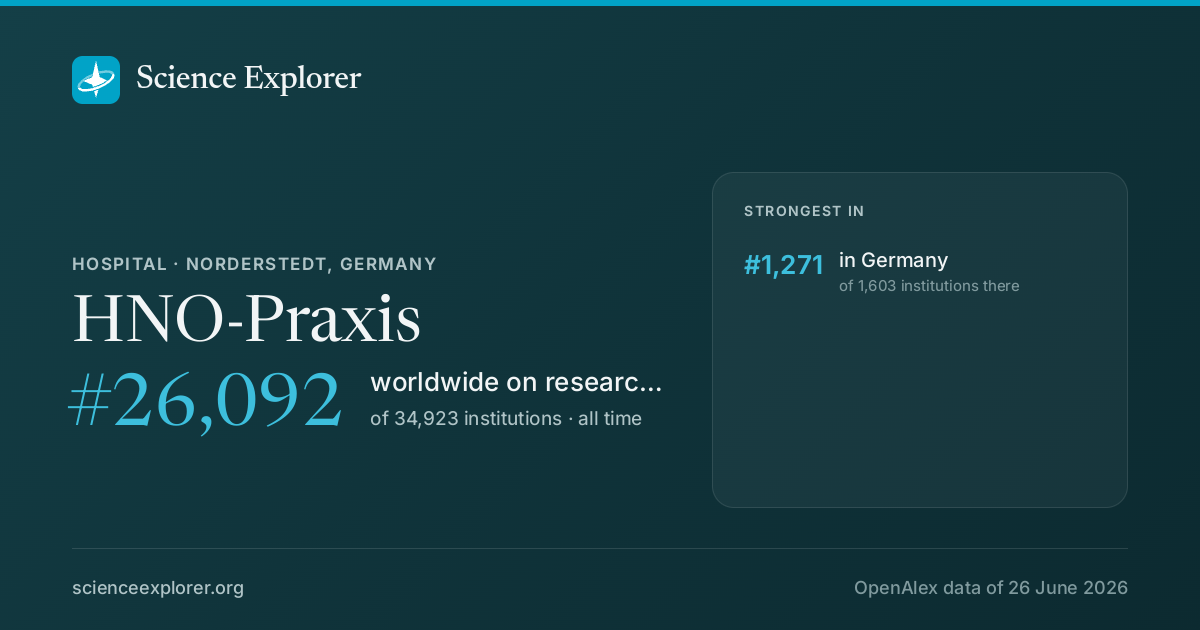
HNO-Praxis on Science Explorer

A card with HNO-Praxis's standing and the fields it leads in, for a post or a slide. A link to this page previews as the same card.

Download the card

1200 × 630 PNG, sized for social posts, drawn from the latest snapshot.

Badges for a website1Each links back here and updates with every snapshot

Research measures only: rankings here say nothing about teaching, admissions or student experience. Comparable institutions and collaboration partners have tabs of their own, above.

Discussion

Ask a question or share a note about HNO-Praxis. Keep it to the research: no personal attacks, advertising or links. Any reader can report a post, which collapses it for everyone until it is opened.
