Institut de Veille Sanitaire
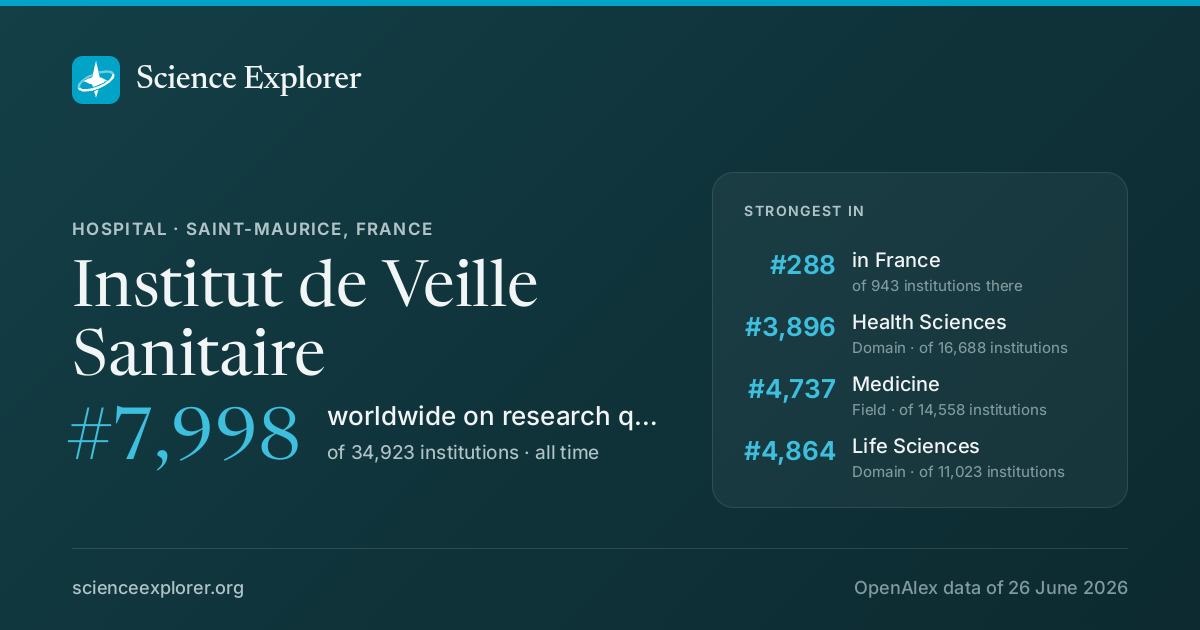
In research, Institut de Veille Sanitaire stands highest in Health Sciences (#3,896 of 16,688 worldwide), Medicine (#4,737 of 14,558 worldwide) and Life Sciences (#4,864 of 11,023 worldwide), over all time.
- World rank, all time
- #7,998 of 34,923
- Rank in France
- #288 of 943
- Research works
- 1.4k ▼ 13% vs 2018-21
- Citations
- 28k 20.3 per fractional work
- Top-10% rate
- 10.5% all institutions 10.0%
- vs its own fields
- 1.15× 1.00× is exactly expected
- Open access
- 43% world 40%
- International
- 12% world 18%
What is Institut de Veille Sanitaire known for in research?
The fields where it stands highest, over all time, ranked among every institution above the floor in each field.
| Field | World rank | Where that sits | Top-10% rate | Works |
|---|---|---|---|---|
| Health SciencesDomain | #3,896 of 16,688 | 8.5% | 791 | |
| MedicineField | #4,737 of 14,558 | 7.7% | 590 | |
| Life SciencesDomain | #4,864 of 11,023 | 6.4% | 258 | |
| EpidemiologySubfield | #987 of 1,970 | 7.9% | 157 | |
| Health ProfessionsField | #1,853 of 3,315 | 11.1% | 191 | |
| General Health ProfessionsSubfield | #1,355 of 1,886 | 14.1% | 141 | |
| Social SciencesDomain | #12,562 of 14,833 | 5.3% | 141 | |
| Environmental ScienceField | #4,736 of 5,407 | 8.0% | 140 | |
| Physical SciencesDomain | #16,839 of 17,446 | 8.1% | 188 |
Each strip is that field's whole ranked pool, with the notch where Institut de Veille Sanitaire sits in it, in the colour of the band that rank falls in. The track under the rate is the rate itself: it carries no average mark, because the average differs by field (from about 6% in Dentistry to 21% in Economics).
Which fields of science does Institut de Veille Sanitaire work in?
In all years, 57% of research at Institut de Veille Sanitaire is in Health Sciences, 19% in Life Sciences. Its largest fields are Medicine (43%), Health Professions (14%), Environmental Science (10%). It does 2.4× the world's share of Health Sciences.
Each ring splits the one inside it: the four domains of science, their fields, their subfields. Size is fractional works in all years. Every slice is a page; the interactive view zooms down to single topics and colours each by how much more of it this institution does than the world.
Its 4 domains and 26 fields, with their numbers
- Health Sciences79157.4%
- Medicine59042.9%
- Health Professions19113.9%
- Nursing60.4%
- Veterinary30.2%
- Dentistry00.0%
- Life Sciences25818.7%
- Physical Sciences18813.7%
- Environmental Science14010.2%
- Mathematics161.1%
- Engineering141.0%
- Computer Science60.4%
- Materials Science50.3%
- Earth and Planetary Sciences30.2%
- Chemistry20.1%
- Chemical Engineering10.1%
- Energy10.1%
- Physics and Astronomy10.1%
- Social Sciences14110.2%
- Social Sciences836.0%
- Economics, Econometrics and Finance221.6%
- Business, Management and Accounting151.1%
- Psychology151.1%
- Arts and Humanities30.2%
- Decision Sciences30.2%
Field profile
Location quotient across every field it publishes in: outside the ring is more than an institution of this size would be expected to publish, inside it is less.
Rings at 0.5×, 1× and 2×. Widest outward: Health Professions, 8.9×. Every wedge is a field page.
All 17 fields, with their numbers
- Health Professions8.90×3 works
- Nursing2.59×0 works
- Immunology and Microbiology2.37×0 works
- Medicine2.05×5 works
- Environmental Science1.34×1 works
- Arts and Humanities1.32×0 works
- Dentistry1.31×0 works
- Social Sciences1.30×2 works
- Mathematics1.09×0 works
- Energy0.35×0 works
- Biochemistry, Genetics and Molecular Biology0.29×0 works
- Agricultural and Biological Sciences0.20×0 works
- Psychology0.18×0 works
- Physics and Astronomy0.10×0 works
- Computer Science0.08×0 works
- Business, Management and Accounting0.06×0 works
- Engineering0.02×0 works
- Health Professions 8.9×
- Nursing 2.6×
- Immunology and Microbiology 2.4×
- Medicine 2.0×
- Environmental Science 1.3×
- Arts and Humanities 1.3×
- Dentistry 1.3×
- Social Sciences 1.3×
- Mathematics 1.1×
- Energy 0.3×
- Biochemistry, Genetics and Molecular Biology 0.3×
- Agricultural and Biological Sciences 0.2×
- Psychology 0.2×
- Physics and Astronomy 0.1×
- Computer Science 0.1×
- Business, Management and Accounting 0.1×
- Engineering 0.0×
Who are the top researchers at Institut de Veille Sanitaire?
Ranked on the quality score, B. Coignard, Christophe Declercq and Alain Le Tertre lead among researchers whose main affiliation is Institut de Veille Sanitaire.
- 1
B. Coignard
 France · #395,920 worldwide
17k citations · 158 works
- 2
Christophe Declercq
France · #439,158 worldwide
6.4k citations · 103 works
- 3
Alain Le Tertre
France · #439,350 worldwide
8.2k citations · 163 works
- 4
Daniel Lévy-Bruhl
France · #556,568 worldwide
12k citations · 391 works
- 5
Sylvia Médina
France · #574,459 worldwide
5.4k citations · 116 works
- 6
Henriette de Valk
France · #648,087 worldwide
8.4k citations · 183 works
- 7
P. Rolland
France · #664,798 worldwide
1.9k citations · 34 works
- 8
Morgane Stempfelet
France · #797,961 worldwide
4.8k citations · 60 works
- 9
V. Goulet
France · #877,581 worldwide
6.4k citations · 116 works
- 10
Olivier Flusin
France · #885,805 worldwide
1.4k citations · 28 works
Which keywords describe research at Institut de Veille Sanitaire?
By fractional works in all years, weighted toward what it does more of than the world: Epidemiology, Public Health, Pathogenesis, Vaccine, Immune Response, Mortality, Infectious Diseases and Social Determinants of Health.
- Epidemiological Studies
- Heat Waves
- Human Health
- Pathogenicity
- Particulate Matter
- Healthcare Legislation
- Medical Ethics
- Food Safety
- Genetic Diversity
- Infection
- Vaccine Development
- Cardiovascular Disease
- Inequalities
- Healthcare Quality Indicators
- Health Effects
- Social Determinants of Health
- Infectious Diseases
- Mortality
- Vaccine
- Public Health
- Epidemiology
- Pathogenesis
- Immune Response
- Treatment
- Diagnosis
- Primary Care
- Healthcare Policy
- Digital Health
- Universal Health Coverage
- Mental Health
- Global Burden
- Risk Perception
- Antimicrobial Resistance
- Palliative Care
- Public Health Policy
- Patient Rights
- Vulnerability
- Global Burden of Disease
- Global Warming
- Temperature
Size is fractional works in all years in the topics tagged with each word; colour is the word's share of this institution's work against its share of the world's. The 40 words are chosen for being large and distinctive. Each links to the topic it comes from most.
All 40 words, with their numbers
- Epidemiology392▲ 7.1×10⁸ topics
- Public Health244▲ 13×44 topics
- Pathogenesis130▲ 17×24 topics
- Vaccine104▲ 19×11 topics
- Immune Response97▲ 11×15 topics
- Mortality88▲ 13×9 topics
- Treatment84▲ 4.7×31 topics
- Infectious Diseases81▲ 24×9 topics
- Diagnosis74▲ 5.2×26 topics
- Social Determinants of Health71▲ 23×5 topics
- Primary Care68▲ 12×9 topics
- Health Effects68▲ 8.2×20 topics
- Healthcare Policy64▲ 62×3 topics
- Healthcare Quality Indicators64▲ 82×2 topics
- Digital Health63▲ 56×2 topics
- Inequalities62▲ 123×1 topic
- Universal Health Coverage62▲ 123×1 topic
- Cardiovascular Disease61▲ 3.9×22 topics
- Mental Health58▲ 3.8×25 topics
- Vaccine Development56▲ 13×10 topics
- Global Burden52▲ 6.9×12 topics
- Infection50▲ 13×8 topics
- Risk Perception49▲ 18×5 topics
- Genetic Diversity49▲ 7.2×5 topics
- Antimicrobial Resistance47▲ 13×9 topics
- Food Safety46▲ 12×10 topics
- Palliative Care44▲ 20×4 topics
- Medical Ethics43▲ 18×2 topics
- Public Health Policy43▲ 18×2 topics
- Healthcare Legislation42▲ 43×1 topic
- Patient Rights42▲ 32×1 topic
- Particulate Matter41▲ 27×2 topics
- Vulnerability40▲ 18×5 topics
- Pathogenicity39▲ 32×4 topics
- Global Burden of Disease38▲ 14×4 topics
- Human Health38▲ 34×2 topics
- Global Warming37▲ 7.3×3 topics
- Heat Waves36▲ 70×1 topic
- Temperature36▲ 20×1 topic
- Epidemiological Studies36▲ 24×2 topics
Which research topics does Institut de Veille Sanitaire publish most on?
By volume in 2022-now: Healthcare Systems and Practices, Health, Medicine and Society, Influenza Virus Research Studies and Zoonotic diseases and public health.
Area is fractional works; colour is the subfield each topic belongs to.
- 1 Healthcare Systems and Practices General Health Professions 1 works
- 2 Health, Medicine and Society General Health Professions 1 works
- 3 Influenza Virus Research Studies Epidemiology 1 works
- 4 Zoonotic diseases and public health Public Health, Environmental and Occupational Health 1 works
- 5 Vaccine Coverage and Hesitancy Health 1 works
- 6 Data-Driven Disease Surveillance Epidemiology 0 works
- 7 Death, Funerary Practices, and Mourning Anthropology 0 works
- 8 Global Maternal and Child Health Pediatrics, Perinatology and Child Health 0 works
- 9 Medieval European History and Architecture Archeology 0 works
- 10 Respiratory viral infections research Epidemiology 0 works
How open and international is its research?
Against the world's own shares: the tick on each track. Both are shares of its output, so they sit on one scale and can be read against each other as well as against the world.
World: 40% of research is openly available.
World: 18% is written across borders.
How has Institut de Veille Sanitaire's research output changed?
Output in 2022-2025 was 13% lower than in 2018-2021.
The same series as a ribbon: one cell per year, darker for more. The line above answers how much; this answers when.
Its share of all research
Growing output can still be a shrinking share: all of science grows. This is Institut de Veille Sanitaire as a percentage of every work published that year, 0.000043% in 2024.
Fractional works of Institut de Veille Sanitaire over all fractional works that year. How the balance of science has shifted.
How much of it reaches the world top 10%
Year by year, against all institutions in the same year.
Of each year's output, the share that reached the world's 10% most cited for its field and year. Peak 14.4% in 2009.
Other research institutions in Saint-Maurice
Share Institut de Veille Sanitaire's ranking
Badges for a website1Each links back here and updates with every snapshot

Research measures only: rankings here say nothing about teaching, admissions or student experience. Comparable institutions and collaboration partners have tabs of their own, above.
Discussion
Ask a question or share a note about Institut de Veille Sanitaire. Posts are plain text and can be reported.