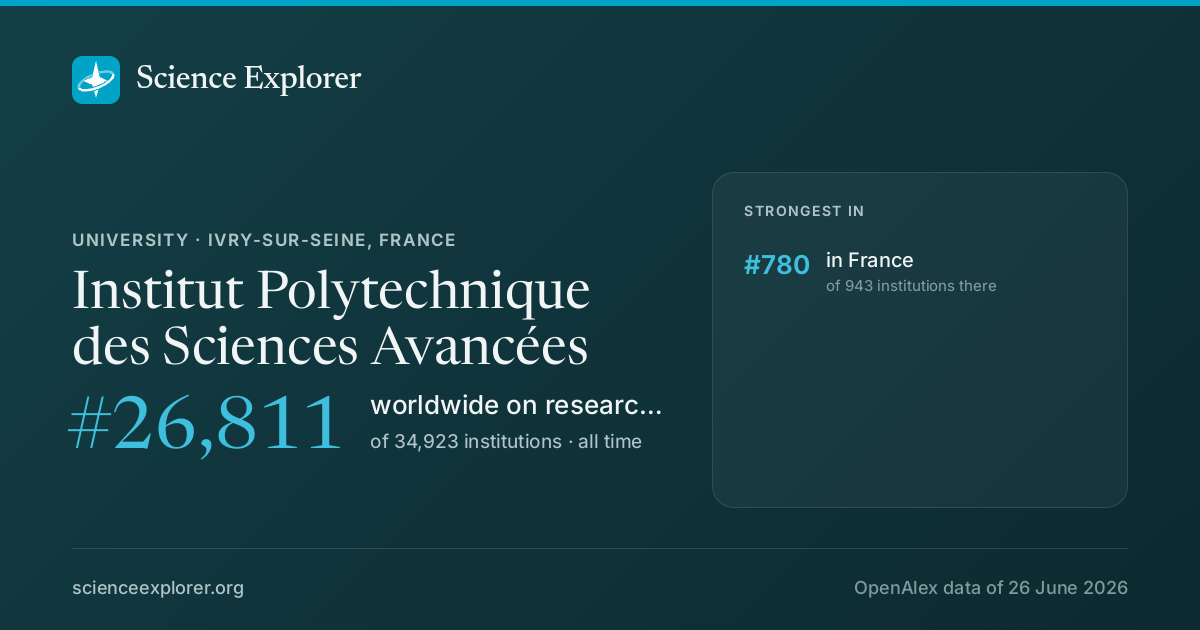
Institut Polytechnique des Sciences Avancées
- World rank, all time
- #26,811 of 34,923
- Rank in France
- #780 of 943
- Research works
- 159 ▲ 60% vs 2018-21
- Citations
- 1.2k 7.8 per fractional work
- Top-10% rate
- 7.1% all institutions 10.0%
- vs its own fields
- 0.94× 1.00× is exactly expected
- Open access
- 48% world 40%
- International
- 40% world 18%
Which fields of science does Institut Polytechnique des Sciences Avancées work in?
In 2022-now, 86% of research at Institut Polytechnique des Sciences Avancées is in Physical Sciences, 8% in Social Sciences. Its largest fields are Engineering (41%), Computer Science (20%), Physics and Astronomy (10%). It does 2.1× the world's share of Physical Sciences.
Each ring splits the one inside it: the four domains of science, their fields, their subfields. Size is fractional works in 2022-now. Every slice is a page; the interactive view zooms down to single topics and colours each by how much more of it this institution does than the world.
Its 4 domains and 22 fields, with their numbers
- Physical Sciences5786.4%
- Engineering2741.0%
- Computer Science1319.6%
- Physics and Astronomy710.3%
- Materials Science46.4%
- Mathematics45.9%
- Environmental Science11.7%
- Earth and Planetary Sciences10.8%
- Chemistry00.4%
- Energy00.3%
- Social Sciences58.2%
- Health Sciences23.2%
- Health Professions11.9%
- Medicine11.2%
- Nursing00.2%
- Life Sciences22.3%
Field profile
Location quotient across every field it publishes in: outside the ring is more than an institution of this size would be expected to publish, inside it is less.
Rings at 0.5×, 1× and 2×. Widest outward: Mathematics, 5.0×. Every wedge is a field page.
All 22 fields, with their numbers
- Mathematics4.98×4 works
- Physics and Astronomy4.64×7 works
- Engineering2.73×27 works
- Decision Sciences2.63×2 works
- Computer Science2.53×13 works
- Materials Science1.84×4 works
- Neuroscience0.77×1 works
- Health Professions0.72×1 works
- Economics, Econometrics and Finance0.55×1 works
- Earth and Planetary Sciences0.49×0 works
- Environmental Science0.34×1 works
- Nursing0.34×0 works
- Social Sciences0.29×2 works
- Energy0.27×0 works
- Chemistry0.26×0 works
- Biochemistry, Genetics and Molecular Biology0.15×0 works
- Business, Management and Accounting0.10×0 works
- Immunology and Microbiology0.08×0 works
- Arts and Humanities0.08×0 works
- Psychology0.08×0 works
- Medicine0.06×1 works
- Agricultural and Biological Sciences0.03×0 works
- Mathematics 5.0×
- Physics and Astronomy 4.6×
- Engineering 2.7×
- Decision Sciences 2.6×
- Computer Science 2.5×
- Materials Science 1.8×
- Neuroscience 0.8×
- Health Professions 0.7×
- Economics, Econometrics and Finance 0.6×
- Earth and Planetary Sciences 0.5×
- Environmental Science 0.3×
- Nursing 0.3×
- Social Sciences 0.3×
- Energy 0.3×
- Chemistry 0.3×
- Biochemistry, Genetics and Molecular Biology 0.1×
- Business, Management and Accounting 0.1×
- Immunology and Microbiology 0.1×
- Arts and Humanities 0.1×
- Psychology 0.1×
- Medicine 0.1×
- Agricultural and Biological Sciences 0.0×
Who are the top researchers at Institut Polytechnique des Sciences Avancées?
Ranked on the quality score, P. Kontaxakis, E. Robutti and F. Pauss lead among researchers whose main affiliation is Institut Polytechnique des Sciences Avancées.
- 1
P. Kontaxakis
 France · #183,577 worldwide
2k citations · 43 works
- 2
E. Robutti
France · #212,662 worldwide
2.3k citations · 40 works
- 3
F. Pauss
France · #283,646 worldwide
2k citations · 19 works
- 4
J. Eysermans
France · #510,288 worldwide
883 citations · 18 works
- 5
T. Lefevre
France · #784,788 worldwide
1.8k citations · 21 works
- 6
P. Sollander
France · #835,015 worldwide
1.8k citations · 20 works
- 7
S. Monteil
France · #902,060 worldwide
2.2k citations · 23 works
- 8
A. Canepa
France · #1,298,633 worldwide
585 citations · 22 works
- 9
Steven James Randles
France · #1,299,403 worldwide
274 citations · 25 works
- 10
A. Lusiani
France · #1,402,124 worldwide
726 citations · 29 works
Which keywords describe research at Institut Polytechnique des Sciences Avancées?
By fractional works in 2022-now, weighted toward what it does more of than the world: Stability Analysis, Mechanical Properties, Event-Triggered Control, Feedback Control, Nonlinear Systems, Deep Learning, Distributed Control and Robust Control.
- Nanocomposites
- Biomedical Applications
- State Estimation
- Evolutionary Algorithms
- Synchronization
- Game Theory
- Particle Swarm Optimization
- Multi-Agent Systems
- Orbit Determination
- Data Mining
- Networked Control Systems
- Beamforming
- Distributed Control
- Nonlinear Systems
- Event-Triggered Control
- Neural Networks
- Machine Learning
- Deep Learning
- Mechanical Properties
- Stability Analysis
- Feedback Control
- Wireless Sensor Networks
- Robust Control
- MIMO Radar
- Sensor Networks
- Energy Efficiency
- Stability
- Optimization
- Wireless Communications
- Switched Systems
- Time-Delay Systems
- Grain Boundary Engineering
- Adaptive Control
- Microstructure
- Path Planning
Size is fractional works in 2022-now in the topics tagged with each word; colour is the word's share of this institution's work against its share of the world's. The 35 words are chosen for being large and distinctive. Each links to the topic it comes from most.
All 35 words, with their numbers
- Deep Learning4▲ 1.75×20 topics
- Machine Learning4▲ 1.65×16 topics
- Mechanical Properties3▲ 4.3×17 topics
- Neural Networks3▲ 2.7×10 topics
- Stability Analysis2▲ 22×4 topics
- Event-Triggered Control2▲ 46×2 topics
- Feedback Control2▲ 18×7 topics
- Nonlinear Systems2▲ 13×6 topics
- Wireless Sensor Networks2▲ 6.3×5 topics
- Distributed Control2▲ 25×3 topics
- Robust Control2▲ 36×2 topics
- Beamforming2▲ 25×2 topics
- MIMO Radar2▲ 67×2 topics
- Networked Control Systems2▲ 58×2 topics
- Sensor Networks2▲ 9.6×3 topics
- Data Mining1▲ 2.9×4 topics
- Energy Efficiency1▲ 2.2×4 topics
- Orbit Determination1▲ 46×2 topics
- Stability1▲ 9.6×3 topics
- Multi-Agent Systems1▲ 10×2 topics
- Optimization1▲ 4.3×6 topics
- Particle Swarm Optimization1▲ 16×4 topics
- Wireless Communications1▲ 12×4 topics
- Game Theory1▲ 10×3 topics
- Switched Systems1▲ 70×1 topic
- Synchronization1▲ 15×4 topics
- Time-Delay Systems1▲ 70×1 topic
- Evolutionary Algorithms1▲ 16×4 topics
- Grain Boundary Engineering1▲ 26×2 topics
- State Estimation1▲ 38×2 topics
- Adaptive Control1▲ 12×5 topics
- Biomedical Applications1▲ 1.31×7 topics
- Microstructure1▲ 3.0×8 topics
- Nanocomposites1▲ 1.93×7 topics
- Path Planning1▲ 12×3 topics
Which research topics does Institut Polytechnique des Sciences Avancées publish most on?
By volume in 2022-now: Stability and Control of Uncertain Systems, Direction-of-Arrival Estimation Techniques, GNSS positioning and interference and Distributed Sensor Networks and Detection Algorithms.
Area is fractional works; colour is the subfield each topic belongs to.
- 1 Stability and Control of Uncertain Systems Control and Systems Engineering 1 works
- 2 Direction-of-Arrival Estimation Techniques Signal Processing 1 works
- 3 GNSS positioning and interference Aerospace Engineering 1 works
- 4 Distributed Sensor Networks and Detection Algorithms Computer Networks and Communications 1 works
- 5 Fatigue and fracture mechanics Mechanics of Materials 1 works
- 6 Distributed Control Multi-Agent Systems Computer Networks and Communications 1 works
- 7 Stability and Controllability of Differential Equations Control and Systems Engineering 1 works
- 8 Indoor and Outdoor Localization Technologies Electrical and Electronic Engineering 1 works
- 9 Speech and Audio Processing Signal Processing 1 works
- 10 Astro and Planetary Science Astronomy and Astrophysics 1 works
How open and international is its research?
Against the world's own shares: the tick on each track. Both are shares of its output, so they sit on one scale and can be read against each other as well as against the world.
World: 40% of research is openly available.
World: 18% is written across borders.
How has Institut Polytechnique des Sciences Avancées's research output changed?
Output in 2022-2025 was 60% higher than in 2018-2021.
The same series as a ribbon: one cell per year, darker for more. The line above answers how much; this answers when.
Its share of all research
Growing output can still be a shrinking share: all of science grows. This is Institut Polytechnique des Sciences Avancées as a percentage of every work published that year, 0.00029% in 2024.
Fractional works of Institut Polytechnique des Sciences Avancées over all fractional works that year. How the balance of science has shifted.
Other research institutions in Ivry-sur-Seine
- Eau de Paris (France)
- ESME - École d’ingénieurs pluridisciplinaires
- TL & Associés
- Fondation d'Aide pour la Recherche sur la Sclerose en Plaques

Share Institut Polytechnique des Sciences Avancées's ranking
Badges for a website1Each links back here and updates with every snapshot

Research measures only: rankings here say nothing about teaching, admissions or student experience. Comparable institutions and collaboration partners have tabs of their own, above.
Discussion
Ask a question or share a note about Institut Polytechnique des Sciences Avancées. Posts are plain text and can be reported.